
Gas water heater making popping sounds? This is caused by sediment buildup. Our guide covers pro flushing techniques or advises when replacement is necessary.
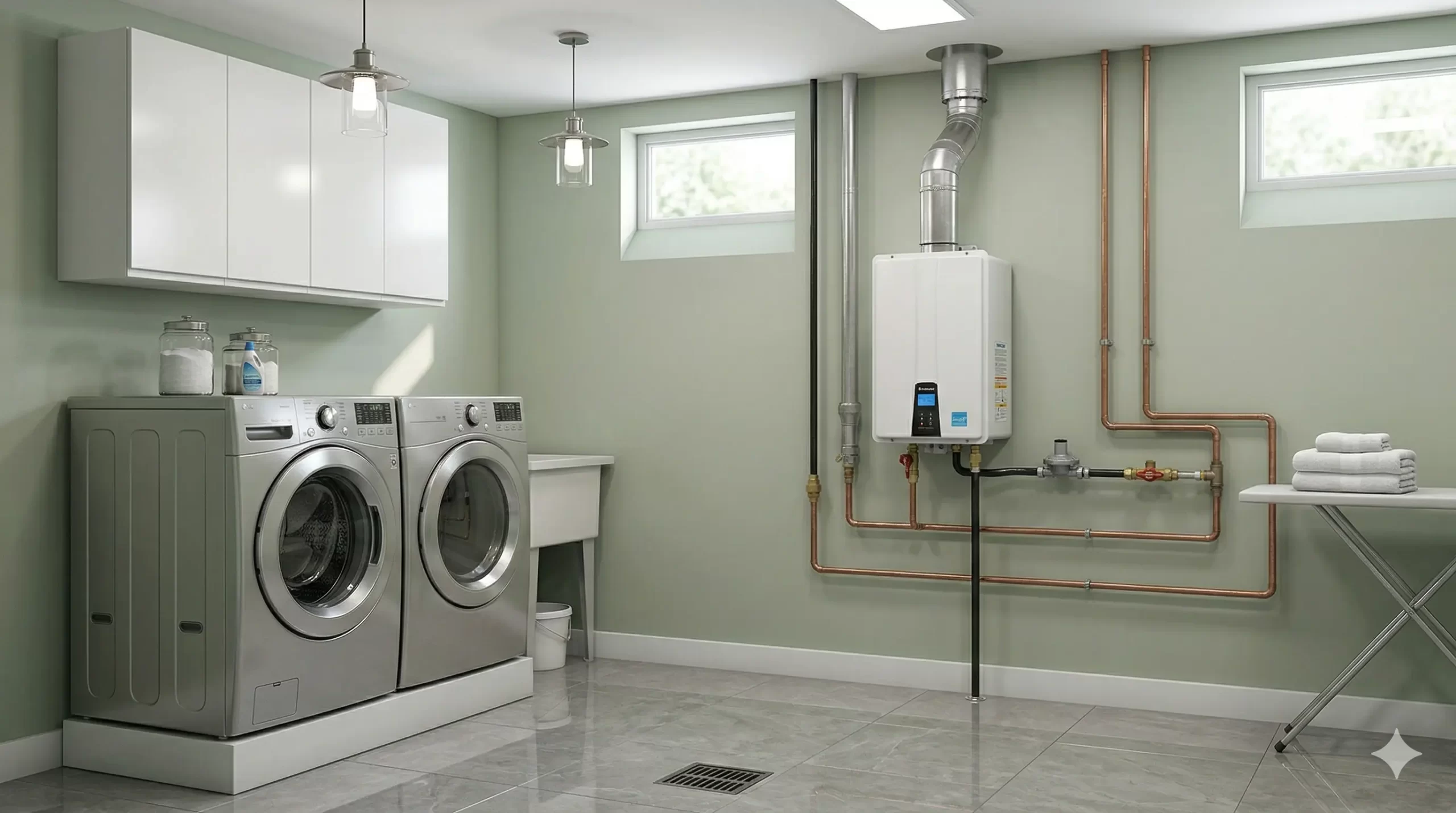
This is not a simple draining procedure. The ‘popping’ sound is a series of violent steam explosions occurring within a pressurized vessel. This process, known as cavitation, exerts significant thermal and kinetic stress on the tank’s bottom and welds. Attempting a flush on a severely scaled tank risks dislodging sediment in a way that could reveal pre-existing corrosion and create an immediate, uncontrollable leak. Handling the discharge from a power flush is also hazardous, as it can contain superheated water and abrasive mineral shards. This procedure requires heat-resistant PPE and a clear understanding of depressurization protocols.
️ Repair Profile
Required Diagnostics Tools
Heavy-duty transfer pump, High-pressure rated hoses, Channel-lock pliers, Pipe wrench, Phillips and flathead screwdrivers, Bucket, Wet/dry vac, Safety glasses, Heat-resistant gloves
Financial Breakdown: Parts vs. Licensed Labor
The cost allocation is heavily weighted towards labor because the procedure is a service-intensive descaling process, not a parts replacement. The expense stems from the technician’s time, diagnostic expertise, and the use of specialized equipment like a high-volume transfer pump.
Deep Technical Diagnosis: The Physics of the Failure
The audible popping or ‘kettling’ phenomenon in a gas-fired tank water heater is a direct result of advanced mineral scale accumulation on the lower tank surface, directly above the combustion chamber. This is not simple debris; it’s a hardened layer of precipitated minerals, primarily calcium carbonate (CaCO3) and magnesium carbonate (MgCO3), whose solubility in water decreases as temperature increases. As this scale layer thickens, it acts as a thermal insulator, impeding the efficient transfer of heat from the burner assembly to the water. Consequently, the water directly in contact with the tank bottom, trapped beneath this mineral crust, becomes superheated beyond its normal boiling point. This process, known as nucleate boiling, forms steam bubbles. These bubbles expand rapidly and then violently collapse as they rise into the cooler water above, creating the distinct popping sound akin to marbles rattling in the tank. This is not a benign noise; each bubble collapse is a small cavitation event that erodes the tank’s protective glass lining.
This condition severely degrades the heater’s thermal efficiency and disrupts the intended stoichiometric combustion of the fuel. The burner must fire for longer periods to satisfy the aquastat’s temperature demand, wasting fuel and increasing stress on all components. A combustion analysis performed with a manometer and flue gas analyzer would likely show elevated stack temperatures and potentially incomplete combustion. The persistent, localized overheating of the steel tank bottom can accelerate the depletion of the sacrificial anode rod, leading to aggressive galvanic corrosion of any exposed steel. The entire system is compromised by this single root issue.
- High Water Hardness: The primary cause, where high concentrations of dissolved minerals (measured in Grains Per Gallon) precipitate out during heating cycles.
- Neglected Maintenance: Failure to perform annual flushing as recommended by manufacturers allows sediment to accumulate and solidify over time.
- High Thermostat Setting: Temperatures above 125°F significantly accelerate the rate at which calcium and magnesium precipitate out of the solution.
- Low Water Usage: In households with low hot water demand, water can remain stagnant in the tank for longer periods, allowing more time for minerals to settle and bake onto the tank bottom.
US Building Codes & Plumbing Regulations
In the context of the National Fuel Gas Code (NFPA 54), a water heater producing loud popping sounds is not operating in accordance with its design or manufacturer’s instructions. Section 9.1.2 (not a direct quote) emphasizes that appliances must be installed and maintained to ensure safe and efficient operation. The kettling caused by sediment buildup signifies a state of severe inefficiency and potential hazard due to thermal stress on the pressure vessel. This condition can also alter flue gas temperatures and composition, which has implications for the venting requirements detailed in the code, designed to prevent the spillage of combustion byproducts like carbon monoxide.
From a Uniform Plumbing Code (UPC) perspective, the issue relates to serviceability and safety. The UPC mandates that appliances be accessible for inspection, maintenance, and repair. If sediment has become so solidified that the unit cannot be effectively flushed through its drain valve, it can be argued that the unit is no longer serviceable as intended. More critically, the violent steam cavitation is a direct threat to the integrity of the tank, a core component of the potable water system. The UPC’s fundamental principles require plumbing systems to be durable and safe; a water heater actively damaging itself from within fails to meet this standard, creating a risk of premature failure and water damage.
Professional Master Plumber Repair Sequence
- Isolate and Depressurize: Turn the gas control valve to the ‘OFF’ position and shut off the upstream manual gas shutoff valve. Close the cold water inlet valve supplying the heater. Open a nearby hot water faucet to relieve all pressure from the tank and plumbing lines.
- Prepare for Draining: Attach a heavy-duty, burst-resistant hose to the drain valve at the bottom of the tank. Route the other end to a floor drain or an area outside capable of handling hot, sediment-filled water.
- Attempt Gravity Drain: Open the drain valve fully. If water flows with strong pressure, allow it to drain completely. If the flow is weak or stops, the drain is clogged with sediment, and a power flush is required.
- Connect Transfer Pump: With the drain valve closed, carefully disconnect the cold water supply line from the top of the heater. Connect the intake hose of a transfer pump to the water heater’s drain valve. Secure the pump’s discharge hose to the drain location.
- Agitate Sediment: Open the drain valve. Briefly and repeatedly open the cold water supply valve for 1-2 seconds at a time. This creates pressure surges that help break apart the solidified mineral layer at the bottom of the tank.
- Engage Power Flush: Turn on the transfer pump. The pump will create a powerful vacuum, pulling water and dislodged sediment from the tank bottom. Continue to pulse the cold water inlet periodically to stir the contents while the pump operates. Observe the discharge water until it runs clear.
- Final Rinse and Refill: Turn off the pump and close the drain valve. Remove all hoses and reconnect the cold water supply line. Open the cold water valve fully and let the tank refill. Keep the nearby hot water faucet open to purge all air from the tank and lines.
- Leak Check and Reactivation: Once water flows steadily from the hot water faucet, close it. Meticulously inspect the drain valve and all water line connections for any leaks. Only when the tank is completely full and verified to be leak-free, follow the manufacturer’s specific lighting procedure to restore gas service and relight the pilot/burner assembly.
Expert Verdict: Is It Worth Repairing?
The return on investment (ROI) for addressing ‘popping sounds’ hinges entirely on the heater’s age and the degree of sediment solidification. Performing a successful power flush, costing between $250 and $450, on a water heater that is 5-8 years old offers a high ROI. This repair restores lost energy efficiency, silences the noise, and can extend the unit’s service life by several years, deferring a much larger replacement cost. However, if the sediment is rock-solid and the flush fails, that service fee is lost capital. For any gas tank heater over 10 years old, or one that has been severely neglected, the financial calculus shifts dramatically. The popping is a symptom of terminal internal degradation. Investing in a flush is a poor gamble, as the underlying damage to the tank lining is irreversible. In this scenario, allocating funds directly toward a full replacement (typically $1500-$2500) is the superior financial decision, providing a new high-efficiency unit, a full warranty, and eliminating the risk of imminent tank failure and potential water damage.
Frequently Asked Questions (FAQ)
Q: Can the popping sound cause my water heater to explode?
A: A catastrophic pressure explosion is extremely unlikely due to the mandatory temperature and pressure (T&P) relief valve. However, the ‘popping’ itself is a series of violent steam bubble collapses (cavitation) that acts like a hammer against the tank’s interior, eroding the protective lining and leading to premature tank failure in the form of leaks.
Q: Will a water softener completely prevent the popping noise?
A: Yes, a properly functioning ion exchange water softener is the most effective preventative measure. By removing the hardness minerals (calcium and magnesium) from the incoming water, it eliminates the source material for scale buildup, thereby preventing the conditions that cause the popping sounds in the first place.
Q: Is it safe to use chemical descalers in my gas water heater?
A: We strongly advise against homeowners using chemical descalers. These are typically potent acids that can damage the tank’s glass lining, gaskets, and metallic components if used improperly. Professional descaling is a specialized service; the standard, safer procedure for heavy buildup is a mechanical power flush.
Q: Why did the popping noise seem to start so suddenly?
A: Sediment accumulation is a gradual process over years. The noise begins when the mineral layer reaches a critical thickness and density. At this tipping point, the layer becomes insulating enough to trap and superheat water underneath it, initiating the cycle of steam bubble formation and collapse. The problem was developing silently long before you could hear it.