
Diagnosis: A Goulds Aquavar SOLO F01 or F02 fault code indicates a severe overcurrent or short circuit condition, typically caused by a failed motor winding or a compromised submersible well pump cable. Troubleshooting requires electrical testing with a megohmmeter and often involves pulling the pump to inspect and replace the motor or cable splice.
In this Guide:
What Causes the Goulds Код F01 / F02 Issue?
The F01 (Overcurrent) and F02 (Ground Fault / Short Circuit) error codes on a Goulds Aquavar SOLO or SOLO2 controller represent the drive’s primary self-preservation mechanism. This is not a simple overload; it signifies a catastrophic, near-instantaneous current demand. Inside the Variable Frequency Drive (VFD), Insulated-Gate Bipolar Transistors (IGBTs) modulate the power to the motor. When a short circuit occurs, these IGBTs detect a current spike that can exceed the drive’s rating by several orders of magnitude. The control logic is designed to shut down all output within microseconds to prevent the IGBTs from vaporizing, which would destroy the drive. This fault points to a direct, low-impedance path for electricity to flow between power phases or directly to ground, bypassing the motor’s intended inductive load.
The root cause is almost always a failure of electrical insulation in the submersible components. The most common culprit is the drop cable insulation being breached due to abrasion against the well casing. Over years of service, the start-up torque of the motor causes the entire pump and cable assembly to twist slightly. This repeated rubbing, especially in wells that are not perfectly straight, eventually wears through the cable’s protective jacket and inner insulation, exposing a copper conductor. Once exposed to water, a direct short to ground is established through the steel casing. Alternatively, the failure can occur within the motor itself. The motor windings consist of hair-thin copper wire coated in a thin enamel insulation. Overheating, age, or manufacturing defects can cause this enamel to crack and fail, allowing a winding to make contact with the motor’s steel stator housing, creating an internal short to ground.
The downstream mechanical damage from such an electrical failure can be significant. The intense, localized heat from the electrical arc can flash-vaporize the water or oil inside the motor housing. This pressure spike can blow out the motor’s mechanical shaft seals, creating a pathway for well water to flood the motor. Once water enters, it contaminates the lubricant for the thrust and journal bearings, leading to rapid corrosion and seizure. The massive magnetic forces generated during a short circuit event can also physically stress the windings and bearings, contributing to their mechanical failure. In essence, a short circuit doesn’t just stop the motor; it often initiates a chain reaction that compromises the motor’s seals and bearings, leading to a complete and irreversible failure of the unit.
DIY Troubleshooting Steps
- Safety First – Isolate and Verify Zero Power: Before any inspection, perform a complete lockout/tagout (LOTO). Switch off the dedicated two-pole circuit breaker supplying the Aquavar controller. Using a calibrated multimeter rated for at least 240V, confirm zero voltage between the line-in terminals (L1 and L2) and between each terminal and ground. This is a lethal voltage system and must be handled with extreme caution.
- Visual Inspection at Controller and Well Head: With power locked out, open the controller cover. Scrutinize the motor output terminals (U, V, W) and the ground lug for signs of overheating, such as melted plastic, discoloration, or arcing. At the well head, inspect the exposed conduit and wiring entering the well cap for any physical damage, UV degradation, or signs of rodent activity.
- Basic Insulation Resistance Check (Ohmmeter): Disconnect the three motor leads (U, V, W) and the ground wire from the controller terminals. Set your multimeter to the highest resistance (Ohms) scale. Test the resistance from each motor lead (U, V, W) to the ground wire. An ideal reading is infinity (often displayed as ‘O.L.’). Any reading below 1 million ohms (1 MΩ) strongly suggests a short to ground in the cable or motor.
- Check Winding-to-Winding Balance: With the leads still disconnected, measure the resistance between the phases: U-to-V, V-to-W, and W-to-U. For a three-phase motor, these readings should be very low (typically 0.5 to 5 ohms) but, crucially, they must be almost identical (balanced). A reading of zero or a significant deviation between the three measurements indicates a phase-to-phase short within the motor windings.
- Fault Reset and Immediate Observation (Use Caution): If, and only if, the initial multimeter checks show no obvious faults, you may briefly restore power to see if the fault was transient. Reconnect all wiring securely. Stand back and have someone reset the controller while you listen and watch. If the F01/F02 fault trips instantly when the pump is called to run, it confirms a hard, permanent short. Do not attempt to reset it repeatedly, as this can damage the drive.
When to Call a Professional Well Service
A definitive diagnosis of an F01 or F02 fault requires specialized electrical testing equipment, primarily a megohmmeter (often referred to by the brand name ‘Megger’). Unlike a standard multimeter that uses a low voltage, a megohmmeter applies a high DC voltage (typically 500V or 1000V) to the circuit. This high-pressure test can reveal insulation weaknesses and microscopic breaches that a multimeter cannot detect. The technician will disconnect the pump wiring from the controller and perform a phased insulation resistance test to ground. Industry standards dictate that a reading below 2 megaohms under a 500V test indicates a critical failure requiring that the pump be pulled from the well for physical inspection and repair.
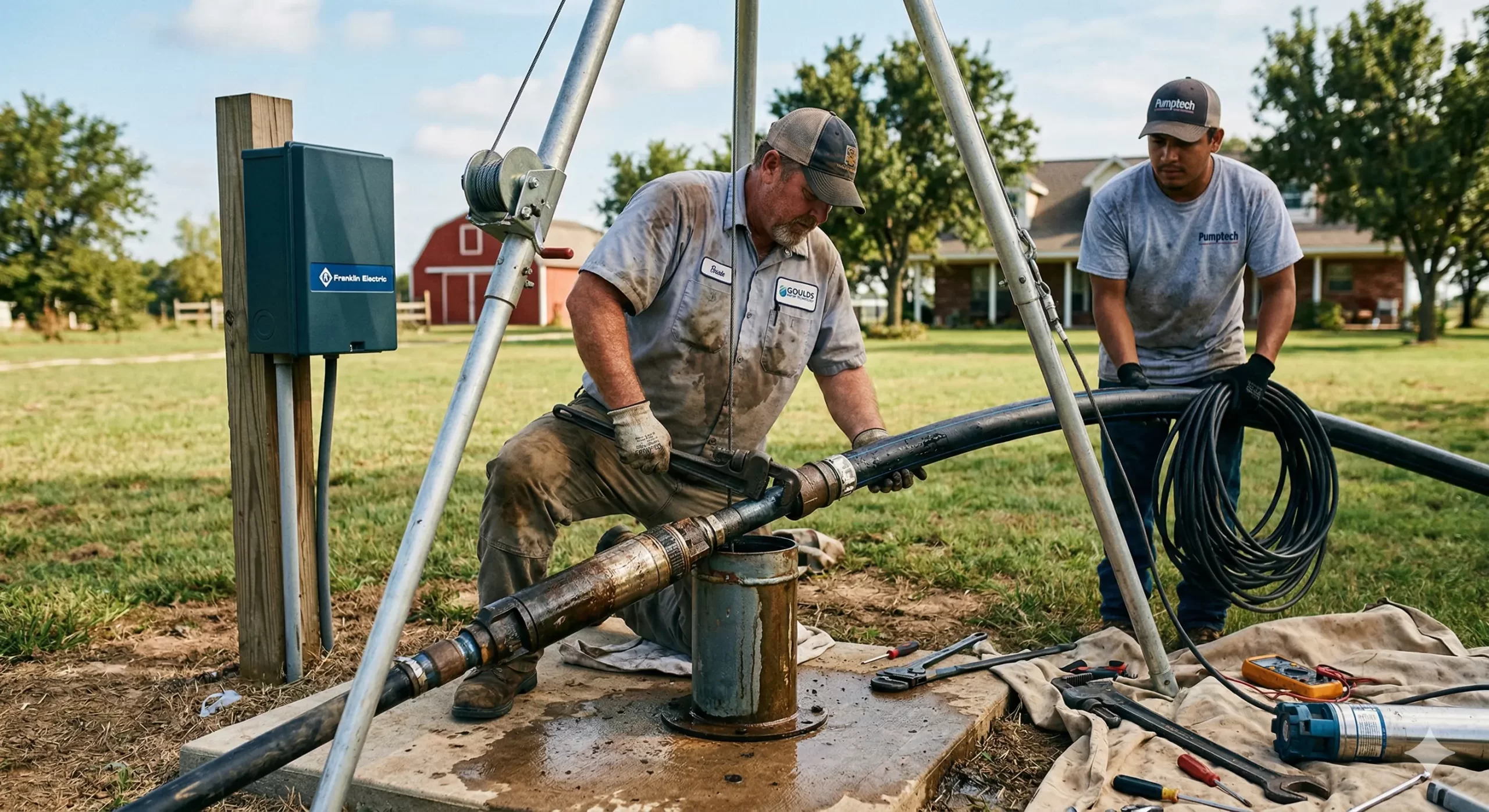
Extracting a submersible pump is a job exclusively for professionals with a dedicated pump hoist or pulling rig. A typical 4-inch residential pump assembly with 200 feet of pipe and water can weigh over 500 pounds. The technician uses a pitless adapter key, a long T-handle tool, to engage the pitless adapter located below the frost line inside the well casing. This allows the entire drop pipe, pump, and cable assembly to be disconnected and lifted vertically by the hoist. This heavy, specialized equipment prevents dropping the assembly, which would destroy the pump and potentially damage the well itself, leading to a far more expensive repair.
Once the pump is at the surface, the technician conducts a forensic inspection. The entire length of the submersible cable is examined for the tell-tale abrasion marks caused by rubbing against the well casing. The most critical point of inspection is the waterproof heat-shrink splice that connects the motor’s short leads to the main drop cable. An improperly made splice is a common failure point. If the cable and splice pass a visual and Megger test, the motor itself is condemned. The repair involves replacing the failed component—either the motor or a section of cable—and creating a new, factory-grade heat-shrink splice. A final Megger test is performed on the fully assembled unit before it is carefully lowered back into the well.
Safety Protocol
Working with a 240V high-amperage circuit and heavy equipment requires strict adherence to safety standards. This includes full LOTO procedures, use of personal protective equipment (PPE) like insulated gloves and safety glasses, and employing a dedicated pump hoist rated for the load. Attempting to pull a deep-set pump by hand or with an inadequate vehicle hitch is extremely dangerous and can result in severe injury, electrocution, or permanent damage to the well system.
Repair Cost & Time Assessment
The professional repair cost for a Goulds Aquavar F01/F02 fault in the United States typically ranges from $900 to $3,500. The final invoice is determined by the specific component that has failed. At the lower end of the range ($900 – $1,600), the issue is often a damaged drop cable or a failed heat-shrink splice. This price includes the service call, 2-4 hours of labor for a two-person crew to pull and reinstall the pump, the use of the pump hoist rig, and the cost of materials for a new splice.
The higher end of the cost spectrum ($1,800 – $3,500+) is incurred when the submersible motor itself is shorted and must be replaced. In this scenario, the customer is paying for the labor and equipment usage as described above, plus the significant cost of a new premium submersible motor, which can range from $800 to over $2,000 depending on its horsepower, phase, and construction materials. The depth of the well is a major factor, as pulling a pump from 500 feet takes considerably more time and labor than one set at 100 feet, directly impacting the final cost. The entire diagnostic and repair process typically takes between 3 to 6 hours for a standard residential well.
Fast Local Service & Diagnostics
Calls are routed to a licensed local well professional.