
Diagnosis: The Goulds Aquavar F04 fault indicates the variable frequency drive (VFD) is receiving insufficient line voltage, typically below 190V on a 230V nominal system. This is often caused by utility power sags, undersized wiring, or loose connections, which can force the motor to draw excessive current, leading to overheating and damage. Troubleshooting involves verifying voltage at the panel and drive, checking for loose terminals, and confirming the circuit is dedicated.
In this Guide:
What Causes the Goulds Код F04 Issue?
The F04 Under Voltage fault is a critical protective function of the Aquavar SOLO series VFD. At its core, the drive operates by converting incoming AC power into a high-voltage DC bus, which is then inverted back into a precise AC waveform to control motor speed. This process requires a stable input voltage, typically 230V nominal. When the incoming line voltage sags significantly—often due to utility grid strain, long wire runs, or high-draw appliances on the same service—the rectified DC bus voltage drops below the VFD’s minimum operational threshold. The drive’s internal microprocessor detects this condition instantly. To prevent catastrophic failure, it triggers the F04 fault and halts operation. This is not a nuisance trip; it is a direct response to a power condition that makes it impossible for the drive to supply the required power (P = V x I) to the motor without drawing dangerously high current (amperage).
The primary victim of a persistent under-voltage condition is the submersible motor itself. When the VFD attempts to start the motor with inadequate voltage, it must dramatically increase the amperage to generate the necessary starting torque. This excessive current creates immense thermal stress (I²R losses) within the motor’s copper windings. The enamel insulation coating on these windings can rapidly degrade, bake, and crack under this heat, leading to turn-to-turn shorts. This permanently compromises the motor’s efficiency and will eventually lead to a dead short and complete failure. Furthermore, the violent magnetic forces and stuttering motion during a low-voltage start attempt place extreme mechanical strain on the pump shaft, splines, and particularly the thrust bearing assembly, which is designed to handle downward force, not the hammering torque of a struggling start.
Secondary damage extends beyond the motor. The intense heat generated by high amperage can conduct up the motor housing and compromise the integrity of the mechanical shaft seals. These seals are vital for keeping motor oil in and well water out; their failure leads to motor contamination and burnout. Inside the Aquavar drive itself, repeated under-voltage events and the subsequent inrush current when power stabilizes can stress the input rectifier diodes and place a heavy cyclical load on the main DC bus capacitors. Over time, this can shorten the operational lifespan of the drive’s power electronics, leading to a premature failure of the controller, which is an expensive component to replace.
DIY Troubleshooting Steps
- SAFETY FIRST: De-energize the Circuit. Before opening any electrical panels, locate the two-pole breaker controlling the well pump in your main service panel and switch it firmly to the ‘OFF’ position. Place a piece of tape over it or use a formal lockout tag to prevent accidental re-energization while you are working.
- Visually Inspect All Connections. Open the cover on the pump’s pressure switch (if present), the dedicated disconnect switch, and the wiring compartment of the Aquavar controller itself. Look for any signs of arcing, discoloration, or melted insulation around the terminals. With the power off, use a screwdriver to gently verify that every screw on the terminal blocks (L1, L2, Ground) is tight. Loose connections are a common source of voltage drop.
- Measure Voltage at the Breaker Panel. If you are qualified and comfortable working in a live panel, set a true RMS multimeter to AC Volts. Carefully measure the voltage across the two terminals of the pump’s circuit breaker. A healthy 240V circuit should read between 230V and 250V. A reading below 220V indicates a potential problem with the utility supply.
- Measure Voltage at the Aquavar Drive. With the breaker back on, carefully measure the voltage at the incoming L1 and L2 terminals on the Aquavar controller. This reading should be nearly identical (within 1-3%) to the voltage you measured at the breaker. A significant drop between the panel and the drive points to undersized or damaged wiring in the circuit.
- Identify and Isolate Other Heavy Loads. Note if the F04 fault occurs when other major appliances—such as a central air conditioner, electric range, or a large shop compressor—are starting up. These can cause a momentary but severe voltage sag on the entire home service. The pump should always be on its own dedicated circuit to mitigate this.
- Check the Pressure Tank Pre-Charge. A waterlogged or improperly charged pressure tank causes the pump to short-cycle, leading to frequent startups that can strain the electrical supply. With the pump breaker off and a hose bib open to relieve all water pressure, check the air pressure at the tank’s Schrader valve. It should be set to 2 PSI below the pump’s cut-in pressure setting (e.g., 38 PSI for a 40/60 switch).
When to Call a Professional Well Service
A professional technician’s diagnosis of an F04 fault goes beyond a simple static voltage check. Using a multimeter with MIN/MAX recording or a dedicated power quality analyzer, the technician will monitor the line voltage *during* the pump’s attempted startup cycle. This is critical as it captures the transient voltage sag that actually triggers the fault, which a standard measurement might miss. The next step is to de-energize and lock out the circuit to perform an insulation resistance test using a megohmmeter. This instrument applies a high DC voltage (typically 500V or 1000V) to the motor windings via the drop cable. The resulting resistance reading, measured in megohms, reveals the health of the motor’s insulation and any splices underwater. A reading below two megohms often indicates failing motor insulation or a compromised heat-shrink splice, which can cause excessive current draw that mimics under-voltage symptoms at the drive.
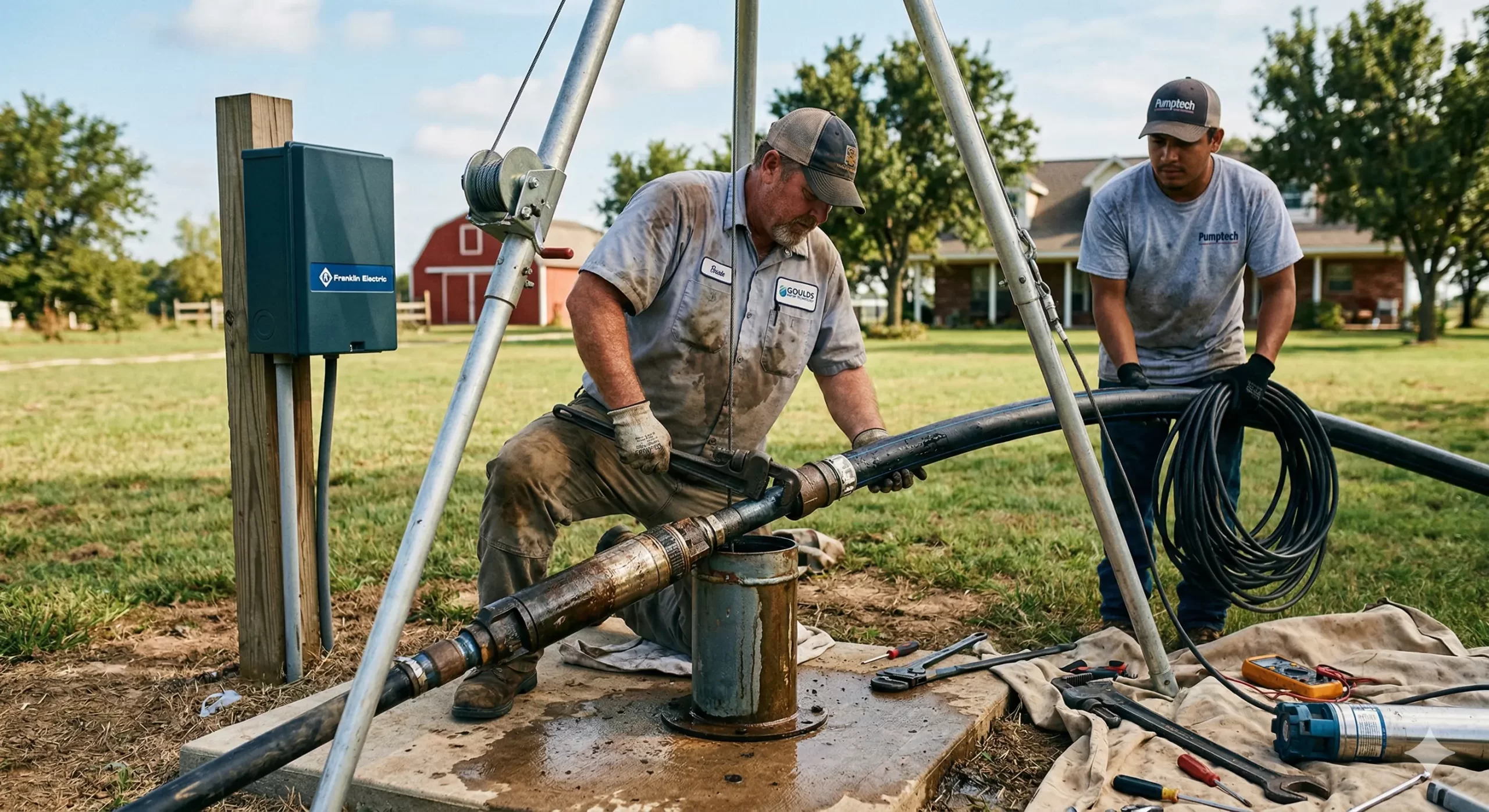
If diagnostics point to a failed motor or a problem downhole, the pump must be pulled. This procedure is non-negotiable and requires specialized heavy equipment. A dedicated pump hoist, a truck-mounted pulling rig, or a tripod hoist is used to manage the immense weight of the pump, motor, water-filled drop pipe, and cable. The technician uses a pitless adapter key, a long T-handled tool, to latch onto the pitless adapter inside the well casing and disengage it. This allows the entire assembly to be safely and controllably lifted from the well without excavating the yard. The process involves carefully laying out hundreds of feet of pipe and wire, preventing kinks, and securing the wellhead at all times.
Safety Protocol: Pulling a submersible pump is a high-risk operation. All work begins with a strict lockout/tagout (LOTO) procedure at the breaker panel to ensure the circuit cannot be energized. A 240V shock can be lethal. The weight of a deep-set pump (often 300-500 lbs or more) makes manual pulling extremely dangerous and nearly impossible; the use of a mechanical rig is an absolute requirement for safety and to prevent dropping the assembly down the well. The technician will wear appropriate personal protective equipment (PPE), including gloves and safety glasses, and will manage the worksite to prevent tripping hazards from the long lengths of pipe and wire being removed from the casing. If the utility voltage is consistently low, the professional solution is the installation of a buck-boost transformer. This must be sized and installed by a licensed electrician to raise the incoming voltage to a stable level, providing a permanent engineering solution to the supply problem.
Repair Cost & Time Assessment
The cost to resolve an F04 fault varies significantly based on the root cause. For an initial diagnostic service call, expect to pay between $250 and $500. This typically covers 1-2 hours of a qualified technician’s time to perform voltage checks, inspect wiring, test the motor with a megohmmeter from the surface, and provide a definitive diagnosis. If the issue is simply a loose connection at the controller or disconnect, this initial fee may cover the entire repair.
If the diagnosis determines the utility supply voltage is consistently low, a more involved repair is required. The installation of a correctly sized buck-boost transformer by a master electrician can range from $800 to $1,800, including the cost of the transformer unit, wiring, conduit, and several hours of specialized labor. If the megohmmeter test fails and the pump must be pulled from the well, the cost escalates significantly. A full pump replacement service, which includes two technicians for safety, the use of a pump pulling rig, a new pump and motor assembly, and new components like a heat-shrink splice kit and torque arrestors, will typically cost between $2,500 and $6,000+. This price is dependent on the well depth, pump horsepower, and site accessibility. The customer is paying for extensive labor (4-8 hours), the use of heavy-duty specialized equipment, liability insurance, and premium, warrantied parts designed for long-term underwater service.
Fast Local Service & Diagnostics
Calls are routed to a licensed local well professional.