
Diagnosis: Grundfos CUE Warning 4 indicates a ‘Mains Phase Loss,’ meaning one of the three incoming power phases from the utility is missing. This is typically caused by an external grid issue and requires a qualified technician to verify the voltage drop and unbalanced load before contacting the power company for repair.
In this Guide:
What Causes the Grundfos Warning 4 Issue?
A ‘Mains Phase Loss’ (Warning 4) on a Grundfos CUE variable frequency drive (VFD) is a critical alert indicating that one of the three legs of your 3-phase power supply has been interrupted. This condition, known in the industry as ‘single-phasing,’ most often originates upstream from your facility—typically due to a fault in the utility grid, a blown high-voltage fuse on a power pole, damage to an overhead line, or a problem with the local step-down transformer. When one phase disappears, the symmetrical, rotating magnetic field that a three-phase motor relies on for smooth, efficient operation collapses. The sophisticated circuitry within the CUE drive continuously monitors the voltage and symmetry at its input terminals (L1, L2, L3). Upon detecting this severe voltage imbalance, it immediately triggers the warning and halts operation to protect the connected motor from certain and catastrophic failure.
The immediate consequence for the motor windings is severe and rapid thermal stress. Without the third phase to maintain electrical balance, the motor attempts to continue running on the remaining two phases. This forces it to draw a massive amount of current, often exceeding its designed full load amperage (FLA) rating by 173% or more as it struggles to generate sufficient torque. This excessive current generates extreme heat (I²R losses) within the stator windings. The NEMA-grade enamel insulation coating the copper wires, rated for a specific temperature class, will quickly begin to break down, melt, and carbonize. This leads to turn-to-turn shorts within a winding, which then cascades into a complete phase-to-ground fault, ultimately resulting in a burned-out, inoperable motor.
The electrical instability of single-phasing translates directly into mechanical violence within the pump assembly. The loss of the balanced, rotating magnetic field creates a pulsating, uneven torque on the motor shaft instead of a smooth rotational force. This induces significant vibration and harmonic distortion throughout the pump and motor. The pump’s precision-engineered bearings, both the radial bearings that support the shaft and the axial thrust bearings that handle the hydraulic load, are subjected to hammering shock loads they were not designed to withstand. This leads to accelerated wear, pitting, and spalling of the bearing races, culminating in seizure. This torsional vibration can also cause minute shaft deflection, compromising the lapped faces of the mechanical seal, which can lead to leaks and eventual failure of the entire pump unit.
DIY Troubleshooting Steps
- Visually Inspect All Breakers and Disconnects: Start at the control panel for the Grundfos CUE. Check if the main breaker feeding the drive is in the ‘ON’ position. Trace the power back to the main electrical panel and ensure no breakers in that chain have been tripped. Firmly switch any tripped breakers OFF and then back ON once. If a breaker trips immediately, there is a serious fault that requires a professional.
- Check for a Tripped Thermal Overload Relay: Inside the control panel, there is likely a motor starter or thermal overload block. Look for a small, often red or blue, ‘RESET’ button. If it has been tripped, press it to reset. This device is designed to trip on over-current conditions, a classic symptom of phase loss.
- (Advanced Users Only) Verify Input Voltage Safely: If you are trained and equipped to work safely with live high-voltage electricity, use a true RMS multimeter set to AC Volts. Carefully measure the phase-to-phase voltage at the input terminals (L1, L2, L3) of the CUE drive. You should measure consistent voltage between L1-to-L2, L2-to-L3, and L1-to-L3 (e.g., 480V, 480V, 480V). A reading of ‘0’ or a significantly lower voltage on one pair (e.g., 480V, 480V, 277V) definitively confirms a lost phase.
- Inspect for Physical Signs of Damage: With the power locked out, look for any signs of arcing (soot marks), melted wire insulation, or discoloration from excessive heat on terminals, fuses, or contactor points within the disconnect switch and control panel. A loose connection can heat up and fail, causing a phase to drop.
- Monitor the Cycle Timer or Pressure Switch: If your system uses external controls like a cycle timer or pressure switch, ensure they are functioning correctly and providing a clear ‘call-to-run’ signal. While not a direct cause of phase loss, a faulty control can sometimes present erratic behavior that can be misdiagnosed.
- Consult with Neighbors or Adjacent Facilities: A simple yet effective step is to check if neighboring properties are experiencing power issues. If they are, it strongly indicates the problem is with the utility grid, and your only action is to report the outage to your power company.
When to Call a Professional Well Service
A certified pump technician or master electrician will initiate a systematic diagnostic procedure under strict safety protocols. The first and most critical step is to implement Lock-Out/Tag-Out (LOTO) on the main disconnect, ensuring the entire system is de-energized and cannot be accidentally started. Using a calibrated power quality analyzer or a professional-grade multimeter, the technician will measure the voltage phase-to-phase and phase-to-ground at the line side of the CUE drive. This definitively confirms the presence of a lost phase and immediately differentiates between a utility problem and an internal equipment fault. They will then methodically work backward from the drive, testing voltage at every key junction—the local disconnect, the main distribution panel, and the service entrance—to pinpoint the exact location of the power interruption.
Once the phase loss is confirmed to be external (originating from the utility company), the technician’s role shifts to providing the power company with definitive proof and technical data to expedite their response. If the fault is internal, such as a blown high-rupture capacity (HRC) fuse in a fused disconnect or a welded/failed contactor, the repair is performed on-site. Critically, before re-energizing the system after any phase loss event, it is imperative to test the motor itself. The technician will use a Megohmmeter (often referred to by the brand name ‘Megger’) to perform an insulation resistance test. This test applies a high DC voltage (typically 500V or 1000V) between the motor windings and ground to measure the integrity of the winding insulation. A low megohm reading indicates that the single-phasing event has already damaged the motor, and simply restoring full three-phase power would cause an immediate and final failure.
Safety Protocol & Mechanical Intervention
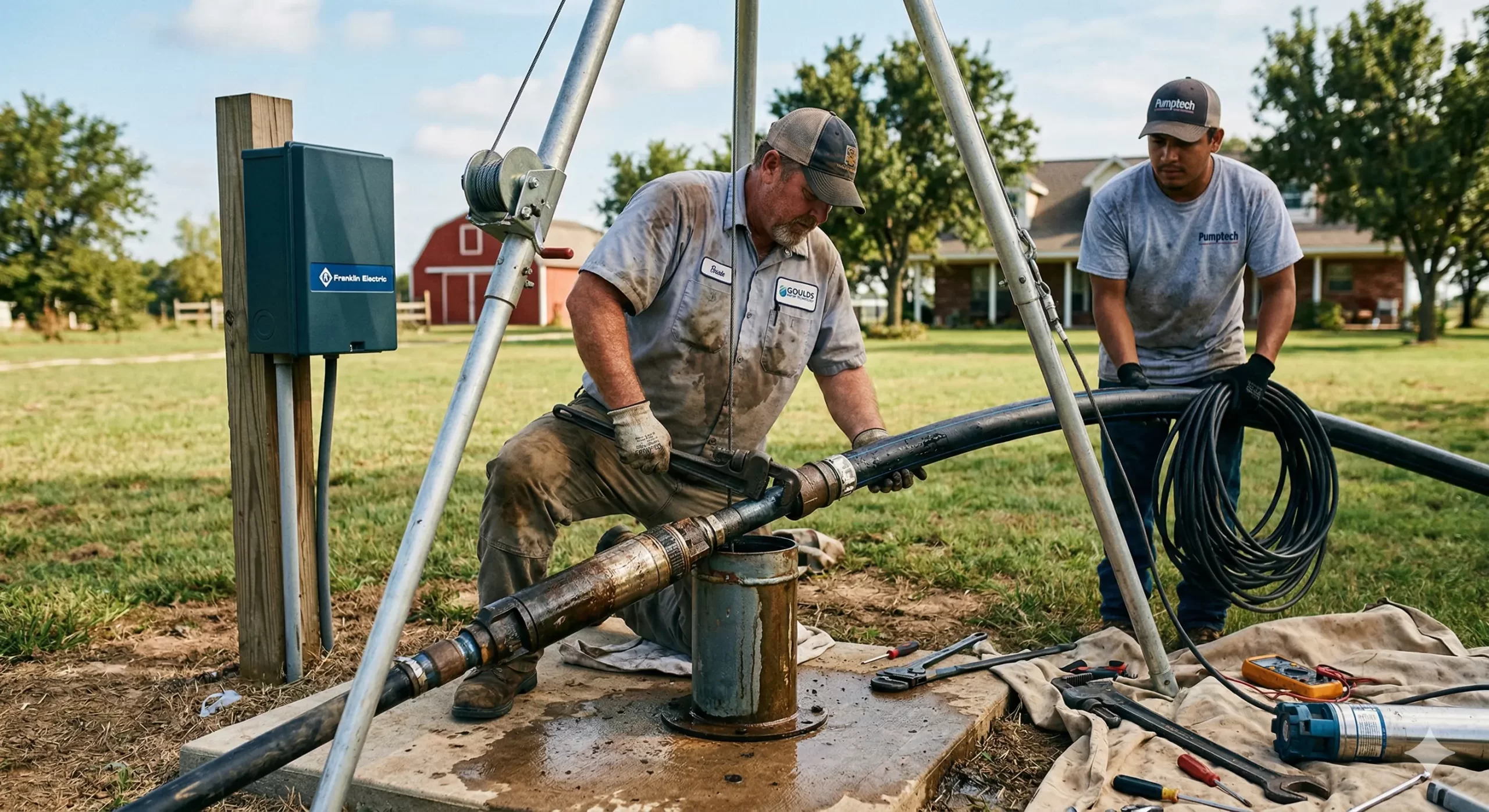
In applications involving submersible well pumps, the repair process involves significant mechanical and electrical hazards. A 480V, 10 HP submersible pump assembly can weigh upwards of 500 lbs and is connected to hundreds of feet of heavy pipe and power cable. Attempting to pull this assembly without a dedicated pump hoist, crane, or derrick rig is exceptionally dangerous and can lead to catastrophic equipment damage, well casing destruction, or severe personal injury. A professional crew uses a specialized pulling rig for a controlled and safe extraction. They employ a pitless adapter key, a long T-handle tool designed to engage and unlock the pump assembly from the pitless adapter inside the well casing, allowing the entire unit to be lifted without excavating the yard. This entire process highlights why handling high-power, heavy-duty pump systems is strictly a job for trained, licensed, and insured professionals.
Repair Cost & Time Assessment
The cost for professionally diagnosing and resolving a ‘Mains Phase Loss’ warning typically ranges from $300 to $950, assuming the issue is on the customer’s side of the meter and does not require pulling the pump. A standard service call for a licensed technician to arrive, perform safety checks (LOTO), and diagnose the problem with a power quality meter will generally fall in the $300-$500 range. This covers the initial 1-2 hours of labor, a service vehicle fee, and the diagnostic process. If the problem is internal, such as replacing a set of high-capacity HRC fuses or a faulty industrial contactor, you can expect to add $150-$450 for premium, OEM-specification parts plus the additional labor for installation and system verification testing.
If the single-phasing event is determined to have damaged the submersible motor, requiring it to be pulled from the well, the costs escalate significantly. Mobilizing a pump hoist rig and a two-person crew for a full-day job can range from $1,800 to $4,500, and this does not include the cost of a new motor or complete pump unit. This higher price reflects the use of heavy, specialized equipment, increased labor hours for a qualified team, the inherent risks and liability involved, and the expertise required to safely pull, repair, and reinstall a heavy pump from a deep well without causing further damage to the well or plumbing.
Fast Local Service & Diagnostics
Calls are routed to a licensed local well professional.