
Diagnosis: A Grundfos CUE Alarm 13 (Overcurrent) indicates a severe electrical or mechanical failure, such as a shorted motor winding or a seized pump. This requires immediate shutdown and professional diagnostics with a megohmmeter to confirm a dead short. The typical resolution is a full replacement of the submersible pump and motor assembly.
In this Guide:
What Causes the Grundfos Alarm 13 Issue?
An ‘Alarm 13’ on a Grundfos CUE Variable Frequency Drive (VFD) is a critical fault condition representing the drive’s self-preservation response to a massive, near-instantaneous surge in electrical current. Unlike a standard overload which is a sustained, moderate increase in amperage, an overcurrent event is an electrical spike that far exceeds the motor’s designed limits. The drive’s internal insulated-gate bipolar transistors (IGBTs) are protected by sophisticated monitoring circuits that will shut down output in milliseconds to prevent their own destruction. This fault is triggered by one of two primary catastrophic events: a direct short circuit to ground or a locked rotor condition from a complete mechanical seizure. In either scenario, the electrical impedance of the motor circuit plummets, and according to Ohm’s Law (I = V/R), current attempts to rise to a theoretically infinite level, stopped only by the drive’s protective trip.
The most common cause is a terminal failure of the motor’s winding insulation. Submersible motors operate in a harsh environment, and over years of thermal cycling, vibration, and potential voltage spikes, the thin enamel coating on the copper motor windings can degrade, crack, or flake off. When this happens, a winding can make direct contact with the steel laminations of the stator, creating a low-resistance path to ground. A similar failure can occur in the submersible drop cable or, more frequently, at the heat-shrink splice connecting the motor leads to the drop cable if it was improperly installed and allowed moisture ingress. This moisture provides a conductive path between phases or from a phase to ground, resulting in a direct short circuit the moment the CUE drive attempts to energize the motor.
Alternatively, a catastrophic mechanical failure within the pump or motor presents the same electrical signature to the drive. A ‘locked rotor’ condition, where the motor shaft is physically incapable of turning, is an effective short circuit from the VFD’s perspective. This can be caused by the complete failure of a thrust bearing, allowing the motor’s rotor to drag against the stator, or the collapse of radial bearings, causing a fatal misalignment. In pumps, severe sediment or sand intrusion can completely jam the impeller stack. When the CUE commands the motor to start, it cannot overcome this mechanical resistance, and the current draw immediately spikes to the Locked Rotor Amp (LRA) value, which is often 500-700% of the normal Full Load Amp (FLA) rating, triggering the Alarm 13 shutdown instantly.
DIY Troubleshooting Steps
- Emergency Power Disconnect: Immediately turn off the circuit breaker feeding the Grundfos CUE drive. Do not attempt to reset it multiple times. This is a hard fault, and repeated attempts to start can cause further damage to the drive. Employ proper Lockout/Tagout procedures if you are trained to do so.
- Visual Inspection: With all power safely disconnected, carefully inspect the CUE controller, the wellhead junction box, and any exposed conduit or wiring. Look for obvious signs of damage such as burnt wires, melted insulation, signs of arcing (soot), or water intrusion. A strong ‘burnt electronics’ odor is a definitive sign of a severe fault.
- Verify Motor Parameters in CUE Drive: If you can safely power the unit on without starting the motor, navigate the CUE’s control panel to verify that the programmed motor data (Voltage, Full Load Amps, Horsepower, RPM) perfectly matches the data on the motor’s nameplate. While incorrect parameters typically cause other alarms, it’s a critical check to rule out a programming error.
- Check Thermal Overload Reset: Some installations may have a separate thermal overload relay between the drive and motor. Check if it has a manual reset button and if it has tripped. A tripped overload suggests a different problem, but it’s worth checking as part of a comprehensive diagnostic.
- Monitor for a Single Restart Attempt: After a full power-down for at least 15 minutes to allow drive capacitors to discharge, you may attempt one single restart. If the Alarm 13 appears instantly upon the start command (within 1-2 seconds), the fault is confirmed as permanent. Do not proceed with further attempts.
- Review the Alarm Log: Access the alarm log in the CUE drive’s menu. Note the frequency of the Alarm 13 and if any other alarms (e.g., Overvoltage, Undervoltage) preceded it. This history can provide valuable context for a professional technician.
When to Call a Professional Well Service
Upon arrival, a licensed pump technician and electrician will first perform a definitive diagnostic to confirm the failure before any heavy equipment is deployed. The initial step is to isolate and lock out all power to the CUE drive. The technician will then open the drive panel and disconnect the motor leads (terminals U, V, W) from the drive’s output. The crucial diagnostic tool for this fault is a high-voltage insulation resistance tester, commonly known as a Megger or megohmmeter. The technician will connect the megohmmeter leads between each motor wire and the system ground, then apply a DC voltage (typically 500V or 1000V). A healthy motor and cable will show very high resistance, typically hundreds or thousands of megohms. A reading of less than 1 megohm, and especially a reading near zero, provides undeniable proof of a dead short to ground in either the drop cable or the motor itself, justifying the pump’s removal.
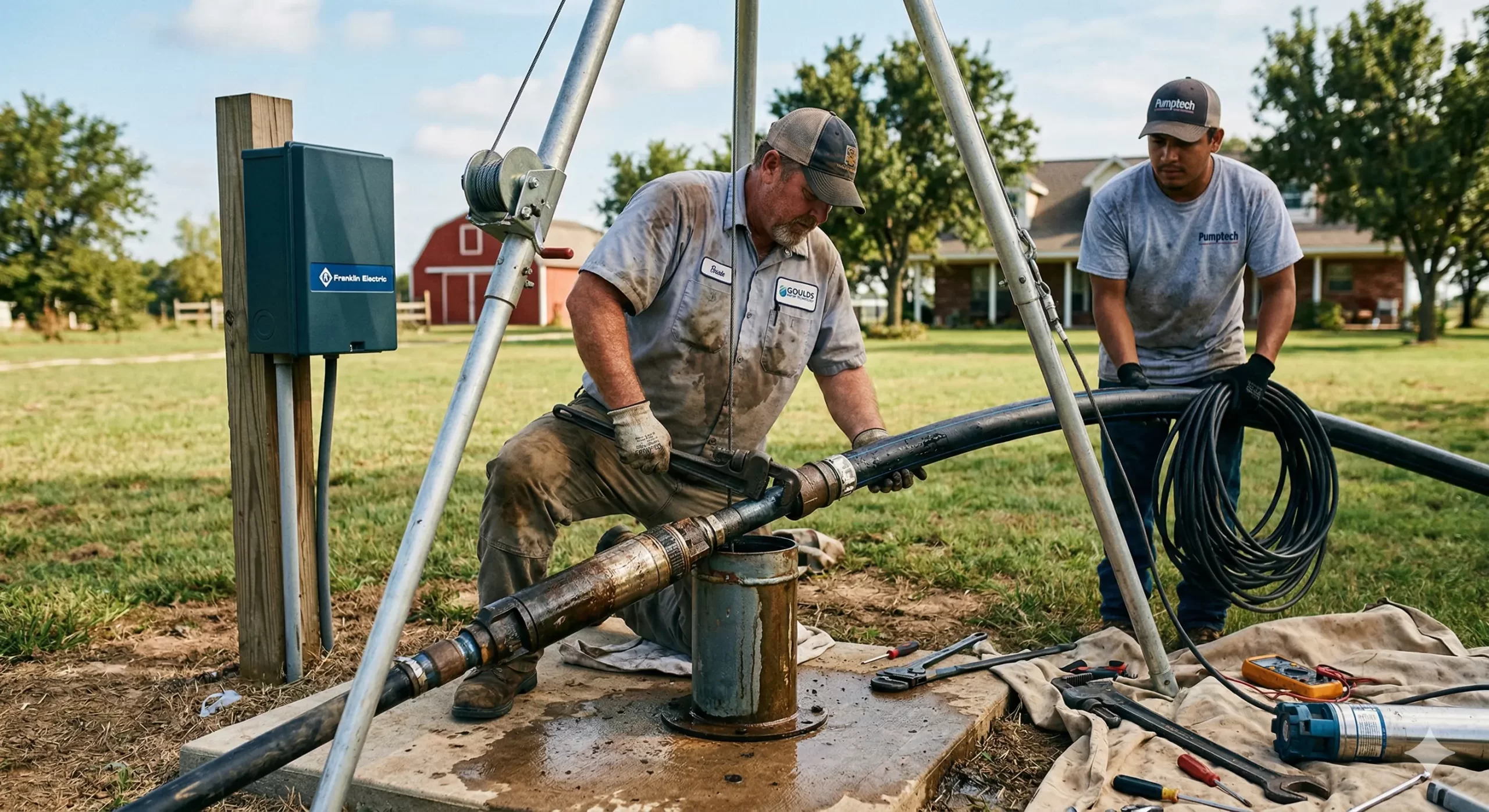
For a submersible well pump, the repair moves from electrical diagnostics to heavy mechanical work. Due to the immense weight of the pump, motor, water-filled drop pipe, and cable—often exceeding 500 pounds for deeper settings—a specialized truck-mounted pump hoist or pulling rig is mandatory. The technician will remove the well cap, thread a pitless adapter key down the casing to engage the adapter, and use the hoist to lift the entire assembly a few inches to disengage it from the well’s side wall. The team then begins the arduous process of hoisting the pump, stopping every 10 or 20 feet to disconnect a section of drop pipe, carefully managing the electrical cable alongside it. This is a hazardous operation requiring experienced personnel to prevent dropping the assembly down the well or causing injury.
Safety Protocol
Working on a 240V or 480V deep-well system presents a dual threat of high-voltage electrocution and severe physical danger from the heavy, suspended load. All technicians must adhere to strict safety protocols, including wearing insulated gloves and safety footwear, using non-conductive tools where possible, and ensuring the pump hoist is level and stable on solid ground. The work area must be cordoned off. The combination of high voltage and a heavy load suspended overhead makes this a job exclusively for trained and insured professionals. Attempting to pull a deep-set pump by hand is a recipe for catastrophic equipment loss, well damage, or life-threatening injury.
Repair Cost & Time Assessment
The cost for diagnosing and replacing a submersible pump following a Grundfos CUE Alarm 13 fault typically ranges from $2,500 to $6,500 in the United States, but can be higher based on several variables. The lower end of this range might apply to a shallow-set, smaller horsepower pump with easy access for the service truck. The higher end reflects deep-set pumps (300ft+), larger horsepower stainless steel units, the need for a new length of expensive submersible drop wire, and emergency after-hours service rates. This cost includes an initial diagnostic service call fee, several hours of labor for two technicians to operate the pump hoist, the price of the new pump and motor assembly (a significant portion of the total), and miscellaneous materials like new heat-shrink splice kits, pitless adapter gaskets, and torque arrestors.
From initial diagnosis to final system startup, the customer should expect the job to take between 4 to 8 hours. The initial megohmmeter test takes less than an hour, but the majority of the time is consumed by the safe and methodical pulling of the old pump and installation of the new one. The price reflects not just parts and labor, but the significant investment the contractor has in specialized equipment like the pump hoist rig (often a $50,000+ vehicle), high-voltage diagnostic tools, and the comprehensive liability insurance required for this type of hazardous work. The customer is paying for a safe, professional restoration of their water system by qualified experts.
Fast Local Service & Diagnostics
Calls are routed to a licensed local well professional.