
Diagnosis: If your Little Giant WE Series pump is sputtering or sucking air, the primary cause is a pump GPM (Gallons Per Minute) rating that exceeds your well’s yield. This over-pumping draws the water level below the pump’s intake, causing severe mechanical and electrical damage. The solution requires installing a flow control valve or replacing the pump with a lower-capacity model.
In this Guide:
What Causes the Little Giant Sucking Air / Sputtering Issue?
The fundamental engineering conflict causing a Little Giant WE Series pump to suck air is a mismatch between the pump’s designed output capacity and the well’s hydrogeological yield rate. Every well has a finite recovery rate, measured in Gallons Per Minute (GPM), which is the speed at which groundwater seeps back into the well bore after being pumped out. A high-horsepower WE series pump, designed for high flow, can easily evacuate water faster than the aquifer can replenish it. This condition, known as over-pumping, creates an excessive drawdown, lowering the dynamic water level in the casing until it falls below the pump’s intake screen. Once the intake is exposed, the pump begins to pull in a mixture of air and water, creating the characteristic sputtering or ‘surging’ at the faucet. This is not a sustainable condition and is a direct precursor to catastrophic equipment failure.
Mechanically, this air-water mixture is devastating to the pump’s internal components. Submersible pumps are designed to be cooled and lubricated by the very water they are moving. When air is introduced, the pump effectively begins to run dry. The precision-engineered pump bearings, often made of carbon-ceramic or other specialized composites, rely on a water film to prevent friction and dissipate heat. Without it, they overheat, score, and seize within seconds. Similarly, the mechanical seal separating the pump end from the motor relies on water for lubrication and cooling. Dry running causes the seal faces to superheat, crack, and fail, allowing water to intrude into the motor housing. The impellers, spinning at thousands of RPM, can also be damaged by the violent pressure fluctuations characteristic of cavitation, which occurs when pumping an air-water mix.
Electrically, the consequences are equally severe. The submersible motor is hermetically sealed and depends entirely on the surrounding water flow to dissipate the heat generated by its windings. When the pump runs dry, this cooling mechanism is eliminated. The motor’s internal temperature rises rapidly, compromising the enamel insulation on the copper windings. This insulation breakdown eventually leads to an internal short-circuit between windings or a ground fault to the motor casing. A ground fault will trip a GFCI breaker, but a winding-to-winding short will cause a massive amperage spike, tripping the primary circuit breaker and potentially destroying the motor control box. Repeated thermal cycling from overheating also weakens the motor leads and waterproof heat-shrink splices, creating points of future failure.
DIY Troubleshooting Steps
- Clock the Pumping Cycle: Turn on a faucet and use a stopwatch. Time how long the pump runs from when it kicks on until you first hear sputtering from the tap. A consistent, repeatable time (e.g., 90 seconds every time) is a strong indicator of the well being drawn down to a specific level, rather than a random equipment fault.
- Monitor System Pressure Gauge: Watch the pressure gauge on your pressure tank. Note the pressure at which the sputtering begins. If it happens at various pressures throughout the cycle, it points to over-pumping. If it only happens right as the pump shuts off, you could have a separate issue with a waterlogged pressure tank.
- Perform a Clamp Ammeter Reading: If you are qualified and comfortable working inside the main electrical panel, use a clamp-on ammeter on one of the 240V leads to the pump. Note the stable running amperage (e.g., 9.5 amps). When the pump begins sucking air, the load will decrease dramatically, and you will see the amperage drop significantly (e.g., to 6 amps). This is a definitive sign the pump is no longer moving a solid column of water.
- Check for Thermal Overload Resets: Inspect the pump’s control box for a manual thermal overload reset button. If this button has been tripping, it’s a critical warning that the motor is overheating, most likely from the loss of cooling water flow during dry-running episodes.
- Estimate Well Recovery: Once the pump shuts off after a sputtering cycle, wait five minutes before starting another cycle. Then, run the water again and time how long it takes to start sputtering. If the run time is now longer, it indicates the well needed that time to partially recover, confirming a yield issue.
- Review Well and Pump Documentation: Locate the original well driller’s report for your property. This document should specify the certified ‘well yield’ in GPM and the static water level. Compare this GPM number to the specifications of your Little Giant WE Series model. If your pump’s GPM rating is significantly higher than the well yield, you have found the source of the problem.
When to Call a Professional Well Service
A qualified technician’s first step is definitive diagnosis, not immediate extraction. They will begin at the control box with a megohmmeter (often called a ‘megger’) to test the insulation resistance of the motor windings and the integrity of the power cable running down the well. This test sends a high voltage (500-1000V) signal down the wires to detect any leakage to ground, which would indicate a failing motor or compromised splice. A healthy reading confirms the electrical system is sound, pointing the diagnosis toward a hydraulic issue. Following the electrical checks, the technician will perform a drawdown test to measure the well’s actual yield. By throttling the outflow at the wellhead and measuring the water level drop over time, they can precisely calculate the GPM the well can sustainably produce, confirming the mismatch with the pump’s capacity.
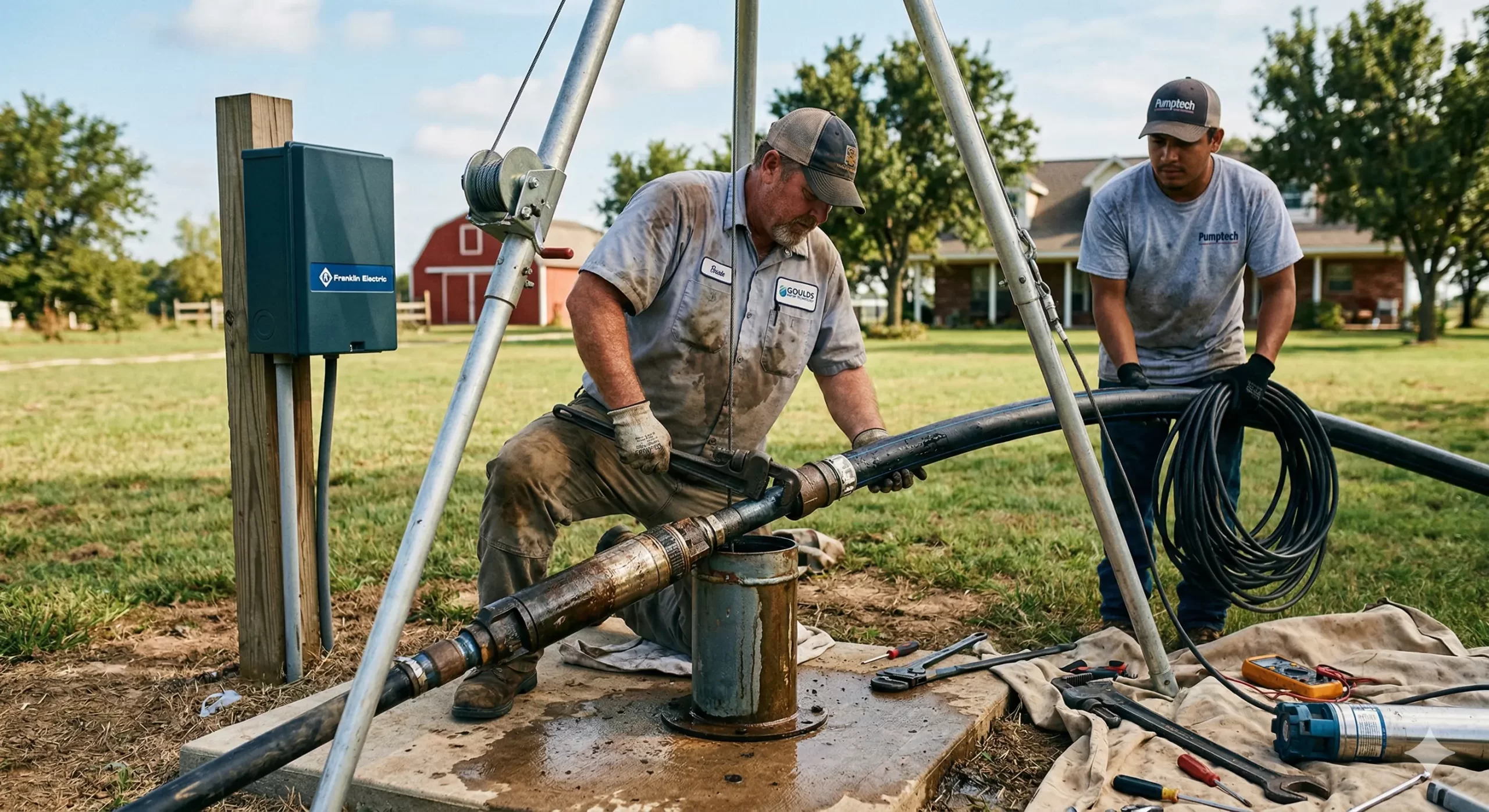
Once over-pumping is confirmed, the pump must be pulled from the well. This is a non-trivial task requiring specialized equipment. A professional crew will arrive with a portable Pump Hoist or a dedicated pulling rig. This machinery is essential for safely managing the immense weight of the pump, hundreds of feet of water-filled pipe, and electrical cable. The technician will use a large T-handle ‘Pitless Key’ to latch onto the pitless adapter deep inside the well casing. This key allows them to disengage the entire drop pipe assembly and lift it straight up without having to excavate the wellhead. The process is methodical, securing the pipe with clamps at the casing top every 10-20 feet to prevent the entire assembly from disastrously dropping back into the well.
With the pump on the surface, the technician will implement one of two corrective actions. The first, more economical option is to install a flow control valve, such as a brass Dole valve, into the drop pipe just above the pump. This device has a precisely-sized orifice that restricts the pump’s maximum output to a GPM rate safely below the well’s measured yield, preventing drawdown. The second, more robust solution is to replace the entire pump with a new, correctly-sized model that matches the well’s capabilities. This is the preferred long-term fix. During reinstallation, the technician will use professional-grade heat-shrink splice kits to create a permanent, watertight connection for the 240V motor leads and install new torque arrestors to prevent the pump from slapping against the well casing on startup.
Safety Protocol: All work is performed after a strict lockout/tagout (LOTO) procedure at the circuit breaker. The combination of 240V electricity, water, and the immense potential energy stored in a suspended 500lb pump assembly presents lethal electrocution and crushing hazards that demand certified professionals and specialized equipment.
Repair Cost & Time Assessment
The cost for a professional repair of an over-pumping well pump typically ranges from $900 to $2,500 in the US. The lower end of this range reflects a scenario where the existing pump is still functional and only requires pulling and the installation of a Dole valve. This cost covers a two-person crew for 3-5 hours, the service call fee, the use of a specialized pump hoist rig, and parts like the valve and new sanitary well seal. The higher end of the range, approaching $2,500 or more, accounts for the full replacement of the pump and motor with a new unit, which can cost $800-$1,500 alone depending on the horsepower and brand. This price includes the additional labor for wiring the new motor and potentially replacing the drop pipe or power cable if they are found to be damaged upon inspection.
The time required for this job is highly dependent on the well’s depth and accessibility. A straightforward Dole valve installation in a 200-foot well might be completed in 3-4 hours from arrival to cleanup. A full pump replacement in a deeper well (400+ feet) or one with complications like a stuck pump or corroded piping can easily extend the job to 5-8 hours. The initial diagnostic phase, including electrical testing and well yield measurement, can take up to an hour itself but is a critical step to ensure the correct repair is performed, saving the homeowner from future call-backs and the expense of a misdiagnosed problem.
Fast Local Service & Diagnostics
Calls are routed to a licensed local well professional.