
Emergency Well Pump Repair in Robinson, TX
Folks in Robinson know that getting a reliable water supply from the ground isn’t always easy. McLennan County sits on varied geology, from the Blackland Prairie’s expansive clays to the deeper limestone formations. Groundwater conditions can be tricky. Drought cycles, especially those we’ve seen in recent years, put immense stress on the water table. This means your well pump works harder, longer, & often pulls from lower depths, leading to increased wear & tear and potential sediment issues. It ain’t just flatland out here; there are real geological challenges.
Down here, we’re primarily drawing from the Trinity Aquifer system, which includes the Paluxy, Glen Rose, & Hosston formations. There’s also some Brazos River Alluvium near the river itself, closer to the riverbed. The Trinity is a reliable source, but depths vary wildly, & water quality can differ between the formations. Understanding which layer your well taps into is crucial for diagnostics & ensuring we select the right pump for your specific conditions.
You put a cheap pump in these McLennan County conditions, & you’re just asking for trouble. Those bargain-bin pumps aren’t built to handle the grit, the varying water levels, or the sustained run-times required by a typical Texas household or farm. They burn out faster, leading to more frequent, & ultimately more expensive, repairs or replacements. You’ll hear me say it a hundred times: buying a quality pump is an investment, not an expense. It’s a false economy to skimp on your water source, pure & simple.
Fast Local Service & Diagnostics
Calls are routed to a licensed local well professional.
Well Pump Repair in
Robinson
Robinson & Mclennan County Well Stats
In McLennan County, we’ve got a mix. Many residential wells are 250-450 feet deep, especially those tapping into the upper Trinity formations. Agricultural wells can go deeper, sometimes 600-800 feet, to get reliable yields. The average static water level might be around 100-200 feet, but that can drop significantly during drought. Yields vary widely, from 5-10 GPM for older residential wells to 30+ GPM for newer, properly developed systems. Most wells are 4-inch or 6-inch diameter, with some larger diameter irrigation wells.
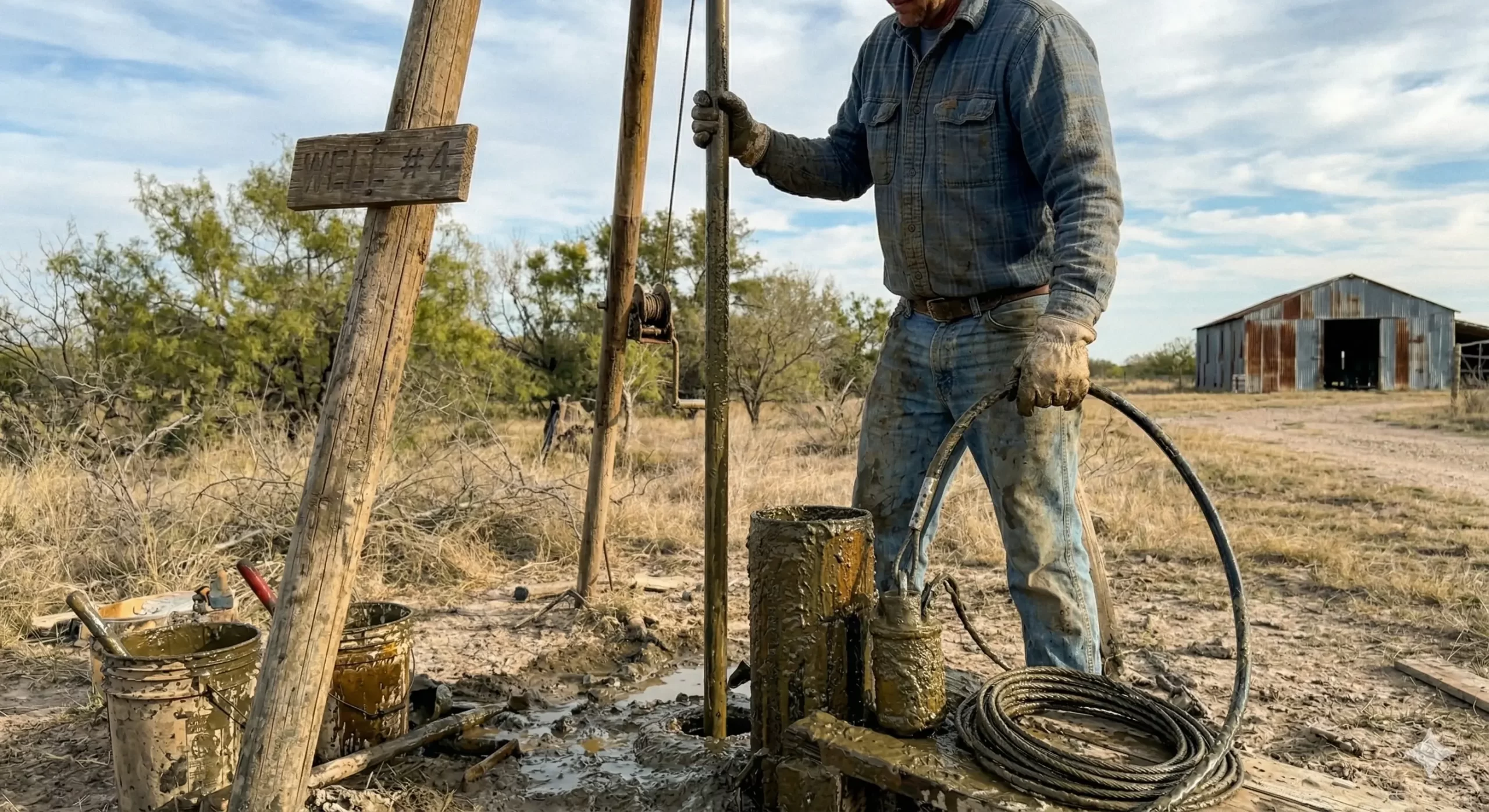
Pulling a pump in McLennan County ain’t always straightforward. A good chunk of this area, especially west & south of Waco, is limestone country. Hitting solid rock at relatively shallow depths is common, which means well drilling & pump installation can be tough. When a pump goes out, getting that heavy column out of a deep well, particularly if it’s bound up or has fallen, requires specialized equipment & trained hands. Access can be an issue too; not every well is sitting pretty next to a paved driveway. Getting a heavy service rig off-road into a pasture, especially after a good rain, takes skill & care, adding to the job’s complexity & time.
We’re talking about a truck-mounted well rig, often a crane-equipped unit, capable of handling thousands of pounds of pipe & pump. Then there’s the associated tools: powerful pipe wrenches, torque gauges, advanced electrical testing equipment, specialized control boxes, large pressure tanks, & all the safety gear necessary for working with high voltage & heavy machinery. It’s not just a guy with a toolbox; it’s a mobile workshop designed for heavy lifting & precision electrical work. All that specialized equipment, its maintenance, & the expertise of the crew to operate it safely & efficiently, contributes to the overall service cost.
Spring Well Maintenance in your area
Heavy spring rains can cause surface runoff to breach well caps. We strongly recommend testing your water for coliform bacteria and inspecting the sanitary seal.
Save Up to $250 on Replacements
Via the Federal Energy Efficient Pump (VFD) Rebate
76°F in Robinson
Local Aquifers & Geology
The primary groundwater sources in Robinson include the Trinity Aquifer system. This complex system is composed of several layers, including the Paluxy, Glen Rose, & Hosston formations. The water quality can vary, with the Paluxy & Hosston generally producing better quality & higher yields than the Glen Rose, which can be more calcareous & prone to lower yields in some areas. Water is typically hard, and iron is a common constituent in varying concentrations.. Drilling through the local Predominantly Blackland Prairie soils, which are characterized by deep, dark, nutrient-rich clays, such as the Houston Black & Austin series. These vertisols are known for their expansive properties; they swell significantly when wet & shrink when dry, leading to soil movement that can affect well casing, wellheads, & surface infrastructure over time. Deeper, you’ll encounter limestone, chalk, & shale formations from the Taylor & Austin groups. means that average well depths range from 250 ft – 650 ft, with some shallower alluvial wells near the Brazos River & deeper irrigation wells..
Due to these geological factors, local homeowners frequently struggle with Electrical motor failure due to overheating from low water levels, often coupled with sediment abrasion. When the water table drops, pumps can run dry or cavitate, causing the motor to overheat & eventually short out. Sediment, common in our aquifers, acts like sandpaper on impellers & motor components, leading to wear & reduced efficiency before total failure..
Drilling Depth Comparison
Deeper wells require heavy-duty crane hoists for pump extraction.
Climate & Water Quality
Pump systems in the Robinson area face severe environmental stressors. The most significant threat is Our Texas heat is brutal. High ambient temperatures combined with heavy pump usage during droughts cause submersible motors to work overtime, increasing internal temperatures & leading to premature failure. Furthermore, the extreme shifts between prolonged drought & sudden, heavy rainfall events stress the geological formations, potentially shifting well casings, affecting static water levels rapidly, or washing out surface wellhead seals, allowing for contamination.
Additionally, the raw groundwater often presents issues with Hardness is almost universal in McLennan County groundwater, leading to scale buildup in pipes, water heaters, & on pump components, reducing efficiency. Iron is also very common, causing reddish-brown staining, metallic tastes, & sometimes promoting iron bacteria growth. Occasional sulfur odors from deeper formations are reported. While not always a *quality* issue in the health sense, fine sand & sediment are frequently pulled, acting as an abrasive on pump parts, causing significant wear..
Regional Groundwater Advisory
Known primary contaminant threat to submersible pumps and pipes in this area:
Common Area Systems
VFD Upgrade Savings
Constant Pressure vs StandardReplacing a standard single-speed pump with a Variable Frequency Drive (VFD) eliminates hard starts and drastically reduces energy draw in Local.
Compliance & Local Permits
Mclennan County Level: The McLennan County Groundwater Conservation District (MCGCD) is the local authority here. Any new well, the deepening of an existing well, or any modification that significantly alters the well’s depth or construction & impacts the aquifer requires a permit from the MCGCD. This includes obtaining a drilling permit before construction, & providing a well log & completion report after the well is finished. They’re focused on conserving & protecting our groundwater resources through responsible management. While a simple pump replacement on an existing, permitted well typically doesn’t require a new permit, any structural changes to the well itself, like adding casing or significantly altering depth, will. Always check with the MCGCD directly before starting major well work.
Top Pump Brands in Local
Most frequently installed hardware based on local geology (2026 data).
- Test pump motor & control box for electrical faults (amperage draw, voltage stability, insulation resistance, capacitor health).
- Check pressure switch settings & functionality, & inspect pressure tank for proper air charge & bladder integrity.
- Measure static & pumping water levels to assess aquifer health, pump draw-down, & potential for running dry.
- Inspect wellhead for integrity, proper seal, security against tampering, & compliance with health codes to prevent contamination.
- Verify pump output (GPM) & system pressure (PSI) to ensure it meets household or agricultural demands efficiently.
- Visually inspect all accessible electrical wiring & conduit for chafing, corrosion, rodent activity, or deterioration.
Premium Well Pump Brands We Service
Our licensed technicians in Robinson are certified to repair, replace, and install high-quality groundwater equipment from industry-leading manufacturers, including:
- No water or very low water pressure from faucets, especially if it was previously normal.
- Pump running continuously without building pressure, or short-cycling frequently (turning on & off rapidly).
- Dirty, sandy, or discolored water suddenly appearing or worsening, particularly after pump cycles.
- Unusual noises coming from the wellhead, pressure tank area, or control box (grinding, humming, clicking).
- Higher than normal electricity bills without a corresponding increase in water usage.
- Circuit breaker tripping repeatedly when the pump tries to run, indicating an electrical overload or short.
Robinson Real Estate Well Regulations
Local Dispatch & Response Times
Live Dispatch: Local Area
Updated Just Now⚠️ High demand. Call now to secure the next available technician.
- Usually within 24-48 hours for total water outage emergencies, depending on current call volume & severity of other emergencies.
- Priority given to homes completely without water, critical livestock watering, or other immediate agricultural needs.
- Non-emergency repairs & routine maintenance scheduled typically within 3-5 business days.
- Our central location in Waco provides us excellent access to Robinson & the surrounding McLennan County rural areas.
- Severe weather, especially heavy rains or icy conditions, can sometimes impact arrival times & service access to well sites.
⚠️ Mclennan County & State Regulatory Warning: Abandoned Wells
Pump Lifespan Estimator
Select household size in Robinson to see strain impact.
Groundwater Threat Level
Current aquifer and mineral impact on pumps in Robinson.
Dropping water tables cause pumps to suck air and overheat.
Hard water calcifies pump impellers, reducing lifespan.
The Cost of Ignoring Symptoms
Fixing a short-cycling pump early saves thousands in Robinson.
Data reflects average well contractor estimates in Robinson.
Local Robinson
Well Pros
Fast Local Service & Diagnostics
Calls are routed to a licensed local well professional.
Robinson Homeowner Feedback
“Had a pump go out in my pasture well, right when I needed it for the cattle. Called ’em up, & they were out here in no time. Got it fixed right & didn’t break the bank. Good fellas, honest work.”

Local Homeowner
✓ Verified TX
“Our old submersible started acting real funky, making grinding noises and the water pressure was real bad. Thought it was just low water but turns out the motor was on its last leg, and some of the impellers were worn from sand. The tech, Bobby, he did a real thorough diagnostic, pulled the pump with his rig, and showed me the damaged parts right there on the well pad. He recomended a new Grundfos, said it’d handle our sandy water better and would be more energy efficient. He worked pretty quick, got the new one in, and the water is flowing better than it has in years. I appresiate the honest work and quick service. They even cleaned up the wellhead after all was done and explained the new control box settings.”

Local Homeowner
✓ Verified TX
“Lost all water on a Saturday afternoon. Panicked a bit, because we had family coming for the weekend, but these guys answered the phone & had a crew out to our place near Robinson by Sunday morning. They diagnosed the issue fast and had the parts on the truck. Got us back up & running before Monday even started. Lifesavers, truly. Can’t thank them enough for the fast turnaround when it mattered most.”

Local Homeowner
✓ Verified TX
Expert Robinson Well System FAQ
My well water in Robinson sometimes smells like rotten eggs, especially after a heavy rain. What’s causing that, & what can be done?
That ‘rotten egg’ smell is almost always hydrogen sulfide gas. It’s naturally occurring in many Texas aquifers, including parts of the Trinity. While it’s generally harmless in typical well water concentrations, it’s certainly unpleasant. The smell can be more pronounced after heavy rains because increased surface water infiltration or changes in static water levels can stir up dormant sulfate-reducing bacteria that produce the gas, or it can be naturally released from geological formations. The most common solutions involve a chlorination system, often a continuous feed system if it’s a constant issue, or a shock chlorination if it’s intermittent. An aeration system which introduces oxygen to oxidize the hydrogen sulfide can also be very effective. For persistent issues, a manganese greensand filter or an activated carbon filter can also be considered. We’d start with a comprehensive water test to confirm the levels & presence of bacteria, & then recommend the best long-term solution based on your specific well, water chemistry, & household usage.
How often should I have my well pump system inspected or serviced in the McLennan County area to prevent failures?
For peace of mind & to prevent costly, inconvenient emergencies, we generally recommend an annual or biennial (every two years) inspection for most residential wells around Robinson. During these check-ups, we’ll monitor your pump’s amperage & voltage draw to identify potential motor issues, check the pressure tank’s air charge & bladder integrity, inspect the pressure switch, and often perform a basic flow test to assess the well’s yield and the pump’s performance. We also thoroughly inspect the wellhead for proper sealing & integrity. This regular maintenance helps us catch small issues like a weakening motor, failing capacitor, or a low-pressure tank air charge before they become major failures, which can save you from being without water and facing a much larger repair bill. If you’re seeing any changes in water quality, pressure, or your pump is running more frequently, don’t wait for the scheduled service – call us immediately.
My well seems to run out of water during summer droughts. Is my well ‘going dry,’ or is it something else, & what are my options?
It’s a common and very stressful concern during our hot, dry Texas summers, but your well isn’t necessarily ‘going dry’ permanently. Rather, the static water level in the aquifer is dropping due to increased regional pumping & lack of natural recharge. Your pump’s intake might be exposed to air, or it’s simply pulling from critically low levels. This can lead to pump cavitation, overheating, & premature failure. Options depend on the severity of the draw-down. Sometimes, simply lowering the pump further into the well, if there’s enough open bore hole below the current setting & sufficient water depth, can solve it. Other times, a variable frequency drive (VFD) can be installed to slow the pump down, allowing the well to recover more slowly & prevent it from running dry frequently. In extreme cases, deepening the existing well or even drilling a new, deeper well into a more reliable formation might be necessary, but those are last resorts. We’d conduct a comprehensive well assessment, including measuring static & pumping water levels over a period, to determine the best course of action for your specific situation.
I’m buying a property in Robinson with an existing well. What specifically should I ask for in a well inspection for the purchase?
Beyond the standard flow & water quality tests for coliform bacteria & nitrates, which are absolutely crucial for health & safety, you should insist on a comprehensive mechanical & electrical inspection of the entire well system. This includes checking the pump’s electrical draw (amperage & voltage) against its specifications, inspecting the wiring, control box components (capacitors, relays), & the pressure switch for proper function. The pressure tank should be verified for proper air charge & bladder integrity. Crucially, the wellhead should be inspected for proper sealing to prevent surface contamination, & its compliance with current TDLR codes. Ask the inspector to check for any signs of sediment in the water, which could indicate pump wear, a deteriorating screen, or a well integrity issue. Finally, ensure you receive a clear, detailed report outlining any deficiencies, estimated costs for necessary repairs, & a recommendation for the well’s overall condition, expected lifespan, & any suggested upgrades. This thoroughness protects your investment & ensures you’re not inheriting a hidden problem that could lead to unexpected expenses down the road.
Robinson Groundwater Expert AI
What are the specific groundwater regulations, average well depths, and the local conservation district for Robinson, Mclennan County?
Groundwater Regulations and Well Information for Residential Wells in Robinson, McLennan County, TX (2026)
As a Senior Hydrogeologist and Local Groundwater Regulatory Expert for Texas, I can provide you with specific information regarding residential water wells in Robinson, McLennan County, Texas, for the current year, 2026.
Local Groundwater Conservation District (GCD)
For Robinson, McLennan County falls under the jurisdiction of the Middle Trinity Groundwater Conservation District (MTGCD). The MTGCD is the primary local regulatory authority for groundwater use and management in your area. Their mission is to conserve, preserve, protect, and recharge the groundwater and groundwater reservoirs within their boundaries.
- Official Website: middletrinitygcd.org
Specific Groundwater Regulations
Groundwater regulation in Texas operates on both state and local levels. For residential water wells in Robinson, you must adhere to regulations set by the Texas Department of Licensing and Regulation (TDLR) at the state level, and the MTGCD at the local level.
State-Level Regulations (Texas Department of Licensing and Regulation - TDLR)
- Well Driller Licensing: All water well drilling and pump installation in Texas must be performed by licensed professionals. You can verify a driller's license through the TDLR.
- Well Registration: Even for a private residential well, the licensed driller is required to submit a State Water Well Driller's Report (also known as a well log) to the TDLR and the Texas Water Development Board (TWDB) within 30 days of completing the well. This registers your well with the state. This requirement is mandated under Texas Water Code Chapter 32.
- Well Plugging: Abandoned or deteriorated wells must be properly plugged by a licensed well driller to prevent contamination of groundwater.
- TDLR Website (Water Well Drillers & Pump Installers): tdlr.texas.gov/wwp/wwp.htm
Local-Level Regulations (Middle Trinity Groundwater Conservation District - MTGCD)
The MTGCD is authorized by Texas Water Code Chapter 36 to establish rules to manage and conserve groundwater within its boundaries. For residential wells, these typically include:
- Well Permitting: You are required to obtain a permit from the MTGCD before drilling a new domestic (residential) or livestock water well. While domestic wells are often exempt from production fees, a permit is still necessary for registration and to ensure compliance with district rules.
- Spacing Requirements: The MTGCD has rules governing the minimum distance a new well must be from property lines and other wells (spacing rules) to prevent localized drawdown and interference. Consult the MTGCD's current rules for specific setback distances.
- Well Completion Standards: The MTGCD may have specific requirements for well construction, such as casing, cementing, and wellhead completion, to protect water quality and the aquifer.
- Reporting Requirements: While not typically requiring meter readings for domestic wells, the district will receive the well driller's report submitted to the state.
- MTGCD Rules and Permits: You can find their comprehensive rules and permit application forms on their website. It is crucial to review the most current version of their rules before initiating any well drilling project.
- MTGCD Rules Page: middletrinitygcd.org/rules/
- MTGCD Permits and Forms Page: middletrinitygcd.org/permits-and-forms/
Average Well Depths for Robinson, McLennan County
Based on historical state well logs compiled by the Texas Water Development Board (TWDB) for McLennan County, the estimated average depth for residential water wells in the Robinson area is approximately 450 feet. It is important to note that actual well depths can vary significantly depending on the specific location, desired water quantity, and the target formation within the aquifer. Some wells may be shallower if they tap into localized perched zones, while others may be deeper to access more productive sections of the aquifer.
Specific Aquifer Beneath Robinson
The primary aquifer providing groundwater to residential wells in Robinson, McLennan County, is the Middle Trinity Aquifer. This aquifer is a major water source in Central Texas and consists primarily of the Glen Rose, Paluxy, and Travis Peak (Hosston) Formations. The Middle Trinity GCD is named for its focus on this critical groundwater resource.
Always consult with a licensed well driller and the Middle Trinity GCD directly for the most precise and up-to-date information pertaining to your specific property and project.
Fast Local Service & Diagnostics
Calls are routed to a licensed local well professional.
Blix
provides official
Emergency Well Pump Repair services for the
Robinson
area.