
Diagnosis: The Pentair Intellidrive error code E-04 signifies an ‘Over Current’ fault, meaning the motor is drawing more amperage than its pre-set safety limits allow. This is typically caused by severe hydraulic load from clogged filters or pipes, or by a failing/seized submersible pump motor. Initial troubleshooting involves checking all filters and plumbing, while a persistent fault requires professional diagnostics and likely pump replacement.
In this Guide:
What Causes the Pentair Код E-04 Issue?
An E-04 Over Current fault on a Pentair Intellidrive is a critical protective trip designed to prevent catastrophic motor failure. The Variable Frequency Drive (VFD) continuously monitors the amperage (current) being drawn by the submersible motor. When the current exceeds a pre-programmed threshold for a specific duration, the VFD immediately cuts power and displays this fault. The root cause is always one of two things: either the mechanical load on the pump has become too great, or the motor’s electrical integrity has been compromised. In essence, the pump is being asked to do more work than it was designed for, or it’s short-circuiting internally.
From a mechanical and hydraulic standpoint, excessive load is the most common culprit. This happens when there is a significant restriction downstream of the pump. A completely clogged whole-house sediment filter, a fouled water softener resin bed, or a partially closed valve dramatically increases the Total Dynamic Head (TDH) the pump must overcome. This backpressure forces the motor to work harder to maintain its RPM, demanding more current from the VFD. Internally, this excessive thrust load places immense stress on the pump’s bearings. The thrust bearing, in particular, can overheat and fail, causing the impeller stack to seize against the diffusers. This creates a locked-rotor condition, which results in an almost instantaneous current spike far exceeding the motor’s Full Load Amp (FLA) rating, triggering the E-04 shutdown.
Electrically, the failure occurs within the submersible motor itself, often hundreds of feet down the well. Over years of service, the enamel insulation on the copper motor windings can degrade due to thermal cycling and vibration. This can lead to a turn-to-turn short, where two windings touch, or a more severe phase-to-ground fault, where a winding shorts out to the motor’s steel casing. When this happens, the effective electrical resistance of the motor circuit drops dramatically. According to Ohm’s Law (I = V/R), a decrease in resistance (R) at a constant voltage (V) results in a massive increase in current (I). The VFD’s IGBTs (Insulated-Gate Bipolar Transistors) detect this surge in microseconds and shut down to protect both the drive and the motor from a meltdown. A similar failure mode involves the motor’s mechanical seals failing, allowing well water to penetrate the motor housing, displacing the dielectric oil and directly shorting the windings.
DIY Troubleshooting Steps
- Perform a Full System Power Cycle: Go to your main electrical panel and turn off the double-pole breaker that supplies power to the pump system. Leave it off for at least 10 minutes to allow all capacitors in the VFD to fully discharge and reset the control logic. Then, power it back on and observe if the fault immediately returns.
- Thoroughly Inspect All Filtration Systems: This is the most critical homeowner check. Systematically check and replace every filter cartridge after the pressure tank. This includes sediment filters, carbon block filters, and any other specialty filters. For a water softener, initiate a manual backwash cycle to ensure the media bed is not compacted and causing a restriction.
- Verify All Valves are Fully Open: Manually trace the plumbing line from your pressure tank to the house. Ensure every ball valve or gate valve is in the 100% open position. A partially closed valve acts as a major source of backpressure, increasing the load on the pump motor.
- Monitor VFD Amperage on Startup: Carefully watch the Intellidrive’s digital display when you reset the system. The screen should show the real-time amperage draw. Note the peak ‘inrush’ current at startup and the stable ‘running’ current. Compare this value to the Full Load Amps (FLA) rating printed on the motor’s nameplate (often found on the original well report or control box). If the running amps are at or above the FLA, the pump is in distress.
- Check the Pressure Tank and for Short Cycling: Use a tire pressure gauge to check the air pre-charge in your pressure tank (with the pump off and water drained). It should be 2 PSI below your pump’s cut-in pressure setting. A waterlogged tank with low or no air charge will cause the pump to ‘short cycle’ (turn on and off rapidly), creating repeated high-current startups that can lead to an over-current fault over time.
- Examine the Well Seal and Wiring: Visually inspect the wiring conduit and connections at the well head. Look for any signs of physical damage, corrosion, or burnt insulation that could indicate a short circuit between the VFD and the pump. Ensure the well cap is secure and that no water is entering the electrical conduit.
When to Call a Professional Well Service
When a qualified technician arrives, their first step is advanced diagnostics to definitively isolate the fault. After confirming the homeowner’s checks, they will use a professional clamp-on multimeter to verify the amperage readings from the VFD. The crucial test involves disconnecting the submersible pump’s power leads at the wellhead control box or disconnect. Using a megohmmeter (often called a ‘Megger’), they will perform an insulation resistance test. This high-voltage tester sends 500-1000V DC down the cable to test for minute leaks in insulation between the motor windings and the motor’s casing (ground). A healthy motor will read well over 100 megohms; a reading below 2 megohms indicates a fatal insulation breakdown, confirming the motor has failed and must be pulled from the well.
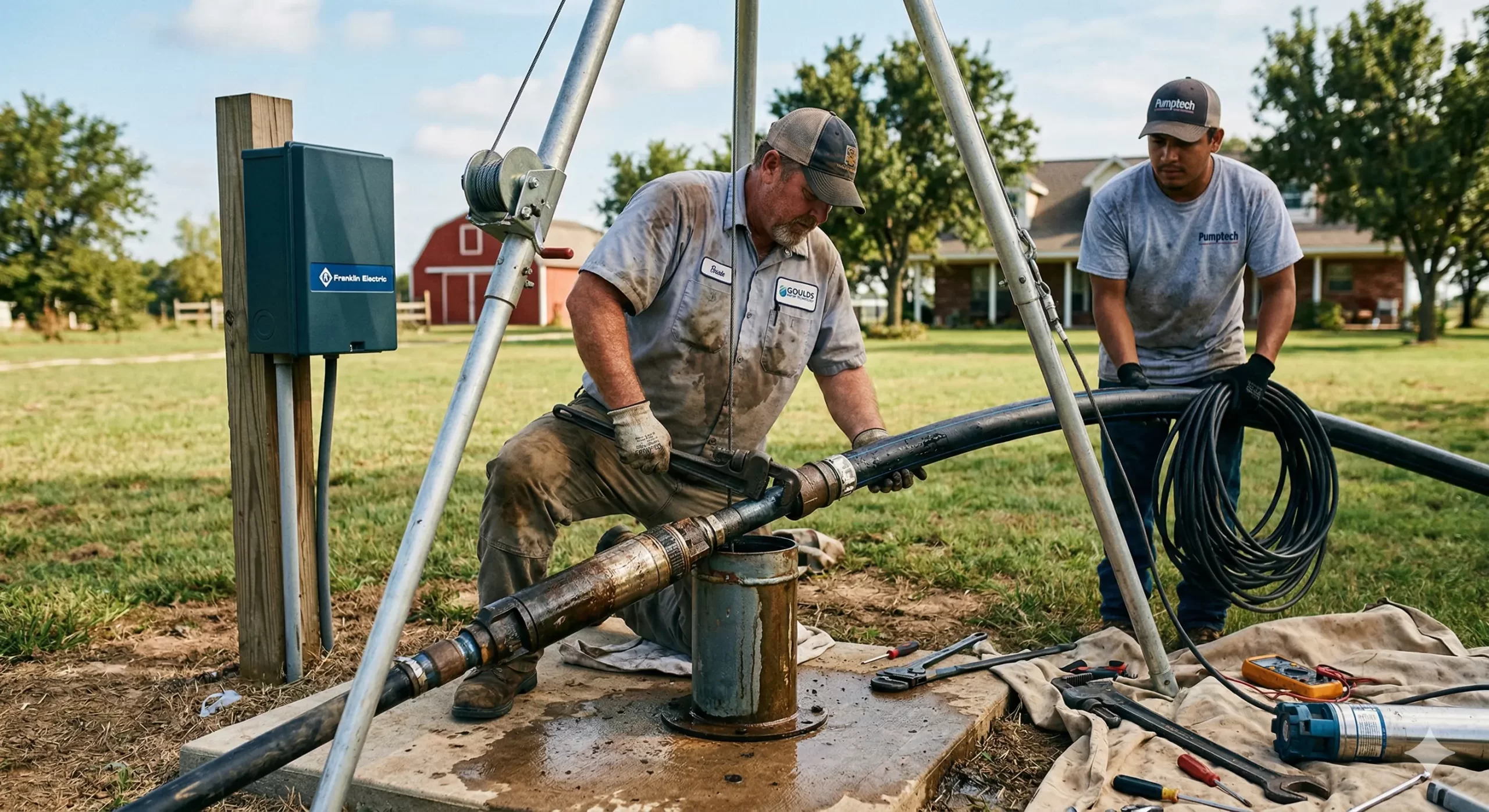
Safety Protocol and Pump Extraction: The process of pulling a deep-set submersible pump is inherently dangerous and requires specialized equipment. The combined weight of the pump, motor, water-filled drop pipe, and heavy-gauge power cable can easily exceed 500 lbs. This is not a job for a pickup truck bumper and a rope. A professional crew uses a purpose-built hydraulic pump hoist or a heavy-duty tripod rig. This equipment provides a stable, controlled pulling force necessary to safely lift the assembly. The technician will first remove the well cap, then use a large ‘pitless key’ or T-handle tool to reach down the casing and disengage the pitless adapter, which is the fitting that connects the pump’s drop pipe to the underground service line. The entire assembly is then slowly and carefully hoisted from the well, with a second technician guiding the pipe and cable to prevent it from snagging on the well casing.
Once the pump is at the surface, a full inspection confirms the failure mode—be it seized bearings, a burnt motor, or a damaged pump end. A new, correctly sized pump and motor are then prepared for installation. This critical stage involves creating a permanent, waterproof connection between the new motor’s leads and the existing submersible cable using a high-quality heat-shrink splice kit. Each conductor is crimped, sealed with adhesive-lined heat shrink tubing, and then covered by a larger outer jacket for total protection. The new pump is then carefully lowered back into the well, the pitless adapter is securely reseated, and the well is sanitized per local health codes. Finally, the system is powered on, and the technician commissions the Intellidrive VFD, programming the exact motor specifications and running the system through its paces to confirm proper amperage draw and performance.
Repair Cost & Time Assessment
The cost for a professional service call to resolve a persistent E-04 fault, culminating in a full pump replacement, typically ranges from $2,500 to $6,000 in the United States. This price is influenced by well depth, pump horsepower, and regional labor rates. The cost can be broken down into several components: an initial diagnostic service call ($250 – $500), which includes the use of specialized tools like a megohmmeter; the labor for two technicians to pull and replace the pump ($800 – $2,000 for 4-6 hours); a dedicated pump hoist usage fee ($300 – $600); and the cost of the new equipment itself, where a high-quality stainless steel submersible pump and motor can range from $1,000 to $3,000+.
The total time on-site for a standard pump replacement job is typically between 4 and 8 hours. This timeline starts from the moment the crew arrives and begins diagnostics. Factors that can extend this duration include extreme well depth (over 300 feet), difficult site access for the pump hoist rig, or complications during the pull, such as a pump that has become stuck in the well casing due to sediment buildup or a broken drop pipe. The final hour is usually dedicated to reinstalling the wellhead, sanitizing the well, and reprogramming the VFD to ensure optimal and efficient operation of the new system.
Fast Local Service & Diagnostics
Calls are routed to a licensed local well professional.