
Diagnosis: A Phase Tech SubMonitor ‘Unb’ fault indicates a significant current difference between the three power phases supplied to your submersible pump motor. This condition, often caused by the utility’s power delivery, can also signal a failing motor winding or a high-resistance electrical connection. Immediate diagnosis is critical to prevent permanent motor burnout and costly replacement.
In this Guide:
What Causes the Phase Tech Display Unb Issue?
A ‘Unb’ fault code on a Phase Tech SubMonitor or VFD is the drive’s self-preservation mechanism, triggered when it detects a current unbalance across the three output phases (T1, T2, T3) feeding the submersible motor. In a perfectly balanced three-phase system, the amperage drawn by each motor winding should be nearly identical. When one or more phases deviate, it induces what are known as ‘negative sequence currents.’ These currents create a counter-rotating magnetic field within the motor’s stator, which effectively works against the primary rotating field. This electromechanical conflict doesn’t just reduce efficiency; it generates enormous amounts of waste heat directly within the stator windings, acting like an internal brake being applied at thousands of RPM.
The primary and most frequent cause of this condition is an unbalanced voltage supply from the electric utility itself. This can be due to a failing transformer on the utility pole, a loose neutral connection miles away, or uneven loading across the local grid. However, the fault can also originate within the user’s system. A high-resistance connection, perhaps from a corroded terminal in a disconnect box or a failing heat-shrink splice down the well, can starve one phase of current. Internally, the motor itself could be failing. A turn-to-turn short within a single winding coil will drastically alter its impedance, causing it to draw a different amount of current than the other two healthy windings, which the VFD will instantly detect.
The consequences of sustained current unbalance are catastrophic for the motor. The excessive heat generated by the negative sequence currents rapidly degrades the winding’s enamel insulation, leading to further shorts and eventual phase-to-ground failure. This thermal stress causes the motor’s copper windings and steel laminations to expand, putting immense pressure on the motor’s precision-engineered journal and thrust bearings, leading to premature wear, increased friction, and eventual seizure. Furthermore, this extreme heat can cook the motor’s internal oil and compromise the rubber components of the mechanical shaft seals. Once these seals fail, well water intrudes into the motor housing, contaminating the oil and ensuring a complete and unrecoverable burnout.
DIY Troubleshooting Steps
- SAFETY FIRST – Power Down: Before any inspection, perform a full electrical lockout. Turn off the dedicated circuit breaker for the pump system. A VFD can store a dangerous electrical charge even when off; wait at least 10 minutes for the internal capacitors to discharge completely.
- Visual Inspection of All Connections: At the VFD control panel and any external disconnects, carefully inspect the incoming line terminals (L1, L2, L3) and the outgoing motor terminals (T1, T2, T3). Look for any signs of overheating, such as discoloration, melted plastic terminal blocks, or bubbled wire insulation. Tighten any connections that may appear loose.
- Measure Incoming Line Voltage Balance: If you are qualified and have a quality multimeter, carefully measure the AC voltage between the incoming phases: L1-to-L2, L2-to-L3, and L1-to-L3. The readings should be within 1-2% of each other. A significant voltage unbalance here points directly to a problem with the utility’s power supply.
- Check VFD Fault Log: Power the unit back on and access the VFD’s fault history menu. The SubMonitor often logs critical data at the time of the trip, such as the exact amperage on each phase. This data is invaluable for a professional technician.
- Inspect for External Overloads: Some installations include a separate magnetic starter or thermal overload relay between the VFD and the motor. Check to see if this device has physically tripped; there is often a small, colored button that needs to be reset.
- Listen for Abnormal Motor Noise: If the pump runs for a short period before tripping, listen for any unusual humming, grinding, or vibration sounds coming from the wellhead. This can indicate bearing wear or mechanical binding that could contribute to an electrical imbalance.
When to Call a Professional Well Service
Upon arrival, a professional technician will confirm the initial voltage readings to rule out the utility supply. Their primary diagnostic step is to completely isolate the submersible motor from the VFD and perform an insulation resistance test using a specialized tool called a Megohmmeter, often referred to by the brand name ‘Megger’. This instrument applies a high DC voltage (typically 500V or 1000V) to the motor leads to measure the resistance of the winding insulation. The technician will test each phase to ground and between each phase (T1-T2, T2-T3, T1-T3). A healthy motor will show readings of hundreds or thousands of megohms; a reading below 2 megohms indicates compromised insulation and a failing motor that must be replaced.
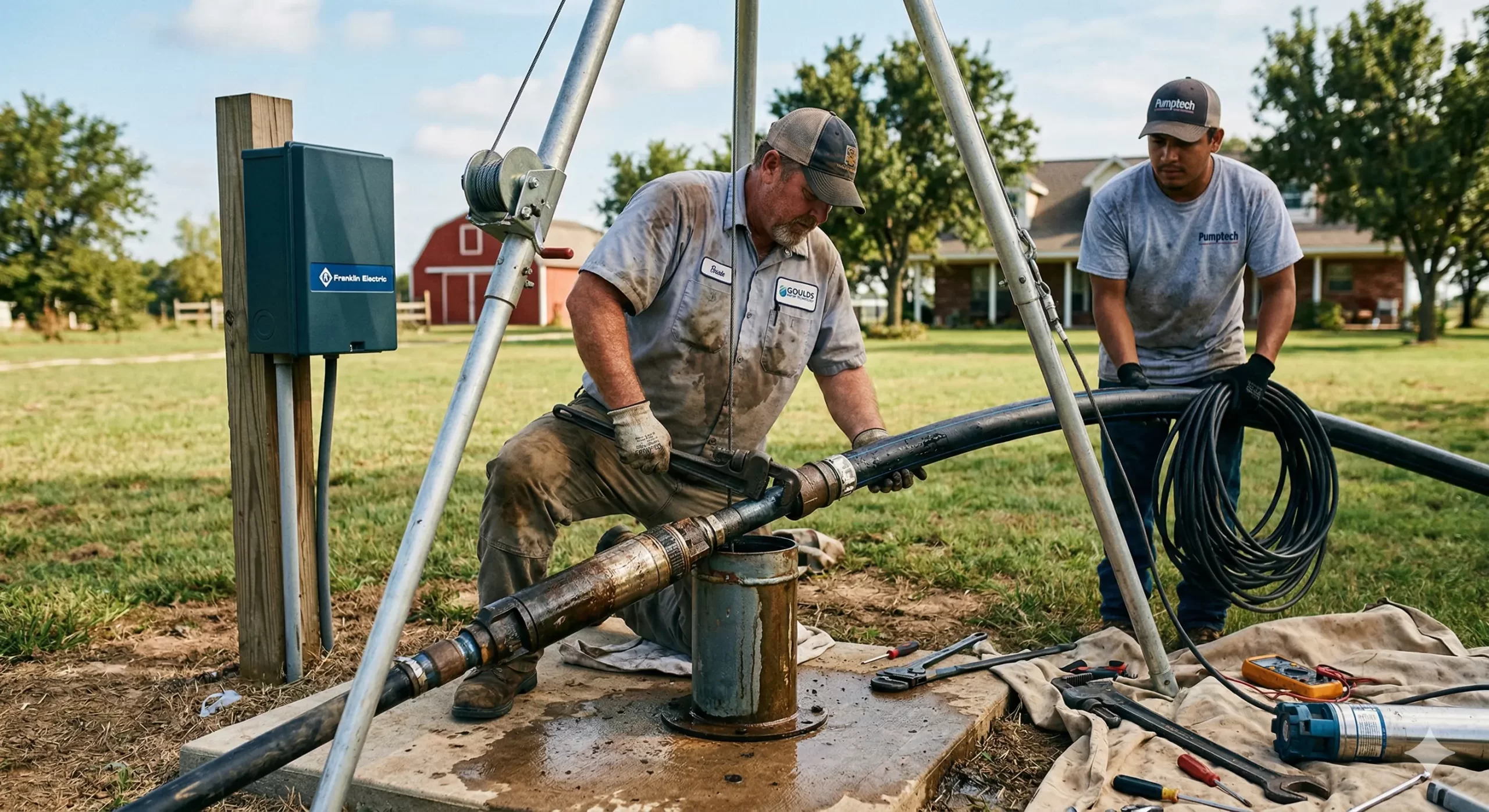
If the megohmmeter test confirms a bad motor, the entire pump and motor assembly must be pulled from the well. This is a labor-intensive process that requires specialized equipment. A heavy-duty truck-mounted **Pump Hoist** or hydraulic pulling rig is essential for safety and to prevent damage to the drop pipe, power cable, and the well casing itself. The technician will use a **Pitless Key**, a long T-handle tool, to securely latch onto and disengage the pitless adapter deep inside the well casing, allowing the entire assembly to be lifted. Once at the surface, the failed motor is disconnected, and the integrity of the heat-shrink splice is closely examined for signs of water ingress, which is a common point of failure.
After replacing the motor and installing a new, high-integrity heat-shrink splice, the technician will perform another megohmmeter test on the new motor and cable before reinstalling it in the well. This verifies the integrity of the new components and the splice work.
Safety Protocol: All work is performed under strict Lockout/Tagout (LOTO) procedures to ensure the circuit cannot be accidentally energized. A 500-pound pump assembly under tension on a hoist presents a significant physical hazard. The work area must be secured, and at least two technicians are required for a safe pull. Attempting to pull a deep-set submersible pump by hand or with an inadequate vehicle is extremely dangerous and can lead to dropping the entire assembly down the well—a multi-thousand-dollar catastrophe.
Repair Cost & Time Assessment
The cost for diagnosing and repairing a ‘Unb’ fault varies significantly based on the root cause. An initial diagnostic service call from a qualified pump technician or electrician typically ranges from $250 to $500. This fee covers the technician’s travel time and 1-2 hours of expert on-site troubleshooting, including voltage balance checks and the critical megohmmeter testing to determine the health of the downhole motor and wiring.
If the diagnosis points to a failed motor requiring the pump to be pulled, the cost escalates substantially. A full pump pull and motor replacement job typically costs between $1,800 and $4,500+. This comprehensive price reflects several factors: 4-6 hours of labor for two technicians, a mobilization fee for the specialized pump hoist truck (often $500-$800 alone), the cost of the new 3-phase submersible motor (which can be $800-$2,000+ depending on horsepower and brand), and premium materials like a new heat-shrink splice kit. If the problem is simply an unbalanced utility supply confirmed by the technician, the initial diagnostic fee is the only cost from the pump company; the subsequent repair is the responsibility of the power utility.
Fast Local Service & Diagnostics
Calls are routed to a licensed local well professional.