
Diagnosis: An ‘O_C’ (Over Current) fault on a Phase Tech SubMonitor indicates the motor’s current draw has critically exceeded its Service Factor Amps (SFA) rating. This is a protective shutdown caused by severe mechanical binding in a worn pump or a catastrophic electrical failure, such as degraded and shorted motor windings. Professional diagnosis with a megohmmeter is required before pulling the pump for replacement.
In this Guide:
What Causes the Phase Tech Display O_C Issue?
The ‘O_C’ or Over Current fault is a critical protective function of your Phase Tech Variable Frequency Drive (VFD). It signifies that the electrical current demanded by the submersible motor has surpassed the pre-programmed Service Factor Amps (SFA) limit. This SFA value, found on the motor’s nameplate, represents the maximum load the motor can handle for short durations without sustaining immediate damage. When the VFD detects amperage exceeding this threshold, it instantly cuts power to prevent a catastrophic motor burnout. The root cause is always the same: the motor is being forced to work harder than its design specifications allow, converting excessive electrical energy into wasted heat and torque against an unmovable load. This is not a transient nuisance trip; it is a clear signal of a severe underlying issue either in the pump’s mechanical assembly (the wet end) or the motor’s electrical integrity.
From a mechanical perspective, the most common culprit is advanced wear and seizure within the pump’s wet end. Over years of service, internal components degrade. The thrust bearings, responsible for handling the immense downthrust of the water column, can fail, causing the impeller stack to drop and grind against the diffuser stages. Similarly, radial bearings can wear out, allowing the shaft to wobble and create metal-on-metal contact. In wells with high sediment or mineral content, sand can infiltrate the tight tolerances between impellers, effectively locking them in place. This mechanical binding creates immense rotational resistance. When the VFD commands the motor to start, it attempts to draw a massive inrush of current to overcome this seizure, instantly exceeding the SFA limit and triggering the O_C fault.
Electrically, an Over Current fault is often the final act of a dying motor. The stator windings inside the submersible motor are coated with a thin layer of enamel insulation. Over a decade or more of thermal cycling (heating during operation, cooling when off), voltage fluctuations from the grid, and potential chemical attack from aggressive well water, this insulation becomes brittle and cracks. These micro-fractures allow for winding-to-winding or winding-to-ground short circuits. When a short occurs, electricity takes a path of near-zero resistance, causing a virtually instantaneous and limitless surge in current draw. The VFD’s sensors detect this spike in microseconds and shut the system down. This is a hard fault, indicating permanent, non-recoverable damage to the motor itself. The motor is effectively ‘shorted out’ and must be replaced.
DIY Troubleshooting Steps
- Perform a Hard Power Cycle: Turn off the circuit breaker supplying the VFD for at least 5 minutes. This allows all capacitors to discharge and clears any transient fault logic. Turn it back on and observe if the fault returns immediately upon the pump being called to run. An instant fault typically points to a permanent hardware failure.
- Verify VFD SFA Programming: Access the VFD’s programming menu and verify that the ‘Service Factor Amps’ or ‘Max Current’ parameter matches the SFA value printed on your motor’s original nameplate or installation record. Incorrect programming can cause nuisance trips, although a persistent O_C fault is rarely a programming error alone.
- Inspect All Surface Wiring Connections: With the power OFF at the breaker, open the VFD cover, the wellhead cap, and any junction boxes. Check for tight, clean, and corrosion-free connections on all power and motor leads. A loose connection acts as a high-resistance point, causing voltage drops and subsequent increases in current.
- Measure Incoming Line Voltage: Using a true RMS multimeter, carefully measure the incoming voltage at the L1 and L2 terminals of the VFD. The voltage should be stable and within 10% of the nominal rating (e.g., 230-240V). A significant voltage imbalance or chronic low voltage will force the motor to draw more current to produce the required horsepower.
- Check for Short Cycling: Observe the system’s behavior. If the pump runs for very short periods (under one minute), this indicates a problem with the pressure tank’s air charge or a failing check valve. Constant starting and stopping puts immense thermal and electrical stress on the motor, which can lead to an Over Current condition over time.
- Bypass the Pressure Switch (Advanced Users Only): If you are confident in your electrical skills, you can temporarily bypass the pressure switch to rule it out as a source of chattering or poor contact that might confuse the drive. If the O_C fault persists with a direct VFD start command, the switch is not the issue.
When to Call a Professional Well Service
Upon arrival, a certified technician’s first step is a definitive electrical diagnosis from the surface, which avoids prematurely pulling the pump. The primary tool for this is a Megohmmeter, often called a ‘megger’. Unlike a standard multimeter, a megger applies a high voltage (typically 500V or 1000V) to test the motor winding’s insulation resistance. The technician disconnects the motor leads from the VFD and connects the megger to test resistance between each leg (U, V, W) and ground. A healthy motor will show readings of over 100 megohms (MΩ); a reading below 2 MΩ indicates compromised insulation and condemns the motor. This test provides irrefutable proof of a downhole electrical failure, confirming the O_C fault’s origin before any heavy lifting begins.
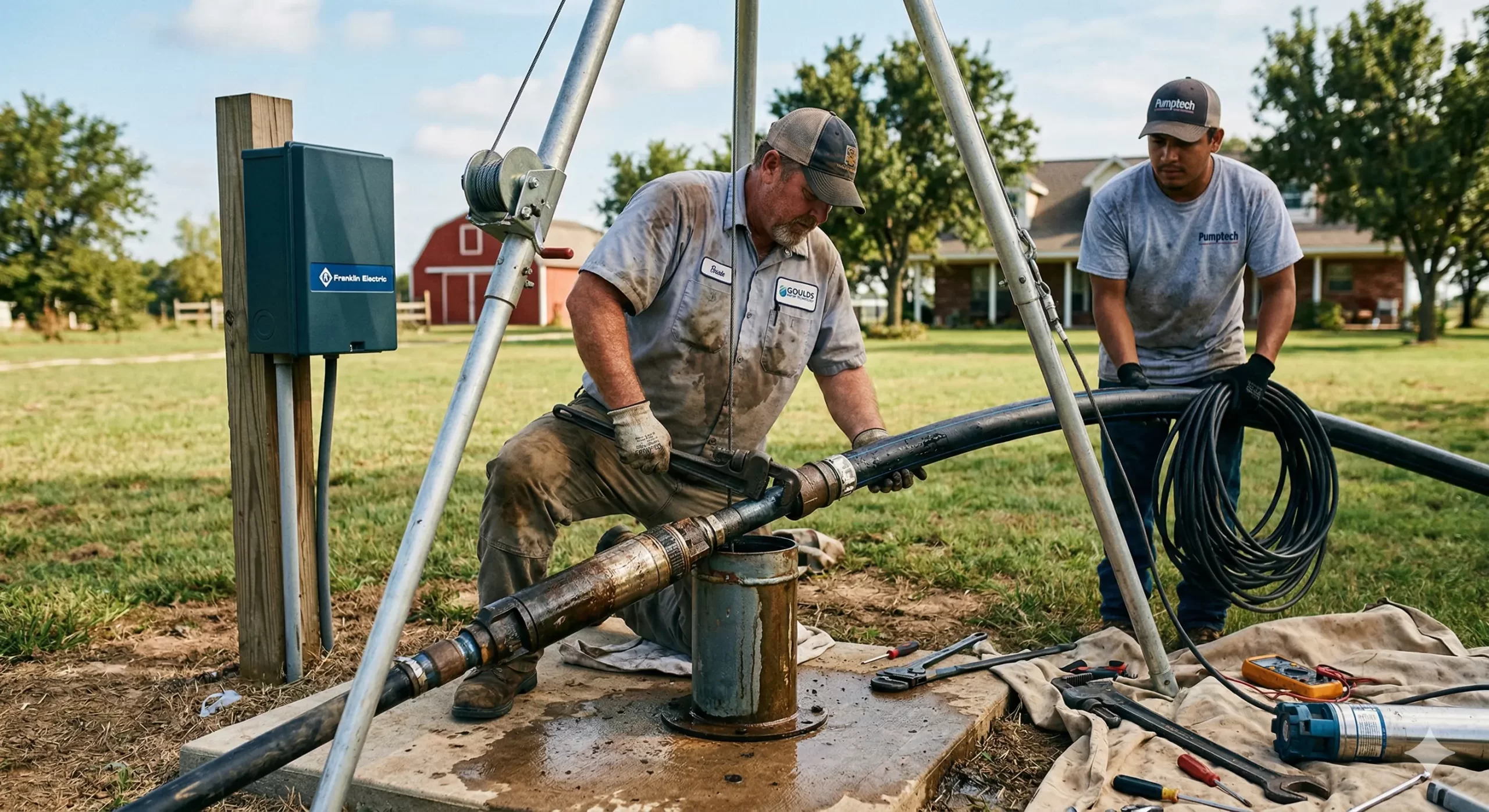
Once the motor is condemned, the mechanical extraction process begins. This is a high-risk operation that demands specialized equipment. For a typical 4-inch or larger submersible pump, which can weigh over 100 pounds and be attached to hundreds of feet of water-filled pipe (adding several hundred more pounds), a dedicated Pump Hoist or pulling rig is non-negotiable. The technician will first secure the rig over the wellhead. Then, using a specialized Pitless Adapter Key—a long T-handle tool—they will reach down the casing to engage the adapter and disengage the entire drop pipe assembly from the side of the well casing. The hoist is then used to carefully and methodically lift the pump, drop pipe, and motor wire out of the well, section by section.
With the pump on the surface, the technician performs the replacement. This involves cutting the old motor off, installing a new, correctly sized submersible motor, and making a permanent, waterproof electrical connection using a high-quality heat-shrink splice kit. This splice is the most critical part of the re-installation; a failed splice will cause a ground fault and ruin the new motor. After the new motor is attached, the entire assembly is lowered back into the well, guided carefully to prevent damage to the wire, and re-seated into the pitless adapter. The system is then re-energized, and the VFD is reprogrammed if necessary.
Safety Protocol: All work is performed only after verifying a complete electrical lockout/tagout at the breaker panel. The 240V potential is lethal. The sheer weight of the pump assembly poses a significant crush hazard. The pump hoist must be properly rated and secured. Attempting to pull a deep-set pump by hand is extremely dangerous and risks dropping the entire assembly—a catastrophic and costly event.
Repair Cost & Time Assessment
The professional replacement of a submersible motor and pump is a significant investment, typically ranging from $1,800 to $4,500 in the United States. This price spectrum is influenced by several key factors. The primary cost driver is the pump and motor itself; a 1.5 HP stainless steel unit for a 300-foot well will be substantially more expensive than a 1/2 HP unit for a 100-foot well. Labor costs for a two-person crew for 4 to 8 hours are also a major component. Deep wells (over 300 feet) require more time, more materials (drop pipe and wire), and more physical effort, increasing the labor charge.
Customers are paying for a comprehensive service that includes specialized expertise and equipment. The final invoice will typically itemize: labor hours, a surcharge for the use of the pump hoist/pulling rig (often $200-$400), the cost of the new motor (and pump wet end if replaced), feet of new submersible drop wire, and miscellaneous parts like torque arrestors, new check valves, and the heat-shrink splice kit. Opting for premium, US-made components will be at the higher end of the cost spectrum but often provides a longer service life and better warranty, representing a better long-term value than cheaper, imported alternatives. Emergency or after-hours service calls will also incur a significant premium.
Fast Local Service & Diagnostics
Calls are routed to a licensed local well professional.