
Diagnosis: A U_C (Under Current) fault on a Phase Tech SubMonitor VFD indicates the pump motor is no longer under a proper water load. This is typically caused by the well running dry, which starves the pump, or a catastrophic mechanical failure like a broken pump shaft. Immediate diagnosis is critical to prevent permanent motor damage.
In this Guide:
What Causes the Phase Tech Display U_C Issue?
An ‘Under Current’ (U_C) fault on a sophisticated Variable Frequency Drive (VFD) like the Phase Tech SubMonitor is an intelligent protective trip. It signifies that the motor is drawing significantly less amperage than its programmed minimum load threshold. In the physics of pump systems, motor amperage draw is directly proportional to the mechanical load—the work of lifting a heavy column of water. When the pump loses this hydraulic load, the work required plummets. The VFD, which constantly monitors current, interprets this sharp drop as an abnormal condition. It shuts the system down to prevent the motor from over-speeding in a no-load scenario and to protect the pump end from the catastrophic damage caused by running dry.
The most common cause is a ‘dry run’ condition. This occurs when the well’s static water level drops below the pump’s intake screen, often due to drought, over-pumping, or a decline in the well’s yield. When the pump begins to draw in air instead of water, it loses its means of lubrication and cooling. Water is essential for lubricating the impeller shaft bearings and cooling the motor windings. Without it, the heat generated by the spinning motor cannot dissipate. This extreme heat can cause the motor’s internal winding insulation to degrade and fail, leading to an electrical short. Simultaneously, the mechanical shaft seals, which rely on water for lubrication, can overheat and fail, allowing water to intrude into the motor housing and causing irreversible damage.
A second, more severe cause is mechanical decoupling, most commonly a broken pump shaft or a sheared motor coupling. In this scenario, the motor itself is electrically sound and receiving power from the VFD, but its rotational energy is not being transferred to the pump’s impeller stack. The motor spins freely against zero load, resulting in a minimal amperage draw that immediately triggers the U_C fault. This type of failure can result from long-term metal fatigue, corrosion, or a sudden seizure of the pump end that creates torque exceeding the shaft’s shear strength. While the VFD’s shutdown protects the motor from further electrical stress, the underlying mechanical failure requires a complete pump replacement.
DIY Troubleshooting Steps
- Safely Power Cycle the System: Turn off the dedicated two-pole breaker for the pump system for at least 5 minutes before turning it back on. This resets the VFD’s logic. Observe if the U_C fault appears instantly on the restart attempt or after a period of running, which provides a crucial diagnostic clue.
- Monitor Real-Time Amperage on the VFD Display: During a brief, supervised restart, watch the live amperage reading on the SubMonitor display. A healthy pump under load will draw a stable, significant current (e.g., 8-12 amps). A system faulting on U_C will show the current drop to an abnormally low level (e.g., 2-4 amps) just before the trip.
- Listen for Abnormal Sounds at the Well Head: Place your ear near the well cap. A healthy pump system produces a consistent, low hum of the motor and the sound of flowing water. A pump cavitation (pumping air) will often produce a higher-pitched whining or gurgling noise. A motor with a broken shaft will sound like a very smooth, quiet, unloaded motor with no associated sound of water movement.
- Review the VFD Fault Log: Consult the Phase Tech SubMonitor manual to access the fault history. Look for a pattern of recurring U_C faults. Note if any other faults, such as Over/Under Voltage (OV/UV), are also logged, as this could point to a power supply issue rather than a pump problem.
- Check Your Pressure Tank and Switch: Ensure the pressure tank has the correct air pre-charge (typically 2 PSI below the pressure switch’s cut-in setting). A waterlogged tank can cause rapid cycling, which can stress the pump system, though it doesn’t directly cause a U_C fault, it can be a related symptom of system distress.
- Evaluate Well Recovery Rate: If the pump runs for a few minutes and then faults, the well may be unable to replenish water as fast as the pump removes it. Turn the system off for 1-2 hours to allow the well to recover. If the pump runs again for a similar duration before faulting, it’s a strong indication of a low well yield issue.
When to Call a Professional Well Service
Upon arrival, a professional technician’s first step is comprehensive electrical diagnostics at the well head, performed with the power safely locked out. Using a high-grade digital multimeter and a clamp-on ammeter, they will verify voltage supply and compare real-world amperage readings to the VFD’s display. The most critical diagnostic tool employed is a Megohmmeter, or ‘Megger’. This instrument applies a high voltage (500V-1000V) to the motor windings and drop cable to measure insulation resistance to ground. A reading in the hundreds or thousands of megaohms indicates a healthy motor and cable. A low reading signals a breach in the winding insulation or a failed heat-shrink splice, which means the motor is shorting to ground and must be replaced.
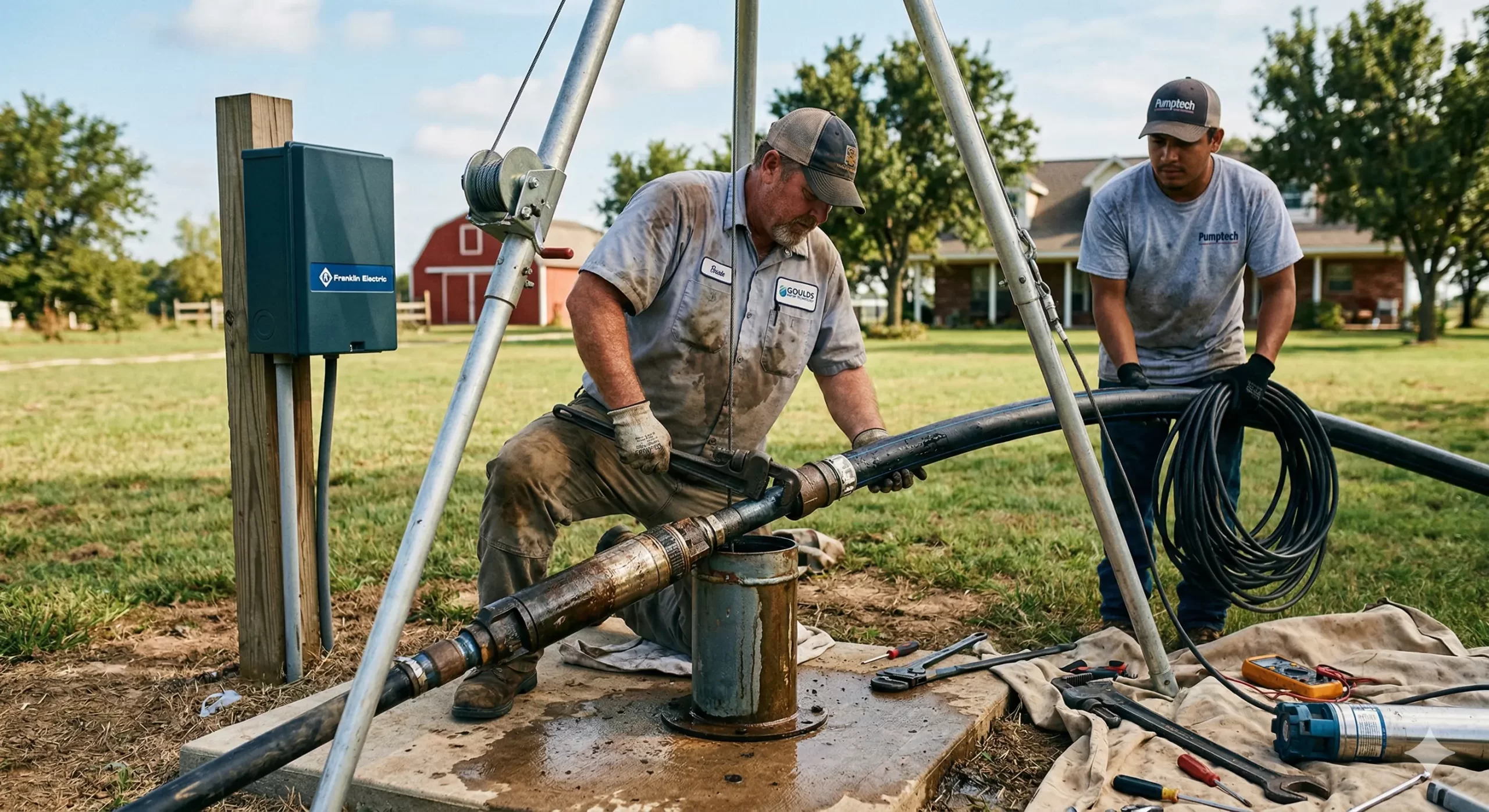
If all electrical tests pass, the problem is confirmed to be either a dry-running well or a mechanical failure within the pump/motor assembly. The technician will then use an electronic water level meter (a ‘well sounder’) to determine the precise static water level inside the casing. If this level is found to be below the pump’s known setting depth, the well has run dry. If the water level is sufficient, a broken shaft is the almost certain diagnosis. In either case, the pump must be pulled from the well. This is a non-negotiable task for a professional pump hoist or pulling rig. These specialized hydraulic or electric winches are designed to handle the immense weight of hundreds of feet of pipe, wire, and a water-filled pump, which can easily exceed 500 lbs.
With the pulling rig securely positioned over the well, the technician uses a T-handle pitless key to engage and unlock the pump assembly from the pitless adapter inside the well casing. They then methodically hoist the pump, laying out the drop pipe and submersible cable for inspection. Once on the surface, a physical inspection confirms the root cause. A seized impeller stack that cannot be turned by hand points to damage from dry-running. Conversely, if the motor shaft can be spun freely without turning the pump’s impellers, the shaft is broken. The solution is the replacement of the entire pump and motor unit, installation of new torque arrestors, and the meticulous creation of a new waterproof heat-shrink splice to connect the new motor to the existing drop cable.
Safety Protocol
This is not a DIY project. A residential well pump system operates on a lethal 240-volt circuit. The VFD contains large capacitors that can store a dangerous electrical charge even after power is disconnected. Furthermore, the mechanical risks are severe; the stored energy in a taut winch line or the potential for a dropped pump assembly weighing hundreds of pounds presents a life-threatening hazard. Only licensed and insured professionals with the proper rig, electrical test equipment, and safety training should ever attempt to pull a submersible pump.
Repair Cost & Time Assessment
The cost for a professional diagnosis and replacement of a submersible well pump ranges from $1,800 to $4,500 in most US markets. This comprehensive price reflects the skilled labor, specialized equipment, and high-quality components required. A typical invoice will include a service call fee for initial diagnostics ($150 – $350), a significant labor charge covering 2 technicians for 4 to 8 hours ($800 – $1,500), and an equipment fee for the use of the pump hoist, megohmmeter, and other specialty tools ($300 – $600). The largest variable is the cost of the replacement pump and motor assembly, which can range from $900 for a standard residential unit to over $2,500 for a high-horsepower or stainless steel model from premium brands like Franklin Electric or Grundfos.
Several factors can influence the final cost. Well depth is the primary driver of labor time; a 500-foot well is significantly more work than a 100-foot well. Difficult site access that complicates setting up the pump hoist can also increase labor hours. If inspection reveals that the submersible drop cable or poly drop pipe has been damaged, those replacement material costs will be added to the total. Most scheduled pump replacements can be completed within a single business day (4-8 hours). However, emergency, after-hours, or weekend service calls will incur a premium rate, potentially adding 25-50% to the labor cost.
Fast Local Service & Diagnostics
Calls are routed to a licensed local well professional.