
Diagnosis: Water squirting from the Schrader air valve on your well’s pressure tank is a definitive sign of a ruptured internal bladder. This failure eliminates the tank’s air cushion, causing the pump to short-cycle violently, which can quickly destroy the pump motor and bearings. The only correct repair is to replace the pressure tank and properly set the new pre-charge pressure.
In this Guide:
What Causes the Pressure Gauge Water squirts from air valve Issue?
The operational principle of a modern bladder-style hydropneumatic tank relies on the absolute separation of water and a captive volume of pressurized air, which acts as a compressible spring. This air cushion, or ‘pre-charge,’ allows the system to store a significant volume of pressurized water (the ‘drawdown’) so the pump doesn’t have to run every time a faucet is opened. When the flexible butyl or vinyl bladder develops a tear due to age, chlorine degradation, or manufacturing defect, this critical separation is lost. System water bypasses the bladder and floods the air-side of the tank, a condition known as being ‘waterlogged.’ Because water is virtually incompressible, the tank’s ability to store pressure is completely eliminated. The slightest use of water causes an immediate pressure drop, forcing the pressure switch to engage the pump instantly.
This failure mode induces a catastrophic condition known as ‘short-cycling.’ Instead of running for a minute or more to replenish the tank’s drawdown, the pump will turn on and off in rapid succession, sometimes every few seconds. Electrically, this is devastating to the pump motor. Each startup demands a massive inrush current, often 5-7 times the motor’s full load amperage (FLA). This surge generates extreme heat in the motor windings. The motor’s thermal overload protection will trip, but repeated, frequent tripping fatigues the winding insulation, leading to delamination, inter-winding shorts, and ultimately, a complete motor burnout. The repeated starting torque and mechanical shock also inflict severe stress on the motor’s thrust bearings, which are designed for continuous runs, not high-frequency stop/start cycles, leading to premature mechanical seizure.
Beyond the motor itself, the shockwaves from short-cycling propagate throughout the entire plumbing system. The rapid pressure fluctuations create a form of hydraulic shock, or water hammer, that stresses every pipe joint, valve, and fixture. For the submersible pump down in the well, this constant mechanical jarring and pressure pulsation can compromise the motor’s shaft seals. These seals are vital for keeping well water out of the oil-filled motor housing. Once breached, water intrusion contaminates the dielectric oil, shorts the windings from within, and causes a complete, unrepairable failure of the motor. What begins as a simple tank failure quickly cascades into a full system catastrophe if not addressed immediately.
DIY Troubleshooting Steps
- Safety-First Power Isolation: Before any inspection, locate the two-pole circuit breaker labeled ‘Well Pump’ or similar in your main electrical panel and switch it to the ‘OFF’ position. Use a non-contact voltage tester or a multimeter at the pressure switch terminals to absolutely verify that all 240V power to the system has been cut. Never proceed without this confirmation.
- The Definitive Air Valve Test: With the pump de-energized, open a nearby faucet to relieve any residual system pressure. Using a small screwdriver or a tire pressure gauge, briefly depress the pin inside the Schrader valve on top of the pressure tank. A puff of air is normal. A spray or gush of water, even a small amount, is an unequivocal confirmation that the internal bladder has failed.
- Monitor Pump Cycle Time: Restore power briefly and observe the pump’s behavior. Open a faucet and watch the pressure gauge. A healthy system will see the pump run for 60 seconds or more to build pressure. A system with a ruptured bladder will cause the pump to turn on and off in less than 15 seconds, often as rapidly as every 2-3 seconds. Immediately turn the pump off at the breaker to prevent further damage.
- Check Amperage Draw (Advanced): For those comfortable and trained in using electrical test equipment, a clamp-on ammeter can provide further evidence. Clamp the meter around one of the two hot wires feeding the pressure switch. A motor subjected to short-cycling will show a high inrush current every few seconds, often exceeding its nameplate FLA rating as it struggles against a waterlogged system.
- Inspect the Pump Control Box: Locate the pump’s control box (a separate grey or black box, common for 3-wire pumps). Many contain a manual reset button for the thermal overload protection. If this button has tripped, it is a critical warning sign that the motor has been severely overheating due to short-cycling. Do not repeatedly reset this without fixing the root cause (the tank).
- Feel for Tank Temperature Differential: On a healthy tank, the lower portion containing water will feel cooler than the upper portion containing air. On a completely waterlogged tank, the entire surface will often have a uniform temperature, as it is completely full of water.
When to Call a Professional Well Service
A professional technician’s workflow begins with confirming the diagnosis and assessing for collateral damage before any parts are replaced. The first step is to verify water at the air valve. The second, and most critical, is to perform an insulation resistance test on the pump motor using a megohmmeter (or ‘megger’). By sending a high-voltage, low-current signal down the electrical lines, the megger can detect microscopic breaches in the motor winding insulation. This test definitively determines if the short-cycling has already destroyed the submersible pump motor, preventing the costly mistake of installing a new tank on a pump that is destined to fail. If the motor tests weak or shorted, the job escalates significantly.
If the pump motor tests healthy, the technician proceeds with the tank replacement. The job starts with a full lockout/tagout of the 240V circuit. The plumbing system is isolated and completely drained. The failed tank, now full of water and weighing potentially hundreds of pounds, must be carefully maneuvered and removed to prevent injury or property damage. The technician then prepares the piping, cleaning all threads and applying new, high-grade Teflon tape and pipe dope. The new professional-grade tank (e.g., an Amtrol Well-X-Trol) is installed, ensuring all connections are mechanically sound and leak-free.
Safety Protocol: The combination of a 240V high-amperage circuit and a pressurized water vessel demands strict safety adherence. All electrical work must assume the circuit is live until proven otherwise with a meter. Capacitors within the control box can hold a dangerous charge and must be safely discharged. Lifting and moving a heavy waterlogged tank requires proper technique and sometimes a second technician to prevent strain injuries or damage to surrounding plumbing.
The final and most crucial step is calibrating the new tank’s air pre-charge. With the system still empty of water, the technician uses a quality air compressor and a low-pressure gauge to set the internal air pressure to exactly 2 PSI below the pump’s pressure switch cut-in setting (e.g., for a 40/60 PSI switch, the pre-charge is set to 38 PSI). This precise calibration is non-negotiable for ensuring a proper drawdown and preventing future short-cycling. Once calibrated, the system is slowly refilled, checked for leaks, and the pump’s cycle time and amperage are monitored through several full cycles to certify a successful and lasting repair.
Repair Cost & Time Assessment
For a straightforward pressure tank replacement by a qualified well technician or plumber, a homeowner in the United States should budget between $850 and $1,600. This price range typically includes a high-quality, professional-grade pressure tank (which can cost $350-$700 alone), all necessary brass fittings, pipe, and materials, and 2-4 hours of skilled labor. The final cost is influenced by the size and type of tank required, the accessibility of the installation site, and prevailing regional labor rates.
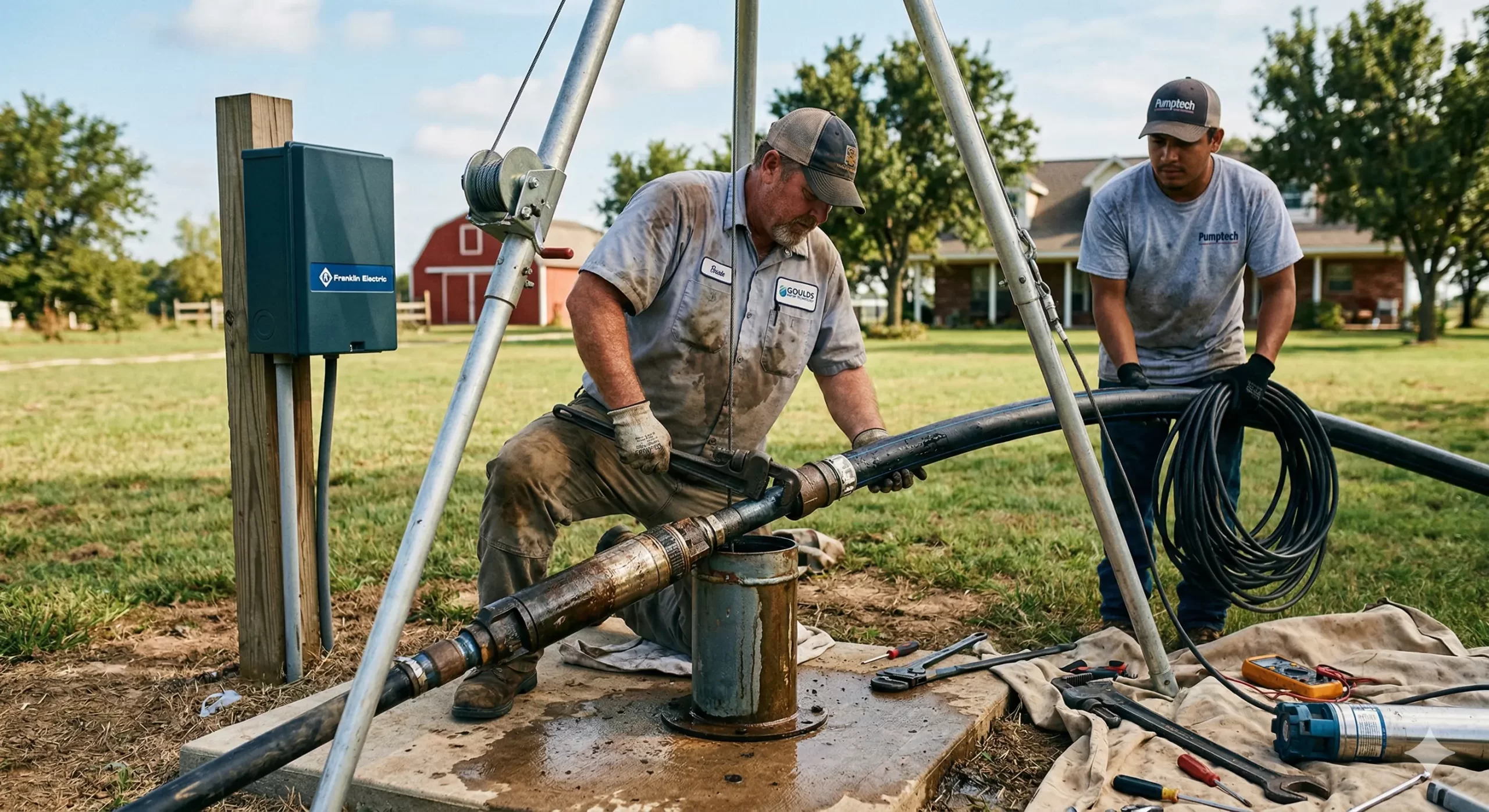
The cost can increase if the diagnostic process reveals collateral damage caused by the initial failure. Replacing a damaged pressure switch, gauge, or associated wiring could add $200-$450 to the final invoice. The most significant cost escalation occurs if the megohmmeter test shows the pump motor has failed. A full submersible pump replacement is a far more involved and expensive job, typically ranging from $2,800 to $6,500+. This major repair requires a specialized pulling rig or pump hoist to lift hundreds of pounds of pipe, wire, and pump from the well, a new pump and motor, and often a full day of labor by a two-person crew.
Fast Local Service & Diagnostics
Calls are routed to a licensed local well professional.