
Diagnosis: A clicking Red Jacket control box typically indicates a failed start capacitor or a faulty start relay. This failure prevents the submersible motor from achieving proper rotational torque, causing it to draw excessive current and repeatedly trip its thermal overload protector. This guide explains the causes and repair procedures.
In this Guide:
What Causes the Red Jacket Control Box Clicking Issue?
The signature clicking sound from a Red Jacket WaterBear control box is the audible symptom of a failed start sequence, almost always rooted in the start capacitor or the potential relay. The start capacitor’s primary function is to create a phase-shifted electrical field for the motor’s start winding. This engineered phase difference generates the initial rotational torque required to overcome the static inertia of the pump assembly and the water column. Over time, the dielectric material inside the capacitor degrades due to voltage spikes, excessive heat from its location (e.g., a sun-beaten wall), or simple component aging. When it fails, it can no longer hold the necessary charge (measured in microfarads, µF). Without this charge, the motor’s start winding receives insufficient energy, causing the motor to hum and draw Locked Rotor Amps (LRA)—a current draw five to seven times its normal operating amperage. This massive inrush of current immediately trips the thermal overload, causing the ‘click’. After a brief cooling period, the overload resets, the relay tries again, and the cycle repeats.
Simultaneously, the start relay is the electromechanical switch that controls this entire process. When power is called for, the relay’s coil energizes, closing a set of contacts that connect the start capacitor into the motor circuit. This should only last for a fraction of a second until the motor reaches about 75% of its rated RPM. A voltage generated by the running motor then forces the relay to ‘pick up’ and open the start circuit contacts. However, the intense arcing caused by switching high-amperage starting currents can weld these contacts together (‘sticking’). If the relay sticks closed, the start winding and capacitor remain energized continuously. This condition will catastrophically overheat and destroy the motor windings in minutes. Conversely, if the relay coil fails or the contacts become too pitted to make a good connection, the start circuit never engages, leading to the same stalled, high-amperage condition as a failed capacitor.
The consequences of these control box failures extend deep into the well casing, directly impacting the submersible motor. Each failed start attempt sends a surge of LRA current down the wires, generating immense heat in the motor’s hermetically sealed windings. This heat rapidly degrades the winding’s enamel insulation, creating the potential for shorts between windings or a direct short to the motor’s steel casing (a ground fault). Furthermore, the violent electrical and magnetic forces exerted on the stalled motor shaft put extreme axial and radial stress on the thrust bearings. These bearings are designed for smooth rotation, not for absorbing the repeated, hammering torque of a failed start. Over time, this stress can lead to bearing failure, shaft misalignment, and ultimately, damage to the internal mechanical seals that keep motor oil in and well water out.
DIY Troubleshooting Steps
- SAFETY SHUTDOWN AND VISUAL INSPECTION: Before any inspection, locate the double-pole circuit breaker labeled ‘Well Pump’ in your main electrical panel and switch it to the OFF position. At the pump control box, use a non-contact voltage tester or a multimeter to verify ZERO voltage is present on the incoming power terminals (L1 and L2). Once confirmed safe, visually inspect the interior. Look for a start capacitor with a bulging top or leaking oily residue, which signifies immediate failure. Check for any black, sooty marks on or around the relay, indicating electrical arcing and component burnout.
- OBSERVE THE FAILURE CYCLE: From a safe distance, have a helper turn the breaker back ON. Listen carefully. A classic failure cycle is a loud ‘thump’ from the pressure switch engaging, followed by a ‘hum’ from the control box, and then a sharp ‘click’ as the thermal overload trips. The system will go silent for 30 seconds to a few minutes, and then the cycle will repeat. This repetitive nature confirms a start-circuit failure rather than a one-time issue.
- CHECK THE PRESSURE SWITCH CONTACTS: With the breaker OFF and power verified as dead, remove the cover from your pressure switch. Inspect the two main electrical contacts. They should be clean and silver-colored. If they are severely pitted, blackened, or appear welded together, they may be delivering erratic or insufficient voltage to the control box, which can mimic a capacitor failure.
- MANUAL OVERLOAD RESET: Some control boxes, particularly older models, feature a small, often red, manual reset button for the thermal overload. With the power OFF, press this button firmly. If it clicks, it may have been a nuisance trip. Attempt to start the system one more time. If it trips again immediately, you have a hard fault.
- FEEL FOR CAPACITOR/RELAY HEAT: Immediately after a failed start attempt, shut off the breaker and carefully (as components can be hot) feel the top of the start capacitor and the body of the relay. Excessive heat in either component points directly to the likely source of failure. A hot capacitor is struggling to discharge into a faulty circuit, while a hot relay indicates excessive current passing through it.
- ADVANCED – CLAMP-ON AMPERAGE TEST: This step is for experienced individuals comfortable working around live 240V circuits. With the system running (or attempting to), use a clamp-on ammeter around one of the two ‘hot’ wires leading from the control box down to the well. During a failed start, you will observe a sustained high amperage reading that matches or exceeds the LRA rating on the motor plate, which does not drop to the normal Full Load Amp (FLA) rating before the overload trips. This confirms the motor is receiving power but cannot start.
When to Call a Professional Well Service
A certified pump technician’s diagnostic process is methodical and prioritizes safety and accuracy to avoid unnecessary, expensive repairs. Upon arrival, the technician will first confirm the homeowner’s complaint and perform their own LOTO (Lockout/Tagout) on the circuit breaker. The initial step inside the control box is not to replace parts, but to test them. Using a digital multimeter with a capacitance function, they will test the start capacitor’s microfarad (µF) rating, comparing it to the manufacturer’s specification printed on the component. A reading more than 10% below the specified value indicates a weak capacitor that requires replacement. The most critical test, however, involves a megohmmeter (often called a ‘Megger’). This instrument applies a high voltage (500-1000V) at a very low current to test the integrity of the motor winding insulation. By testing the resistance between the motor leads and ground, the technician can definitively determine if the motor downhole is shorted out. A healthy motor will show readings of several hundred megohms or more; a failed motor will read near zero. This test is the dividing line between a simple control box repair and a major pump replacement job.
Safety Protocol & Repair Execution: The paramount safety procedure before touching any internal components is to discharge the start capacitor. Even with the power off, a capacitor can store a lethal electrical charge. A technician will use a high-wattage resistor tool or a heavy-duty, insulated screwdriver to safely bridge the capacitor’s terminals, discharging it completely. Only then is it safe to proceed. The physical replacement involves carefully documenting the wiring, removing the old capacitor or relay, and installing a new, OEM-specified component. Using a generic part with the wrong voltage or µF rating can lead to poor performance or immediate failure. Once the new component is installed and wiring is double-checked, the technician will power up the system and take critical amperage readings. They will measure the start-up amperage spike and, more importantly, the running amperage, ensuring it aligns with the motor’s FLA rating under the well’s specific load conditions.
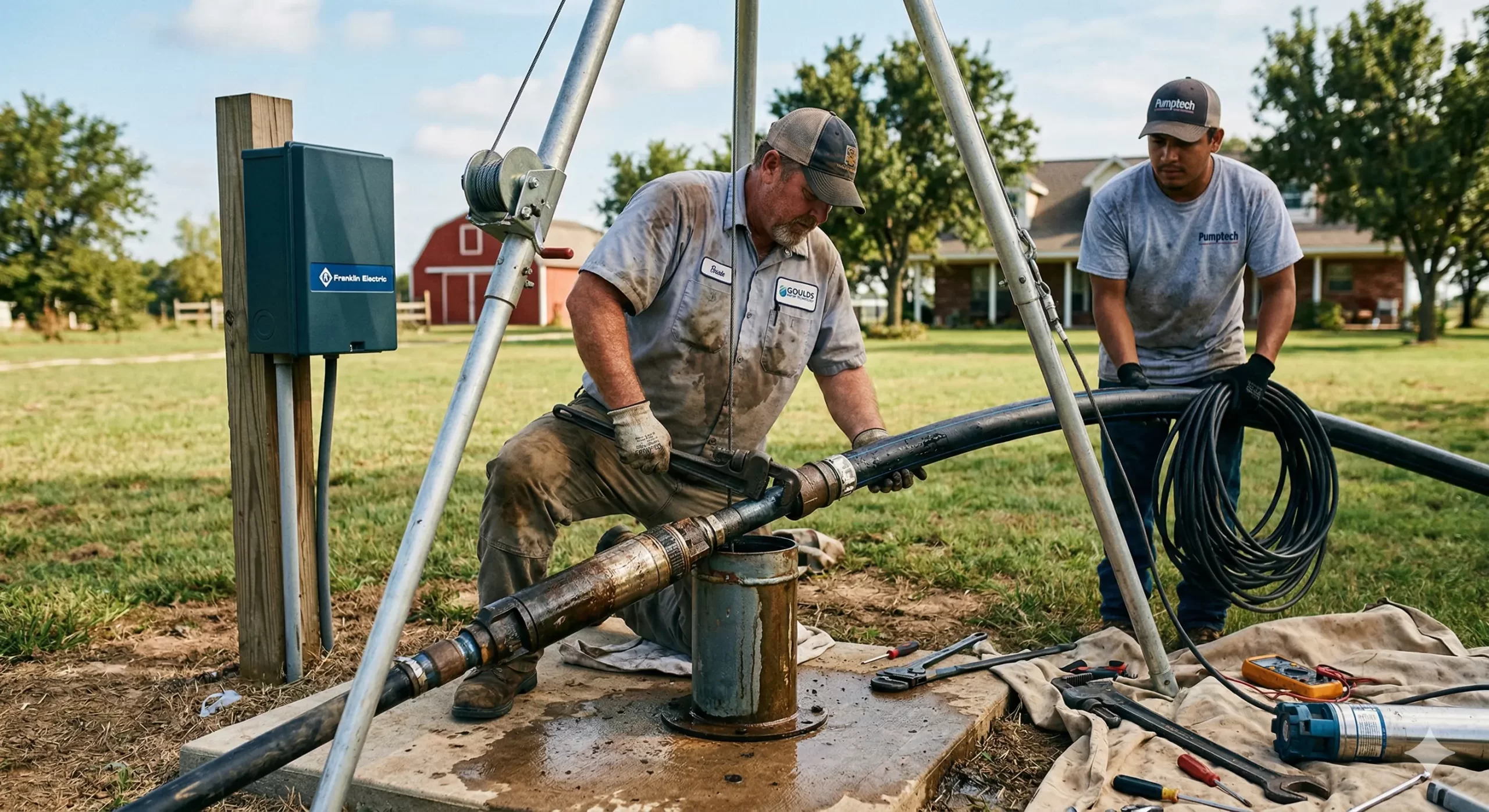
Should the megohmmeter test indicate a grounded motor, the repair escalates to pulling the pump. This is a non-negotiable professional task due to the extreme dangers involved. A residential submersible pump, along with hundreds of feet of water-filled pipe and heavy gauge wire, can weigh 300-800 lbs or more. This requires a specialized hydraulic pump hoist or a small crane rig—not a pickup truck and a rope. The technician uses a long T-handle ‘pitless key’ to reach down into the well casing and unlock the pitless adapter, which is the fitting that allows the pump assembly to be disconnected from the main water line below the frost line. The entire process involves managing immense weight, high-voltage wiring, and working over an open wellhead, making it one of the more hazardous jobs in the water service industry.
Repair Cost & Time Assessment
For a standard service call where the issue is confirmed to be a failed start capacitor or relay within the control box, a homeowner in the United States should expect to pay between $350 and $650. This cost typically includes a diagnostic or truck fee ($100-$175), one to two hours of a licensed technician’s labor ($125-$200 per hour), and the cost of the high-quality replacement parts ($75-$200). The price reflects the technician’s expertise, specialized diagnostic tools, and the liability of working with 240V systems. This type of repair is generally completed within 1 to 2.5 hours.
If the diagnostics determine that the submersible motor itself has failed and the pump must be pulled from the well, the cost increases dramatically. A full pump replacement job is a major undertaking involving a two-person crew and specialized rigging equipment. The total cost can range from $2,500 to over $6,000. This comprehensive price includes the cost of a new pump and motor assembly ($800 – $2,500+ depending on horsepower and brand), new drop pipe, new submersible wire, miscellaneous materials like heat-shrink splices and torque arrestors, and the labor for the crew and hoist rig usage for a half-day to a full day. The final price is heavily influenced by the depth of the well, the horsepower of the pump, and regional labor rates.
Fast Local Service & Diagnostics
Calls are routed to a licensed local well professional.