
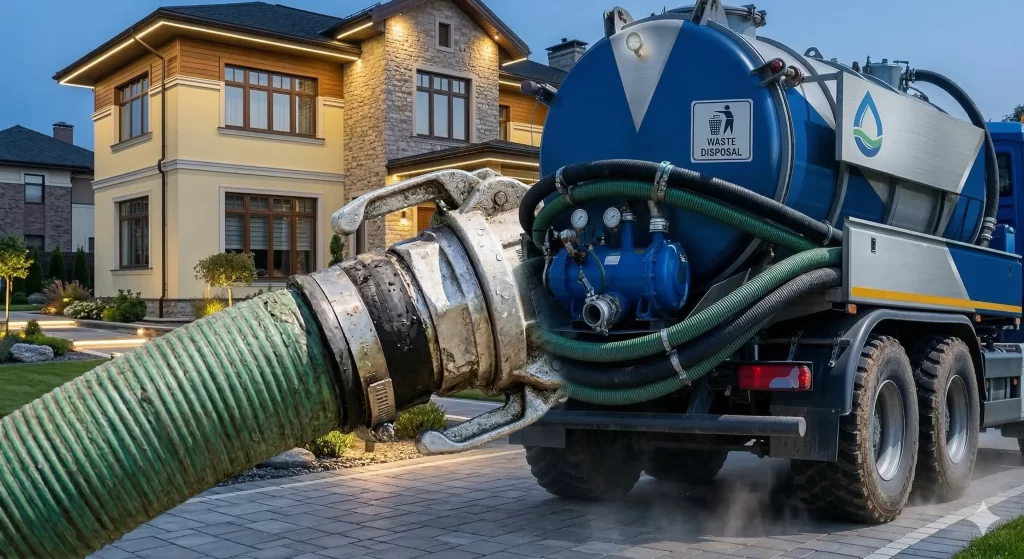
If you own a home with a private wastewater system, you've likely heard the terms "septic pumping" and "septic cleaning" used interchangeably. Homeowners, and sometimes even less scrupulous contractors, use these words as if they mean the exact same thing.
However, in the professional sanitation industry, pumping and cleaning represent two entirely different levels of service, requiring different equipment, varying amounts of time, and, most importantly, completely different price tags.
Ordering a standard "pump" when your tank desperately needs a deep "clean" can leave dangerous, rock-hard sludge at the bottom of your system. Eventually, this sludge will overflow into your leach field, causing a catastrophic failure that costs over $15,000 to replace.
In this guide, we will break down the exact technical differences between septic pumping and cleaning, compare the 2026 costs, and show you exactly how to determine which service your property requires.
The Anatomy of Your Septic Tank
To understand the difference between the two services, you must visualize what is happening inside the concrete (or fiberglass) tank buried in your yard. As household wastewater enters the tank, it naturally separates into three distinct layers:
- The Scum Layer (Top): Oils, fats, greases, and soaps float to the surface.
- The Effluent Layer (Middle): Relatively clear, grey wastewater. This is the liquid that eventually flows out into your drain field to be filtered by the soil.
- The Sludge Layer (Bottom): Heavy, solid waste, un-dissolved toilet paper, and inorganic materials sink to the bottom. Over time, this layer compresses and becomes thick and tar-like.
What is Septic Pumping? (The Standard Service)
Septic pumping is standard, routine maintenance. The primary goal of pumping is to remove the liquid effluent and the floating scum layer, along with whatever loose, un-compacted sludge happens to be easily sucked up by the vacuum hose.
During a standard pumping service, the technician inserts the vacuum hose into the tank and sucks out the liquid. Because the liquid is easy to move, this process is relatively fast. It relieves the hydrostatic pressure inside the tank and gives the system a "reset."
✅ Best Suited For:
Pumping is perfect for well-maintained systems that are serviced strictly every 2 to 3 years. If you don't use a garbage disposal and are careful about what goes down your drains, a standard pump-out is usually all you need.
What is Septic Cleaning? (The Deep Dive)
Septic cleaning is a much more aggressive, labor-intensive process. While pumping removes liquids, cleaning is specifically focused on removing the dense, compacted, and stubborn sludge layer at the bottom of the tank.
If a tank has been neglected for 5, 7, or 10+ years, the bottom sludge hardens into a material resembling wet cement. A standard vacuum hose cannot suck this up. The technician must use a process called "back-flushing" (pumping liquid back into the tank to agitate the solids) or use a mechanical tool called a "crust buster" to physically break up the sludge before it can be extracted.
A true cleaning service ensures the tank is completely evacuated down to the bare concrete floor.
🚨 The "Pump and Dump" Scam
Many homeowners looking for a cheap deal hire a discount contractor who quotes $200 for a "pump." The contractor simply sucks out the liquid (which takes 15 minutes) and drives off, leaving the dangerous solid sludge behind. You paid for a pump, but your tank is still effectively full of solids. Always ask if the quote includes full sludge evacuation.
Regional Soil & Climate Factors
The need for deep cleaning often depends on your local environment and state laws. For example, in the arid, hard-packed soils of Arizona, preventing heavy sludge from entering a restrictive leach field is critical, as the ground cannot absorb rapid liquid overflows. Conversely, properties in Arkansas with higher water tables face severe state health department penalties if un-cleaned tanks cause raw sewage to surface during heavy spring rains.
Routine Preventative Care
- Removes liquids & floating scum
- Takes 30 to 45 minutes
- Recommended every 3 years
- Uses standard vacuum suction
- Cheaper service cost
Intensive System Reset
- Removes hard, compacted bottom sludge
- Takes 1 to 2.5 hours
- Needed for neglected or heavily used tanks
- Requires mechanical agitation / crust busters
- Higher labor & disposal costs
Not Sure What Your Tank Needs?
Connect with certified local professionals who provide transparent inspections before they quote.
Cost Comparison: Pumping vs. Cleaning in 2026
Because the labor, equipment, and time required differ vastly, the costs reflect these differences. A contractor charging you for a "cleaning" is spending an extra hour at your property manually breaking up solids.
*Prices vary based on location, distance from disposal facilities, and exact tank size.
How to Know Which Service You Need
If you are scheduling a service, how do you know what to ask for? Here are the clear indicators:
You need a Standard Pumping if:
- You have documented proof the tank was pumped 3 to 5 years ago.
- You have a small household (1-3 people) relative to the tank size.
- You do not use a kitchen garbage disposal.
You need a Deep Cleaning if:
- You just bought the house and the previous owner has no maintenance records.
- It has been 7, 10, or more years since the last service.
- You use a garbage disposal daily (which introduces massive amounts of un-digestible solids).
- The technician opens the lid and sees the sludge layer is within a few inches of the outlet baffle.
Expert FAQ
Can I just ask for pumping if it's been 10 years to save money?
Do professionals use chemicals to 'clean' the tank?
How long does each service take?
Protect Your Property Investment
Find certified technicians who will honestly evaluate whether you need a quick pump or a deep clean.