
Diagnosis: An SJE Rhombus WellZone VFD F3 fault code signifies a critical ‘Dry Run’ or underload condition, where the pump operates without sufficient water. This is typically caused by a depleted well, a physically obstructed pump intake screen, or a major system leak. Continued operation in this state will cause catastrophic failure of the pump motor and wet-end components, requiring professional diagnosis and repair.
In this Guide:
What Causes the SJE Rhombus F3 Issue?
The F3 ‘Dry Run’ fault on an SJE WellZone VFD is an intelligent protective trip, triggered when the drive detects an underload condition. The Variable Frequency Drive constantly monitors the amperage (current) required to turn the pump’s motor at a given speed (frequency). When a pump is moving a column of water, it is under a significant hydraulic load, resulting in a predictable amperage draw. If the water level in the well drops below the pump’s intake, or if the intake screen becomes clogged with sediment or bio-fouling, the pump is no longer moving water. This drastically reduces the load on the motor, causing the amperage to fall below a pre-programmed threshold. The VFD’s microprocessor interprets this sustained low-current state as a dry run and initiates a fault to prevent catastrophic equipment failure.
From a physics perspective, the consequences of a dry run are severe and multifaceted. The submersible motor relies entirely on the surrounding well water as its primary cooling medium. Without this fluid to dissipate the heat generated by the motor windings, their temperature rapidly exceeds the thermal rating of their enamel insulation (typically Class F, 155°C). This thermal breakdown causes the insulation to become brittle and fail, leading to inter-winding short circuits or a short-to-ground against the motor’s steel housing. This damage is permanent and necessitates a complete motor replacement. The VFD’s protective shutdown is the only defense against this rapid thermal runaway.
Simultaneously, the pump’s ‘wet end’ experiences mechanical self-destruction. Internal components, such as the impeller stack bearings (often bronze or carbon-ceramic) and the primary mechanical shaft seal, are water-lubricated. Without water, these surfaces experience extreme frictional heating. The precision-lapped faces of the mechanical seal can shatter, and the bearings will gall and seize onto the pump shaft. This seizure can lock the rotor, and if the VFD were to attempt a restart, it would immediately trip on an overcurrent (F1) fault due to the locked rotor condition. Therefore, an F3 fault is not merely an alert; it is an emergency stop to prevent the cascading thermal and mechanical failures that destroy the entire pump and motor assembly.
DIY Troubleshooting Steps
- Document VFD Parameters: Before resetting any faults, carefully navigate the SJE WellZone display menu. Write down the exact fault code, the output frequency (Hz), the motor amperage (Amps), and the DC bus voltage at the time of the fault. This data is invaluable for a professional technician.
- Perform a Controlled Power Cycle: Shut off the dedicated two-pole breaker for the pump system. Wait at least five minutes for the VFD capacitors to fully discharge. Turn the breaker back on and observe the VFD’s startup sequence. Note if the F3 fault appears immediately upon the pump starting, or if it runs for a period before tripping. Do not repeatedly cycle the power.
- Check and Calibrate Restart Delay: Access the VFD’s parameter settings and check the ‘Restart Delay’ time. For wells with slow recovery, this delay might be too short, causing the pump to restart before the water level has sufficiently recovered. Consider increasing this delay as a temporary measure, but note that this does not fix the underlying cause of the low water level.
- Inspect Pressure Tank Pre-Charge: Turn off the pump breaker and drain all pressure from the plumbing system by opening a faucet. Using an accurate tire pressure gauge, check the air pressure in the schrader valve on your pressure tank. It should be 2 PSI below the pump’s cut-in pressure setting (e.g., 38 PSI for a 40/60 pressure switch). An incorrect pre-charge can cause rapid cycling, which can exacerbate low-yield well issues.
- Review Well Logs and System History: If available, consult the original well driller’s report. This document contains critical information such as the static water level, the well yield (gallons per minute), and the original pump setting depth. A recent drought or increased local water usage could mean the current water level is now below the pump.
- Verify Above-Ground Check Valve Function: If your system has an accessible check valve installed after the pressure tank, listen to it after the pump shuts off. A ‘clunk’ followed by silence is normal. If you hear water running back towards the well, the valve has failed. A failed check valve can cause the pump to lose its prime and potentially contribute to a dry run condition on startup.
When to Call a Professional Well Service
Upon arrival, a qualified technician’s first step is advanced electrical diagnosis at the control panel. They will confirm the F3 fault history in the VFD log and use a true-RMS clamp-on ammeter to verify the load readings against what the drive is reporting. The most critical diagnostic test is performed with a megohmmeter (often called a ‘Megger’). By disconnecting the motor leads at the VFD, the technician will conduct an insulation resistance test, applying 500-1000V DC to check the integrity of the motor windings and the submersible drop cable. A reading below 1-2 megohms to ground indicates a failed motor or compromised wire splice, often a direct result of overheating from a previous dry run event. This test definitively determines if the motor is electrically viable before undertaking the labor-intensive process of pulling it from the well.
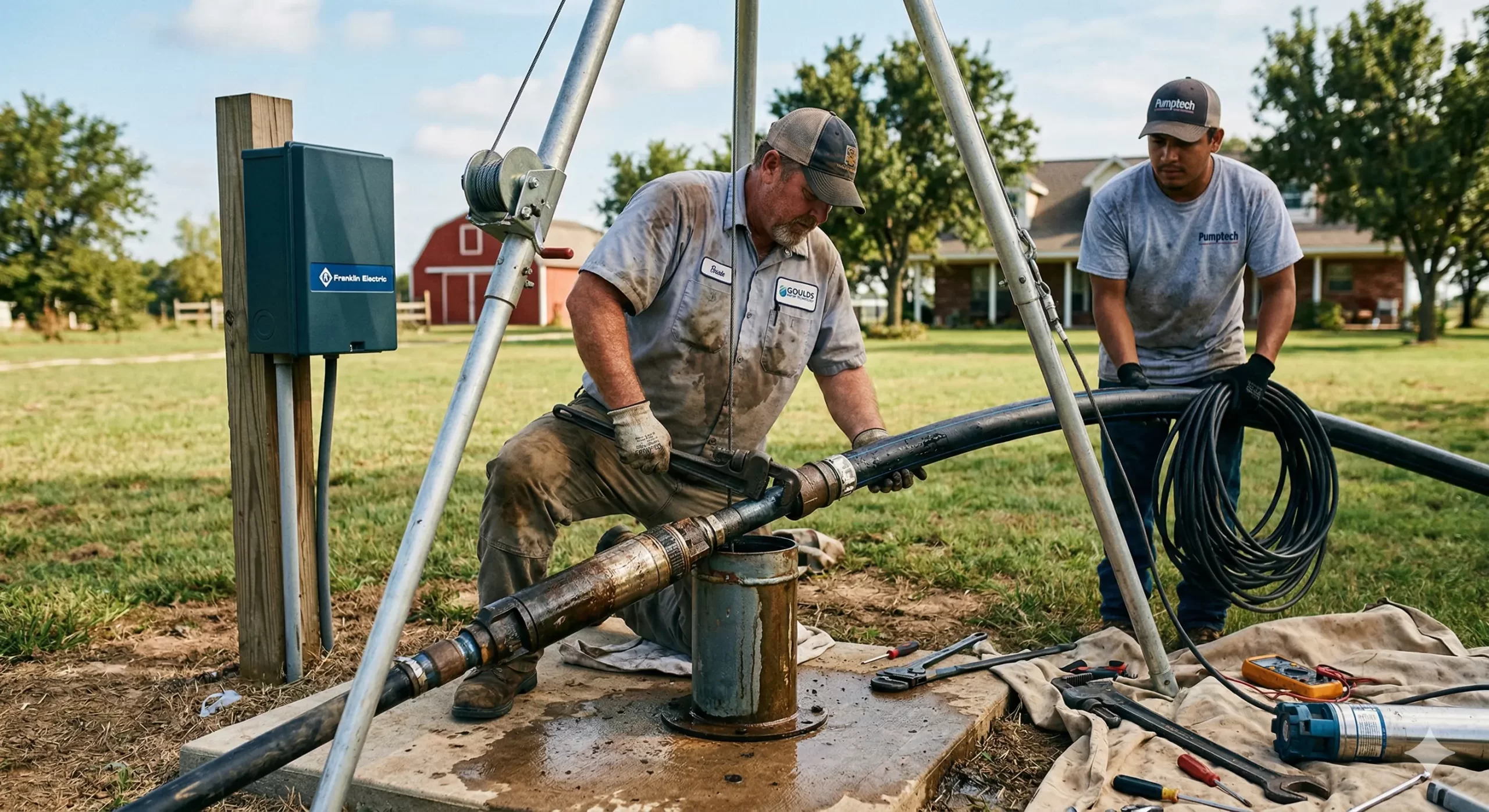
If the electrical tests pass or are inconclusive, the submersible pump must be pulled for physical inspection. This is a hazardous operation that requires specialized equipment. A heavy-duty pump hoist or portable crane is positioned over the wellhead. After removing the well cap, a specialized pitless adapter key is lowered and locked into the assembly to disengage it from the well casing. A two-person team then carefully hoists the pump, drop pipe, and cable, which can weigh over 500 lbs depending on depth and pipe material. Each section of pipe is disconnected and stacked methodically. This process is complex, dangerous, and physically demanding, and should never be attempted without proper rigging and training.
Safety Protocol: Prior to any physical work, a strict Lockout/Tagout (LOTO) procedure is non-negotiable. The 240V dual-pole circuit breaker feeding the system is switched off, secured with a physical lock, and tagged with the technician’s name and warning. This prevents any possibility of accidental energization while handling the motor leads. The work area is secured to manage the immense potential energy of a suspended pump column, which can cause severe injury or damage if dropped.
With the pump on the surface, a thorough physical inspection is conducted. The intake screen is examined for clogging from sediment, minerals, or bio-fouling (iron bacteria). The technician will attempt to turn the pump shaft by hand; any resistance or grinding indicates seized bearings or impellers. If the well’s condition is the suspected cause, a downhole video camera inspection is deployed to assess the casing integrity, check for collapsed well screens, and visually confirm the static water level and recharge rate. The final repair may involve cleaning the existing pump, replacing the entire pump/motor unit, lowering the pump deeper into the well (if possible), and precisely recalibrating the VFD’s underload fault parameters to match the pump’s true operational curve.
Repair Cost & Time Assessment
The cost for professionally diagnosing and repairing an F3 Dry Run fault is significant and typically ranges from $1,200 to $4,500, though it can be higher. The initial service call and on-site electrical diagnosis by a licensed pump technician will range from $250 to $500. If the pump must be pulled, you are paying for a two-person crew for a minimum of 4-6 hours ($100-$175 per hour, per person). The use of specialized equipment carries its own fees; a pump hoist or pulling rig can add $400 – $800 to the invoice. If a downhole video inspection is required to assess the well itself, that service typically costs an additional $500 – $1,000.
These initial costs cover diagnosis and labor only. If the inspection reveals a failed component, parts costs are additional. A new high-quality 1.5 HP stainless steel submersible pump and motor assembly can cost between $900 and $2,200. Furthermore, if the drop cable or pipe was damaged during the failure or pulling process, replacement costs for these materials are calculated per foot. Ancillary parts like new heat-shrink splice kits, torque arrestors, and pitless adapters add to the total. A complete replacement on a 300-foot well can easily exceed $5,000, making the preventative function of the SJE WellZone VFD’s F3 fault a critical money-saving feature in the long run.
Fast Local Service & Diagnostics
Calls are routed to a licensed local well professional.