
Diagnosis: An F1 High Pressure Fault on an SJE Rhombus WellZone VFD is a critical shutdown triggered by pressure exceeding the system’s safety limit. This is most often caused by a failed pressure transducer, a frozen sensor line creating a false reading, or a genuine overpressure event from a blockage. While basic checks are possible, professional repair is required to replace components and ensure system safety.
In this Guide:
What Causes the SJE Rhombus F1 Issue?
The F1 High Pressure Fault is a protective shutdown designed to prevent catastrophic failure of your plumbing system, pressure tank, and submersible pump. The primary cause is often a failure in the system’s feedback loop, specifically the pressure transducer. This solid-state device, typically a 4-20mA or 0-5VDC transmitter, converts water pressure into an electrical signal the VFD can interpret. Over time, exposure to voltage spikes, water vibration, and mineral buildup can cause the internal strain gauge or piezoelectric crystal to drift out of calibration or fail entirely. When it fails, it can send an erroneous, high-voltage signal to the VFD, tricking the controller into believing system pressure is at a dangerous level (e.g., 100+ PSI) when it is actually normal, triggering the F1 fault and an immediate shutdown.
A second, very common cause in colder climates originates from the small-diameter sensing line—typically 1/4-inch copper or PEX tubing—that connects the main plumbing to the pressure transducer. When water inside this isolated tube freezes, it expands by approximately 9% in volume. This expansion, confined within the rigid walls of the tube, generates immense localized hydraulic pressure, often exceeding several hundred PSI directly at the transducer’s diaphragm. The transducer accurately reports this localized high pressure to the VFD, which then correctly initiates the F1 fault to protect the system. The VFD is operating as designed; however, the input it’s receiving is based on a false condition caused by ice, not a system-wide overpressure event.
The most dangerous scenario is a genuine overpressure condition. This occurs if the VFD’s control logic fails or, more commonly, if a valve downstream of the pump is closed, effectively ‘dead-heading’ the pump. When a centrifugal pump is dead-headed, it continues to churn the same volume of water, converting nearly all of the motor’s horsepower into heat. This rapidly increases water temperature and pressure. Internally, the pump experiences extreme hydraulic forces that overload the thrust bearings, potentially causing shaft deflection and impeller damage. The motor, operating at near locked-rotor amperage, experiences severe thermal stress on its windings, which can degrade and melt the insulation, leading to a short-to-ground failure. The mechanical seals, designed for specific operating temperatures, can overheat and fail, allowing water to intrude into the motor housing and guarantee catastrophic failure.
DIY Troubleshooting Steps
- SAFETY FIRST – Power Cycle the System: Locate the double-pole circuit breaker labeled ‘Well Pump’ in your main electrical panel. Turn it fully to the OFF position. Wait for five full minutes to allow the VFD’s internal capacitors to discharge completely. Turn the breaker back ON. Observe the VFD display as it re-initializes. If the F1 fault clears and the system runs normally, it may have been a transient error, but monitor it closely.
- Visual Inspection of Transducer and Sensing Line: Carefully examine the pressure transducer (a small, cylindrical sensor threaded into the plumbing near your pressure tank) and its small attached tube. Look for signs of water leakage, corrosion on the electrical connector, or physical damage. If temperatures are near or below freezing, feel the tube and transducer body; if they are ice-cold or have frost, freezing is the likely culprit.
- Compare Mechanical Gauge to VFD Setpoint: Your system should have a standard mechanical pressure gauge near the pressure tank. Note the pressure reading on this gauge. Compare it to the pressure setpoint configured in the WellZone VFD (e.g., 60 PSI). If the mechanical gauge reads a normal pressure (e.g., 0 PSI when off, or 55 PSI when running) but the VFD immediately faults on F1 upon startup, this strongly suggests the electronic transducer is faulty and sending a false signal.
- Check for Closed Valves: Trace your plumbing from the pressure tank towards the house. Ensure every ball valve, gate valve, or boiler drain is in the fully open position. A partially or fully closed valve can cause the pump to build pressure too quickly, triggering the fault.
- Gently Thaw a Suspected Frozen Line: If you suspect a frozen sensing line, use a hairdryer on a low-to-medium setting to gently warm the transducer and the entire length of its small tube. NEVER use a torch or open flame, as this will damage components and create a fire hazard. After 10-15 minutes of gentle warming, attempt to power cycle the system again.
- Monitor VFD Display During Startup: If the pump attempts to run before faulting, watch the real-time pressure reading on the VFD’s digital display. If the pressure reading jumps erratically or instantly reads a very high number (e.g., 120 PSI) the moment the pump engages, the transducer has failed electrically.
When to Call a Professional Well Service
Upon arrival, a qualified technician’s first step is to verify the fault’s origin with precision instruments, ruling out guesswork. Using a calibrated digital pressure gauge connected to a drain port, they will compare the actual, true system pressure against the value being reported by the VFD’s transducer. A significant discrepancy confirms transducer failure. They will then use a multimeter to check the transducer’s output signal. For a 4-20mA transducer, they will check if the milliamp reading corresponds correctly to the pressure (e.g., 4mA at 0 PSI, 20mA at 100 PSI). An out-of-spec or non-responsive signal confirms the component must be replaced. The technician will then perform the replacement, which involves depressurizing the system, carefully unthreading the old transducer, and installing a new, high-quality unit using appropriate thread sealant.
Best practice, as dictated by decades of field experience, is to also install a mechanical pressure relief valve. This is a critical, non-electrical safety device, typically a brass valve rated for 100 PSI (or 25 PSI above the system’s high-pressure cutoff). It is installed on a tee near the pressure tank. In the event of a future VFD or transducer failure that causes a genuine overpressure event, this valve will automatically open and discharge water, physically preventing the system pressure from reaching a level that could rupture the tank or plumbing. This provides a vital layer of mechanical redundancy that protects the homeowner’s property.
Safety Protocol & Major Repair
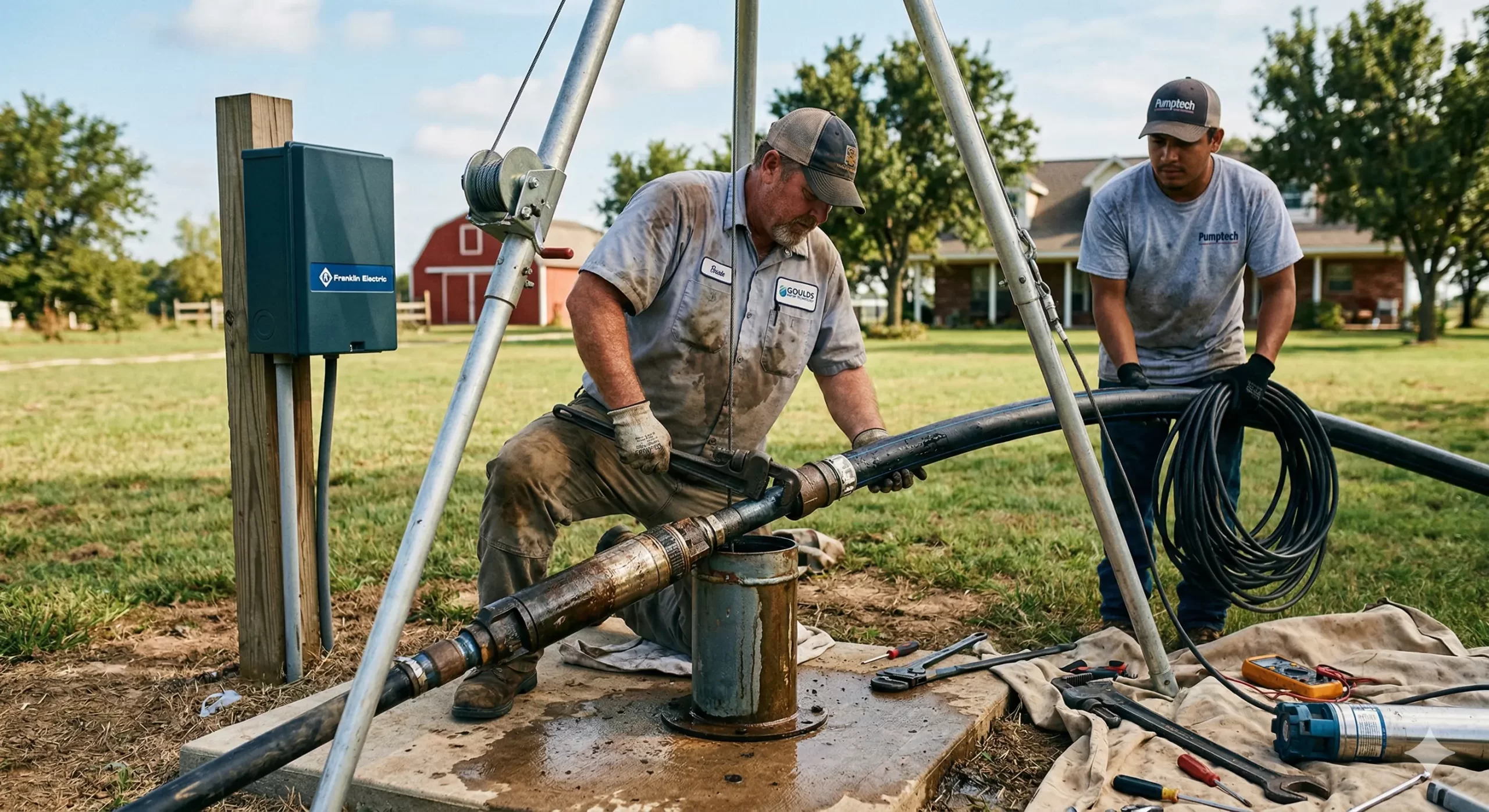
All work on a 240V VFD system must begin with a strict Lockout/Tagout (LOTO) procedure at the circuit breaker to ensure the circuit cannot be accidentally re-energized. If diagnostics indicate the pump motor itself was damaged by the overpressure event (e.g., a dead short is detected with an ohmmeter), the pump must be pulled from the well. A submersible pump, drop pipe, and cable assembly can weigh 300-500 lbs or more, making manual pulling unsafe and impractical. A professional pump hoist or a dedicated pulling rig is required to lift the assembly without damaging the components or endangering personnel. Before pulling, a megohmmeter (or ‘Megger’) is used to perform an insulation resistance test, sending 500-1000V through the motor windings to detect any insulation breakdown that would lead to premature failure. Once the decision to pull is made, a specialized Pitless Key is used to disengage the pump assembly from the pitless adapter located below the frost line inside the well casing, allowing the entire unit to be safely brought to the surface for replacement.
Repair Cost & Time Assessment
For a standard repair involving a faulty pressure transducer, the cost in the U.S. typically ranges from $450 to $800. This price includes a standard service call fee ($100-$175), 1.5-2.5 hours of skilled labor from a licensed technician ($125-$200/hr), a premium-grade pressure transducer ($150-$250), and the installation of a new brass pressure relief valve with associated fittings ($50-$75). This procedure is usually completed within a single visit and takes approximately 2-3 hours from diagnosis to final system testing.
In the event of a more severe failure where the overpressure event damaged the submersible pump motor, the cost escalates significantly, typically ranging from $1,800 to $4,500+. This reflects a major system overhaul. The cost includes the diagnostics, the use of a specialized pump pulling rig ($300-$500 fee), significantly more labor for two technicians (4-8 hours), the cost of a new submersible pump and motor assembly (which can range from $800 for a basic model to over $2,500 for a high-performance stainless steel unit), and potentially new drop pipe or submersible wiring if they are found to be damaged during the extraction process.
Fast Local Service & Diagnostics
Calls are routed to a licensed local well professional.