
Diagnosis: Black water and a rotten egg smell from your Sta-Rite Signature 2000 pump indicate a severe iron bacteria infestation. This bacterial colony physically clogs the pump’s intake screen, causing motor strain and decay that produces hydrogen sulfide gas. The solution requires professional shock chlorination of the well and mechanical cleaning of the pump.
In this Guide:
What Causes the Sta-Rite Black water / Rotten Egg Issue?
The root cause of black water and hydrogen sulfide gas (rotten egg smell) is a massive biological infestation of iron-reducing bacteria within the well and pumping system. These are naturally occurring microorganisms that metabolize dissolved ferrous iron and manganese. In doing so, they create a protective, gelatinous biofilm—a thick, slimy mass—that adheres tenaciously to the well casing, drop pipe, and, most critically, the intake screen of your Sta-Rite pump. From an engineering perspective, this biofilm acts as a catastrophic hydraulic restriction. It progressively chokes off the water flow into the pump’s multi-stage impeller stack, forcing the unit to operate far outside its designed performance curve in a condition known as ‘starvation’ or ‘dead-heading’.
This severe hydraulic restriction places immense and sustained stress on the pump’s electromechanical components. The motor, struggling to pull water through the clogged screen, will experience a significant increase in amperage draw. This overcurrent condition generates excessive thermal energy within the motor windings. Over time, this heat breaks down the winding’s enamel insulation, increasing the risk of an internal short circuit and complete motor burnout. Concurrently, the starved impellers create intense axial and radial thrust on the pump shaft. This abnormal load is transferred directly to the motor’s thrust bearings and the pump’s internal seals. The bearings can overheat, causing lubricant failure and eventual seizure, while the seals can be compromised, allowing water intrusion into the sealed motor housing—a terminal failure event.
The chemical degradation compounds the mechanical failure. As the bacterial colony dies and decays under anaerobic conditions, it releases hydrogen sulfide (H2S) gas, the source of the foul odor. H2S dissolved in water forms sulfuric acid, which is highly corrosive to the pump’s stainless steel components, fasteners, and shaft. Simultaneously, the decay process precipitates black manganese sulfide, which is the source of the discolored water. Therefore, the symptoms are not merely a water quality issue; they are the external indicators of a hostile downhole environment that is actively destroying the pump through a combination of mechanical overload, thermal stress, and chemical corrosion.
DIY Troubleshooting Steps
- Amperage Draw Measurement (Advanced Users Only): With the power disconnected via the circuit breaker, access the pump control box or pressure switch. Using a clamp-on ammeter, measure the amperage on one of the hot legs (typically black or red wire) while the pump is running. Compare this reading to the Full Load Amps (FLA) rating on the motor’s nameplate. A reading that is consistently 10-15% or more above the FLA indicates a severe mechanical bind or hydraulic restriction, consistent with a clogged intake. WARNING: This involves live 240V electricity and should only be performed by individuals with proven electrical competence.
- Monitor Pump Cycle Time: Drain the pressure tank until the pump engages. Using a stopwatch, time how long the pump runs to satisfy the pressure switch and shut off. If this cycle time has become significantly longer over weeks or months, it’s a clear indication of reduced flow (gallons per minute), pointing directly to an obstruction at the pump intake.
- Inspect the Thermal Overload Reset: Locate the pump’s control box (a separate box for 3-wire models). Many contain a manual reset button for the thermal overload protection. If this button has tripped, it means the motor has overheated due to excessive amp draw. A recurring trip is a definitive sign that the pump is under extreme strain.
- Check Pressure Switch Contacts and Gauge: Turn off power at the breaker. Remove the cover of the pressure switch. Look for any black, slimy residue on the contacts or inside the switch housing. This confirms that the bacterial sludge has been pulled all the way through the system. Also, observe the pressure gauge while the pump runs; sluggish or erratic pressure build-up is symptomatic of a starved pump.
- Sample Water at the Boiler Drain: Draw a water sample from the boiler drain spigot on your pressure tank. This provides the most direct sample from the well before it travels through the house. If this water is black and odorous, the problem is definitively in the well or the pump, not the household plumbing.
- Inspect Whole-House Sediment Filters: If your system has a sediment filter, remove the cartridge. If it is coated in a thick, gelatinous black or reddish-brown slime, it serves as undeniable evidence of a severe iron bacteria infestation.
When to Call a Professional Well Service
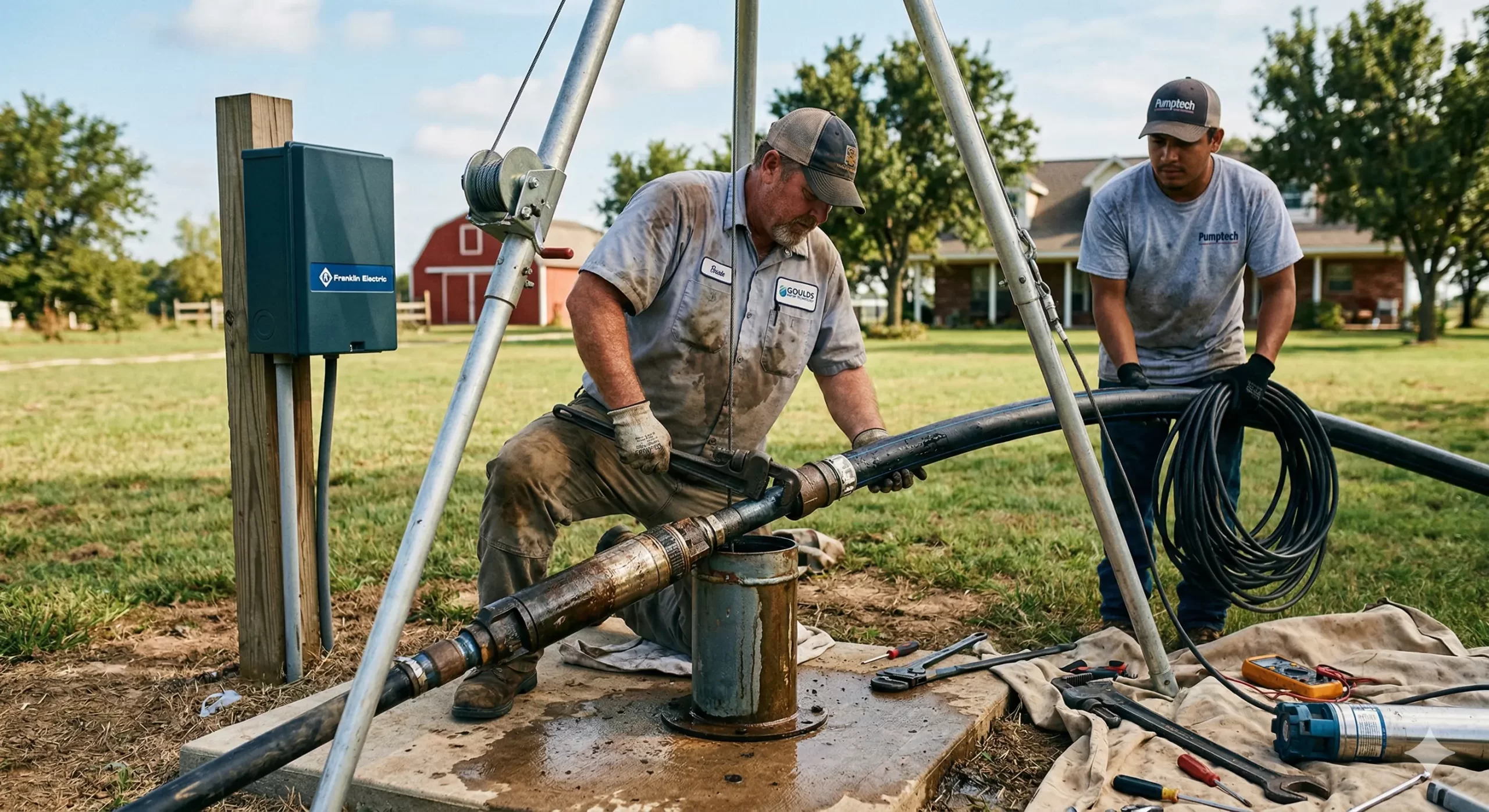
A professional intervention begins with a conclusive diagnosis to confirm the bacterial infestation and rule out other failures. The technician will first verify the amperage draw and may use a Megohmmeter to perform an insulation resistance test on the motor windings. This test sends a high-voltage DC signal through the windings to detect any insulation breakdown, providing a predictive assessment of the motor’s remaining service life. Following the electrical tests, the technician will prepare for pump extraction by setting up a dedicated pump hoist or pulling rig. Using a specialized T-handle pitless adapter key, they will engage the pitless adapter inside the well casing to disconnect the drop pipe assembly and lift it without needing to excavate the well head.
The extraction process is a critical, high-risk operation. The combined weight of the Sta-Rite pump, motor, hundreds of feet of water-filled drop pipe, and heavy-gauge submersible wiring can easily exceed 500 lbs. The pump hoist provides the mechanical advantage and control necessary to pull the assembly straight up without damaging the well casing, drop pipe, or power cable. Once surfaced, a thorough mechanical cleaning is performed. The pump’s intake screen will be scoured using high-pressure water jets and stiff brushes to remove all traces of the bacterial biofilm. In severe cases, the pump’s diffuser stack may be disassembled for individual cleaning of each impeller to restore full hydraulic efficiency.
With the pump removed, the well itself is treated via shock chlorination. The technician calculates the precise volume of sodium hypochlorite required to bring the entire water column to a sanitizing concentration of at least 200 parts per million (ppm). This potent chlorine solution is circulated throughout the well to ensure it contacts and neutralizes the bacterial colonies on the casing walls and in the surrounding gravel pack. After a dwell time of 12-24 hours, the cleaned pump is reinstalled, any compromised wiring is repaired using submersible-rated, adhesive-lined heat-shrink splices, and the system is activated to purge the chlorinated water until it runs clear and tests safe. A final pressure test ensures the integrity of the entire system from the pitless adapter to the pressure tank.
Safety Protocol: All work on a 240V submersible pump system is inherently dangerous. Technicians are required to follow strict Lock-Out/Tag-Out (LOTO) procedures at the circuit breaker to ensure the circuit cannot be accidentally energized. The use of a professional pump hoist is non-negotiable for a pump of this class to prevent catastrophic equipment loss, well damage, and severe personal injury from uncontrolled weight.
Repair Cost & Time Assessment
The cost for a professional pump pull, mechanical cleaning, and well shock chlorination typically ranges from $1,200 to $2,800 in the United States. This price reflects several key factors: labor for two certified technicians for 4-8 hours, a significant equipment surcharge for the use of the specialized pump hoist rig, the cost of materials including high-concentration chlorine and potentially new heat-shrink splices, and an environmental fee for managing the purged chlorinated water where required. The total cost is a direct function of the well’s depth—a deeper well means more labor time for pulling and reinstalling, and more materials.
The final invoice can be influenced by well accessibility and the severity of the problem. If the well head is in a difficult-to-reach location, requiring extra setup time for the rig, labor costs will increase. If upon inspection the technician finds that the chronic overheating has terminally damaged the pump motor, you will be quoted for a full pump replacement, which can elevate the total project cost to $3,500 or more, depending on the pump model and depth. The timeline for the repair is typically 4-6 hours of on-site work, followed by a 12-24 hour period where the chlorine ‘dwells’ in the well. The final purging process can take several additional hours before the water is potable and the job is considered complete.
Fast Local Service & Diagnostics
Calls are routed to a licensed local well professional.