
Diagnosis: A fast blinking red light on a SymCom PumpSaver indicates a severe Overcurrent or Locked Rotor fault. This is typically caused by a seized pump/motor assembly or a critical short in the motor windings. Immediate shutdown is required, and professional diagnosis with a megohmmeter is necessary to determine if the pump needs replacement.
In this Guide:
What Causes the SymCom Blinking Red (Fast) Issue?
The fast red blink on a SymCom protective relay is a critical alert signifying an overcurrent condition that exceeds the pre-set trip limit, often pointing to a Locked Rotor Amperage (LRA) event. The primary mechanical cause is a seized pump rotating assembly. This occurs when foreign material, such as sand, gravel, or high mineral content, infiltrates the pump stack and wedges the impellers, preventing rotation. Simultaneously, the thrust bearings, designed to handle thousands of pounds of downthrust, may fail from abrasive wear or loss of lubrication, causing the entire shaft to seize. When the motor receives power but cannot turn, it acts like a dead short from a physics standpoint. The stator windings draw an immense amount of current—often 500-700% of the normal Full Load Amps (FLA)—as the magnetic field attempts to overcome the insurmountable mechanical resistance. The PumpSaver is engineered to detect this surge within milliseconds and disconnect power, fulfilling its primary role: it saved the motor from an immediate, fiery burnout and protected the entire electrical circuit from the wellhead to the breaker panel from catastrophic failure.
The second major cause is an electrical failure within the submersible motor itself, specifically an inter-turn or phase-to-ground short circuit in the stator windings. Over years of service, the thin enamel insulation coating on the copper magnet wire can degrade due to thermal cycling, voltage surges, or moisture intrusion from a compromised shaft seal or a failed cable splice. When this insulation breaks down, two adjacent windings can make contact, creating a low-resistance path for the current. This short circuit bypasses a portion of the electromotive coil, causing a dramatic and instantaneous spike in amperage draw. The motor may attempt to start but will have significantly reduced torque and efficiency, quickly leading to an overcurrent trip. In a more severe phase-to-ground fault, current shorts directly to the motor’s steel housing. This is an extremely dangerous condition that the PumpSaver immediately interprets as a massive overcurrent, tripping the circuit to prevent down-line equipment damage and mitigate electrocution risk.
These failure modes are often interconnected. A progressive bearing failure can introduce excessive vibration and rotor wobble, causing the rotor to physically scrape against the stator, mechanically damaging the winding insulation and inducing a short circuit. Conversely, an initial inter-turn short can generate intense, localized heat far beyond the motor’s design limits. This extreme heat can cause metal components to expand and warp, leading to the mechanical seizure of the rotating assembly. Therefore, the PumpSaver’s ‘Overcurrent’ fault code does not distinguish between a mechanical or electrical root cause because, from an electrical perspective, they are identical: the motor is demanding a dangerously high level of current that must be interrupted. The relay has performed its function perfectly; the next step is a definitive diagnosis of the downhole equipment.
DIY Troubleshooting Steps
- SAFETY SHUTDOWN AND LOCKOUT/TAGOUT: Immediately turn off the double-pole breaker feeding the pump system. Apply a lockout tag or, at a minimum, heavy tape over the breaker handle with a ‘DO NOT OPERATE’ warning. This is a 240V system with lethal potential; all further checks must begin with a confirmed zero-energy state.
- VERIFY INCOMING VOLTAGE: With extreme caution, after removing the control box cover, use a quality multimeter to verify the supply voltage at the line-side terminals (L1 and L2). It should be stable and within 5% of the nominal voltage (e.g., 230V-240V). Low voltage forces a motor to draw higher current, which could trip a sensitive relay, though it’s unlikely to cause the instantaneous trip seen in this scenario.
- INSPECT THE START CAPACITOR (SINGLE-PHASE SYSTEMS): With power locked out, visually inspect the start capacitor (and run capacitor, if present) in the control box. Look for any signs of bulging, leaking oily residue, or burn marks. If you have a multimeter with a capacitance setting, you can (after safely discharging the capacitor) test if it’s within its rated microfarad (µF) value. A failed start capacitor can prevent the motor from starting, mimicking a locked rotor condition.
- CONDUCT A BRIEF AMPERAGE TEST: This is an advanced step for qualified individuals only. Place a clamp-on ammeter around one of the motor lead wires. Stand clear, turn the breaker on for no more than 1-2 seconds, and observe the meter. If the amperage spikes to the Locked Rotor Amps (LRA) value (check motor plate) and the PumpSaver trips instantly, it confirms a severe downhole fault. Immediately shut the system down again. Do not repeat this test.
- CHECK ALL SURFACE WIRING: Meticulously inspect all wiring connections from the breaker panel to the pressure switch, to the PumpSaver/control box, and to the wellhead cap. Look for loose connections, chafed wire insulation, signs of arcing (black soot), or melted terminals. A short circuit in the surface wiring could also cause an overcurrent trip.
- REVIEW PUMPSAVER FAULT CODES AND SETTINGS: Before resetting, carefully review the specific fault code history if your model allows. Double-check that the overcurrent trip point (amps) and trip delay (seconds) are programmed correctly according to the pump motor’s nameplate data. While unlikely to be the root cause of a severe fault, incorrect settings can cause issues and should be verified.
When to Call a Professional Well Service
Upon arrival, a certified pump technician’s first action is to validate the diagnosis from the surface, avoiding a premature and costly pump extraction. Using a high-voltage digital insulation resistance tester, commonly known as a megohmmeter or ‘Megger,’ they will perform a definitive electrical test. After disconnecting the motor leads at the control box, the technician applies a test voltage (typically 500V or 1000V) to measure the resistance between the motor windings and ground. A healthy motor will show hundreds or thousands of megohms. A reading of less than one megohm indicates a catastrophic insulation failure and a condemned motor. This test provides irrefutable evidence that the problem is downhole, justifying the use of a pump hoist and proceeding with extraction.
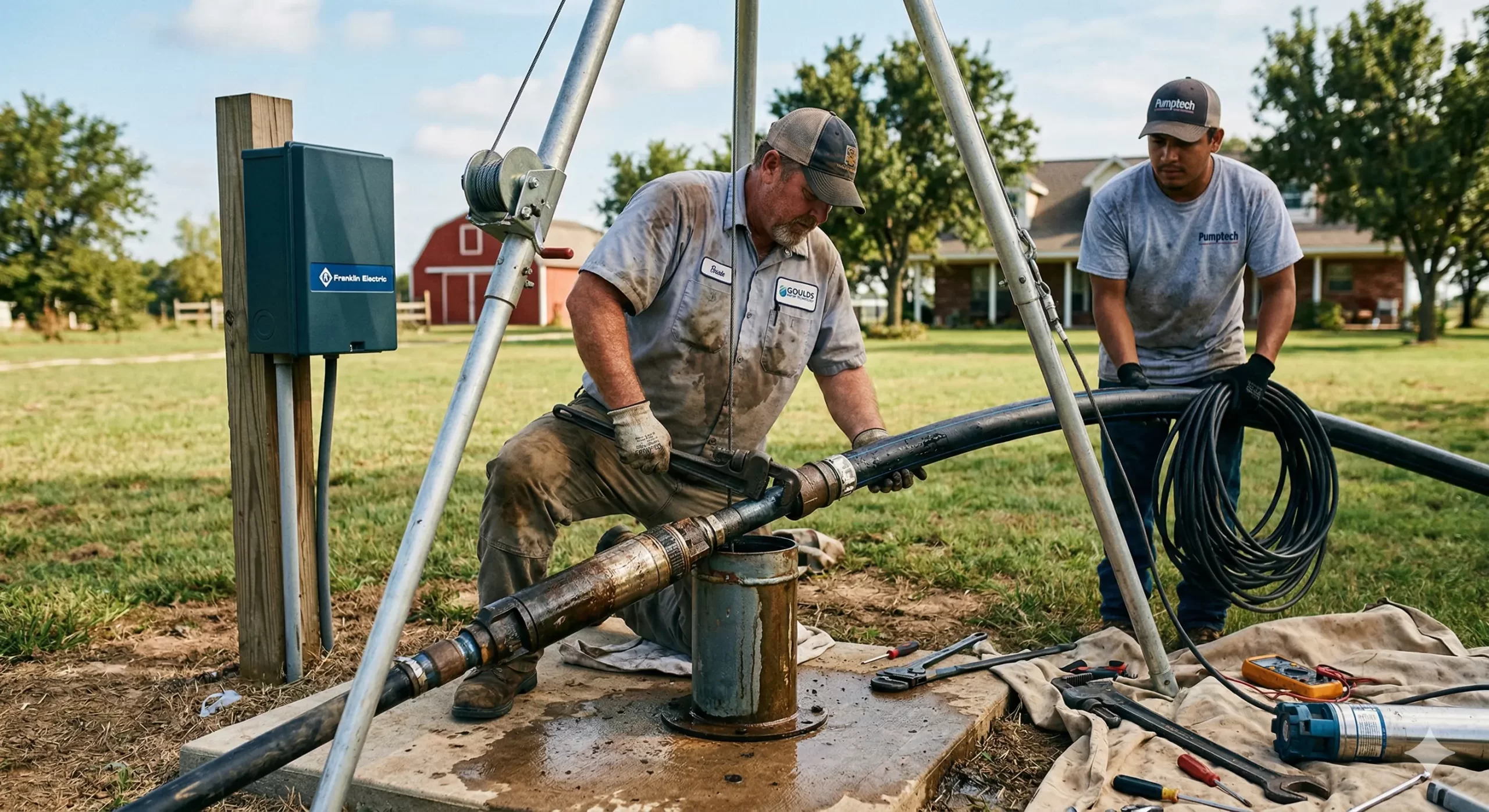
The extraction process is a heavy-duty, safety-critical operation. For a submersible pump set hundreds of feet deep, the combined weight of the pump, motor, water-filled drop pipe, and power cable can easily exceed 500-1000 lbs. A specialized hydraulic pump hoist or pulling rig is absolutely mandatory. The technician will first remove the well cap, secure the drop pipe with a slip-on pipe elevator, and then use a T-handle pitless adapter key to disengage the internal assembly from the well casing. The hoist then carefully lifts the entire column from the well, with technicians managing the pipe and wire to prevent kinking or damage to the well casing. Once on the surface, the failed pump is disconnected and a thorough inspection often reveals the physical cause—impellers packed with sand, a burnt smell from the motor, or a seized shaft that cannot be turned by hand.
Installation of the new unit is a precision process. The new pump and motor are assembled, and the electrical connection is made using a high-quality, submersible heat-shrink splice kit. This splice is the motor’s lifeline and must be perfectly executed to ensure a decade or more of watertight service. New torque arrestors and cable guards are installed on the drop pipe to prevent the pump from torquing on startup and abrading the cable against the well casing. The entire assembly is then carefully lowered back into the well, the pitless adapter is seated to create a sanitary seal, and the wellhead is reassembled. Before energizing, a final megohmmeter test is performed on the new installation to ensure its integrity. Finally, the system is started, the PumpSaver is calibrated precisely to the new motor’s FLA rating, and the well is disinfected per local health code.
Safety Protocol: All work is performed under strict safety protocols. This involves de-energizing and locking out a 240V, high-amperage circuit, managing extreme suspended loads with a certified hoist, and preventing surface contaminants from entering the potable water supply. Attempting this work without the proper rig, tools, and expertise risks dropping the pump down the well (a catastrophic event), severe damage to the well itself, or life-threatening electrical shock.
Repair Cost & Time Assessment
The cost for a complete submersible pump replacement following a locked rotor or shorted motor fault is substantial, typically ranging from $2,500 to $6,000+ in the United States. The final price is dictated by several factors. The largest single expense is the pump and motor assembly itself, which can range from $1,200 for a standard-duty residential unit to over $4,000 for a high-horsepower, constant pressure, or all-stainless-steel model. Labor is a significant component, often billed for two technicians for 4 to 8 hours at a rate of $150-$250 per hour, per technician. A dedicated ‘Rig Fee’ or ‘Pump Hoist Usage Fee’ of $300-$600 is standard to cover the cost, maintenance, and transportation of this specialized heavy equipment.
Additional costs include materials such as new drop wire (if the old wire is damaged or undersized), a new heat-shrink splice kit, stainless steel safety rope, torque arrestors, and potentially a new pitless adapter if the old one is corroded. The total time on-site for a standard-depth well (100-300 feet) with good access is typically 4-6 hours. However, the time and cost can increase significantly due to variables like extreme well depth (over 300 feet requires more time and pipe), difficult site access for the service truck and hoist, or if additional work like well chlorination and flushing is required to address the sediment or bacteria issues that may have contributed to the original pump’s failure.
Fast Local Service & Diagnostics
Calls are routed to a licensed local well professional.