
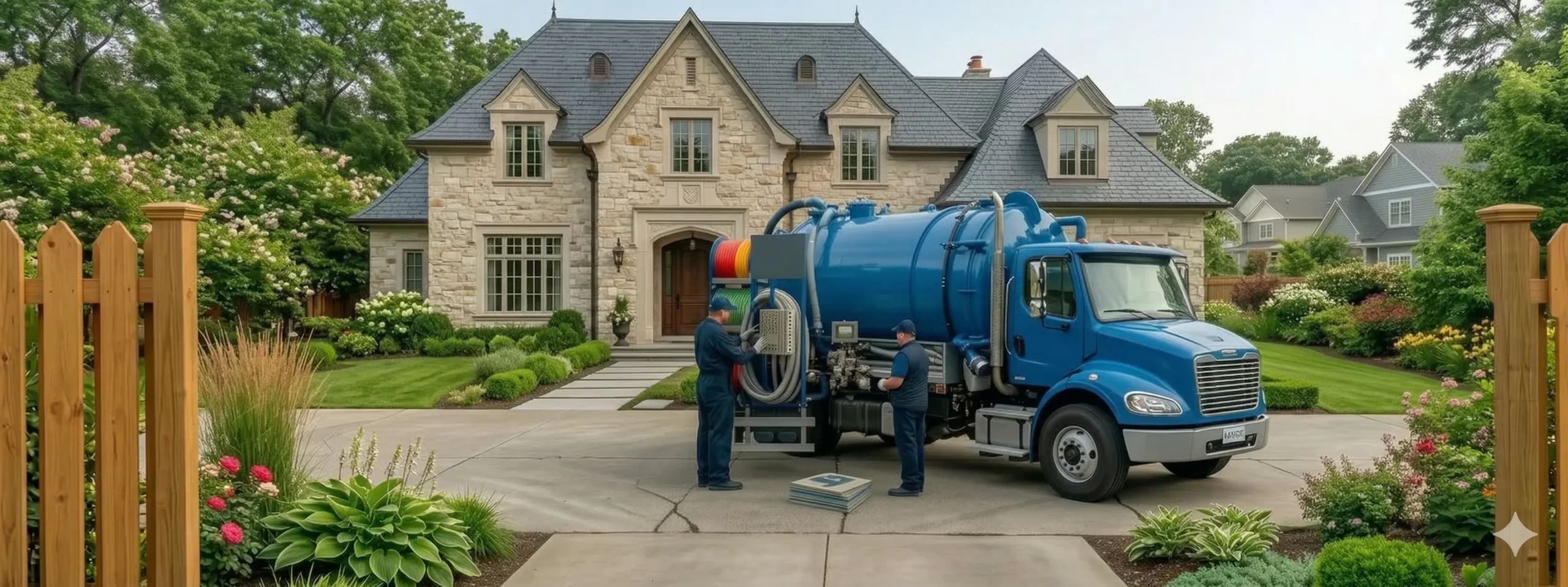
Top Septic Pumping in
Canton
Canton Pumping Costs & Data
| Canton Terrain / Soil Profile | Drainage Capacity | Impact on Wastewater Systems | Maintenance Need |
|---|---|---|---|
| Sandy Loam over Clay Pan | Deceptively Poor | Topsoil drains, but water pools on the clay layer. Creates underground flooding. Highly vulnerable to RV soil compaction. | High (Interval pumping & structural checks) |
| Rolling Timbered Hills | Moderate | Runoff issues combined with massive post oak/pine root intrusion crushing PVC pipes. | Standard (Frequent root mitigation) |
Cost Estimation by Service Profile in Canton:
| Service Description | Estimated Range | Primary Labor Factors |
|---|---|---|
| First Monday Commercial / RV Remediation | $600 – $850+ | Pumping multiple high-capacity lift stations, deploying hydro-jetters to destroy dense grease/wipe clogs from massive tourist traffic. |
| Root Extraction & Clay Pan Pumping | $500 – $660+ | Deploying heavy mechanical augers to destroy oak root blockages, plus manual excavation through dense clay. |
| Standard Rural Pump-Out (With Risers) | $400 – $505 | Standard evacuation and visual check. Assumes the tank has PVC surface risers eliminating digging labor. |
βοΈ Local Service Details
- Commercial Hydro-Jetting: Deploying high-pressure water systems to obliterate dense, concrete-like blockages caused by commercial grease and “flushable” wipes that notoriously plague First Monday vendor camps and RV parks.
- Aggressive Oak Root Cutting: Utilizing specialized mechanical augers and high-pressure hydro-jetters to obliterate dense oak roots that have infiltrated concrete baffles and PVC lateral lines in wooded lots.
- Clay Pan Excavation & Riser Retrofitting: Utilizing heavy digging equipment to break through dense, baked clay to access legacy tanks, followed by the highly recommended installation of heavy-duty PVC surface risers to permanently protect the homeowner from future digging fees.
π± Local Environmental Status
When a septic system fails in the Canton area, the localized consequences are deeply tied to the environment and the local economy:
- The “First Monday” Commercial Overload: Once a month, Canton’s population swells from a few thousand to over 100,000 people for First Monday Trade Days. Sprawling RV parks, vendor lots, and commercial venues are subjected to unimaginable hydraulic shock. Standard commercial systems are routinely choked by thousands of “flushable” wipes, extreme grease buildup, and constant use. This causes rapid, catastrophic inlet blockages, overflowing tanks, and burned-out lift station pumps.
- The “Bathtub Effect” & Clay Pans: The sandy topsoil in Canton absorbs rain quickly, but the water immediately hits the impenetrable clay pan just a few feet below. During heavy East Texas thunderstorms, this creates an underground “bathtub.” If a traditional drain field is submerged in this trapped water, the effluent cannot drain, forcing raw sewage to back up directly into home plumbing or pool on the surface.
- Oak & Pine Root Annihilation: The rolling, wooded hills of Canton are dotted with massive, ancient oak and pine trees. During the scorching Texas droughts, these deep root systems aggressively seek out the moisture inside septic tanks and lateral lines. They easily crush older concrete joints, infiltrate PVC pipes, and create impenetrable root mats.
- Agricultural & RV Soil Compaction: Canton has a massive footprint of RV parking and agricultural land. If heavy RVs, vendor trucks, or tractors are repeatedly driven over a shallow residential drain field, the immense weight will compact the sandy soil and instantly crush the PVC lateral lines against the clay pan beneath.
To protect their investments and navigate Canton’s intense commercial environment, property owners must enforce uncompromising maintenance:
- Monthly/Quarterly Commercial Pumping: RV parks and vendor grounds surrounding First Monday must schedule professional vacuum pumping and line jetting frequently to prevent catastrophic grease and wipe clogs during the event.
- Drain Field Protection: Clearly mark the perimeter of your drain field and strictly prohibit any vendor trucks, RVs, or heavy equipment from parking over the area to prevent soil compaction and pipe crushing.
π Coverage & ZIP Codes
π‘ Real Estate Transactions
Navigating a property sale involving a septic system in Van Zandt County requires diligence:
- Commercial RV Park Due Diligence: Investors buying land converted to house vendors and RVs face extreme scrutiny. Commercial lenders require extensive proof that the OSSF is legally permitted for high-capacity, high-density use by the county. A full pump-out and hydro-jetting of the lateral lines is considered mandatory during the option period to guarantee the drain field hasn’t been destroyed by years of trade days abuse.
- USDA & Agricultural Loan Rigor: A large percentage of rural home sales utilize USDA or specialized agricultural loans. A simple visual flush test is never accepted; the tank must be completely evacuated and structurally inspected by a TCEQ-licensed professional to guarantee it hasn’t been fractured by tractors, root intrusion, or shifting clay.
- Engineered ATU Contract Transfers: Because traditional gravity fields frequently fail in the clay pans, many upgraded properties utilize mechanical Aerobic Treatment Units (ATUs). To legally close a sale, buyers must assume an active, continuous maintenance contract.
β οΈ Local Regulatory Warning
Hyper-Local Service Graph
We track local contractor dispatch. Septic pumping is currently the top-trending emergency in Canton.
Local Soil Saturation Impact
Understand how the current moisture levels in Canton affect your drain field's ability to process effluent.
Contractor Network
We locate the fastest origin point for your crew to guarantee minimal waiting time in Canton.
Solid Waste Recovery
You will build profound sludge layers over time. Here is how close you are to needing a pump in Canton.
The Ultimate Flush Protocol
Melt away the stress of a Canton backup. Hit the schedule button on your calendar exactly at this time.
Maintenance Budget Optimizer
Maximize your system life without draining your wallet. Here is your projected risk in the Canton area.
Base Drain Field Replacement in Canton: $13,211
Homeowner Feedback



Reliable Septic Services in
Canton, TX
Canton Septic Expert AI
What are the specific septic tank regulations, typical soil drainage characteristics, and the local permitting authority for Van Zandt County?
Septic System Regulations and Characteristics for Canton, Van Zandt County, Texas (2026)
As a Senior Environmental Health Inspector and Septic Regulatory Expert for Texas, I can provide you with specific, hard data regarding residential septic systems in Canton, Van Zandt County, as of 2026.
Specific Septic Tank Regulations
In Texas, the primary regulatory authority for On-Site Sewage Facilities (OSSF), commonly known as septic systems, is the Texas Commission on Environmental Quality (TCEQ). All systems must comply with the statewide regulations outlined in 30 Texas Administrative Code (TAC) Chapter 285, "On-Site Sewage Facilities."
Key aspects of TCEQ Chapter 285 include:
- Permitting Requirements: A permit to construct and an authorization to operate are required for all new OSSF installations, modifications, and repairs. These permits are issued based on a detailed site evaluation and system design.
- Licensed Professionals: All OSSF work, from site evaluation and design to installation and maintenance, must be performed by individuals licensed by the TCEQ. This includes Site Evaluators, Designated Representatives, Installers, and Maintenance Providers.
- System Design Criteria: Regulations dictate minimum tank sizes, drain field sizing based on soil characteristics and wastewater flow (e.g., number of bedrooms), setback distances from wells, property lines, and water bodies, and requirements for system components.
- Wastewater Quality: Performance requirements for effluent quality, especially for aerobic treatment units (ATUs), are strictly defined.
- Maintenance Contracts: Aerobic systems, due to their advanced treatment nature, require a two-year maintenance contract with a TCEQ-licensed maintenance provider upon installation, which is typically renewed thereafter.
Typical Soil Drainage Characteristics in Canton, TX
The Canton area, situated within Van Zandt County, generally exhibits challenging soil conditions for conventional septic systems. Based on USDA soil surveys, the predominant soil series in the region often include:
- Fine Sandy Loams and Clay Loams: Soils like the Lindale fine sandy loam, Kirvin fine sandy loam, and the Callis-Sacul complex are common.
- Drainage Characteristics: These soils are typically characterized by a sandy or loamy topsoil, but often transition quickly to a dense, impermeable, and heavy clay subsoil (known as a "Bt horizon" or "argillic horizon") at relatively shallow depths. This results in moderately well-drained to somewhat poorly drained conditions, with slow to very slow permeability in the subsoil.
- Impact on Drain Field Design: Due to the restrictive clay layers and slow percolation rates, conventional gravity-fed drain field systems (standard absorption beds) are often impractical or require significantly larger footprints than in areas with better draining soils. This necessitates:
- Larger Drain Fields: If a conventional system is approved, the absorption area will be considerably larger to compensate for the limited soil absorption capacity.
- Aerobic Treatment Units (ATUs): More commonly, the soil conditions in Canton dictate the use of aerobic treatment units (ATUs). These systems provide a higher level of wastewater treatment, producing an effluent that is cleaner than that from a conventional septic tank. This allows the treated effluent to be dispersed through various methods, such as:
- Surface Application/Spray Fields: The treated effluent is disinfected and then sprayed over a designated lawn area. This is a common and effective solution in areas with poor drainage.
- Drip Irrigation Systems: Effluent is slowly released into the upper soil profile through subsurface drip lines.
- Mound Systems: In some instances, where the water table is high or soil permeability is extremely low, a mound system may be required. This involves constructing an elevated drain field using specially selected fill material.
Local Permitting Authority for Van Zandt County
For residential OSSF permitting in Canton and the rest of Van Zandt County, the local permitting authority is the Van Zandt County Judge's Office, acting as the designated Authorized Agent for OSSF permitting. While the County Judge's Office holds the authority, the day-to-day administration and receipt of applications are typically handled by the Van Zandt County Clerk's Office.
All permit applications for new installations, repairs, or alterations to existing OSSF systems must be submitted to this office. They ensure that the proposed system design, which must be prepared by a TCEQ-licensed Site Evaluator and/or Professional Engineer, complies with 30 TAC Chapter 285 and any local variances or specific requirements adopted by Van Zandt County.
Realistic 2026 Cost Estimates for Canton Market
Please note that these are estimates for 2026 and can vary significantly based on specific site conditions, system complexity, contractor, and material costs.
- Septic System Pumping (Conventional Tank): For a standard 1,000-1,500 gallon septic tank, you can anticipate costs in the range of $400 - $700. This service should typically be performed every 3-5 years, depending on household usage.
- New Septic System Installation:
- Conventional Septic System (Tank and Drain Field): If site conditions and soil tests allow for a conventional system, which is less common in areas with heavy clay, the estimated cost for a typical 3-bedroom residence would be between $9,000 - $17,000. This range accounts for tank, drain field, excavation, and labor.
- Aerobic Treatment Unit (ATU) System with Spray or Drip Field: Given the typical soil characteristics in Canton, an aerobic system is far more common. For a standard 3-bedroom residence, the estimated cost, including the aerobic unit, disinfection, pump, controls, and spray/drip field installation, typically ranges from $16,500 - $28,000. This figure also includes the initial two-year maintenance contract often required by TCEQ.
- Mound System (Less Common but Possible): If a mound system is required due to severe site limitations, costs can exceed $30,000 due to the extensive earthwork and imported fill material needed.