

Top Septic Pumping in
Llano
Llano Pumping Costs & Data
| Llano Terrain / Soil Profile | Drainage Capacity | Impact on Wastewater Systems | Maintenance Need |
|---|---|---|---|
| Solid Pink Granite Bedrock | Practically Zero | Water hits the rock and runs laterally. Extreme risk of surface pooling. Requires intense mechanical labor to excavate. | High (Strict interval pumping) |
| Llano Riverfront Slopes | Extremely Poor / High Risk | High water tables combined with steep rocky drop-offs. Forces reliance on advanced ATUs. Extreme risk of waterway contamination. | High (Strict ATU servicing) |
Cost Estimation by Service Profile in Llano:
| Service Description | Estimated Range | Primary Labor Factors |
|---|---|---|
| Llano River ATU Pump-Out | $450 – $680 | Multi-chamber evacuation, cleaning fine-micron diffusers, deploying long hoses on steep river lots, and ensuring TCEQ compliance. |
| Vacation Rental / Hunting Lease Remediation | $550 – $800+ | Deploying hydro-jetters to destroy dense grease and tourist wipe clogs, plus potential dosing pump replacement. |
| Granite / Bedrock Excavation & Pumping | $525 – $700+ | Intense manual labor using jackhammers and breaker bars to dig through solid granite to locate and unseal buried lids without risers. |
⚙️ Local Service Details
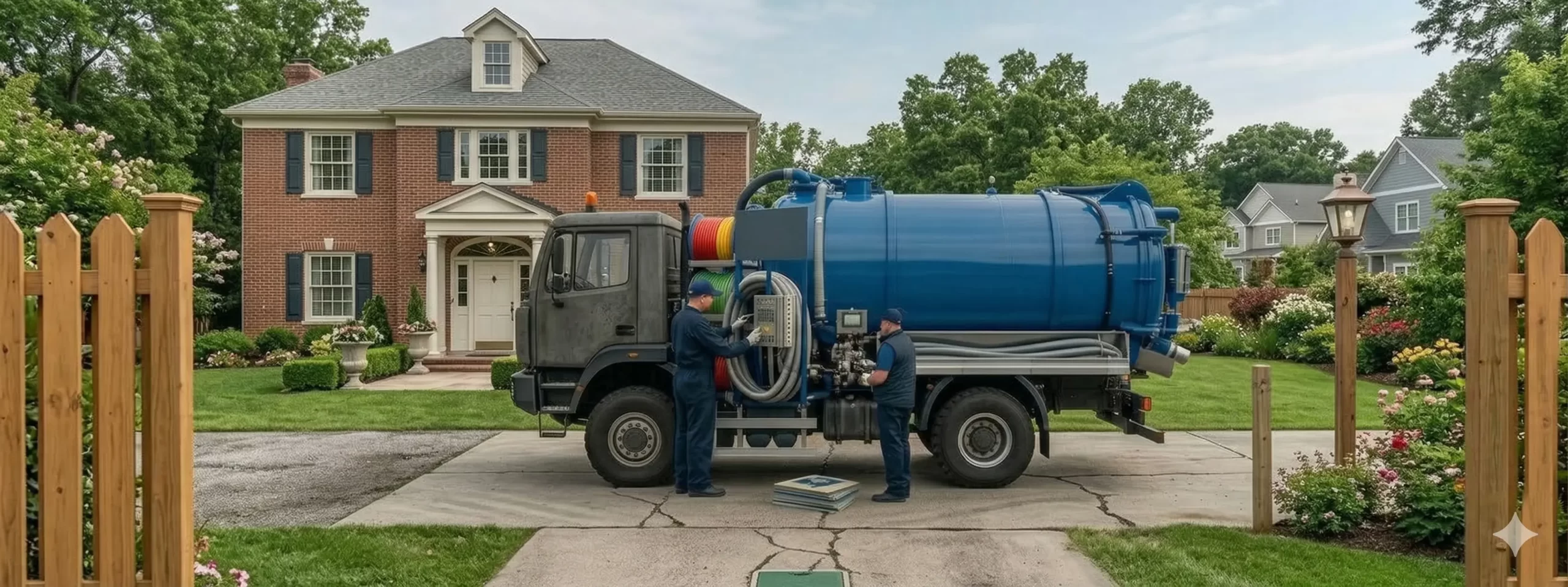
- Steep Riverfront Hose Deployments: Strategically parking heavy 30,000-gallon vacuum trucks on solid ground and deploying up to 250+ feet of heavy industrial hose to safely reach tanks located down steep, rocky drop-offs near the water.
- Granite Rock Excavation & Riser Retrofitting: Utilizing heavy breaker bars and jackhammers to penetrate solid granite and metamorphic rock to access legacy tanks, followed by the highly recommended installation of PVC surface risers to permanently protect the homeowner from future digging fees.
- Hunting Season Hydro-Jetting: Deploying high-pressure water systems to obliterate dense, concrete-like blockages caused by intense weekend usage and “flushable” wipes that notoriously plague hunting cabins and Airbnbs.
🌱 Local Environmental Status
When a septic system fails in the Llano area, the localized consequences are severe and heavily regulated:
- The Granite Bedrock Barrier: The most significant physical challenge in Llano County is the total lack of soil depth. Water cannot naturally percolate downward through solid granite. When a traditional septic tank overflows or a drain field saturates, the liquid effluent is forced outward along the rock shelf, resulting in toxic, raw sewage pooling directly on the surface of your yard or running down steep slopes into the river.
- Llano River Contamination: Properties bordering the Llano River and its tributaries are under intense environmental scrutiny. A failing system that leaks over the bedrock sends raw, nutrient-heavy effluent directly into these critical recreational waterways, triggering toxic algae blooms and violating strict state drinking water protections.
- Hunting Season & Vacation Rental Overload: Llano experiences a massive influx of hunters in the fall and river tourists in the summer. These sprawling short-term rentals and hunting lodges are frequently subjected to industrial-level abuse. Non-biodegradable “flushable” wipes instantly destroy ATU impellers, clog fine-micron diffusers, and cause catastrophic backups.
- Engineered System (ATU) Mandates: Because traditional gravity drain fields fail completely in shallow rock, the vast majority of new homes and riverfront properties are mandated to use mechanical Aerobic Treatment Units (ATUs). These systems require rigorous, uninterrupted maintenance to function in the harsh Hill Country environment.
To protect their investments and the Llano County ecosystem, homeowners must enforce uncompromising maintenance:
- Strict ATU Compliance: If you live near the Llano River with an engineered aerobic system, you must maintain a continuous service contract. Ensure your air compressor and dosing pumps are inspected annually to prevent biological failure and massive fines.
- Tourist & Hunter Mitigation (No Wipes): Vacation rental managers and lease owners must post clear, strict signage prohibiting the flushing of wipes, feminine products, and grease to prevent massive clogs in sensitive rocky systems.
📍 Coverage & ZIP Codes
🏡 Real Estate Transactions
Navigating a property transfer involving an OSSF in Llano County demands precision:
- Llano River Environmental Clearances: Appraisers, title companies, and lenders for properties near the river demand rigorous proof that the septic system is not illicitly discharging into the watershed. A full pump-out and a strict structural integrity test by a TCEQ-licensed professional are required to secure a mortgage or transfer riverfront property.
- Hunting Ranch Commercial Due Diligence: Investors purchasing high-capacity hunting lodges must secure a complete system pump-out and high-pressure line jetting during the option period. These systems are notoriously abused with grease and wipes, requiring proof of functionality before a commercial or agricultural lender will approve the loan.
- Bedrock Drain Field Inspections: Buyers of homes in rugged, rocky terrain should always demand a structural camera inspection of the drain field. Because the lines are buried so shallowly over the granite, they are incredibly susceptible to being crushed by heavy ranch vehicles or thick tree roots.
⚠️ Local Regulatory Warning
The Llano Transit Route
Track the estimated physical distance of your service crew. Most local pros utilize these exact regional hubs.
Time-Restricted Pumping
When you pump is just as important as how you pump. Here is the golden season for Llano residents.
Why Llano is Pumping Now
The data is clear. Residents are prioritizing maintenance, driving up demand for local septic technicians.
Llano Ground Moisture Report
See the real-time soil index. When the ground is saturated, your septic tank fills up dangerously fast.
The Llano Sludge Metric
Local habits change how your tank separates waste. Keep this warning level in mind.
True Cost of Ownership
A routine pump seems annoying until you compare it to local Llano excavation fees. Do the math.
Base Drain Field Replacement in Llano: $16,649
Homeowner Feedback



Reliable Septic Services in
Llano, TX
Llano Septic Expert AI
What are the specific septic tank regulations, typical soil drainage characteristics, and the local permitting authority for Llano County?
Septic System Regulations and Permitting in Llano County, Texas (2026)
As a Senior Environmental Health Inspector and Septic Regulatory Expert for Texas, I can provide you with the precise information you need regarding residential septic systems in Llano County as of 2026. Understanding the local context, particularly in the unique environment of the Texas Hill Country, is paramount for successful and compliant on-site sewage facility (OSSF) operations.
Specific Septic Tank Regulations for Llano County
In Llano County, as with most non-delegated counties in Texas, the primary regulations governing residential septic systems fall under the authority of the Texas Commission on Environmental Quality (TCEQ). The foundational state rule is:
- 30 Texas Administrative Code (TAC) Chapter 285 – On-Site Sewage Facilities. This comprehensive chapter dictates everything from permitting requirements, site evaluation, design criteria, installation standards, and operational guidelines for all OSSFs in Texas, including conventional and aerobic systems.
Key aspects of TCEQ Chapter 285 that are particularly relevant in Llano County include:
- Site-Specific Design: Every OSSF must be designed by a licensed professional (Professional Engineer or Registered Sanitarian) based on a thorough site evaluation, including soil analysis.
- Minimum Setback Distances: Strict setbacks from property lines, water wells, streams, lakes, and buildings are enforced to prevent contamination.
- Maintenance Requirements: Aerobic treatment units (ATUs), which are common in Llano due to soil conditions, require regular maintenance contracts and periodic inspections to ensure proper operation.
- Discharge Standards: Treated effluent from aerobic systems must meet specific quality standards before discharge (typically spray or drip irrigation).
While Llano County itself does not have separate, more stringent county-level septic ordinances beyond TCEQ Chapter 285, its local permitting authority strictly enforces these state regulations.
Typical Soil Drainage Characteristics in Llano County
Llano County, situated in the heart of the Central Texas Hill Country, is predominantly characterized by challenging soil conditions for conventional septic systems. The typical soil drainage characteristics include:
- Shallow Soils: Much of the county features relatively shallow topsoil depths, often underlain by significant limestone or granite bedrock. This limits the available soil depth for effluent absorption.
- Rocky/Calcareous Soils: Soils are frequently rocky, containing fragments of limestone, granite, or chert. Calcareous soils can also impact nutrient absorption.
- Variable Textures: While some areas may have sandy loams or loamy sands with moderate permeability, large portions consist of clay loams or even heavy clays (e.g., Tarrant and Doss series soils) which exhibit very slow percolation rates.
- Fractured Bedrock: The underlying bedrock, while solid in many places, can also be fractured. Direct discharge into fractured bedrock is a significant concern due to the potential for groundwater contamination.
These soil characteristics have a direct and profound impact on drain field design:
- Limited Conventional Systems: Due to shallow depths and poor percolation rates, conventional gravity-fed drain fields (leach fields) are often not feasible or permitted for new installations.
- Prevalence of Aerobic Treatment Units (ATUs): Aerobic systems are the most common type of OSSF installed in Llano County. These systems provide a higher level of treatment, producing a cleaner effluent that can be safely dispersed over a smaller area, often via spray irrigation or drip fields, which can compensate for poor soil absorption.
- Alternative Systems: Other alternative systems such as low-pressure dosing (LPD) fields, mounded systems, or evapotranspiration beds may be required in very challenging sites to increase the effective soil absorption area or manage effluent with difficult soil characteristics.
- Larger Dispersal Areas: Even with advanced treatment, the poor absorptive capacity of the soil typically necessitates larger dispersal areas (spray fields or drip fields) than would be required in areas with highly permeable soils.
Local Permitting Authority for Llano County
The local permitting authority for On-Site Sewage Facilities in Llano County is the Llano County On-Site Sewage Facility (OSSF) Program, which operates under the authority of the Llano County Commissioners Court. This program is typically managed by a designated OSSF Coordinator or Inspector.
- Application Process: Applications for OSSF permits are typically submitted through the Llano County Clerk's Office, which then forwards them to the OSSF Coordinator for review.
- Technical Review and Inspection: The Llano County OSSF Coordinator/Inspector is responsible for the technical review of design plans, conducting site evaluations, and performing required inspections during the installation process (e.g., tank placement, drain field layout, final inspection).
- Contact: For specific questions regarding permit applications, design requirements, or inspections, property owners should contact the Llano County Clerk's Office to be directed to the current Llano County OSSF Coordinator.
Realistic 2026 Cost Estimates for Llano County
Please note that these are estimates based on current market trends and projected inflation for 2026. Actual costs can vary significantly based on site-specific conditions, system complexity, and the contractor selected.
- Septic Tank Pumping (Residential):
- For a standard 1,000 to 1,500-gallon conventional or aerobic trash tank: Expect to pay in the range of $350 to $700. Factors influencing this include accessibility, location within the county, and the last time the tank was pumped.
- New Septic System Installation (Residential):
- Conventional System (if site-appropriate, rare for new construction): If exceptional soil and site conditions allow, costs could range from $9,000 to $18,000+. This is becoming increasingly uncommon for new builds in Llano County.
- Aerobic Treatment Unit (ATU) System with Spray or Drip Field (most common): Due to the challenging soils, the majority of new installations will be aerobic systems. Costs for a typical 3-bedroom home can range from $20,000 to $38,000+. This includes the aerobic unit, pump tank, disinfection system, and the necessary spray or drip irrigation field, which often requires significant earthwork due to shallow bedrock.
- Alternative Systems (Mounded, LPD, etc.): For particularly difficult sites requiring more complex designs, costs could escalate to $30,000 to $45,000+.
These installation costs factor in the system components, design by a licensed professional, permitting fees, excavation, labor, and final inspection. It is highly recommended to obtain multiple bids from TCEQ-licensed OSSF installers who are experienced with Llano County's specific soil conditions and regulatory environment.