
Diagnosis: A buzzing well pump that fails to start is most often caused by a faulty start capacitor or a defective start relay within the external 3-wire control box. This failure prevents the single-phase motor from creating the necessary rotating magnetic field to begin operation, resulting in a loud hum and a tripped breaker.
In this Guide:
What Causes the Universal Buzzing but no start Issue?
In a single-phase submersible pump system, the motor requires an auxiliary electrical ‘push’ to initiate rotation. This is the primary function of the start capacitor and start relay housed in the wall-mounted control box. The start capacitor stores a significant electrical charge and, upon demand from the relay, discharges it through a dedicated ‘start’ winding in the motor. This creates a secondary, phase-shifted magnetic field relative to the main ‘run’ winding. It is this engineered magnetic imbalance that generates the initial starting torque, forcing the motor’s rotor to turn. When you hear the pump buzzing or humming but not starting, it’s the sound of the main winding being energized but without the corresponding starting kick; the motor is ‘stuck’ between magnetic poles, drawing immense current—known as Locked Rotor Amperage (LRA)—but producing zero rotational force.
The technical failure typically originates from one of two components. The most common culprit is the start capacitor. Over time, due to voltage spikes, heat, or simple age, the dielectric material inside the capacitor degrades, reducing its ability to hold a charge (measured in microfarads, µF). When its capacitance drops below a critical threshold, it can no longer provide the necessary jolt to the start winding. Alternatively, the capacitor can fail shorted, creating a direct path to ground. The second point of failure is the potential relay. This relay is designed to energize the start circuit for a fraction of a second and then disconnect it once the motor approaches its operational speed. The high inrush current can cause the relay’s internal contacts to arc and eventually weld themselves shut, or the relay’s coil can burn out, preventing it from closing the contacts at all. In either case, the start winding is never properly energized, leading to the tell-tale hum of a stalled motor.
The consequences of this failure mode extend beyond a simple lack of water. Each time the system attempts to start, the motor draws LRA, which can be 5-7 times the normal running current. This massive current flow generates extreme heat in the motor windings down in the well. While the thermal overload protector in the control box is designed to trip and prevent a fire, repeated failed start attempts can progressively cook the motor’s enamel winding insulation. This thermal stress can lead to micro-fractures in the insulation, eventually causing a winding-to-winding or winding-to-ground short, which permanently destroys the motor. Although the pump’s bearings and mechanical seals are not directly affected since there is no rotation, the severe overheating of the motor housing can accelerate the degradation of nearby polymer components and compromise the motor’s hermetic seal over the long term.
DIY Troubleshooting Steps
- Absolute Safety First – Power Disconnect: Before touching any component, locate the double-pole circuit breaker for the well pump in your main electrical panel. Turn it completely off. For added security, apply a piece of tape over the breaker with a ‘Do Not Turn On’ note. A 240V system is unforgiving.
- Visual Inspection of the Control Box: Open the cover of the pump control box on the wall. Look for obvious signs of failure. Is there a burnt electronics smell? Are there black soot marks around the relay or terminals? Look closely at the start capacitor (the larger of the two cylinders, if you have two); is its top domed or bulging, or is there any fluid leaking from it? These are clear indicators of component failure.
- Check the Thermal Overload Reset: Most control boxes have a small, often red, reset button for the thermal overload. If this button is popped out, it means the motor has been overheating from drawing excessive current. Press it firmly to reset it. If it trips again immediately on the next start attempt, you have confirmed a severe over-current condition.
- Listen for the Click and Buzz: With the cover still off (but standing clear of any wiring), have someone else momentarily restore power at the breaker. Listen carefully. You should hear a sharp ‘click’ from the pressure switch, followed by a ‘clunk’ from the relay in the control box and the loud buzzing. If the buzz is coming directly from the control box itself, it strongly points to a failed relay struggling to engage.
- Measure Amperage (Advanced): If you are proficient with a clamp-on ammeter, clamp it around one of the two hot ‘line’ wires coming into the control box. When power is applied, observe the reading. If it spikes to a very high number (check the motor nameplate for the LRA rating) and stays there while the pump hums, it confirms the motor is stalled and the start circuit is not functioning. A successful start would show a brief spike followed by a drop to the normal Run Load Amps (RLA).
- Safely Discharge and Test the Capacitor: **WARNING: Capacitors store a lethal charge even when power is off.** With power locked out, use a screwdriver with a heavily insulated handle to bridge the two terminals of the start capacitor for several seconds to safely discharge it. You may see a small spark. Once discharged, disconnect its wires and set your multimeter to the capacitance (µF) setting. A healthy capacitor will read within +/- 10% of the rating printed on its side. A reading of zero or significantly below spec means it has failed.
When to Call a Professional Well Service
Upon arrival, a professional technician’s first step is to confirm the symptom and perform a systematic diagnosis, starting at the control box. After verifying a complete power lockout, the technician will conduct a thorough visual and olfactory inspection of the box’s interior. Using a multimeter with a capacitance function, they will test the start capacitor’s microfarad rating against its specifications, having safely discharged it first. They will also test the start relay, checking the coil for proper resistance (ohms) and manually testing the contacts for continuity. If these surface components are faulty, the repair is straightforward: replace the defective part or, more commonly, the entire control box assembly with a new, factory-matched unit to ensure all components are fresh and correctly rated for the pump’s horsepower.
If the control box components test satisfactory, the problem may lie with the motor itself or the wiring going down the well. At this stage, specialized diagnostic equipment is required. The technician will use a megohmmeter, often called a ‘Megger’, to perform an insulation resistance test. This instrument applies a high voltage (500-1000V) to the motor windings to detect any leakage of current to ground, which would indicate failed insulation. If the readings are poor at the control box, the technician will proceed to the wellhead. Using a specialized T-handle pitless adapter key, they will disengage the pump assembly from the pitless adapter inside the casing and raise it slightly to access the heat-shrink splice connecting the submersible drop cable to the motor leads. Testing here isolates the problem to either the underground wire or the motor itself.
Safety Protocol
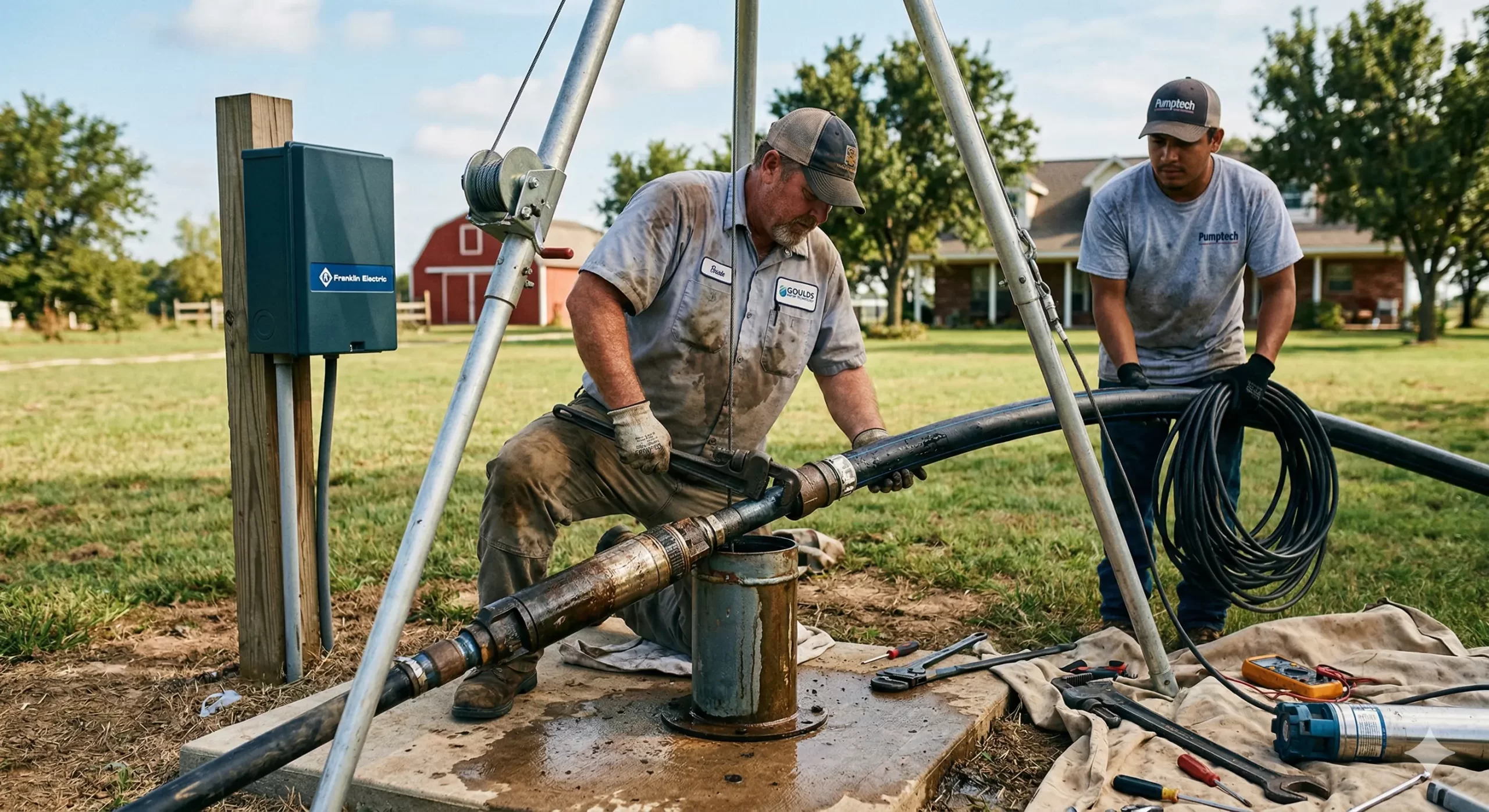
Handling a 240V system connected to a heavy, deep-set pump is a high-risk operation. A strict safety protocol is non-negotiable. All electrical work begins with a confirmed Lockout/Tagout (LOTO) procedure at the breaker panel to prevent accidental re-energization. When the pump must be pulled, a dedicated pump hoist or derrick rig is mandatory. These rigs provide a mechanical advantage and, crucially, a braking system to prevent the several hundred pounds of pump, pipe, and water-filled cable from free-falling down the well, which could sever the assembly or damage the well casing. Technicians will wear appropriate Personal Protective Equipment (PPE), including insulated gloves and safety glasses. Attempting to pull a pump by hand or with a standard vehicle is exceptionally dangerous and is the leading cause of lost equipment and serious injury in this trade.
Repair Cost & Time Assessment
The cost and time for this repair depend entirely on the diagnosis. For the most common scenario—a failed start capacitor or relay—the repair is confined to the surface. A professional can typically diagnose and replace the entire control box in about 1 to 1.5 hours. The cost for a new, high-quality control box ranges from $150 to $400, depending on the brand and motor horsepower. Combined with a service call fee and labor charges (typically $125-$200 per hour), the total cost for a control box replacement usually falls between $350 and $750.
However, if the diagnostic tests point to a failed motor or a damaged drop cable down the well, the scope of the job expands dramatically. The service call now involves pulling the pump, which requires a pump hoist rig and often a two-person crew. Labor time increases to 3-6 hours or more, depending on the pump’s depth and any complications. The cost of using the specialized pulling rig is factored into the labor rate or as a separate line item. In this case, the initial diagnostic and pump-pulling labor alone can cost $800 to $2,000, before accounting for the cost of a new pump, wire, or any other necessary parts. This is why a thorough and accurate initial diagnosis at the control box is critical to managing customer expectations and costs.
Fast Local Service & Diagnostics
Calls are routed to a licensed local well professional.