
Diagnosis: A sputtering faucet indicates your submersible pump is sucking air, a critical condition caused by a dropping water table or a pump oversized for the well’s yield. This starves the pump of water, causing severe overheating and internal damage. Professional repair involves a well yield test and either lowering the pump or installing a flow control valve to prevent burnout.
In this Guide:
What Causes the Universal Sputtering Air from Faucet Issue?
The primary cause of air sputtering from faucets is that the pump’s intake is no longer fully submerged in water. This typically occurs for one of two reasons. First, the static water level in the well has dropped due to drought conditions or increased water usage in the surrounding area, leaving the pump hanging in open air. Second, the pump’s flow rate (gallons per minute, or GPM) is significantly higher than the well’s yield — its ability to replenish itself from the aquifer. In this scenario, the pump rapidly draws the water level down below its intake, a condition known as ‘outrunning the well’. In either case, the pump begins to pull in a mixture of air and water, creating cavitation and sending slugs of air through the plumbing to your fixtures.
This condition is mechanically catastrophic for a submersible pump. These units are designed to be cooled and lubricated by the very water they are pumping. When air is introduced, the motor, which is sealed inside the pump housing, loses its primary cooling medium. The motor windings rapidly overheat, which can melt their enamel insulation, leading to an electrical short and complete motor failure. The lack of water flow also starves the internal components of lubrication. The pump’s multi-stage impeller assembly and bearings, often made of engineered polymers or stainless steel, rely on water to prevent friction and dissipate heat. Without it, they will gall, seize, or literally melt, destroying the pump’s hydraulic end.
Furthermore, the mechanical shaft seal, which separates the wet ‘hydraulic end’ from the oil-filled motor housing, is also water-cooled and lubricated. Cavitation and dry running cause this seal to overheat and fail. Once the seal is compromised, well water can intrude into the motor housing, contaminating the oil, shorting the windings, and causing irreversible failure. The repeated violent action of cavitation also sends shockwaves through the pump assembly, which can lead to shaft fatigue and eventual fracture. Ignoring this symptom guarantees catastrophic and expensive pump failure.
DIY Troubleshooting Steps
- Observe and Document the Symptom: Note precisely when the sputtering occurs. Is it after a long shower? When the washing machine and dishwasher run simultaneously? Or does it happen every time the pump cycles? This pattern provides crucial diagnostic clues about the severity of the well yield issue.
- Check Pressure Tank and Switch: Ensure your pressure tank’s pre-charge is correct. With the pump breaker off and the system drained, check the air pressure via the Schrader valve; it should be 2 PSI below the pump controller’s cut-in pressure setting (e.g., 38 PSI for a 40/60 switch). An improperly charged tank can cause rapid cycling, which can exacerbate drawdown issues.
- Listen at the Well Head: When the pump is running, listen carefully at the well cap. A gurgling or cascading water sound can indicate that the water level is extremely low and water is falling back down the well bore around the pump. This is a definitive sign of a severe drawdown problem.
- Inspect the Pump Control Box: Locate the pump’s control box. Look for a manual thermal overload reset button. If it has tripped, you can reset it ONCE. If it trips again, do not continue to reset it. This indicates the motor is overheating severely, and continued operation will burn it out completely.
- (Advanced) Measure Amperage Draw: If you are a qualified individual with a clamp-on ammeter and are comfortable working with 240V systems, measure the amperage on one of the pump’s power legs at the control box. Compare this reading to the Full Load Amps (FLA) printed on the control box or motor tag. A pump sucking air is not under load and will draw significantly less current than its FLA rating. This is a key professional diagnostic step.
- Review Well Driller’s Report: Locate the original paperwork for your well. This document should list the total well depth, the original static water level, the pump’s setting depth, and, most importantly, the tested well yield in GPM. Comparing these figures to the pump’s nameplate GPM can quickly reveal if the pump was oversized from the start.
When to Call a Professional Well Service
Upon arrival, a certified technician’s first step is a comprehensive diagnostic assessment, not immediate pump pulling. They will confirm voltage at the control box and perform an insulation resistance test on the motor windings using a megohmmeter (often called a ‘Megger’). This test sends high voltage through the motor windings to detect any breakdown in the insulation, which indicates imminent or existing motor failure from overheating. Next, a well yield and drawdown test is performed. This involves using a water level sounder to measure the static water level, then running the pump and tracking how far and how fast the water level drops (drawdown) and how quickly it recovers. This data is non-negotiable for a correct diagnosis and solution.
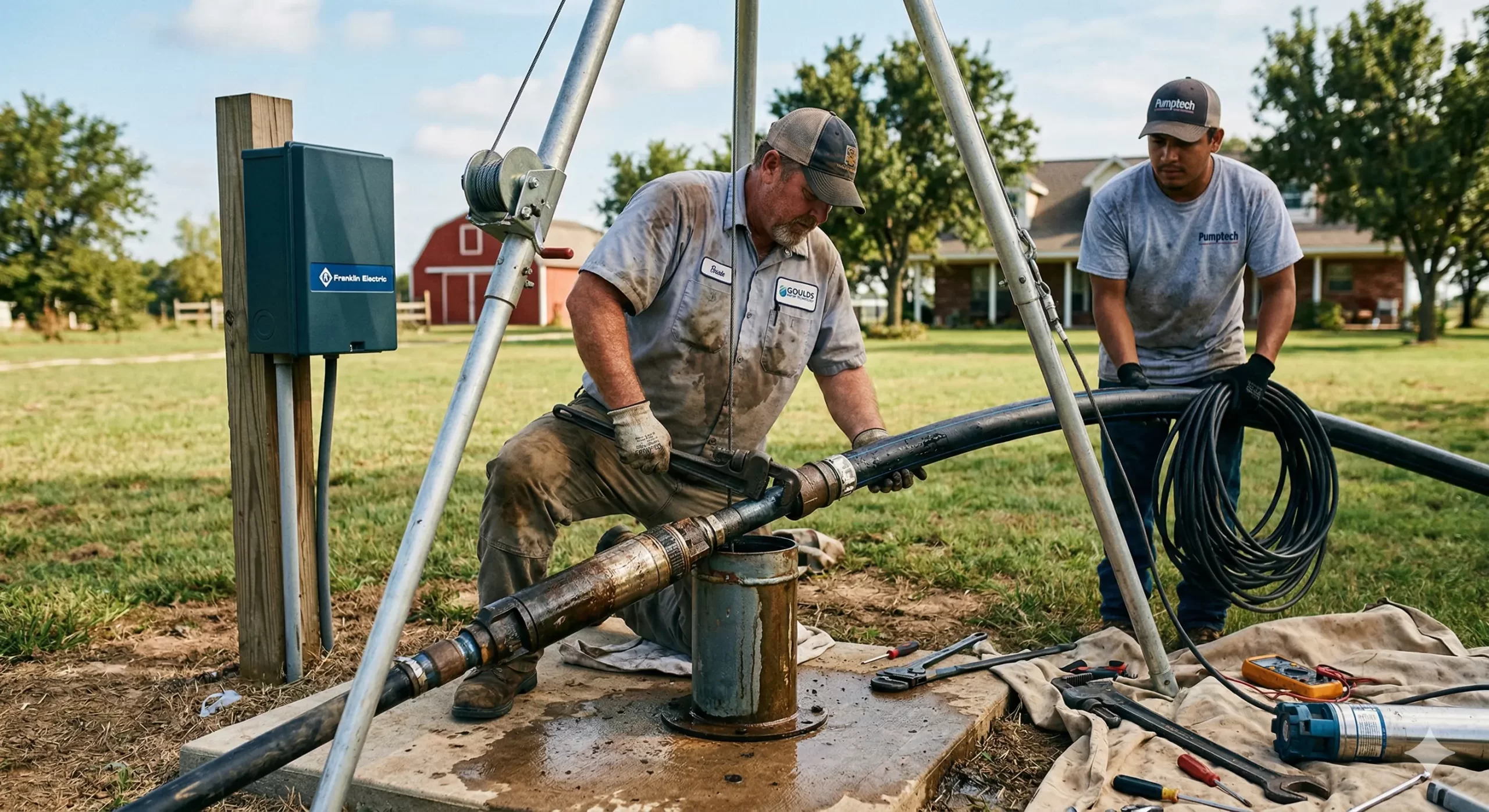
Safety Protocol: Extracting a submersible pump is a high-risk operation that should never be attempted without proper equipment and a two-person crew. The technician will begin by performing a full lockout/tagout on the 240V circuit breaker to ensure the system cannot be accidentally energized. The combined weight of the pump, hundreds of feet of water-filled drop pipe, and heavy-gauge submersible wire can easily exceed 500 lbs. Attempting to lift this manually is impossible and will likely result in dropping the entire assembly to the bottom of the well, a catastrophic event that can destroy the well itself. A professional crew uses a dedicated pump hoist or a tripod pulling rig with a heavy-duty electric winch. This rig is securely positioned over the wellhead, and a specialized T-handle key is used to engage and unlock the pitless adapter deep inside the casing, allowing the entire assembly to be safely winched out of the well.
With the pump out of the well, the technician can implement the correct repair. If the diagnostic tests show the well has adequate depth and the issue is a lowered water table, the solution is to add one or two 20-foot sections of drop pipe and splice in additional submersible wire using waterproof, heat-shrink splices. The pump is then lowered deeper into the well, ensuring it remains below the new, lower pumping water level. However, if the well yield test proves the well is a ‘low yield’ well and the pump is simply oversized, lowering it may not solve the problem. In this case, the technician will install a flow control valve, such as a Dole Valve, into the drop pipe. This is a self-regulating orifice that physically limits the pump’s GPM output to match the well’s slow recovery rate, preventing drawdown and ensuring the pump remains submerged and protected.
Repair Cost & Time Assessment
The cost for a professional repair of a pump sucking air in the United States typically ranges from $900 to $3,500. The final price is heavily dependent on the depth of the well, the accessibility of the wellhead, and the extent of any damage to the pump. A more straightforward job, involving pulling the pump, adding one section of pipe, and reinstalling it (a 4-6 hour job for a two-person crew), will fall in the $900 to $1,600 range. This cost includes the service call fee, labor charges, and the fee for using the specialized pump pulling rig.
The higher end of the cost spectrum, from $2,000 to $3,500+, is encountered when the pump has been run dry for too long and has failed. In this scenario, the customer is paying for the full pump pulling and re-installation service, plus the cost of a new, high-quality stainless steel submersible pump and motor (which can range from $800 to $1,800 alone for a typical residential model), a new length of submersible wire, and potentially a new flow control valve or other components. This is a full-day job and reflects the significant cost of both specialized labor and premium-grade replacement equipment designed for decades of service.
Fast Local Service & Diagnostics
Calls are routed to a licensed local well professional.