
Diagnosis: Submersible pump failure from sand is caused by extreme abrasive wear on internal hydraulic components like impellers and diffusers. This results in a complete loss of water pressure even though the motor runs. A professional repair involves replacing the pump’s hydraulic section (wet end) and often requires installing a sand separator or flow sleeve to prevent recurrence.
In this Guide:
What Causes the Water Quality Sand in faucet aerators Issue?
The primary cause of this failure mode is rooted in basic fluid dynamics and material science. When a submersible pump operates in a well with high concentrations of fine sand, silt, or rock sediment, it ingests an abrasive slurry. This mixture is accelerated to high velocities within the pump’s hydraulic assembly, known as the ‘wet end’. The precision-engineered surfaces of the polycarbonate or stainless steel impellers and diffusers are not designed to handle solids. The sand acts like industrial sandpaper, rapidly eroding the leading edges of the impeller vanes and scouring the smooth, curved passages of the diffusers. This erosion dramatically increases the internal clearances between the rotating and stationary components, leading to a phenomenon called ‘hydraulic slippage.’ Instead of lifting water, the pump simply recirculates it internally, resulting in a catastrophic loss of discharge pressure and flow, even while the motor consumes full power.
The mechanical damage extends beyond the primary hydraulic components. Abrasive particles inevitably migrate into critical wear points, such as the pump’s shaft bearings and mechanical seals. These components rely on clean water for lubrication and cooling. Sand contamination displaces this lubricating film, causing direct, high-friction contact that generates excessive heat and leads to rapid wear. A compromised mechanical seal, which separates the wet end from the oil-filled motor housing, will allow water and abrasives to penetrate the motor. This contamination displaces the motor’s cooling oil, corrodes bearings, and creates a pathway for catastrophic electrical failure.
Electrically, the consequences of this mechanical degradation are severe. As the pump’s hydraulic efficiency plummets, the motor must work harder to attempt to build pressure, causing amperage to climb well above the nameplate Full Load Amps (FLA). This sustained over-current condition generates immense heat in the motor windings, which are tightly-wound, insulated copper wires. The excessive heat degrades and eventually melts this insulation, leading to a short circuit between windings or a direct short-to-ground fault. Initially, this will trip the thermal overload protector in the control box. However, repeated tripping or a failed overload protector will result in a complete motor burnout, a condition easily verified by a technician using a megohmmeter to test insulation resistance.
DIY Troubleshooting Steps
- Inspect Faucet Aerators: The first and most definitive sign is sand accumulation. Unscrew the aerators from several faucets in your home. If you find a gritty, dark sediment, you have confirmed that your well is producing sand and it is being passed by the pump.
- Observe the Pressure Switch and Gauge: Locate your pressure tank and watch the pressure gauge as water is used. Does the pump kick on at the cut-in pressure (e.g., 40 PSI) but then run continuously without ever reaching the cut-off pressure (e.g., 60 PSI)? This indicates the pump can no longer generate sufficient head pressure.
- Listen at the Wellhead and Control Box: You should hear the distinct ‘clunk’ of the pressure switch contactor engaging, followed by the hum of the motor. If you hear the motor running but see no corresponding rise in pressure on the gauge, the wet end has failed.
- Measure Amperage (Qualified Personnel Only): If you are trained and have a clamp-on ammeter, carefully measure the current on one of the motor’s power legs at the control box. A pump that is drawing near or above its rated FLA but producing no pressure is a classic symptom of a completely worn-out hydraulic section.
- Check the Thermal Overload Reset: Open your pump control box and look for a reset button. If this button has tripped, it means the pump motor was overheating due to excessive load. Reset it once. If it trips again quickly, do not continue to reset it, as this can lead to permanent motor damage. Call a professional immediately.
- Monitor Cycle Time: Pay attention to how long the pump runs to satisfy demand. A healthy system might run for 1-2 minutes to refill the pressure tank. A pump with severe abrasive wear might run for 5-10 minutes or indefinitely, struggling to build pressure.
When to Call a Professional Well Service
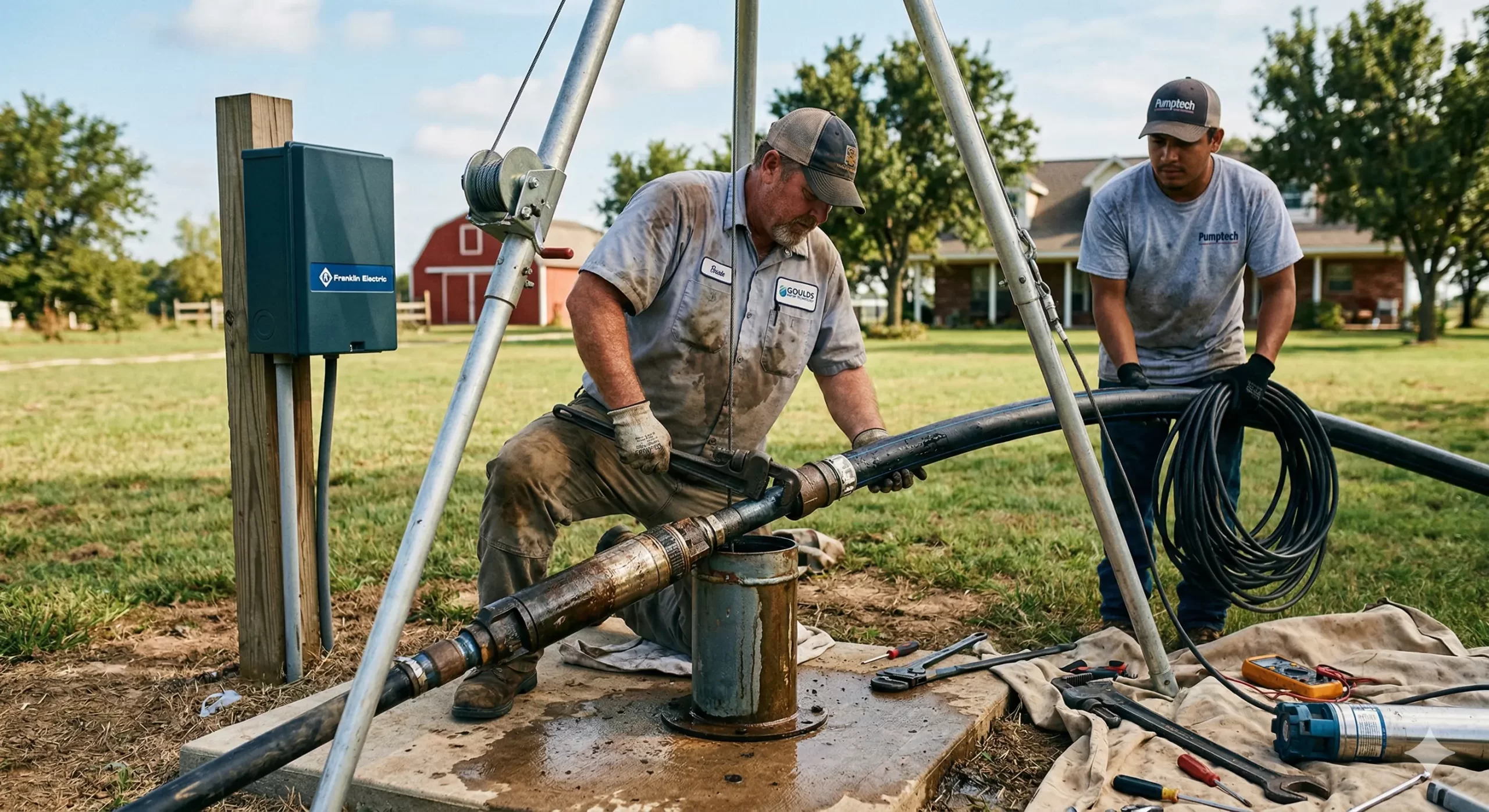
A professional service call begins with a systematic and safe diagnostic procedure. Upon arrival, the technician will first perform a complete electrical checkout at the pump’s control box. This involves verifying correct voltage and using a megohmmeter (‘megger’) to test the insulation resistance of the motor windings through the drop cable. This critical test determines if the failure is isolated to the hydraulic ‘wet end’ or if the motor itself has suffered a terminal short-to-ground fault. If the motor tests healthy, the technician proceeds to the wellhead. After ensuring the circuit is de-energized via lockout/tagout protocol, they will utilize a heavy-duty pump hoist or pulling rig. A specialized T-handle pitless adapter key is inserted down the well casing to disengage the pump assembly from the underground discharge pipe, allowing for extraction.
Once the pump is on the surface, a physical teardown inspection commences. The technician separates the motor from the hydraulic section. The diagnosis is typically immediate and obvious: the impellers will have their edges worn down to nubs, and the diffuser stack will be scoured and scored internally. The technician will then install a brand-new, factory-matched wet end onto the existing motor, ensuring the splined shaft is clean and properly seated. The electrical connection between the motor leads and the drop cable is remade using high-quality, waterproof heat-shrink splice kits, a critical step for ensuring a multi-year service life thousands of feet underground.
The final phase involves reinstallation and implementing preventative measures. The rebuilt pump assembly is carefully lowered back into the well using the hoist. To prevent a rapid recurrence of the same failure, the technician will recommend solutions based on the well’s specific conditions. This may involve raising the pump intake several feet higher in the well column to avoid a sand-producing zone. For wells with persistent sand issues, the best practice is to install a protective flow sleeve around the pump and motor to ensure proper cooling velocity and/or install a centrifugal sand separator on the surface plumbing between the wellhead and the pressure tank. Following reinstallation, the system is fully pressure tested, sanitized with chlorine to ensure potability, and the amperage draw is checked to confirm it is within nameplate specifications.
Safety Protocol: A submersible pump system operates on high-voltage (240V) and involves extremely heavy equipment. The combined weight of the pump, motor, drop pipe filled with water, and power cable can easily exceed 500 lbs. Attempting to pull a pump manually is exceptionally dangerous and can result in equipment loss, well damage, or severe personal injury. A dedicated pump hoist provides the mechanical advantage and control necessary for safe extraction and reinstallation.
Repair Cost & Time Assessment
For a professional repair of a submersible pump destroyed by sand abrasion, a homeowner in the United States should expect the cost to range from $1,800 to $4,500. This is a significant range dictated by several factors. The lower end of this estimate typically covers a shallower well (e.g., under 200 feet) where only the hydraulic wet end needs replacement, and the job can be completed in 2-3 hours by a two-person crew. The higher end of the range reflects more complex scenarios, such as a deep-set pump (300+ feet), the need for a full pump and motor replacement, the use of premium stainless steel components, or the installation of additional preventative equipment like a spin-down filter or a centrifugal sand separator system.
The final invoice is a composite of several critical costs. The majority comes from the specialized labor, typically billed at $150-$250 per hour for a lead technician and an assistant. The mobilization and use of a dedicated pump hoist or crane rig often adds a flat fee of $300-$600. The cost of the replacement parts themselves is a major variable; a standard thermoplastic wet end might cost $400, while a more durable stainless steel version could be over $1,200. Finally, miscellaneous materials like heavy-duty heat-shrink splices, new torque arrestors, and well sanitization chemicals contribute to the total. This investment ensures the repair is performed safely with the correct equipment and durable parts, protecting the longevity of your water system.
Fast Local Service & Diagnostics
Calls are routed to a licensed local well professional.