
Emergency Well Pump Repair in Waxahachie, TX
Folks often don’t realize the harsh realities of pulling water out of the ground here in Waxahachie. It ain’t like some places where you just poke a hole and water gushes. We’re dealing with deep formations, shifting soils, and a demand that can really strain a system, especially during those long, dry Texas summers. Cheap pumps just don’t cut it when your livelihood or home comfort depends on a consistent water supply.
Our local groundwater comes primarily from the Trinity Aquifer system, which includes the Paluxy and Glen Rose formations. While it’s generally good water, accessing it means drilling through layers of limestone, shale, and often very dense clays. These geological conditions make well drilling and pump installation a specialized job that demands specific knowledge of the local strata.
Many folks learn the hard way that a bargain-basement pump from a big box store just isn’t built for the long haul in Ellis County. The stress of constant cycling, the abrasive nature of our water (sand & minerals), and the sheer depth required to get good yield will chew up an inferior pump in no time, leaving you without water and facing a bigger bill than if you’d just done it right the first time.
Fast Local Service & Diagnostics
Calls are routed to a licensed local well professional.
Well Pump Repair in
Waxahachie
Waxahachie & Ellis County Well Stats
Ellis County has a significant number of private wells, especially in the unincorporated areas. Most are drilled into the Trinity Aquifer. Water levels can fluctuate depending on rainfall and regional pumping, making it crucial to have a well drilled by a licensed professional who understands local hydrology. Well yields can vary, but generally, a properly constructed well here can provide sufficient water for domestic use.
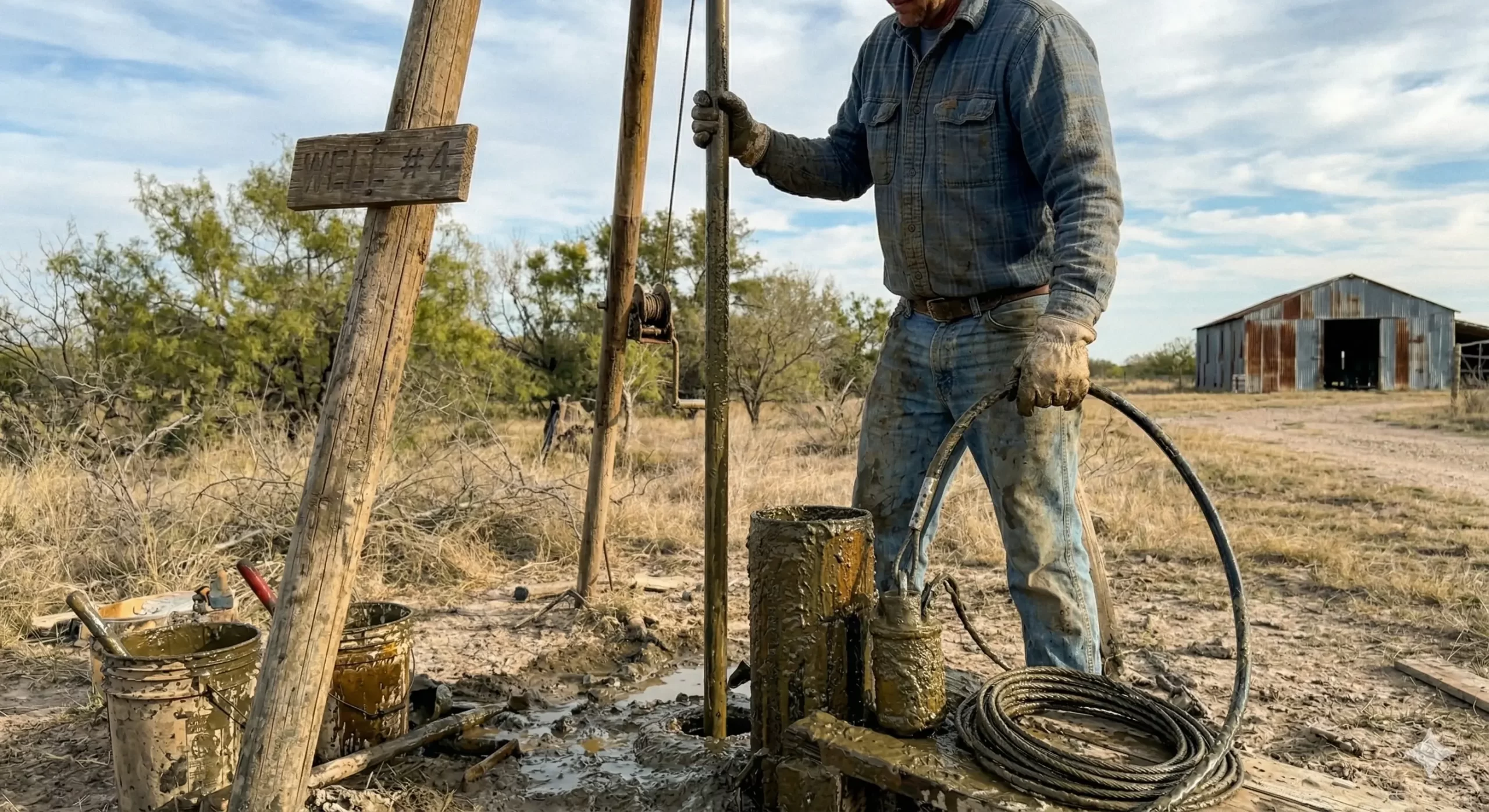
Pulling a pump in Waxahachie, particularly out in the rural areas, ain’t cheap for a reason. Often, we’re working with wells drilled deep into limestone and shale, meaning a substantial column of pipe and wire has to be extracted. This requires heavy-duty well service rigs, not just a pickup truck with a winch. Access can also be a challenge on some properties, requiring careful maneuvering of equipment.
The equipment needed goes beyond just the pump itself. You’ve got specialized pipe wrenches, pulling rigs with sufficient lift capacity for hundreds of feet of pipe, heavy-gauge electrical wire, and often a crane or boom truck. Plus, we’re talking about experienced crews who understand the geology and safety protocols specific to our area, ensuring the job is done right and safely the first time.
Spring Well Maintenance in Texas
Heavy spring rains can cause surface runoff to breach well caps. We strongly recommend testing your water for coliform bacteria and inspecting the sanitary seal.
Save $500+ on Replacements
Via the TX Energy Co-op VFD Upgrade Program
73°F in Waxahachie
Local Aquifers & Geology
The primary groundwater sources in Waxahachie include the Trinity Aquifer (specifically the Paluxy and Glen Rose formations). This aquifer system is a major source of groundwater across Central Texas. It’s composed primarily of sandstones, limestones, and shales. The water quality is generally good, though it’s typically hard and can sometimes have elevated levels of iron or hydrogen sulfide, depending on the specific formation and depth.. Drilling through the local Waxahachie sits largely within the Blackland Prairie region, characterized by deep, fertile, dark-colored clay soils. These soils are notoriously expansive, meaning they swell significantly when wet and shrink when dry. Below this, we encounter layers of limestone, shale, and sand, typical of the Woodbine and Austin Chalk formations, making for a challenging drilling environment. means that average well depths range from 300 ft – 700 ft.
Due to these geological factors, local homeowners frequently struggle with Motor burn-out due to consistent low-voltage issues or running dry, particularly during prolonged droughts when the well can’t recover fast enough..
Drilling Depth Comparison
Deeper wells require heavy-duty crane hoists for pump extraction.
Climate & Water Quality
Pump systems in the Waxahachie area face severe environmental stressors. The most significant threat is Our extreme Texas heat increases demand on wells, causing pumps to run longer and hotter, leading to premature wear. Droughts lower the water table, increasing the lift required and often causing pumps to run dry, overheating the motor. Conversely, rare hard freezes can burst exposed lines, pressure tanks, or surface components if not properly insulated.
Additionally, the raw groundwater often presents issues with Hardness (high mineral content, leading to scale buildup on fixtures & appliances), occasional iron staining, and sometimes a ‘rotten egg’ smell from hydrogen sulfide (sulfur bacteria). Sand is also a common issue, especially in older wells or those not properly developed..
Regional Groundwater Advisory
Known primary contaminant threat to submersible pumps and pipes in this area:
Common Area Systems
VFD Upgrade Savings
Constant Pressure vs StandardReplacing a standard single-speed pump with a Variable Frequency Drive (VFD) eliminates hard starts and drastically reduces energy draw in Texas.
Compliance & Local Permits
Ellis County Level: For private domestic wells in unincorporated areas of Ellis County, the primary permitting and regulatory body is the Texas Department of Licensing and Regulation (TDLR). While there isn’t a specific local Groundwater Conservation District covering all of Ellis County, all wells must be drilled and maintained by TDLR-licensed professionals, adhere to TDLR’s construction standards (Title 16, Chapter 76), and be registered with the state. If you’re within city limits or certain subdivisions, additional city or HOA permits might be required, so it’s always best to check with your local planning department.
Top Pump Brands in Texas
Most frequently installed hardware based on local geology (2026 data).
- Measure Amperage & Voltage at control box & pump terminals.
- Check Pressure Switch operation & settings.
- Inspect Pressure Tank for proper air charge & bladder integrity.
- Test Well for recovery rate (static & pumping water levels).
- Examine all exposed piping & electrical connections for corrosion or damage.
- Verify proper grounding & surge protection.
Premium Well Pump Brands We Service
Our licensed technicians in Waxahachie are certified to repair, replace, and install high-quality groundwater equipment from industry-leading manufacturers, including:
- No water at all.
- Low water pressure, especially when multiple fixtures are on.
- Pump runs continuously without shutting off.
- Water coming out of the wellhead or nearby ground (indicating a leak).
- Sputtering or air coming out of faucets.
- Higher-than-usual electric bills for no apparent reason.
Waxahachie Real Estate Well Regulations
Local Dispatch & Response Times
Live Dispatch: Texas
Updated Just Now⚠️ High demand. Call now to secure the next available technician.
- Typically within 24 hours for no-water emergencies, often faster.
- Prioritization for medical needs, livestock, or critical business operations.
- Our crews are local and familiar with Ellis County roads & properties.
- Stocked trucks with common parts for quick fixes.
- After-hours emergency service available, but response times may vary.
⚠️ Ellis County & State Regulatory Warning: Abandoned Wells
The Cost of Ignoring Symptoms
Fixing a short-cycling pump early saves thousands in Waxahachie.
Data reflects average well contractor estimates in Waxahachie.
Groundwater Threat Level
Current aquifer and mineral impact on pumps in Waxahachie.
Dropping water tables cause pumps to suck air and overheat.
Hard water calcifies pump impellers, reducing lifespan.
Pump Lifespan Estimator
Select household size in Waxahachie to see strain impact.
Local Waxahachie
Well Pros
Fast Local Service & Diagnostics
Calls are routed to a licensed local well professional.
Septic System Services in Waxahachie, TX
Do you have a septic tank on your property? Proper maintenance is critical to protecting your well water quality.
Waxahachie Homeowner Feedback
“These fellas saved my bacon. Pump went out on a Saturday and they were out here by dinner. Had us fixed up good as new. Can’t beat that for service.”

Local Homeowner
✓ Verified TX
“Our water pressure had been droppin’ for months, real slow-like. Started seein’ sand in the water too, which was a new thing. Called up the crew, and they came out, pulled the pump, and sure enough, the impellers were all chewed up from sand abrading ’em, and the foot valve was clogged. They replaced the whole pump assembly, put in a new sand shroud, and checked the pressure tank. Now we got water flowin’ like a river again. No more grainy coffee! Good job, really appreciate the fix.”

Local Homeowner
✓ Verified TX
“Lost water on a Sunday morning with company coming. Called ’em up, and they got a tech out in record time. Didn’t mess around, got right to it and had us back in business before lunch. You don’t realize how much you depend on water till it’s gone. Lifesavers!”

Local Homeowner
✓ Verified TX
Expert Waxahachie Well System FAQ
My well pump keeps cycling on and off every few minutes, even when no water is being used. What’s going on?
That’s a classic symptom of a few common issues here in Waxahachie. Most likely, it’s either your pressure tank that’s lost its air charge or has a ruptured bladder, or you have a leak somewhere in your well system. When the pressure tank isn’t properly charged, it can’t maintain pressure, causing the pump to short-cycle. A leak, even a small one, will also cause pressure to drop and the pump to kick on to compensate. We’d start by checking the pressure tank, then meticulously inspect all exposed plumbing and connections for any drips or wet spots. If nothing is visible, it could be a leak underground in the drop pipe or even within the well casing, which would require pulling the pump to investigate further.
I’m buying a rural property in Waxahachie with an existing well. What should I absolutely check before closing?
When buying a property with a well in Ellis County, you’ve got to be extra diligent. First, insist on a comprehensive well inspection by a licensed well driller or pump installer, not just a general home inspector. This inspection should include a flow test (gallons per minute over time), a pressure check, and an electrical test of the pump motor. Second, a full water quality test is non-negotiable. At a minimum, check for coliform bacteria and nitrates, but also consider testing for hardness, iron, manganese, and pH, as these are common issues here. Finally, ask the seller for any past well service records, well logs, and the well registration information with TDLR. This gives you a historical perspective on the well’s performance and any recurring problems.
How often should I have my well and pump system serviced in this area?
For folks in Waxahachie, I generally recommend an annual preventative maintenance check-up for your well and pump system, especially if it’s your sole source of water. Our climate and geology put a lot of stress on these systems. An annual check allows us to catch small issues before they become major, costly breakdowns. We’ll check the pressure tank air charge, inspect electrical connections for corrosion, verify pump motor efficiency (amps & voltage), check the pressure switch settings, and ensure the well is recovering properly. This proactive approach can significantly extend the life of your pump and avoid unexpected no-water situations.
What’s the deal with ‘sanding up’ in Waxahachie wells and how do I prevent it?
Sanding up is a real headache here, and it’s basically when fine sand and sediment are drawn into your well casing and eventually into your pump and plumbing. It’s often caused by an improperly developed well, a damaged screen, or sometimes just the natural geology of the formation. You’ll notice it as gritty water, clogged fixtures, or even a decrease in pump efficiency as the impellers wear down. To prevent it, ensure your well was drilled and cased by a reputable, licensed driller who properly developed the well. If you’re experiencing sand, a well professional might recommend installing a sand separator or, in severe cases, pulling the pump to install a sand shroud. Regular flushing of your hot water heater can also help remove accumulated sediment from your household system.
Waxahachie Groundwater Expert AI
What are the specific groundwater regulations, average well depths, and the local conservation district for Waxahachie, Ellis County?
Groundwater Regulations for Residential Wells in Waxahachie, Ellis County (2026)
As a Senior Hydrogeologist and Local Groundwater Regulatory Expert for Texas, I can confirm that as of 2026, Waxahachie in Ellis County, Texas, is NOT situated within the boundaries of a designated Groundwater Conservation District (GCD). This means that primary oversight for residential water wells falls under statewide regulations, rather than specific local GCD rules. The key state agencies involved are:
- Texas Department of Licensing and Regulation (TDLR): TDLR is the primary regulatory body for the licensing of water well drillers and pump installers, and for establishing construction standards for water wells. All water wells in Texas, including those in Waxahachie, must be drilled and completed by a licensed well driller according to TDLR rules.
- Texas Water Development Board (TWDB): The TWDB maintains the statewide water well registry. While residential wells drilled for household use and for watering livestock on tracts larger than 10 acres are generally exempt from state permitting, they are still REQUIRED to be registered with the TWDB once completed. This registration is crucial for statewide water resource planning and data collection.
- Texas Commission on Environmental Quality (TCEQ): TCEQ is responsible for protecting water quality and establishes standards for drinking water. While they do not directly regulate individual residential well construction (TDLR does), they oversee potential contamination sources and provide guidance on water quality testing for private well owners.
Specific State Regulations and Setback Rules
The core regulations governing residential water wells in Waxahachie are found in the following state codes and administrative rules:
- Texas Occupations Code, Chapter 1901: This chapter establishes the requirements for licensing water well drillers and pump installers by the TDLR.
- 16 Texas Administrative Code (TAC), Chapter 76 (Water Well Drillers and Pump Installers): These are the detailed rules from TDLR governing well drilling, completion, and plugging. Key provisions include:
- Well Construction Standards: Requirements for casing, cementing, and prevention of contamination to protect the aquifer.
- Minimum Setback Requirements:
- A minimum of 50 feet from septic tanks, septic tank drainfields, and feedlots.
- A minimum of 100 feet from existing or potential sources of contamination such as sewage treatment plants, waste disposal sites, or chemical storage facilities.
- Wells should be located on the property so as not to be a source of contamination to adjacent properties.
- Texas Water Code, Chapter 35: Pertains to the licensing of water well drillers and pump installers.
- Texas Water Code, Chapter 36: While primarily focused on GCDs, it establishes the general framework for groundwater management in Texas.
Average Well Depths and Aquifer for Waxahachie, Ellis County
Waxahachie sits geologically atop the Trinity Aquifer System. Specifically, residential wells in this area typically draw from the various formations within the Trinity Group, including the Glen Rose Limestone and the Paluxy and Travis Peak Formations. The depth to suitable water-bearing zones can vary significantly based on the specific location within Waxahachie and local hydrogeological conditions.
Based on historical state well logs from the Texas Water Development Board (TWDB) for domestic wells in the Waxahachie area of Ellis County, the average well depth for residential supply typically ranges from approximately 350 to 450 feet. Some wells may be shallower (around 200-300 feet) where the Upper Trinity (Glen Rose/Paluxy) is productive and accessible, while others may extend deeper (up to 600 feet or more) to tap more prolific zones within the Travis Peak Formation, especially if higher yields or better water quality are sought, or if shallower zones have been depleted or impacted.
Local Groundwater Conservation District (GCD)
As confirmed, there is no designated Groundwater Conservation District (GCD) covering Waxahachie or Ellis County as of 2026. Therefore, local permitting and management responsibilities that would typically fall under a GCD defer to statewide regulations enforced by the TDLR, TWDB, and TCEQ.
Official Resources and Forms
Here are some essential official resources for further information:
- Find a Licensed Water Well Driller or Pump Installer (TDLR):
https://www.tdlr.texas.gov/driller/drillerdb.htm - TDLR Water Well Driller and Pump Installer Program Information:
https://www.tdlr.texas.gov/wwp/wwp.htm - TWDB Water Well Registration Information:
https://www.twdb.texas.gov/waterplanning/water_supply/well_registration/index.asp
(Note: While registration forms are linked from this page, they are typically completed and submitted by the licensed driller upon well completion.) - TWDB Groundwater Conservation District Map (to verify GCD coverage):
https://www.twdb.texas.gov/groundwater/districts/map/index.asp - TCEQ Private Water Well Information (for water quality guidance):
https://www.tceq.texas.gov/drinkingwater/private-water-wells
It is highly recommended to consult with a licensed water well driller who is familiar with the specific geological conditions and current regulatory requirements in the Waxahachie area before planning any well construction. They will be your primary point of contact for ensuring compliance and successful well installation.
Fast Local Service & Diagnostics
Calls are routed to a licensed local well professional.
Blix
provides official
Emergency Well Pump Repair services for the
Waxahachie
area.