
Emergency Well Pump Repair in Richmond, TX
Folks out here in Richmond, Fort Bend County, we’re sitting on some challenging ground when it comes to groundwater. Rapid development means increased demand, and that puts a strain on our aquifers. Couple that with the specific geology, and you’ve got conditions that demand robust, reliable well and pump systems. It ain’t like drilling in the Hill Country; we’re dealing with unconsolidated sands and clays that can shift and put stress on your setup.
Our lifeline here is primarily the Gulf Coast Aquifer system, specifically the Chicot and Evangeline aquifers. These are mighty reservoirs, but they’re not inexhaustible, and heavy pumping in our region leads to significant water level declines and, in turn, land subsidence. This means your pump has to work harder to lift water from deeper, and the ground itself can move, affecting well integrity over time.
That’s why cheap, off-brand pumps just don’t cut it in our neck of the woods. The water often carries fine sand and sediment, which acts like sandpaper on impellers and motor bearings. The constant demand, especially during our scorching Texas summers, puts immense thermal and mechanical stress on the equipment. A cheap pump might save you a few bucks upfront, but it’ll cost you a whole lot more in breakdowns and premature replacements down the line, I guarantee it.
Fast Local Service & Diagnostics
Calls are routed to a licensed local well professional.
Well Pump Repair in
Richmond
Richmond & Fort Bend County Well Stats
Fort Bend County, as part of the Houston-Galveston region, relies heavily on groundwater. Residential wells typically range from 350 to 800 feet deep, sometimes even deeper for higher yields or better quality. The Fort Bend Subsidence District (FBSD) monitors significant declines in water levels, often 1 to 3 feet per year in some areas, necessitating deeper pump settings and sometimes requiring well redevelopment. Older, shallower wells are more susceptible to running dry or pumping sand as water levels drop.
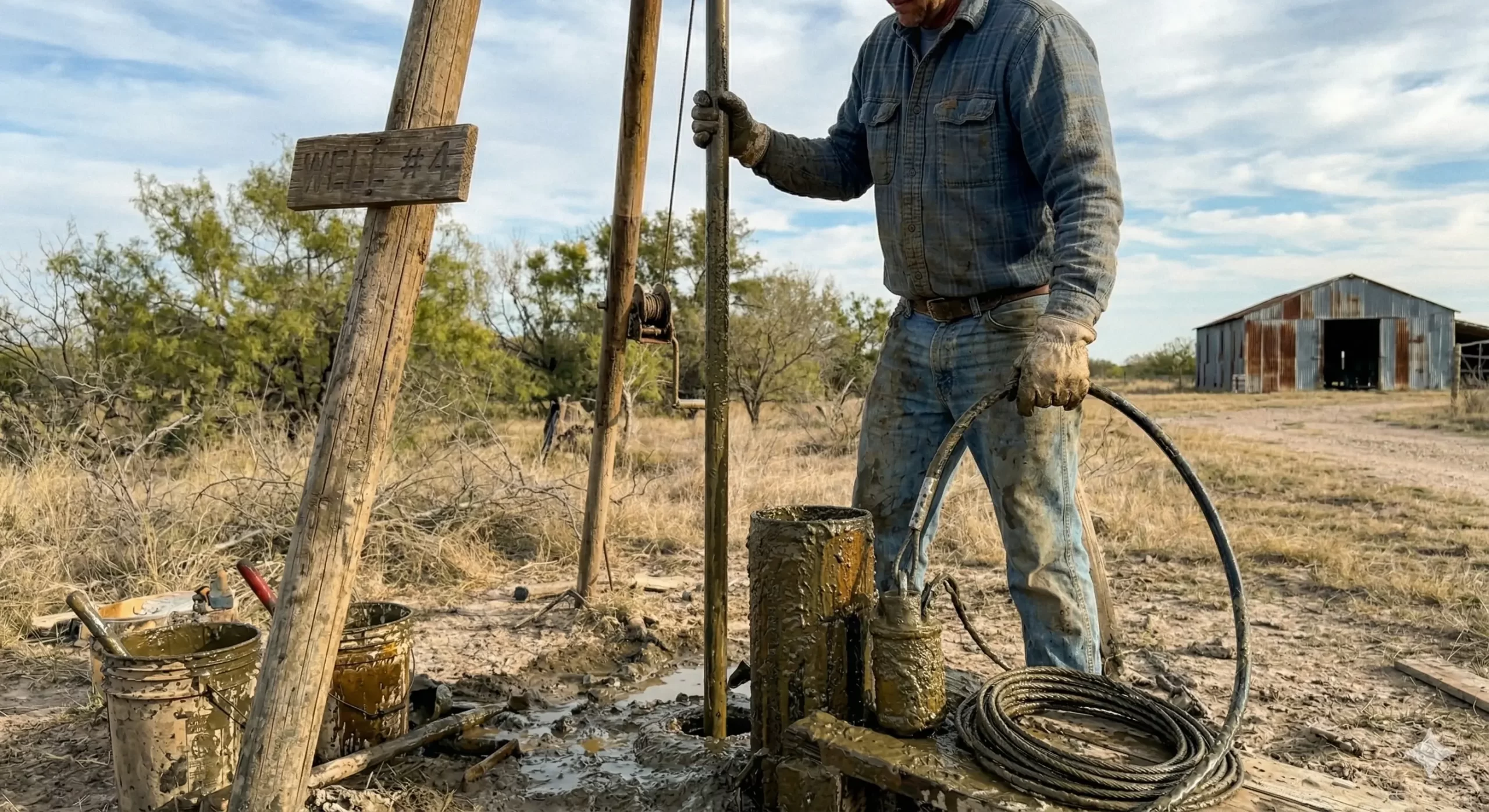
Pulling a pump out here in Fort Bend ain’t always about deep rock, but it’s about deep wells in unconsolidated sediment that can be tricky. We often encounter sticky, heavy clays that can make getting casing up and down a real chore. Plus, many of these rural properties might have limited access for a full-sized well rig, meaning we might need specialized, more compact equipment or even have to clear a path, which adds time and cost.
To do the job right, we’re talking about heavy-duty well rigs capable of handling substantial depths and weights, especially for those deeper residential or irrigation wells. We need specialized tools for both PVC and steel drop pipes, proper safety gear for working at heights and with heavy machinery, and an experienced crew that knows how to navigate the local soil conditions without damaging the well or your property. It’s not a two-man job with a pickup truck; it’s an operation.
Spring Well Maintenance in Texas
Heavy spring rains can cause surface runoff to breach well caps. We strongly recommend testing your water for coliform bacteria and inspecting the sanitary seal.
Save $500+ on Replacements
Via the TX Energy Co-op VFD Upgrade Program
77°F in Richmond
Local Aquifers & Geology
The primary groundwater sources in Richmond include the The Chicot Aquifer and the Evangeline Aquifer are the primary sources for Richmond. These are part of the larger Gulf Coast Aquifer system and consist of interbedded sands, silts, and clays. The sands are permeable and yield water, while the clays act as confining layers. The water quality can vary significantly with depth and location, often containing dissolved minerals, iron, and sometimes sand due to the unconsolidated nature of the formation.. Drilling through the local The soil profile in Richmond and surrounding Fort Bend County is predominantly composed of heavy, expansive clays, notably the Houston Black clay series. These soils exhibit significant shrink-swell potential, meaning they expand when wet and contract when dry. Below these clays, you’ll find layers of silts and sands typical of the Gulf Coastal Plain, extending down to the water-bearing aquifers. This expansive clay can put lateral pressure on well casings and impact surface infrastructure. means that average well depths range from 350 ft – 800 ft.
Due to these geological factors, local homeowners frequently struggle with Sand abrasion on pump impellers and bowls, leading to reduced efficiency and premature pump failure. The unconsolidated nature of our aquifers often allows fine sand to enter the well..
Drilling Depth Comparison
Deeper wells require heavy-duty crane hoists for pump extraction.
Climate & Water Quality
Pump systems in the Richmond area face severe environmental stressors. The most significant threat is Our intense Texas heat and humidity during summer stress pump motors, leading to overheating and premature failure. Heavy rainfall, tropical storms, and hurricanes bring power surges that can fry control boxes and motors, and cause localized flooding that can inundate well pits or damage surface infrastructure. Prolonged droughts, on the other hand, increase demand on wells, causing pumps to run longer, harder, and potentially drawing down water levels to critical points, leading to dry running and burnouts.
Additionally, the raw groundwater often presents issues with Hardness (calcium & magnesium), dissolved iron (rust stains, metallic taste), manganese, and frequently, fine sand. Sulfur (rotten egg smell) is also a common complaint in many wells here..
Regional Groundwater Advisory
Known primary contaminant threat to submersible pumps and pipes in this area:
Common Area Systems
VFD Upgrade Savings
Constant Pressure vs StandardReplacing a standard single-speed pump with a Variable Frequency Drive (VFD) eliminates hard starts and drastically reduces energy draw in Texas.
Compliance & Local Permits
Fort Bend County Level: In Fort Bend County, new well construction, major repairs, or alterations often fall under the purview of the Fort Bend Subsidence District (FBSD) regulations, even if your property is also within the Fort Bend Groundwater Conservation District (FBGCD). While FBGCD manages groundwater resources more broadly, FBSD’s primary mission is to control and prevent land subsidence. For most domestic wells, you’ll need to register your well with FBSD and ensure it meets their construction standards, particularly regarding casing and grouting. Larger irrigation or commercial wells will require specific permits and reporting of groundwater usage. Always check with FBSD and FBGCD before starting any new well project or major modification to understand the latest requirements.
Top Pump Brands in Texas
Most frequently installed hardware based on local geology (2026 data).
- Check pump motor amp draw & voltage against manufacturer specifications.
- Verify pressure tank air charge & bladder integrity to ensure proper system cycling.
- Perform a visual inspection and simple test for sand or sediment in water discharge.
- Inspect well cap or seal for proper sealing and integrity against contaminants.
- Measure and log system discharge pressure and flow rate to assess pump performance.
- Diagnose control box components, including relays, capacitors, & pressure switch.
Premium Well Pump Brands We Service
Our licensed technicians in Richmond are certified to repair, replace, and install high-quality groundwater equipment from industry-leading manufacturers, including:
- Complete loss of water pressure or no water coming from faucets.
- Significantly reduced water pressure or inconsistent water flow.
- Pump running continuously or cycling on and off too frequently (short cycling).
- Water appearing cloudy, sandy, or having visible sediment.
- Unusual noises coming from the wellhead, pump, or pressure tank area (grinding, humming, banging).
- Unexpectedly high electricity bills without changes in water usage.
Richmond Real Estate Well Regulations
Local Dispatch & Response Times
Live Dispatch: Texas
Updated Just Now⚠️ High demand. Call now to secure the next available technician.
- Generally, for non-emergency service calls, we aim for a 24-48 hour response time.
- For true ‘no water’ emergencies, we prioritize getting a crew out within 4-8 hours, depending on current call volume & technician availability.
- Response times can be extended during peak seasons (summer heat) or after major storm events.
- Weekend and holiday emergency calls might incur additional charges and could have slightly longer response times due to limited staffing.
- Rural access in some parts of Fort Bend can add to travel time, so please provide clear directions.
⚠️ Fort Bend County & State Regulatory Warning: Abandoned Wells
Groundwater Threat Level
Current aquifer and mineral impact on pumps in Richmond.
Dropping water tables cause pumps to suck air and overheat.
Hard water calcifies pump impellers, reducing lifespan.
The Cost of Ignoring Symptoms
Fixing a short-cycling pump early saves thousands in Richmond.
Data reflects average well contractor estimates in Richmond.
Pump Lifespan Estimator
Select household size in Richmond to see strain impact.
Local Richmond
Well Pros
Fast Local Service & Diagnostics
Calls are routed to a licensed local well professional.
Septic System Services in Richmond, TX
Do you have a septic tank on your property? Proper maintenance is critical to protecting your well water quality.
Richmond Homeowner Feedback
“Old Man Johnson got my well pump workin’ again, real quick. Good fella, knows his stuff.”

Local Homeowner
✓ Verified TX
“Had a real head-scratcher with our well. Pressure kept dropping, pump would cycle weird. Thought it was the tank, but turned out to be a pinhole in the drop pipe & the control box was acting up. Took ’em a bit to diagnose, but they stuck with it and got it fixed. Water’s flowin’ better than ever now. Real pros, even with my pesky pump. They know their stuff, no dought.”

Local Homeowner
✓ Verified TX
“Lost water on a Sunday morning, and with kids, that’s a crisis! Called them up, and they had a crew out within a few hours. Diagnosed a burnt-out motor and had us back in water by evening. Can’t thank ’em enough for the fast service when we needed it most!”

Local Homeowner
✓ Verified TX
Expert Richmond Well System FAQ
Why do I keep getting sand in my water, and what can I do about it in Richmond, Fort Bend County?
Getting sand in your water in Fort Bend County is a common issue, primarily due to our local geology. The aquifers here are composed of unconsolidated sands and silts. Over time, or with changes in pumping rates and water levels, these fine sediments can enter the well bore. If your well was not properly developed during construction, or if the well screen has degraded, it can exacerbate the problem. Sand acts like sandpaper on your pump, causing premature wear and failure. To address this, we can first verify the source – sometimes it’s simply settled sediment in your pressure tank. If it’s coming from the well, options include installing a sediment filter system at the wellhead, adjusting the pump setting deeper into a cleaner zone (if possible), or in some cases, redeveloping the well to clear out fine sediments around the screen. Each solution has its pros & cons, and we’d need to assess your specific well.
My water well pump runs constantly in Fort Bend County. What’s the common cause for this issue?
A pump that runs constantly, or ‘short cycles,’ is a big red flag and often indicates a problem that needs immediate attention to prevent premature pump failure. The most common causes we see in Fort Bend County are usually related to leaks or pressure tank issues. It could be a leak in your drop pipe (the pipe connecting the pump to the surface), a leak in your main water line somewhere on your property, or a leaky toilet or faucet. Another major culprit is a waterlogged pressure tank, meaning the air bladder has failed or the air charge is too low, preventing it from holding pressure effectively. Less common but still possible are a faulty pressure switch that isn’t cutting off power at the set pressure, or in very rare cases, an undersized pump for your demand or the well going partially dry, forcing the pump to constantly chase water. We’d start by checking your pressure tank and then systematically look for leaks.
How does land subsidence in Fort Bend County affect my water well and pump system?
Land subsidence, or the gradual sinking of the ground, is a significant concern in Fort Bend County due to extensive groundwater withdrawal. It affects your well in several critical ways. Firstly, as the land sinks, the relative depth to the water table increases, meaning your pump has to work harder and lift water from a greater distance. This increases energy consumption and puts more stress on the pump. Secondly, ground movement associated with subsidence can exert significant pressure on well casings, potentially causing them to crack, shear, or become misaligned. This can lead to reduced well yield, sand infiltration, or even well failure. In some extreme cases, it can necessitate deepening the well or even drilling a new one if the existing casing is compromised. Regular well monitoring and proper initial well construction (with appropriate casing and grouting) are essential to mitigate these risks.
What are the common water quality issues in Richmond wells and how do they impact my well system?
Well water in Richmond often presents with a few common quality issues that impact both your plumbing and your well system. Hardness, from calcium & magnesium, is very prevalent, leading to scale buildup in pipes, water heaters, & appliances, reducing efficiency & lifespan. Iron, sometimes with manganese, causes rust-colored stains on fixtures, laundry, and can create a metallic taste; it also fosters iron bacteria growth which can clog screens & pipes. As mentioned, fine sand is a persistent issue that causes mechanical wear on pump impellers and clogs plumbing fixtures. Lastly, hydrogen sulfide (sulfur) gas is common, giving water a distinct ‘rotten egg’ smell, which is unpleasant and can corrode some plumbing materials. Each of these issues requires specific treatment, like water softeners for hardness, oxidation/filtration for iron & sulfur, and sediment filters for sand, to protect your well system and ensure potable water.
Richmond Groundwater Expert AI
What are the specific groundwater regulations, average well depths, and the local conservation district for Richmond, Fort Bend County?
Groundwater Regulations and Residential Wells in Richmond, Fort Bend County, TX (2026)
As a Senior Hydrogeologist and Local Groundwater Regulatory Expert for Texas, I can provide you with the specific information regarding residential water wells in Richmond, Fort Bend County, based on current regulations projected for 2026.Local Groundwater Regulatory Authority: Fort Bend Subsidence District (FBSD)
For residential water wells in Richmond, Fort Bend County, the primary local regulatory authority governing groundwater withdrawal is the Fort Bend Subsidence District (FBSD). While not a "Groundwater Conservation District" (GCD) in the traditional sense under Texas Water Code Chapter 36, the FBSD has a very similar function concerning groundwater withdrawal permits, but with the specific mission of controlling and preventing land subsidence. All new or modified water wells, including residential, are subject to FBSD regulations.
- FBSD Jurisdiction: The FBSD encompasses all of Fort Bend County.
- Well Registration and Permitting: All non-exempt wells (typically those with a pump capacity greater than 17,000 gallons per day) require an operating permit from the FBSD. While residential wells for domestic use (defined as one-acre feet per year or less, which is approximately 325,851 gallons per year) are often exempt from annual operating permits, they still generally require registration and adherence to construction standards. It is crucial to verify your specific well's status with the FBSD.
- Reporting: Even exempt wells may need to be registered with the FBSD and well logs submitted.
- FBSD Official Website: For specific ordinances, permit applications, and contact information, please visit the official FBSD website: www.fbsd.org
State-Level Regulations and Authorities: Texas Department of Licensing and Regulation (TDLR)
In addition to the FBSD, the Texas Department of Licensing and Regulation (TDLR) oversees the licensing of water well drillers and pump installers and sets statewide minimum standards for well construction.
- Texas Water Code Chapter 36: While primarily focused on GCDs, this chapter also outlines general state policy on groundwater.
- Texas Occupations Code Chapter 1901: This chapter governs the licensing of water well drillers and pump installers in Texas.
- 16 Texas Administrative Code (TAC) Chapter 76: This rule set details the technical standards for drilling, altering, or plugging water wells, including setback distances and construction requirements to protect groundwater quality.
- Well Driller Licensing: Any individual drilling a water well in Texas must be licensed by the TDLR. You can verify a driller's license and search for well logs submitted to the state here: TDLR Water Well Driller and Pump Installer Program
- Well Registration: All new water wells drilled in Texas, including residential, must be registered with the TDLR by the licensed driller. A well log (Form 009) is submitted, which contains critical information about the well's construction and geology encountered.
Specific Setback Rules (16 TAC Chapter 76):
Texas law mandates minimum separation distances for water wells to prevent contamination:
- Property Line: At least 50 feet from any property line.
- Septic System (Drainfield/Absorption Field): At least 50 feet from a septic system absorption field.
- Septic System (Tank/Distribution Box): At least 100 feet from a septic tank, sewage line, or distribution box.
- Waste Disposal Site/Feedlot: At least 150 feet from a concentrated animal feeding operation or waste disposal site.
- Roadway/Easement: Generally not permitted within public right-of-ways or utility easements without specific approval.
Average Well Depths in Richmond, Fort Bend County
Residential water wells in Richmond typically tap into the Gulf Coast Aquifer System, specifically the shallower portions of the Chicot Aquifer and sometimes the upper parts of the Evangeline Aquifer. Based on historical well logs and hydrogeological assessments in the Richmond area of Fort Bend County:
- The average residential well depth is estimated to be between 350 and 450 feet.
- Depths can vary significantly depending on the specific location within Richmond, the desired yield, and the depth to reliable, high-quality sand layers. Some wells may be shallower (e.g., 200-300 feet), while others needing higher yields or avoiding localized poor water quality may extend to 500-600 feet.
Specific Aquifer Beneath Richmond
The primary aquifer system supplying groundwater to Richmond, Fort Bend County, is the Gulf Coast Aquifer System. This complex system is composed of several regionally significant sand and clay units. The most commonly utilized units for residential supply in the Richmond area are:
- Chicot Aquifer: The uppermost major aquifer, generally encountered from near the surface down to several hundred feet.
- Evangeline Aquifer: Underlies the Chicot and consists of permeable sand layers interbedded with clays, extending to greater depths.
These aquifers are primarily unconfined to semiconfined in Fort Bend County and are the source of groundwater regulated by the FBSD due to their susceptibility to subsidence when over-pumped.
Before proceeding with any well drilling project, it is strongly recommended to contact both the Fort Bend Subsidence District and consult with a licensed water well driller experienced in the Richmond area to ensure full compliance with all local and state regulations.
Fast Local Service & Diagnostics
Calls are routed to a licensed local well professional.
Blix
provides official
Emergency Well Pump Repair services for the
Richmond
area.