
Emergency Well Pump Repair in Santa Fe, TX
Down here in Santa Fe, you’re not just dealing with any old groundwater. The realities of digging into this coastal plain mean you’re up against high clay content, a risk of saltwater intrusion closer to the coast, and the ever-present issue of subsidence. It’s a tough environment for a well, and it takes a toll on equipment.
Our water largely comes from the Chicot and Evangeline aquifers, part of the Gulf Coast Aquifer System. These are complex systems of interbedded sands, silts, and clays. While they provide good water generally, their nature means water levels can fluctuate, and sediment can be a real headache for pumps if the well isn’t designed right.
That’s why those bargain-basement pumps just don’t cut it here. They’re not built for the corrosive nature of the water, the abrasive sand, or the demands of pumping from greater depths through heavy clay. You put a cheap pump in, and you’re just asking for an early failure and another service call, costing you more in the long run.
Fast Local Service & Diagnostics
Calls are routed to a licensed local well professional.
Well Pump Repair in
Santa Fe
Santa Fe & Galveston County Well Stats
Galveston County has over 1,500 registered water wells, with a significant portion serving agricultural and rural residential needs. Groundwater pumping has contributed to measurable land subsidence, a critical issue locally. Water usage for wells primarily focuses on domestic, livestock, and irrigation purposes. Average well age here often exceeds 25 years, meaning older casing, deteriorating screens, and potential for well degradation are common.
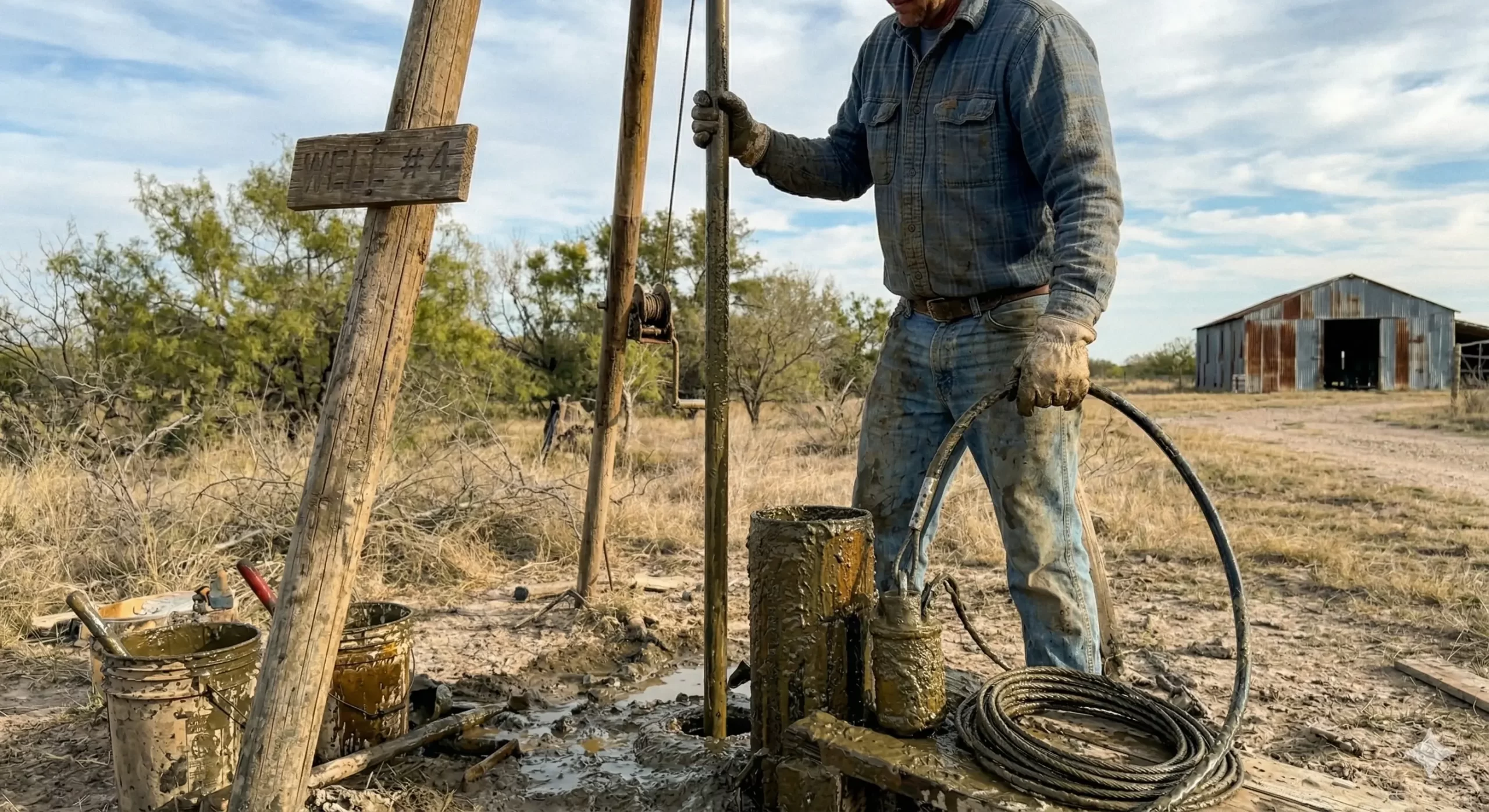
Pulling a pump in Santa Fe is no simple task. Our ground is often saturated, full of heavy, expansive clays, and depending on the well’s age, you might be dealing with casing issues or settled material around the bore. Rig access can also be tricky on older, established properties with mature landscaping or tight driveways, adding time and complexity.
Proper equipment is non-negotiable. We’re talking about heavy-duty service rigs capable of handling deep pulls, pipe wrenches that can tackle corroded joints, and often, specialized tools for retrieving stuck pumps or clearing sediment. You can’t just show up with a pickup and a chain; it’s a dedicated operation.
Spring Well Maintenance in Texas
Heavy spring rains can cause surface runoff to breach well caps. We strongly recommend testing your water for coliform bacteria and inspecting the sanitary seal.
Save $500+ on Replacements
Via the TX Energy Co-op VFD Upgrade Program
80°F in Santa Fe
Local Aquifers & Geology
The primary groundwater sources in Santa Fe include the The Chicot Aquifer System is our primary water source here. It’s characterized by its shallow depth, generally extending from near the surface down to about 1,000 feet. It consists of layers of sands, silts, and clays. Water quality can vary, with elevated dissolved solids and hardness being common. Near the coast, there’s always a watchful eye on potential saltwater encroachment due to overpumping and subsidence.. Drilling through the local Santa Fe’s soil profile is dominated by highly expansive clays, specifically the Beaumont Clay formation, mixed with silty sands and occasional shell fragments from ancient marine deposits. These clays are notorious for their shrink-swell potential, which can stress well casings and foundations. Drainage is often poor due to the clay content, leading to saturated conditions for extended periods after rain. means that average well depths range from 150 ft – 400 ft, though some deeper commercial or older wells can go beyond 600 ft..
Due to these geological factors, local homeowners frequently struggle with Without a doubt, the #1 mechanical failure reason for pumps in Santa Fe is sand abrasion, closely followed by corrosion. The interbedded nature of our aquifers means fine sand and silt are always a threat to pump impellers and seals. Combined with the mineral content in the water, it’s a recipe for early pump failure if not properly selected and installed..
Drilling Depth Comparison
Deeper wells require heavy-duty crane hoists for pump extraction.
Climate & Water Quality
Pump systems in the Santa Fe area face severe environmental stressors. The most significant threat is Our coastal climate in Galveston County is brutal on well equipment. High humidity promotes external corrosion on control boxes, wiring, and pressure tanks. Salt air, even inland, contributes to this. Frequent heavy rains and potential flooding saturate the ground, stressing submersible wiring and increasing the likelihood of electrical shorts. Plus, the extreme heat during summers puts a strain on motors, especially if ventilation is poor or they’re running in high temperatures.
Additionally, the raw groundwater often presents issues with Hardness and elevated iron are extremely common. We also see sulfur odors in many wells, particularly in shallower zones. Sand and silt are pervasive issues, causing abrasive wear on pumps and accumulating in pressure tanks. Salinity can also be a concern in wells closer to coastal zones or those affected by historical over-pumping and subsidence..
Regional Groundwater Advisory
Known primary contaminant threat to submersible pumps and pipes in this area:
Common Area Systems
VFD Upgrade Savings
Constant Pressure vs StandardReplacing a standard single-speed pump with a Variable Frequency Drive (VFD) eliminates hard starts and drastically reduces energy draw in Texas.
Compliance & Local Permits
Galveston County Level: While the state mandates certain well construction standards, here in Galveston County, we fall under the Galveston County Groundwater Conservation District (GCD). They require permits for drilling new wells, significant well alterations, and plugging abandoned wells. They also have regulations regarding well spacing and reporting of water use, all aimed at managing our precious groundwater resources and mitigating subsidence. Always check with the GCD before any major well work.
Top Pump Brands in Texas
Most frequently installed hardware based on local geology (2026 data).
- Verify power supply to pump & control box.
- Check pressure switch operation & settings.
- Measure pump motor amperage & voltage while running.
- Inspect pressure tank air charge & bladder integrity.
- Test water quality for sediment, iron, & hardness.
- Visually inspect wellhead, casing integrity, & wiring connections.
Premium Well Pump Brands We Service
Our licensed technicians in Santa Fe are certified to repair, replace, and install high-quality groundwater equipment from industry-leading manufacturers, including:
- No water coming out, or only a trickle.
- Pump runs constantly or cycles on & off frequently.
- Sudden drop in water pressure throughout the house.
- Cloudy, sandy, or discolored water coming from faucets.
- Unusual noises, grinding, or buzzing from the wellhead or pressure tank.
- Higher-than-normal electric bills without increased usage.
Santa Fe Real Estate Well Regulations
Local Dispatch & Response Times
Live Dispatch: Texas
Updated Just Now⚠️ High demand. Call now to secure the next available technician.
- Usually within 24-48 hours for non-critical failures during business days.
- Emergency service for total water loss can often be dispatched same-day, even on weekends if crew is available.
- Expect slightly longer response times during peak summer months due to high demand.
- Remote or difficult-to-access properties may require additional travel time and planning.
- Our priority is always getting your water back, understanding the unique challenges of rural living.
⚠️ Galveston County & State Regulatory Warning: Abandoned Wells
Groundwater Threat Level
Current aquifer and mineral impact on pumps in Santa Fe.
Dropping water tables cause pumps to suck air and overheat.
Hard water calcifies pump impellers, reducing lifespan.
The Cost of Ignoring Symptoms
Fixing a short-cycling pump early saves thousands in Santa Fe.
Data reflects average well contractor estimates in Santa Fe.
Pump Lifespan Estimator
Select household size in Santa Fe to see strain impact.
Local Santa Fe
Well Pros
Fast Local Service & Diagnostics
Calls are routed to a licensed local well professional.
Septic System Services in Santa Fe, TX
Do you have a septic tank on your property? Proper maintenance is critical to protecting your well water quality.
Santa Fe Homeowner Feedback
“Had a problem with low pressure for days. Called ’em up, they were out quick. Fella knew exactly what it was, fixed a bad pressure switch. Water’s back to normal. Good honest work.”

Local Homeowner
✓ Verified TX
“Our old well pump finally gave up the ghost after a bad storm. I thought we were out of luck, but these guys came out the next day. The tech, a real stand-up guy, explained that the motor had seized due to sand ingestion over the years, and the old well casing was allowing too much sediment. He recommended a new submersible pump designed for high-sand environments and even installed a sand separator. It was a bigger job than I expected, but they got it done right. No more gritty water, and the pressure is better than it’s been in yers. Just a bit of a wait for the part, but worth it.”

Local Homeowner
✓ Verified TX
“Lost all water Sunday morning. My family was in a panic. Called their emergency line and they had a tech out by noon. He quickly diagnosed a control box issue, had the part on his truck, and we were back in business before dinner. Absolutely saved our weekend. Can’t thank them enough for the fast service.”

Local Homeowner
✓ Verified TX
Expert Santa Fe Well System FAQ
My water suddenly started tasting salty here in Santa Fe. Is my well going bad, or is it saltwater intrusion?
A sudden salty taste in your Santa Fe well water is a serious concern and needs immediate investigation. While it could indicate a well integrity issue allowing surface contaminants, given our coastal proximity and the historical subsidence in Galveston County, saltwater intrusion into the Chicot or Evangeline aquifers is a real possibility. Overpumping, especially during dry periods, can draw the saltwater interface closer to freshwater zones. We’d need to test your water for chloride levels and potentially run a downhole camera to inspect your well casing for breaches. Early detection is key to determining if mitigation is possible or if a deeper, more protected aquifer needs to be accessed.
My pressure tank keeps cycling really fast, even when no water is being used. What’s going on with my well system?
Fast cycling of your pressure tank, especially with no water use, almost always points to either a significant leak in your plumbing system (which you’d likely see) or a problem with the pressure tank itself. Most commonly, it’s a ruptured or waterlogged bladder inside the pressure tank, or a loss of air pre-charge. When the bladder fails, water fills the tank’s air chamber, drastically reducing its capacity to maintain pressure, causing the pump to short-cycle. We’d check the air pressure on the tank and if water comes out of the air valve, it’s definitely a failed bladder and the tank needs replacement. It’s a common issue that can burn out your pump if not addressed quickly.
What’s the deal with all the red stains in my sinks and laundry down here in Santa Fe? Is it the well?
Those red or reddish-brown stains are a classic sign of high iron content in your well water, which is very common in Galveston County aquifers. Iron occurs naturally in our local geology. When iron in the water is exposed to air, it oxidizes, creating rust-like particles that stain fixtures, laundry, and can even affect the taste of your water. While not typically a health hazard, it’s definitely a nuisance. We can test your water for iron levels and recommend appropriate filtration solutions, such as an iron filter, aeration system, or a water softener designed to handle iron, to get rid of those unsightly stains and improve your water quality.
I’m looking to buy a property in Santa Fe with an old well. What should I be most worried about?
When buying a property with an old well in Santa Fe, your biggest concerns should be the well’s physical integrity and the quality & quantity of its water supply. First, we need to inspect the casing for corrosion or collapse, which is common in older wells in our clay soils and can lead to sediment issues or contamination. Second, water quality testing is paramount; we need to check for bacteria (E. coli), nitrates, and local contaminants like high iron, hardness, and especially chlorides (for saltwater intrusion). Finally, assess the pump’s age and condition, and perform a flow test to ensure the well can still deliver adequate water for your needs. Neglecting these checks can lead to significant and costly surprises post-purchase.
Santa Fe Groundwater Expert AI
What are the specific groundwater regulations, average well depths, and the local conservation district for Santa Fe, Galveston County?
Groundwater Regulations and Residential Water Wells in Santa Fe, Galveston County, TX (2026)
As a Senior Hydrogeologist and Local Groundwater Regulatory Expert for Texas, I can provide you with precise information regarding residential water wells in Santa Fe, Galveston County. It's crucial to understand that groundwater management in Texas operates on a dual system of state regulation and local control via Groundwater Conservation Districts (GCDs). However, Galveston County presents a unique situation regarding local control.
Local Groundwater Conservation District
Galveston County does NOT currently have an active Groundwater Conservation District (GCD) established under Texas Water Code Chapter 36. This means that while the "rule of capture" generally applies to groundwater ownership, the drilling and operation of water wells are primarily governed by state-level regulations rather than local GCD permitting.
Specific Groundwater Regulations for Residential Wells
Given the absence of a local GCD in Galveston County, the primary regulatory oversight for residential water wells falls under the Texas Department of Licensing and Regulation (TDLR) and, for certain aspects like water quality and septic system setbacks, the Texas Commission on Environmental Quality (TCEQ).
- TDLR Licensing and Registration: All water well drillers and pump installers operating in Texas must be licensed by the TDLR. Furthermore, all new water wells, including residential wells, must be registered with the TDLR within 30 days of completion. The driller is responsible for submitting a "Well Report" (also known as a "Drillers Log") to the TDLR.
- Applicable State Code: Texas Water Code Chapter 35, "Water Well Drillers and Pump Installers," and Texas Administrative Code, Title 16, Chapter 76, "Water Well Drillers and Pump Installers."
- Official Resource: You can verify driller licenses and access well report forms via the TDLR website: TDLR Water Well Drillers and Pump Installers
- Well Log Database: To research existing wells, the TDLR maintains a well report viewer: TDLR Water Well Search
- Well Construction Standards: TDLR rules outline specific construction standards for water wells to protect groundwater quality and public health. These include requirements for casing, cementing, and wellhead completion.
- Setback Requirements (TCEQ): While TDLR handles well construction, the TCEQ regulates aspects of water quality and potential contamination sources, particularly concerning on-site sewage facilities (septic systems).
- Minimum Setback from Septic Systems: A private water well must generally be located at least 50 feet from any part of an on-site sewage facility (septic tank, drainfield, etc.) and 100 feet from a spray field. These are minimums, and local health authorities may have stricter requirements.
- Applicable State Code: Texas Administrative Code, Title 30, Chapter 285, "On-Site Sewage Facilities."
- Official Resource: For more on private well guidance related to septic systems, consult TCEQ resources: TCEQ Private Wells Information
- Plugging Requirements: Abandoned or deteriorated water wells must be properly plugged by a licensed driller to prevent contamination of aquifers. This is also regulated by TDLR.
Average Well Depths in Santa Fe, Galveston County
Based on historical state well logs for the Santa Fe area within Galveston County, residential water wells primarily tap into the shallower to intermediate zones of the Gulf Coast Aquifer system. The specific depth can vary depending on the target aquifer zone, water quality objectives, and the driller's assessment of local geology.
For typical residential use in Santa Fe, drawing from the Chicot Aquifer or the upper portions of the Evangeline Aquifer (which are part of the larger Gulf Coast Aquifer system), you can expect average well depths to be in the range of approximately 250 to 450 feet. A reasonable general average for a reliable residential supply in this area would be around 350 feet.
Deeper wells tapping the Evangeline or Jasper aquifers might be found, but for standard residential supply, the shallower zones are often sufficient and more economical to install.
Specific Aquifer Beneath Santa Fe
The primary aquifer system underlying Santa Fe, Galveston County, is the Gulf Coast Aquifer system. This system is composed of several hydraulically connected aquifers, which, from shallowest to deepest, include:
- Chicot Aquifer: The shallowest major aquifer, often targeted for residential and irrigation use.
- Evangeline Aquifer: Lies beneath the Chicot and is also a significant water source in the region.
- Jasper Aquifer: Found deeper than the Evangeline.
- Catahoula Aquifer: The deepest major unit within this system in the area.
Residential wells in Santa Fe most commonly draw from the Chicot and Evangeline aquifers.
For more detailed information on Texas aquifers and to view geological cross-sections, you can refer to the Texas Water Development Board (TWDB) resources:
- Official Resource: TWDB Texas Aquifers
It is always recommended to consult with a licensed water well driller experienced in the Galveston County area for site-specific drilling and well design recommendations.
Fast Local Service & Diagnostics
Calls are routed to a licensed local well professional.
Blix
provides official
Emergency Well Pump Repair services for the
Santa Fe
area.