
Emergency Well Pump Repair in Plainview, TX
Out here in Plainview, the High Plains ain’t forgiving when it comes to groundwater. We’re staring down some of the steepest water table declines in the state, and that puts a real strain on every pump in the ground. You run a well here, you’re not just pulling water; you’re battling geology, climate, & decades of draw-down.
Our lifeblood is the Ogallala Aquifer, a magnificent but finite resource that’s been feeding us for generations. But every year, it gets a little deeper, and that means your pump’s gotta work harder, lift further, and endure more stress. It ain’t like tapping into a spring; it’s a constant effort to keep the water flowing.
Folks try to save a buck with cheap, off-brand pumps, & I’ve seen ’em fail time & again within a few years. In this environment, with deep lifts, potential for sand, & heavy demand, those economy models just don’t cut it. They burn out, seize up, or just can’t handle the head pressure required to get water from way down deep to your faucet or irrigation pivot.
Fast Local Service & Diagnostics
Calls are routed to a licensed local well professional.
Well Pump Repair in
Plainview
Plainview & Hale County Well Stats
Hale County has one of the highest concentrations of irrigation wells in Texas, with thousands of wells primarily drawing from the Ogallala Aquifer. While domestic wells are also numerous, agriculture accounts for the vast majority of water usage. Well depths commonly range from 200 to 600 feet, with some irrigation wells exceeding 800 feet. The average yield for domestic wells is typically 10-30 GPM, while irrigation wells can range from 300 GPM up to 1,000 GPM or more, placing immense stress on pump systems & the aquifer.
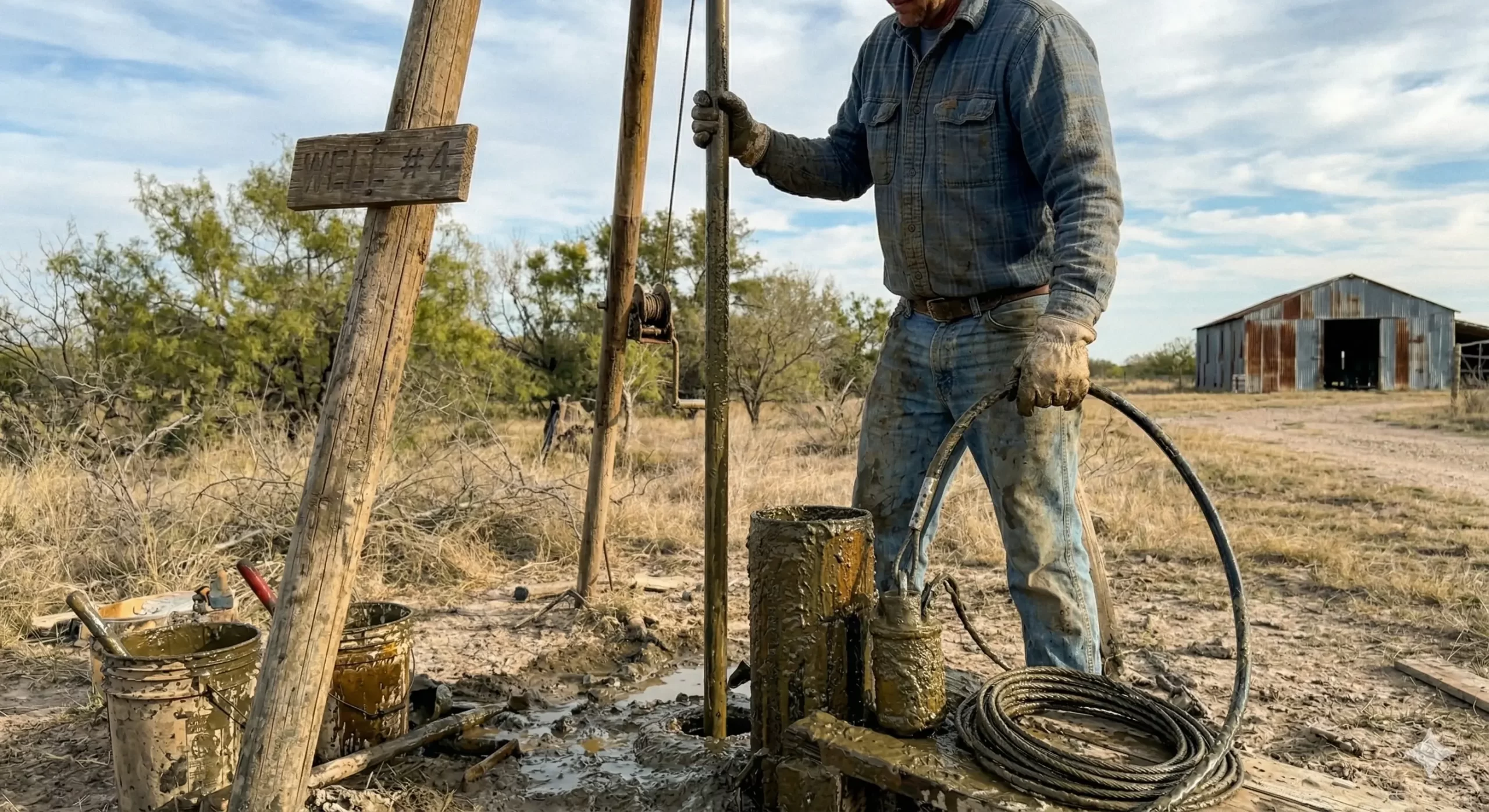
Pulling a pump out here in Hale County ain’t for the faint of heart, or the ill-equipped. We’re often dealing with wells that are hundreds of feet deep, sometimes punching through stubborn caliche or even a little bit of harder rock formations before hitting the main water bearing zones. That means a standard tripod & winch ain’t gonna cut it; you need a proper well rig, usually a heavy-duty service truck with a hydraulic mast to handle the weight of hundreds of feet of drop pipe & wiring, not to mention the pump itself.
The equipment needed for a deep-set pump job includes not just the rig, but specialized pulling tools, safety harnesses, pipe wrenches big enough for 4-inch or 6-inch steel pipe, heavy-gauge electrical wire splice kits that can withstand submersible conditions, & often a small crane or boom for handling large irrigation pump motors & bowls. Access can also be a beast, especially on agricultural lands where you might have to navigate around pivot irrigation systems or through muddy fields.
Spring Well Maintenance in Texas
Heavy spring rains can cause surface runoff to breach well caps. We strongly recommend testing your water for coliform bacteria and inspecting the sanitary seal.
Save $500+ on Replacements
Via the TX Energy Co-op VFD Upgrade Program
68°F in Plainview
Local Aquifers & Geology
The primary groundwater sources in Plainview include the The Ogallala Aquifer, part of the High Plains Aquifer system. It’s an unconfined, unlithified sand, silt, clay, & gravel aquifer. The water table has been declining steadily for decades due to extensive agricultural irrigation, leading to increased pumping costs & necessitating deeper pump settings. The water quality is generally good but can vary, with localized issues of hardness, dissolved solids, & occasional sand intrusion, particularly as water levels drop & pumps are set lower in the formation.. Drilling through the local Plainview sits primarily on soils derived from the Blackwater Draw Formation & Ogallala Formation. The dominant soil types are fine sandy loams & silty clay loams, particularly Pullman & Olton series soils, which are deep, fertile, & well-drained, making them excellent for agriculture. Beneath these topsoils, you quickly encounter caliche layers, which are cemented calcium carbonate formations. These caliche beds can be quite hard & extensive, making well drilling & excavation challenging, sometimes requiring specialized drilling bits. means that average well depths range from 250 ft – 700 ft (domestic wells typically 250-450 ft, irrigation wells 400-700+ ft).
Due to these geological factors, local homeowners frequently struggle with Sand abrasion & motor burnout. As the Ogallala water levels drop, pumps are often set deeper, closer to the bottom of the screened interval. This increases the likelihood of pulling in fine sand or silt, which acts like sandpaper on impellers & bowls, grinding them down. Also, running dry or operating at the bottom of the well can cause submersible motors to overheat & burn out due to lack of cooling water flow..
Drilling Depth Comparison
Deeper wells require heavy-duty crane hoists for pump extraction.
Climate & Water Quality
Pump systems in the Plainview area face severe environmental stressors. The most significant threat is Our unpredictable Panhandle weather is brutal on well equipment. Prolonged droughts lead to lower water tables, forcing pumps to work harder & leading to premature motor failure due to overheating or running dry. Extreme summer heat can also stress above-ground electrical components & pressure tanks. Then there are the sudden, severe freezes; uninsulated pipes, pressure switches, & even shallow-buried lines can burst, causing significant damage & costly repairs.
Additionally, the raw groundwater often presents issues with Hardness is common due to dissolved minerals from the caliche & limestone formations. Iron is also frequently present, causing staining & issues with fixtures. Sand is a significant problem, especially in older wells or those drawing from lower aquifer zones, leading to pump wear. Sulfur (hydrogen sulfide gas) can sometimes be detected, giving water a ‘rotten egg’ smell, though it’s less prevalent than hardness & iron..
Regional Groundwater Advisory
Known primary contaminant threat to submersible pumps and pipes in this area:
Common Area Systems
VFD Upgrade Savings
Constant Pressure vs StandardReplacing a standard single-speed pump with a Variable Frequency Drive (VFD) eliminates hard starts and drastically reduces energy draw in Texas.
Compliance & Local Permits
Hale County Level: Plainview falls under the jurisdiction of the High Plains Underground Water Conservation District (HPUWCD). Any new well, deepening of an existing well, or major repair (like replacing casing) requires a permit from HPUWCD before work can begin. They have strict rules regarding well spacing to prevent interference with neighboring wells, mandatory well registration, & conservation requirements, especially for irrigation wells. Property owners are also required to install & maintain flow meters on most irrigation wells & report water usage annually to the HPUWCD to help monitor aquifer decline & manage water resources sustainably.
Top Pump Brands in Texas
Most frequently installed hardware based on local geology (2026 data).
- Verify correct voltage & amperage at the control box & motor leads.
- Check pressure switch operation, cut-in/cut-out settings, & diaphragm condition.
- Inspect pressure tank for proper air charge (pre-charge) & bladder integrity.
- Measure static water level & pumping water level to assess aquifer conditions & pump setting.
- Test water quality for sand, sediment, hardness, iron, & pH.
- Visually inspect exposed piping, electrical conduit, & connections for leaks or damage.
Premium Well Pump Brands We Service
Our licensed technicians in Plainview are certified to repair, replace, and install high-quality groundwater equipment from industry-leading manufacturers, including:
- No water at all, or very low water pressure.
- Pump runs continuously without shutting off, or cycles on & off too frequently.
- Cloudy, sandy, or discolored water coming from faucets.
- Strange noises, grinding, or humming coming from the well head or pressure tank area.
- Increased electricity bills without a change in water usage.
- Water spitting or air coming out of faucets when pump is running.
Plainview Real Estate Well Regulations
Local Dispatch & Response Times
Live Dispatch: Texas
Updated Just Now⚠️ High demand. Call now to secure the next available technician.
- During normal business hours, we aim for a 2-4 hour on-site response for critical failures.
- For after-hours or weekend emergencies, you can expect a technician to be dispatched within 4-6 hours.
- Complex issues requiring specific parts or heavy equipment might extend initial repair times, but we’ll get a temporary solution if possible.
- Our priority is always to restore water as quickly & safely as we can, understanding that no water means no life out here.
- Road conditions, especially during extreme weather, can impact our ability to reach your property promptly.
⚠️ Hale County & State Regulatory Warning: Abandoned Wells
Groundwater Threat Level
Current aquifer and mineral impact on pumps in Plainview.
Dropping water tables cause pumps to suck air and overheat.
Hard water calcifies pump impellers, reducing lifespan.
Pump Lifespan Estimator
Select household size in Plainview to see strain impact.
The Cost of Ignoring Symptoms
Fixing a short-cycling pump early saves thousands in Plainview.
Data reflects average well contractor estimates in Plainview.
Local Plainview
Well Pros
Fast Local Service & Diagnostics
Calls are routed to a licensed local well professional.
Septic System Services in Plainview, TX
Do you have a septic tank on your property? Proper maintenance is critical to protecting your well water quality.
Plainview Homeowner Feedback
“Had my pump go out cold on a Sunday morning. Called these folks up, & they had a crew out here quicker than I thought possible. Got my water back before lunch. Good honest work, real fair price. Can’t ask for more.”

Local Homeowner
✓ Verified TX
“Our irrigation well started spitting sand like a broken sprinkler, & then the GPM dropped way off. We were worried sick about the corn crop. The tech, a fella named Billy, spent a good hour diagnosing it. Turns out the old submersible motor was drawing too much power, prob’ly due to worn bearings, and the intake screen was partially clogged with some pretty fine sediment from where the water table had dropped. He recommended a new, more efficient Grundfos pump & a deeper setting. They had a rig out the next day. They pulled the old one, put the new one in, fixed the electrical connection that was getting hot, and even cleaned out some debris from the bore. Water pressure is strong again, no more sand, and the crop’s gonna make it. Real pros, they know their stuff out here.”

Local Homeowner
✓ Verified TX
“Lost water completely at 6 PM. Called their emergency line, & a truck was rolling towards my place outside Plainview within the hour. They didn’t just show up fast; they fixed it fast. Replaced a corroded pressure switch & a leaky union. Total lifesavers when we needed water for livestock.”
Local Homeowner
✓ Verified TX
Expert Plainview Well System FAQ
My water pressure has been steadily getting weaker over the past year. Is this just my pump going bad, or something else?
While a failing pump is certainly a possibility, especially if it’s an older unit or one that’s been exposed to sand, a common reason for gradual pressure loss in Plainview is the declining water table of the Ogallala Aquifer. As the water level drops, your pump has to work harder to lift the water further, which can reduce its efficiency & ultimate pressure output. It might also mean your pump is starting to ‘starve’ for water, leading to air in the lines & inconsistent pressure. We’d start by measuring the static & pumping water levels, checking the pump’s amp draw, & inspecting your pressure tank & switch. Sometimes, the solution might involve lowering your pump further into the well, or in some cases, upgrading to a more powerful, deeper-set pump designed for lower water levels.
I’m getting sand in my water sometimes, especially after the pump runs for a while. What causes this, & what can be done?
Sand in your water is a serious issue that needs attention, as it can quickly damage your pump & plumbing fixtures. In our area, it’s often caused by a few factors. First, as the water table drops, your pump might be set too low, drawing from silty or sandy layers at the bottom of the well. Second, the well screen could be corroded or damaged, allowing sand to enter the casing. Third, heavy pumping (especially with irrigation wells) can sometimes cause formation collapse around the screen. What can be done? We’d typically pull the pump to inspect its condition & the well casing/screen. We might recommend installing a sand separator or a new pump with improved sand handling capabilities, or potentially re-screening or rehabilitating the well itself. Ignoring sand will lead to premature pump failure.
My large irrigation well suddenly stopped working, & now my fields are drying up. What’s the most common culprit for these big systems?
When a large irrigation well goes down, it’s an emergency for sure. For big irrigation pumps in Plainview, the common culprits often revolve around the massive demands placed on them. Motor burnout is frequent, either from running dry, extended periods of high load, or electrical faults due to voltage spikes or brownouts. We also see impellers & bowls get worn out from sand abrasion, leading to a loss of pumping capacity before complete failure. Sometimes, it’s simply a control panel issue – a tripped breaker, a faulty contactor, or a problem with the motor starter. Given the depth & size of these pumps, pulling them requires specialized heavy rigs & often takes a full day or more. We’d start by checking the electrical supply & controls at the surface before assuming a major pump pull is needed, but be prepared for that possibility.
How often should I have my well pump system inspected in Plainview, considering our unique water challenges?
Given the hard work your well pump does in Plainview & the challenges of the declining Ogallala Aquifer, I strongly recommend a professional inspection at least once every 1-3 years for domestic wells, & annually for high-demand irrigation wells. A regular inspection allows us to catch small issues before they become major, costly failures. We check things like pump performance (flow rates, pressure), water levels, motor amp draw, electrical connections, pressure tank air charge, & water quality for sand or mineral buildup. Proactive maintenance helps extend the life of your pump, ensures consistent water supply, & can save you significant money & headaches down the line, especially when compared to emergency repair costs.
Plainview Groundwater Expert AI
What are the specific groundwater regulations, average well depths, and the local conservation district for Plainview, Hale County?
Groundwater Regulations and Information for Residential Water Wells in Plainview, Hale County (2026)
As a Senior Hydrogeologist and Local Groundwater Regulatory Expert for Texas, I can provide you with precise information regarding residential water wells in Plainview, Hale County, TX, for the year 2026.
Local Groundwater Conservation District (GCD)
Plainview, Hale County, falls under the jurisdiction of the High Plains Underground Water Conservation District No. 1 (HPUWCD No. 1). This district is responsible for conserving, protecting, and preserving the groundwater resources within its service area, which includes Hale County.
- Official HPUWCD Website: https://www.hpuwcd.org/
Specific Groundwater Regulations
Residential water wells in Plainview are subject to regulations from both state agencies and the HPUWCD No. 1.
-
State Regulations (Texas Department of Licensing and Regulation - TDLR):
- All water well drillers and pump installers in Texas must be licensed by the TDLR.
- New water wells must be registered with the TDLR upon completion. This is mandated by Texas Water Code Chapter 32.
- Well plugs and abandonment procedures are also regulated by TDLR.
- TDLR Water Well Driller & Pump Installer Program: https://www.tdlr.texas.gov/wwpd/wwpd.htm
- TDLR Online Water Well Report Viewer (for historical logs): https://www.tdlr.texas.gov/WaterWellReportViewer/
-
Local Regulations (HPUWCD No. 1):
The HPUWCD No. 1 operates under the authority of Texas Water Code Chapter 36 and has specific rules for drilling and operating water wells within its boundaries. For residential wells (defined by the district, typically for household use not exceeding 25,000 gallons per day), key regulations include:
- Well Permit Required: You will need to obtain a permit from the HPUWCD No. 1 *before* drilling a new residential well or significantly modifying an existing one.
- Well Spacing Requirements: The District has rules concerning the minimum distance between new wells and existing wells, as well as property lines, to prevent undue interference. While specific setbacks can vary based on the latest rules, it's typical for new residential wells to require a minimum distance of 150 feet from adjacent property lines and 600 feet from existing non-exempt wells. Always consult the latest HPUWCD No. 1 rules for exact setbacks applicable to residential wells.
- Well Construction Standards: The District enforces specific casing, cementing, and well completion standards to protect water quality and ensure efficient operation.
- Exemptions for Domestic Use: While requiring a permit and adhering to construction and spacing rules, residential wells for domestic and livestock use are typically exempt from production limits and historical use requirements. However, this exemption *does not* relieve the owner from obtaining a drilling permit and registering the well with both the HPUWCD No. 1 and TDLR.
- HPUWCD No. 1 Rules: https://www.hpuwcd.org/rules (Always refer to the most current version of their rules and regulations).
- HPUWCD No. 1 Well Permit Application Forms: https://www.hpuwcd.org/forms
Average Well Depths for Plainview, Hale County
Residential water wells in the Plainview area of Hale County primarily target the Ogallala Aquifer. Based on historical state well logs and current regional hydrogeological data, the average well depth for residential use in Plainview is approximately 375 feet. Depths can range, however, often falling between 300 and 450 feet, depending on localized water table elevation, specific property topography, and the desired yield.
Specific Aquifer
The primary groundwater source for Plainview, Hale County, is the Ogallala Aquifer, which is part of the larger High Plains Aquifer system. This unconfined aquifer consists primarily of sands, silts, clays, and gravels deposited during the Miocene and Pliocene epochs.
- Texas Water Development Board (TWDB) Ogallala Aquifer Information: https://www.twdb.texas.gov/groundwater/aquifer/G_Ogallala.asp
I strongly advise contacting the HPUWCD No. 1 directly before initiating any drilling activity to ensure full compliance with current regulations and to obtain the necessary permits.
Fast Local Service & Diagnostics
Calls are routed to a licensed local well professional.
Blix
provides official
Emergency Well Pump Repair services for the
Plainview
area.