
Emergency Well Pump Repair in Jasper, TX
East Texas groundwater is a beast of its own. We get plenty of rain, but that doesn’t always mean easy water. The soil profiles here, especially around Jasper, are a mix of sands and clays, and that water can carry a lot of dissolved minerals and even fine sand. It’s not like drilling into solid rock; you’re often navigating layers that can shift and cause issues over time, stressing your pump.
Here in Jasper County, we’re drawing from the massive Gulf Coast Aquifer system. Primarily, that means the Jasper, Evangeline, and Chicot aquifers. These aren’t distinct underground rivers, but rather a series of interconnected sand, silt, clay, and gravel layers. The water quality and yield can vary significantly even between wells a few miles apart, depending on which sand you’re tapping into.
Buying a cheap pump for a well in this region is often throwing money away. The aggressive water chemistry (iron, low pH), coupled with the potential for fine sand, demands a robust, well-engineered pump. Cheaper units often have lower-grade components that corrode quickly or abrade from sand, leading to premature failure and more expensive repairs down the line. It’s truly a case of “you get what you pay for” out here.
Fast Local Service & Diagnostics
Calls are routed to a licensed local well professional.
Well Pump Repair in
Jasper
Jasper & Jasper County Well Stats
In Jasper County, most domestic wells range from 250 to 500 feet deep, targeting various sands within the Jasper and Evangeline aquifers. Yields are generally good, typically producing 10-30 gallons per minute (GPM), which is ample for household use. Water quality often presents issues with elevated iron, manganese, and occasional hydrogen sulfide gas, as well as fine sediment or sand, particularly in shallower or older wells.
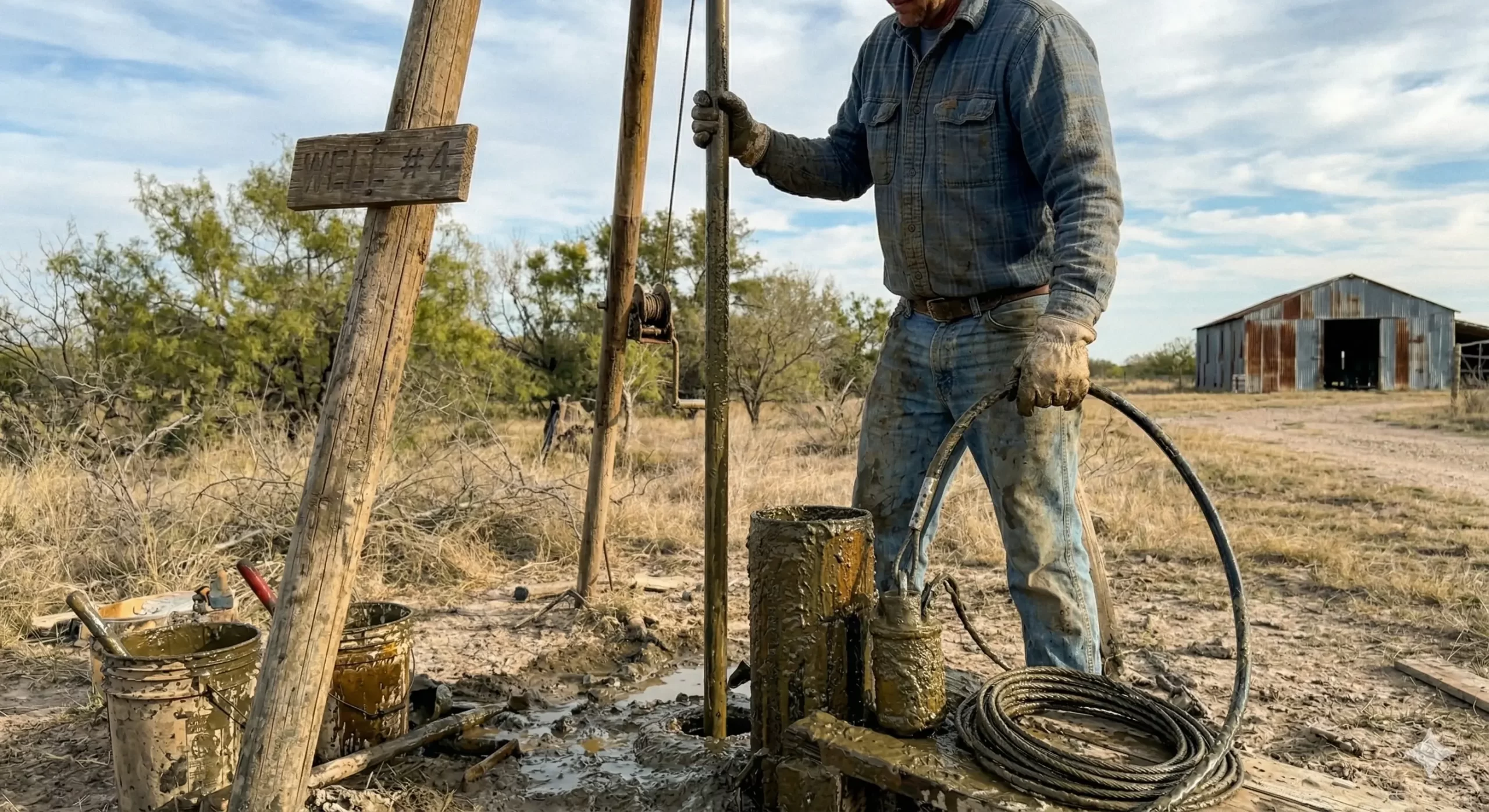
Pulling a pump in Jasper isn’t always about deep rock like out west, but it presents its own set of challenges that drive up costs. Many properties are heavily wooded, or the well might be in a soft, sandy, or even swampy area, making it tough to get a proper well rig close enough. Deep wells also mean a lot of heavy pipe, wire, and pump to pull, sometimes 400-500 feet, which requires specialized equipment and manpower.
A professional pump pull requires a dedicated well service rig, not just a pickup truck with a winch. We’re talking about a boom truck capable of lifting thousands of pounds, specialized pulling tools, safety equipment, and sometimes even an excavator or bulldozer to clear access. Plus, we carry a full inventory of different pump sizes, motors, control boxes, and pipe to ensure we can fix it on the first trip if possible.
Spring Well Maintenance in Texas
Heavy spring rains can cause surface runoff to breach well caps. We strongly recommend testing your water for coliform bacteria and inspecting the sanitary seal.
Save $500+ on Replacements
Via the TX Energy Co-op VFD Upgrade Program
75°F in Jasper
Local Aquifers & Geology
The primary groundwater sources in Jasper include the The Jasper Aquifer is the primary source for many wells in this region, part of the larger Gulf Coast Aquifer system. It consists mainly of fine to medium-grained sand, interbedded with clay and shale. Water from the Jasper Aquifer is typically soft, but often contains elevated levels of iron and manganese, giving it a rusty appearance or metallic taste. The aquifer is highly productive, providing reliable water to most domestic and agricultural users in the area.. Drilling through the local The predominant soil types around Jasper are deep, sandy loams and loamy sands, particularly those of the Tenaha-Boykin-Doucette association. These soils are generally acidic, well-drained in the upper layers but can become less permeable at depth, leading to water accumulation in certain areas. They are often low in organic matter. This sandy profile contributes to potential sand production in wells if screens are not properly designed or maintained. means that average well depths range from 250 ft – 550 ft.
Due to these geological factors, local homeowners frequently struggle with Sand abrasion and sediment buildup are the #1 mechanical failure reasons for pumps in Jasper. The sandy nature of the local aquifers means that if a well is not properly developed, screened, or if the screen becomes compromised, fine sand can enter the well. This sand acts like sandpaper on the pump’s impellers and diffusers, rapidly wearing down components and reducing pump efficiency, eventually leading to complete failure..
Drilling Depth Comparison
Deeper wells require heavy-duty crane hoists for pump extraction.
Climate & Water Quality
Pump systems in the Jasper area face severe environmental stressors. The most significant threat is East Texas weather, with its high humidity, heavy rainfall, and occasional extreme temperatures, significantly impacts well equipment. Frequent lightning storms in the summer can cause power surges, frying control boxes and submersible pump motors. High humidity contributes to corrosion of exposed metal components like pressure switches and tanks. And while rare, deep freezes can burst above-ground pipes and pressure tanks if not properly insulated, leading to major leaks and system failures.
Additionally, the raw groundwater often presents issues with High levels of dissolved iron and manganese are extremely common in Jasper well water, causing rust-colored staining on fixtures and laundry, and a metallic taste. Hydrogen sulfide (sulfur) gas, characterized by a “rotten egg” smell, is also frequently present. Fine sand or sediment is another persistent problem, especially in older wells or those with insufficient screening, leading to cloudy water and pump damage..
Regional Groundwater Advisory
Known primary contaminant threat to submersible pumps and pipes in this area:
Common Area Systems
VFD Upgrade Savings
Constant Pressure vs StandardReplacing a standard single-speed pump with a Variable Frequency Drive (VFD) eliminates hard starts and drastically reduces energy draw in Texas.
Compliance & Local Permits
Jasper County Level: Jasper County falls within the jurisdiction of the Neches Valley Groundwater Conservation District (NVGCD). Any new well construction, or significant alteration to an existing well (like deepening or replacing a casing), typically requires a permit from the NVGCD prior to commencing work. Exemptions exist for certain low-volume domestic and livestock wells, but even then, a registration form is usually required. The NVGCD also has rules regarding well spacing, production limits for larger wells, and proper well plugging procedures to protect the aquifer. Always check with the NVGCD directly before starting any well project.
Top Pump Brands in Texas
Most frequently installed hardware based on local geology (2026 data).
- Check voltage & amperage at the control box and motor leads.
- Inspect pressure tank for proper air charge and signs of waterlogging.
- Test pressure switch for proper cut-in/cut-out settings and functionality.
- Verify pump performance by checking flow rate (GPM) and pressure.
- Visually inspect wellhead for integrity, cap security, and signs of leakage.
- Check for continuity and insulation resistance on pump wires to identify shorts or opens.
Premium Well Pump Brands We Service
Our licensed technicians in Jasper are certified to repair, replace, and install high-quality groundwater equipment from industry-leading manufacturers, including:
- No water at all, even when the pump is running or trying to run.
- Low water pressure, especially after previously adequate pressure.
- Pump runs constantly or cycles on and off too frequently (short cycling).
- Murky water, sand in the water, or a sudden change in water quality.
- Unusual noises coming from the wellhead, pressure tank, or control box.
- High electric bills without a corresponding increase in water usage.
Jasper Real Estate Well Regulations
Local Dispatch & Response Times
Live Dispatch: Texas
Updated Just Now⚠️ High demand. Call now to secure the next available technician.
- We aim for same-day or next-day response for ‘no water’ emergencies, especially for families without alternative water sources.
- Our priority is to get a technician to your property as quickly as possible, usually within a few hours for calls placed early in the day.
- Travel time within Jasper County can vary, especially for remote locations or during bad weather.
- For complex issues or deep wells requiring specialized equipment, diagnosis might happen quickly, but repair could extend into the next day.
- We stock common parts to minimize delays, ensuring a speedy resolution whenever feasible.
⚠️ Jasper County & State Regulatory Warning: Abandoned Wells
The Cost of Ignoring Symptoms
Fixing a short-cycling pump early saves thousands in Jasper.
Data reflects average well contractor estimates in Jasper.
Pump Lifespan Estimator
Select household size in Jasper to see strain impact.
Groundwater Threat Level
Current aquifer and mineral impact on pumps in Jasper.
Dropping water tables cause pumps to suck air and overheat.
Hard water calcifies pump impellers, reducing lifespan.
Local Jasper
Well Pros
Fast Local Service & Diagnostics
Calls are routed to a licensed local well professional.
Septic System Services in Jasper, TX
Do you have a septic tank on your property? Proper maintenance is critical to protecting your well water quality.
Jasper Homeowner Feedback
“Had a well go out middle of July, hottest time. Called ’em up, they was out quick. Fella knew his stuff, fixed her right up. Good honest work.”

Local Homeowner
✓ Verified TX
“Our well had been acting up for months, pump running on and off, then suddenly no water at all. Thought it was the pump motor for sure. The tech came out, tested everything. Turns out, my pressure tank was waterlogged and the pressure switch was clogged with fine sediment, making the pump short cycle. He drained the tank, reset the switch, and even showed me how to maintain the air charge. He also suggested a sediment filter to help with the sandy water. Saved me from a costly pump replacement I didn’t need. Good fellas, even with my crazy dogs. It’s nice to find someone who don’t just jump to the most expensive fix.”

Local Homeowner
✓ Verified TX
“We called after hours, thought we’d be without water for days. These guys were there within a couple of hours. Got our water back on that night. Can’t thank ’em enough for the quick service when we needed it most.”

Local Homeowner
✓ Verified TX
Expert Jasper Well System FAQ
My well in Jasper has always had a little sand, but now I’m getting a lot more, and my water pressure is dropping. What gives?
When you start seeing a significant increase in sand, especially accompanied by dropping pressure, it’s a serious red flag. Several things could be happening. It might indicate that your well screen has corroded or degraded over time, allowing more sediment to enter the well bore. Older wells can also simply have the integrity of their filter pack around the screen break down. Sometimes, excessive pump cycling or an improperly sized pump can exacerbate sand production by drawing water too aggressively. Left unaddressed, this sand will abrade your pump’s impellers, leading to premature pump failure. We’d typically recommend a camera inspection to assess the well’s condition, followed by potential re-development, screen repair, or even installation of a specialized sand separator system.
I’m always battling rust stains on my laundry and fixtures, and my water sometimes tastes metallic. Is this common in Jasper, and what can I do about it?
Absolutely, that’s a classic sign of dissolved iron and often manganese, which is extremely common in groundwater throughout Jasper County and much of East Texas. These minerals are naturally occurring in the aquifer’s geology. When the water comes into contact with air or chlorine, the dissolved (clear) iron oxidizes and becomes particulate (reddish-brown), causing staining. The metallic taste is also due to these minerals. While safe to drink at these levels, it’s certainly a nuisance. Treatment options range from simple aeration and filtration systems, often combined with a greensand filter or catalytic carbon, to more advanced ion exchange systems or chemical oxidation. A water test is always the first step to determine the specific concentrations and recommend the most effective and efficient treatment solution for your particular situation.
Do I need a permit to drill a new well on my land just outside of Jasper for my house and a couple of cows?
Yes, even for domestic and livestock wells, you will almost certainly need to register your well with the Neches Valley Groundwater Conservation District (NVGCD) and potentially obtain a permit before drilling. While some very low-volume domestic and livestock wells might be exempt from *certain* permitting requirements under Texas law, the NVGCD still typically requires registration and may have specific rules regarding well spacing from property lines, septic systems, and other wells, even for exempt wells. It’s always best practice to contact the NVGCD directly before hiring a driller. They can provide you with the most up-to-date regulations and forms specific to your property location and intended use to ensure you’re in full compliance.
My pump is running constantly, and I can hear it, but I’m getting no water to the house. What could be the issue, and how urgent is it?
This is an urgent situation, and you should immediately shut off power to your pump to prevent damage. A pump running constantly with no water discharge indicates a critical failure. It could be several things: a broken drop pipe inside the well, a complete loss of prime (if it’s a jet pump, though less likely for submersibles once installed), a severely damaged pump impeller or motor, or even a total well collapse if you’re pulling in a lot of sand and the screen is compromised. Running the pump ‘dry’ (without water flowing through it) will quickly lead to overheating and irreparable damage to the motor. Turn it off, and call us right away. This usually requires pulling the pump to diagnose the exact problem downhole.
Jasper Groundwater Expert AI
What are the specific groundwater regulations, average well depths, and the local conservation district for Jasper, Jasper County?
Residential Water Wells in Jasper, Jasper County, TX - Year 2026
As a Senior Hydrogeologist and Local Groundwater Regulatory Expert for Texas, I can provide you with specific and current information regarding residential water wells in Jasper, Jasper County, TX for 2026.
1. Local Groundwater Conservation District (GCD)
The local Groundwater Conservation District (GCD) with regulatory authority over Jasper, Jasper County, is the Jasper-Newton Counties Groundwater Conservation District (JNCGCD). The JNCGCD is responsible for managing and protecting the groundwater resources within its jurisdiction through the implementation of district rules and state law.
- For detailed information, rules, and permit applications, visit the official JNCGCD website: https://jnwcd.org/
2. Primary Aquifer System
The primary aquifer system beneath Jasper, Jasper County, is the Gulf Coast Aquifer System. This extensive system in East Texas comprises several hydrogeologic units, including the Chicot Aquifer, Evangeline Aquifer, and the Jasper Aquifer. Residential wells in the area typically draw water from one or more of these formations.
3. Average Well Depths in Jasper
Based on historical state well logs and typical drilling practices for residential water wells in the Jasper area of Jasper County, the average well depth typically ranges from 150 to 350 feet. The specific depth can vary depending on the local topography, the desired water quality, and the targeted producing zone within the Gulf Coast Aquifer System.
4. Specific Groundwater Regulations for Residential Wells
Residential water wells in Jasper, Jasper County, are subject to a combination of state and local regulations. It is crucial to understand that local GCD rules often supplement or are more stringent than state minimums.
State-Level Regulations:
These regulations are primarily enforced by the Texas Department of Licensing and Regulation (TDLR) and the Texas Commission on Environmental Quality (TCEQ).
- Well Driller and Pump Installer Licensing: All individuals or companies drilling new water wells, deepening existing wells, or installing/repairing well pumps must be licensed by the TDLR. This is mandated under Texas Water Code Chapter 32.
- Check the TDLR water well driller and pump installer database: https://www.tdlr.texas.gov/driller/drillerdb.htm
- View TDLR's Water Well Driller and Pump Installer Program: https://www.tdlr.texas.gov/wwd/wwd.htm
- Well Registration (State Well Report): All new water wells, deepened wells, or reactivated wells must be registered with the TDLR by the licensed driller within 30 days of completion. This involves submitting a State of Texas Water Well Report (TDLR Form 0524), which provides vital data about the well's construction and geology.
- Well Construction Standards: Minimum construction standards for water wells are established by the TCEQ in Title 30 Texas Administrative Code (TAC) Chapter 290, Subchapter D, and Chapter 331. These rules dictate requirements for casing, cementing, wellhead completion, and proper sealing to protect groundwater from contamination.
- Setback Requirements: Residential wells must adhere to specific setback distances from potential contamination sources (e.g., septic systems, property lines, waste disposal sites). For instance, TCEQ rules often require a minimum distance of 50 feet from an on-site sewage facility (OSSF) drain field to a private water well.
- Review TCEQ water well rules (30 TAC Chapters 290 and 331): https://www.tceq.texas.gov/rules/rules_view_ch.html?chap=290
Local-Level Regulations (Jasper-Newton Counties GCD):
The JNCGCD has adopted its own set of rules and regulations under the authority granted by Texas Water Code Chapter 36. These rules are specific to Jasper and Newton Counties and are in addition to state requirements.
- Well Permitting: The JNCGCD requires a permit for the drilling of all new water wells, including residential wells, within its boundaries. This is separate from and in addition to the state's well registration process. You must obtain a permit from the JNCGCD *before* drilling commences.
- Spacing Requirements: The JNCGCD has specific rules regarding the minimum distance between a new well and existing wells, as well as minimum distances from property lines. These spacing rules are designed to prevent undue interference between wells and ensure the equitable distribution of groundwater resources.
- Well Construction and Installation Standards: While generally adhering to TCEQ construction standards, the JNCGCD may have additional or more stringent local requirements for well construction, pump installation, or well abandonment.
- Production Limitations: Although less common for typical single-family residential wells, the JNCGCD has the authority to monitor and, if necessary, regulate groundwater production rates to conserve the aquifer, especially during declared drought conditions or in areas with known resource limitations.
It is highly recommended that you directly contact the Jasper-Newton Counties Groundwater Conservation District for the most current rules, permit applications, and any specific requirements that may apply to your property before initiating any well drilling or related activities.
Fast Local Service & Diagnostics
Calls are routed to a licensed local well professional.
Blix
provides official
Emergency Well Pump Repair services for the
Jasper
area.