
Emergency Well Pump Repair in Conroe, TX
Folks often move to Conroe for the taste of country living, but the truth about groundwater out here is a harsh reality for many. With the tremendous growth Montgomery County has seen, the demand on our aquifers is higher than ever. Old systems are getting pushed to their limits, and even new ones face unique challenges from our local geology and water chemistry.
We’re primarily tapping into the Evangeline and Jasper aquifers around here. These are robust sources, but they come with their own quirks. You’re dealing with varying depths, and often, water that’s got its fair share of sand, iron, and sometimes even corrosive properties. It’s not a simple, clean tap water situation like you might find up north.
This is precisely why cheap, off-the-shelf pumps just don’t cut it in Conroe. They’re not built for the constant battle against fine sand abrasion, the mineral content, or the high demand that a Texas home puts on a well. You skimp on a pump out here, and you’ll be calling me back in half the time, wishing you’d invested in quality from the start.
Fast Local Service & Diagnostics
Calls are routed to a licensed local well professional.
Well Pump Repair in
Conroe
Conroe & Montgomery County Well Stats
Montgomery County relies heavily on groundwater, with hundreds of thousands of residents using private wells or water supplied by districts that pump from local aquifers. New residential wells are typically drilled into the Jasper or deeper Evangeline Aquifer, while many older wells draw from the upper Evangeline. Average residential water usage, especially with irrigation, is substantial, often exceeding 5,000-10,000 gallons per month per household.
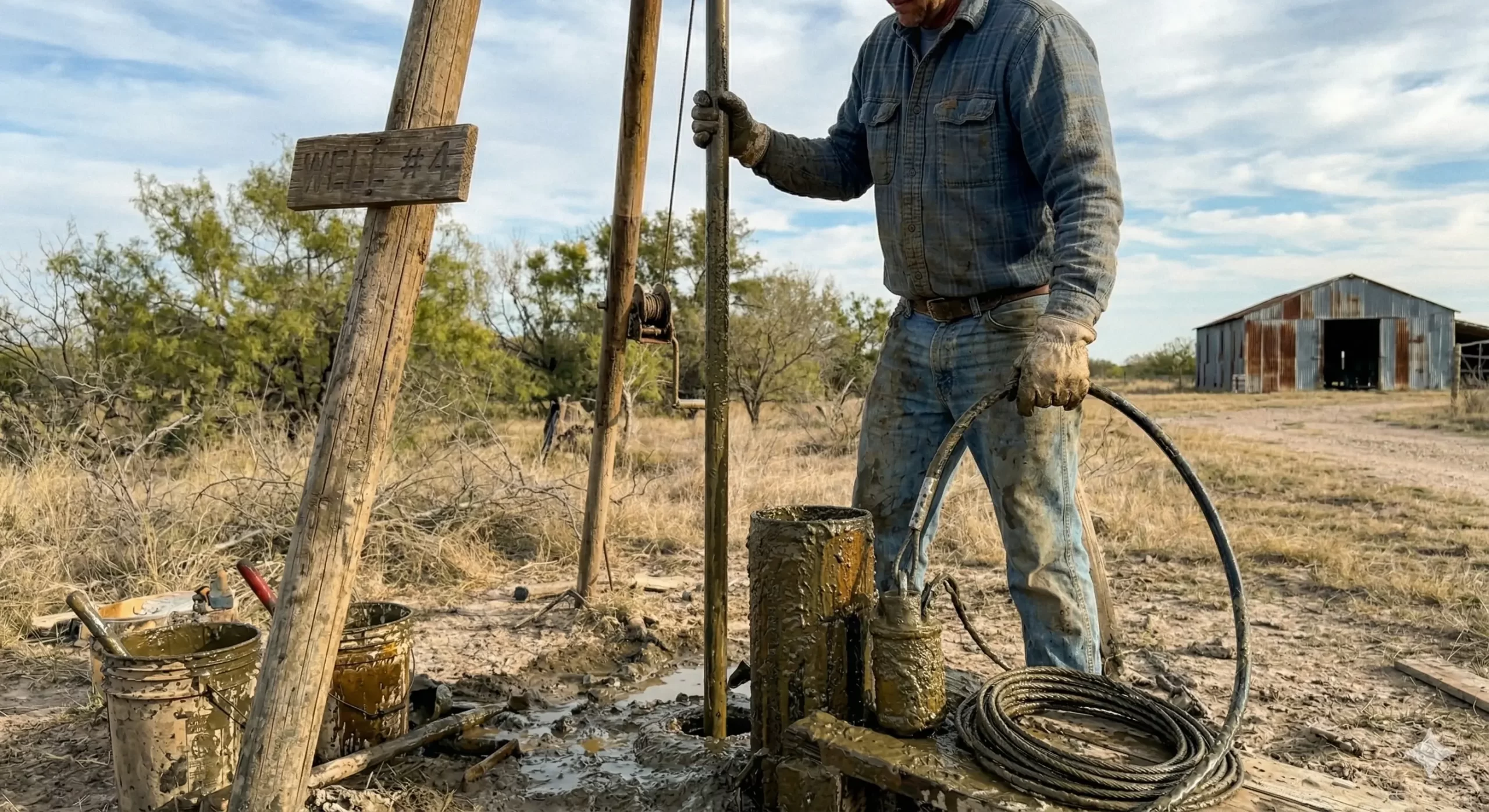
Pulling a pump in Montgomery County ain’t like pulling a shallow pump in Kansas. Our wells are deep, often anywhere from 250 to 800 feet, sometimes even deeper. That means a specialized well rig is absolutely necessary. You’re not just dealing with the weight of the pump & motor, but also hundreds of feet of drop pipe, wire, and often, water. We also frequently encounter wells with sand bridging issues or old, brittle PVC casing that requires extra care.
The cost factors include the specialized service truck and hoist, skilled labor, the well camera to inspect the casing, and the sheer time it takes to safely retrieve and replace a pump from these depths. We also carry a full inventory of quality parts on our trucks because nobody wants to wait days for a specialized component when they’re out of water.
Spring Well Maintenance in Texas
Heavy spring rains can cause surface runoff to breach well caps. We strongly recommend testing your water for coliform bacteria and inspecting the sanitary seal.
Save $500+ on Replacements
Via the TX Energy Co-op VFD Upgrade Program
78°F in Conroe
Local Aquifers & Geology
The primary groundwater sources in Conroe include the Evangeline Aquifer (part of the Gulf Coast Aquifer system). This aquifer consists of interbedded sands, silts, and clays, with sands providing the primary water-bearing zones. Water quality can be variable; it’s generally fresh but often contains elevated levels of iron, manganese, and hardness. Sand production is a common issue due to the fine-grained nature of some of the sands. Yields are typically sufficient for domestic use, but sustained pumping can cause local drawdown.. Drilling through the local The surface soils in Conroe and Montgomery County are predominantly sandy loams and clayey loams, often underlain by deeper clays from the Beaumont Formation. These soils can be unstable when saturated. Beneath these, you’ll encounter the unconsolidated sands, silts, and clays of the Evangeline and Jasper aquifers. This means that while drilling can be relatively fast through softer formations, well integrity and grouting are critical to prevent surface contamination. means that average well depths range from 250 ft – 800 ft.
Due to these geological factors, local homeowners frequently struggle with Sand abrasion. The fine sands common in our aquifers act like sandpaper on pump impellers and motors, leading to premature wear, reduced efficiency, and eventual failure. This is often exacerbated by improper well screen selection or historical over-pumping..
Drilling Depth Comparison
Deeper wells require heavy-duty crane hoists for pump extraction.
Climate & Water Quality
Pump systems in the Conroe area face severe environmental stressors. The most significant threat is The extreme heat and humidity here stress pump motors, control boxes, and above-ground electrical components, accelerating corrosion and insulation breakdown. Droughts cause water tables to drop, forcing pumps to work harder, suck air, or ingest more sand. Conversely, heavy rainfall can lead to localized flooding around wellheads, potentially causing electrical faults or introducing contaminants if the well isn’t properly sealed and elevated.
Additionally, the raw groundwater often presents issues with High iron content (causing reddish-brown staining) and significant hardness are widespread. Sulfur (rotten egg smell) is present in some deeper wells. Sand production is a chronic problem for many wells, leading to pump damage and plumbing issues..
Regional Groundwater Advisory
Known primary contaminant threat to submersible pumps and pipes in this area:
Common Area Systems
VFD Upgrade Savings
Constant Pressure vs StandardReplacing a standard single-speed pump with a Variable Frequency Drive (VFD) eliminates hard starts and drastically reduces energy draw in Texas.
Compliance & Local Permits
Montgomery County Level: The Lone Star Groundwater Conservation District (LSGCD) manages groundwater in Montgomery County. While domestic and livestock wells are generally exempt from LSGCD production permits, all wells must be registered with the district. Any new well drilling or significant alteration (like deepening) also requires a permit from the Texas Department of Licensing & Regulation (TDLR) and must comply with their construction standards. For pump repair or replacement on an existing, registered well, no additional local permit from LSGCD is typically required.
Top Pump Brands in Texas
Most frequently installed hardware based on local geology (2026 data).
- Test pump motor amp draw & insulation resistance (megger test) to diagnose motor health.
- Verify pressure tank air charge and check for diaphragm integrity, ensuring proper system cycling.
- Inspect and test the pressure switch for proper cut-in/cut-out settings and condition of contacts.
- Examine all visible electrical connections, wires, & conduits for corrosion, rodent damage, or wear.
- Measure static & pumping water levels (if well access permits) to assess aquifer performance.
- Perform a flow test to evaluate the well’s yield and pump’s performance under actual load.
Premium Well Pump Brands We Service
Our licensed technicians in Conroe are certified to repair, replace, and install high-quality groundwater equipment from industry-leading manufacturers, including:
- Complete loss of water pressure or no water at all.
- Pump cycles on & off very rapidly or frequently (short cycling).
- Noticeable decrease in water pressure or flow volume.
- Water appearing muddy, sandy, or discolored from your faucets.
- Higher than usual electricity bills without increased usage.
- Audible grinding, humming, or excessive noise coming from the well area.
Conroe Real Estate Well Regulations
Local Dispatch & Response Times
Live Dispatch: Texas
Updated Just Now⚠️ High demand. Call now to secure the next available technician.
- Within Conroe city limits & immediate surrounding areas: Often 1-2 hours.
- Remote parts of Montgomery County: Generally 2-4 hours, depending on current call volume & technician availability.
- Priority is always given to no-water emergencies for families, especially those with vulnerable occupants (elderly, infants).
- We offer 24/7 emergency service, but after-hours calls may incur higher rates.
- During severe weather events (e.g., hurricanes, ice storms), response times can be significantly extended due to road conditions and extremely high demand.
⚠️ Montgomery County & State Regulatory Warning: Abandoned Wells
Pump Lifespan Estimator
Select household size in Conroe to see strain impact.
The Cost of Ignoring Symptoms
Fixing a short-cycling pump early saves thousands in Conroe.
Data reflects average well contractor estimates in Conroe.
Groundwater Threat Level
Current aquifer and mineral impact on pumps in Conroe.
Dropping water tables cause pumps to suck air and overheat.
Hard water calcifies pump impellers, reducing lifespan.
Local Conroe
Well Pros
Fast Local Service & Diagnostics
Calls are routed to a licensed local well professional.
Septic System Services in Conroe, TX
Do you have a septic tank on your property? Proper maintenance is critical to protecting your well water quality.
Conroe Homeowner Feedback
“Had a pump go out late Friday. Called ’em up and they were out Saturday morning. Fixed it right up. Good honest folks.”

Local Homeowner
✓ Verified TX
“Our well pump started acting real weird a few weeks back. Water would come out strong for a bit, then just trickle, and the pump was constantly kicking on and off. Thought we might need a whole new well. The tech, a fella named Billy, came out and spent a good hour diagnosing. Turned out our pressure tank was waterlogged, and the pressure switch contacts were all burnt up. He had the parts on the truck and swapped ’em out. Even checked the pump’s amp draw just to be sure it wasn’t the motor itself. Saved us a ton of money and the water’s been perfect ever since. Really appreciate the thorough job and the clear explanation of what went wrong. No more of that short cycling non-sense.”

Local Homeowner
✓ Verified TX
“Lost all water Sunday evening. Called these guys and they were here within an hour and a half. Knew exactly what they were doing. Had us back up and running before bedtime. Lifesavers when you’ve got kids who need a bath!”

Local Homeowner
✓ Verified TX
Expert Conroe Well System FAQ
My water suddenly turned sandy/muddy in Conroe. What’s going on & what should I do?
This is a common issue in our area, especially with older wells or after heavy pumping. It usually indicates that the well screen or casing has failed, allowing sand from the aquifer to enter the well. Less commonly, it could be a damaged pump intake or the pump itself stirring up sediment if it’s sitting too low. First, avoid running appliances that use water (like washing machines, dishwashers, water heaters) to prevent clogging them. Turn off your pump if it’s actively pushing sand. Next, call a licensed well technician immediately. We’ll use a well camera to inspect the casing and screen for damage, assess the pump’s condition, and determine the best course of action, which might involve pulling the pump for inspection, well rehabilitation, or in severe cases, even drilling a new well.
How often should I have my well pump and system inspected in Montgomery County?
Given our local conditions, we recommend a professional inspection every 3-5 years for most residential wells. However, if your well is older, experiencing frequent power outages, or if you notice any changes in water pressure, clarity, or taste, an annual check-up might be prudent. Regular inspections help identify minor issues like failing pressure switches, corroded wiring, or declining pump performance before they lead to complete system failure. Proactive maintenance, especially checking things like pressure tank air charge and electrical connections, can significantly extend the life of your pump and prevent costly emergency repairs down the line.
What’s the deal with iron staining in my Conroe well water & can it be fixed?
Iron is naturally abundant in the Evangeline Aquifer that supplies most of Conroe’s well water, so iron staining (reddish-brown streaks in sinks, toilets, and laundry) is a very common complaint. It’s primarily aesthetic and not a health risk, but it can be a nuisance. The good news is, yes, it can be fixed. We typically recommend installing a water treatment system. This usually involves an iron filter, which uses oxidation and filtration to remove the dissolved iron before it reaches your household plumbing. The specific type and size of the filter depend on your water test results and household water usage. It’s a highly effective solution for improving water quality and eliminating those unsightly stains.
Can lightning strikes damage my submersible pump system even if my house isn’t directly hit?
Absolutely. Lightning is a huge threat to well pump systems in Texas, especially with our frequent thunderstorms. Even indirect strikes nearby can send powerful electrical surges through the ground or power lines. These surges can travel down to your submersible pump motor and controls, frying the windings, control box, pressure switch, or even damaging the wires. While your house might be spared, the pump system is vulnerable. We strongly recommend installing robust surge protectors specifically designed for well pump applications at your control box and main electrical panel. It’s a relatively inexpensive preventative measure that can save you thousands of dollars in pump replacement costs.
Conroe Groundwater Expert AI
What are the specific groundwater regulations, average well depths, and the local conservation district for Conroe, Montgomery County?
Groundwater Regulations and Residential Wells in Conroe, Montgomery County, TX (2026)
As a Senior Hydrogeologist and Local Groundwater Regulatory Expert for Texas, I can provide you with specific and current information regarding residential water wells in Conroe, Montgomery County, TX, as of 2026. Understanding your local regulations and hydrogeology is crucial for responsible well ownership.
Local Groundwater Conservation District (GCD)
For Conroe and all of Montgomery County, the primary local regulatory authority for groundwater is the Lone Star Groundwater Conservation District (LSGCD). The LSGCD is responsible for conserving, protecting, and enhancing the groundwater resources of Montgomery County. They establish rules, issue permits, and monitor groundwater use to manage the resource sustainably.
- Official LSGCD Website: https://www.lonestargcd.org/
Specific Groundwater Regulations and Permitting
To drill a new residential water well in Conroe, you will need to adhere to both state and local regulations:
- LSGCD Permitting: The Lone Star Groundwater Conservation District requires a permit for all new water wells, including residential wells. While domestic, non-commercial wells often have less stringent permitting requirements than large production wells, you must still apply for a permit, meet construction standards, and register your well with the District. The LSGCD's rules cover well spacing, construction, and plugging requirements.
- State-Level Regulation (TDLR): In addition to LSGCD rules, the State of Texas, through the Texas Department of Licensing and Regulation (TDLR), regulates water well drillers and pump installers. All well drilling and pump installation must be performed by a licensed professional. New wells must also be registered with the TDLR within 30 days of completion. This is mandated under Texas Occupations Code Chapter 1901.
- Texas Water Code Chapter 36: This state code provides the statutory framework for the creation and operation of Groundwater Conservation Districts like the LSGCD, granting them the authority to regulate groundwater.
- Setback Rules: Both state and local regulations stipulate minimum setback distances for water wells to protect them from potential contamination. Typically, the TDLR requires a minimum distance of 50 feet from septic tanks, septic system drain fields, property lines, and other potential sources of contamination. LSGCD rules may include additional or more stringent setback requirements for certain situations. Always consult the most current LSGCD rules and your licensed driller.
Key Resources for Regulations and Permitting:
- LSGCD Rules and Permitting Information: https://www.lonestargcd.org/rules/ (Look for the most current District Rules document and well permit applications.)
- TDLR Water Well Driller and Pump Installer Program: https://www.tdlr.texas.gov/wwpd/wwpd.htm
- Texas Water Code Chapter 36 (Groundwater Conservation Districts): https://statutes.capitol.texas.gov/Docs/WA/htm/WA.36.htm
- Texas Occupations Code Chapter 1901 (Water Well Drillers and Pump Installers): https://statutes.capitol.texas.gov/Docs/OC/htm/OC.1901.htm
Average Residential Well Depths in Conroe
Based on historical state well logs and hydrogeological mapping of Montgomery County, the average depth for a new residential water well in the Conroe area typically ranges from 600 to 800 feet. A reliable average to ensure consistent yield and good water quality in this region is approximately 700 feet. This depth generally allows for sufficient penetration into the primary aquifers that serve domestic use, avoiding shallower zones that may be more susceptible to drought impacts or specific water quality issues.
However, actual well depth can vary significantly based on the specific lot location, the desired yield, and the specific hydrogeological conditions encountered by the driller. Some wells may be shallower (e.g., 400-500 feet), while others might need to extend deeper (e.g., 900+ feet) to access optimal water-bearing sands.
Primary Aquifers Beneath Conroe
Conroe, Montgomery County, draws its groundwater primarily from the **Gulf Coast Aquifer System**. Within this system, the main aquifers targeted for residential and public supply wells are:
- Jasper Aquifer: This is a major source of freshwater in the region and is typically targeted by wells in the 400-800 foot depth range.
- Evangeline Aquifer: Lying beneath the Jasper, the Evangeline Aquifer is also a significant water source, often accessed by deeper wells (700-1,200+ feet), providing excellent quality and quantity.
- Chicot Aquifer: While present and shallower, the Chicot Aquifer is less commonly the sole source for deeper, high-yield residential wells in Conroe compared to the Jasper and Evangeline due to varying water quality and susceptibility to surface impacts in some areas.
Important Resources for Well Owners and Prospective Drillers
- TDLR Water Well Driller and Pump Installer Search: https://www.tdlr.texas.gov/licenses/LicenseSearch/ (Use this to find a licensed driller in your area.)
- Texas Water Development Board (TWDB) Gulf Coast Aquifer Information: https://www.twdb.texas.gov/groundwater/aquifer/GCA.asp
Before proceeding with any well drilling, I highly recommend contacting the Lone Star Groundwater Conservation District directly to obtain the most up-to-date regulations and permit application forms for your specific property.
Fast Local Service & Diagnostics
Calls are routed to a licensed local well professional.
Blix
provides official
Emergency Well Pump Repair services for the
Conroe
area.