
Emergency Well Pump Repair in Rockwall, TX
Rockwall County, for all its beauty, sits on some challenging geology when it comes to groundwater. You’re not always dealing with the easy sand & gravel of East Texas. Here, often you’re drawing from deeper, tighter formations, meaning lower yields can be a real headache, especially during a dry spell. We see a lot of wells struggling to keep up with demand, leading to pump cycling and premature wear.
Most folks here are pulling water from the Woodbine Aquifer. It’s primarily a sandstone formation, generally decent quality but not without its quirks. Depth varies, but you’re usually looking at hundreds of feet down. This means higher head pressure on your pump, and the water can carry dissolved minerals that cause problems over time if not properly managed.
This combination of depth, potential for lower yields, and specific water chemistry is why a cheap, off-the-shelf pump often doesn’t last long here. They’re not built for the constant strain, the mineral content, or the higher amp draws needed to lift water from these depths. Investing in quality equipment from the start saves a pile of money and frustration in the long run.
Fast Local Service & Diagnostics
Calls are routed to a licensed local well professional.
Well Pump Repair in
Rockwall
Rockwall & Rockwall County Well Stats
Rockwall County has a smaller number of domestic wells compared to more rural counties, but those wells are critical infrastructure for their owners. Average yields typically range from 5 to 25 gallons per minute (GPM) from the Woodbine Aquifer, which is adequate for most residential uses if the well is properly drilled & sized. However, some older wells or those in less productive zones can struggle, particularly during drought conditions.
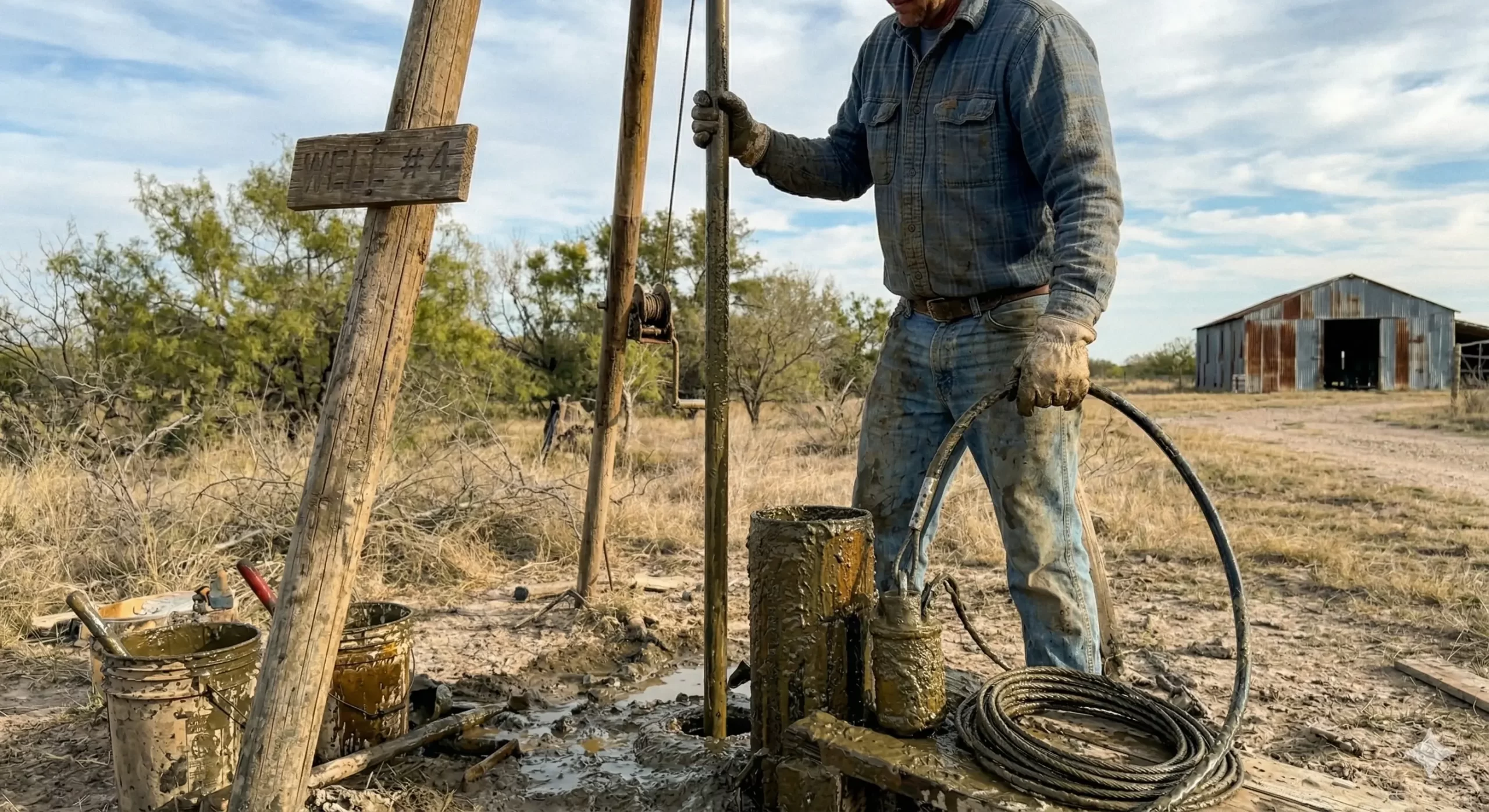
Pulling a pump in Rockwall isn’t like pulling one from a shallow sandy well. Underneath the Blackland Prairie topsoil, you hit some serious rock layers – primarily the Austin Chalk and then down into the Eagle Ford Shale. This means drilling a well is more expensive initially, and when it comes to pulling a pump, you’ve often got a deep set, requiring heavy-duty pump rigs. Access can also be tricky on some older, rural properties, which adds to the setup time & complexity.
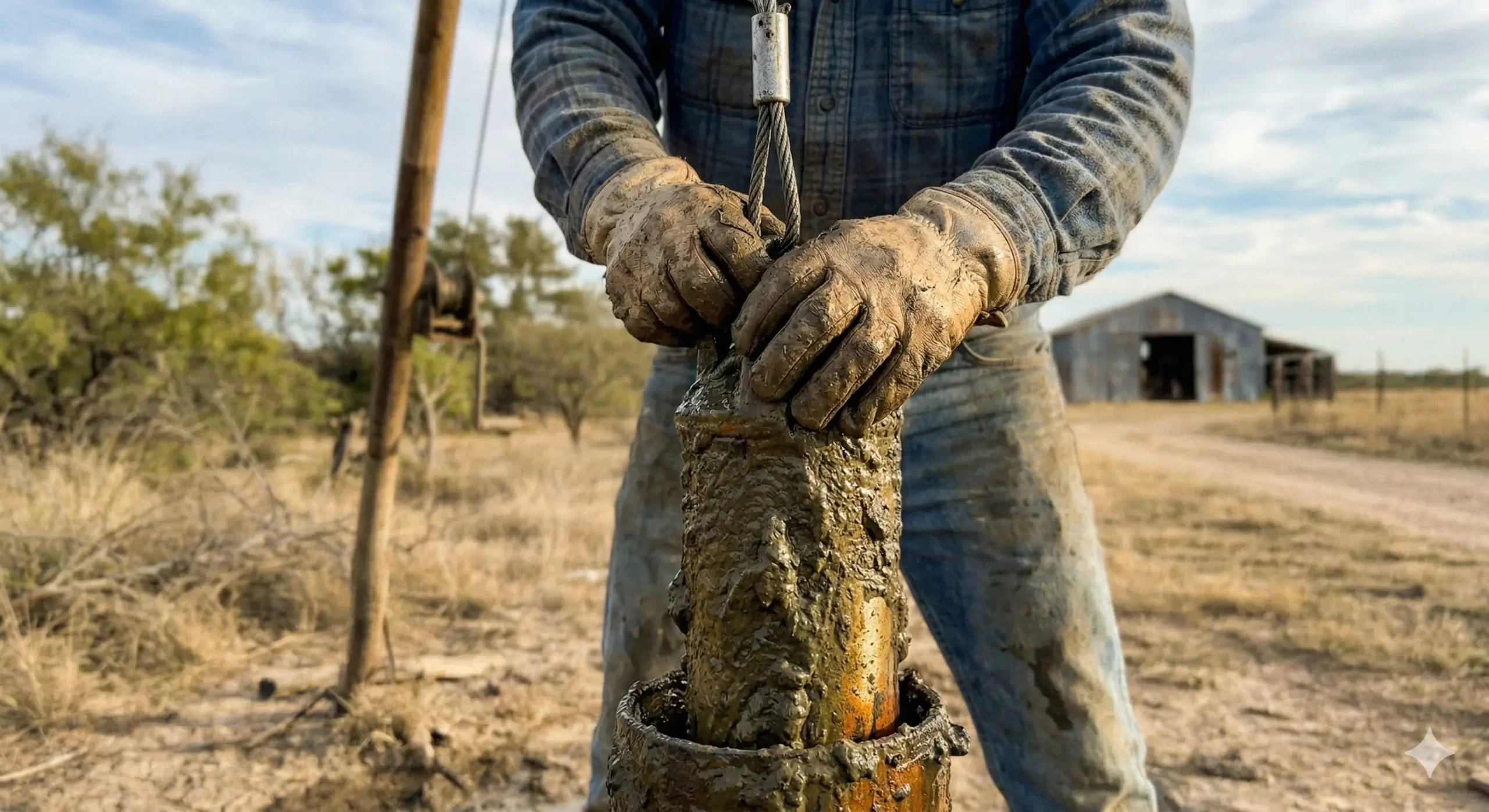
To safely & efficiently pull and replace a pump from 300-600 feet down, we need specialized equipment. That includes a crane-equipped pump truck, high-torque pipe wrenches, electrical diagnostic tools, safety gear, and often a crew of two experienced technicians. This isn’t a DIY job, & the cost reflects the significant capital investment in equipment & the highly specialized training of the crew.
Spring Well Maintenance in Texas
Heavy spring rains can cause surface runoff to breach well caps. We strongly recommend testing your water for coliform bacteria and inspecting the sanitary seal.
Save $500+ on Replacements
Via the TX Energy Co-op VFD Upgrade Program
74°F in Rockwall
Local Aquifers & Geology
The primary groundwater sources in Rockwall include the Woodbine Aquifer. This aquifer is composed primarily of fine- to medium-grained sandstones with interbedded shales & clays. It’s an important source of water for much of North Texas, including Rockwall. Water quality is generally good, but elevated levels of total dissolved solids (TDS), iron, and hardness are common due to the mineral composition of the rock & the depth of the water. Yields can be variable, depending on the specific geology & well construction.. Drilling through the local Rockwall County primarily sits on the Blackland Prairie ecological region. The topsoil is characterized by dark, alkaline, clay-rich soils (Vertisols), often referred to as ‘gumbo.’ These soils are deep & expansive, meaning they swell significantly when wet & crack when dry, which can impact surface well infrastructure over time. Beneath these rich agricultural soils, you’ll encounter the Austin Chalk formation, a white limestone, & then the Eagle Ford Shale, both of which are significant bedrock layers. means that average well depths range from 300 ft – 650 ft, with some older wells potentially shallower & newer wells needing to go deeper for reliable yields..
Due to these geological factors, local homeowners frequently struggle with Mineral buildup & iron fouling. The water chemistry in the Woodbine often leads to scale & iron deposits on pump impellers, motors, & inside the drop pipe. This reduces efficiency, increases power consumption, & eventually causes mechanical failure. Electrical surges from lightning are a close second..
Drilling Depth Comparison
Deeper wells require heavy-duty crane hoists for pump extraction.
Climate & Water Quality
Pump systems in the Rockwall area face severe environmental stressors. The most significant threat is Texas summers are brutal, & Rockwall gets its share. Extreme heat stresses pump motors & control boxes, leading to overheating & premature failure. Deeper static water levels during prolonged droughts force pumps to work harder. While less frequent, winter freezes can burst exposed pipes, pressure tanks, & pressure switches if not properly insulated or installed, though submersible pumps themselves are protected underground. Lightning strikes are a significant threat, often frying control boxes & even submersible motors.
Additionally, the raw groundwater often presents issues with Hardness (calcium & magnesium) is very common, leading to scale in pipes & appliances. Elevated iron levels are also widespread, causing reddish-brown staining, metallic taste, & fostering iron bacteria. Sulfur (hydrogen sulfide gas) can sometimes be present, giving water a ‘rotten egg’ smell. Sand isn’t a primary issue with properly cased wells, but fine sediment can sometimes be pulled during peak demand or if the well screen is damaged..
Regional Groundwater Advisory
Known primary contaminant threat to submersible pumps and pipes in this area:
Common Area Systems
VFD Upgrade Savings
Constant Pressure vs StandardReplacing a standard single-speed pump with a Variable Frequency Drive (VFD) eliminates hard starts and drastically reduces energy draw in Texas.
Compliance & Local Permits
Rockwall County Level: Rockwall County does not have its own specific Groundwater Conservation District like some other parts of Texas. However, all new well drilling & significant repairs, like casing replacements, are still subject to statewide regulations enforced by the Texas Department of Licensing & Regulation (TDLR) & local county health department rules. A permit is required for new well construction & often for major modifications. Always check with the Rockwall County Environmental Health Department before starting any significant well work to ensure compliance with setback requirements & other local ordinances.
Top Pump Brands in Texas
Most frequently installed hardware based on local geology (2026 data).
- Check system voltage & amperage draw at the control box & pressure switch for proper motor operation.
- Verify pressure tank pre-charge & operation; inspect tank for signs of waterlogging or internal bladder failure.
- Inspect pressure switch for proper cut-in/cut-out settings & contact condition; clean or replace as needed.
- Test water quality for hardness, iron, pH, & sediment, as these impact pump longevity & system health.
- Examine all exposed wiring & conduit for rodent damage, corrosion, or insulation breakdown.
- Cycle pump manually to listen for unusual noises & observe water flow & pressure at various points.
Premium Well Pump Brands We Service
Our licensed technicians in Rockwall are certified to repair, replace, and install high-quality groundwater equipment from industry-leading manufacturers, including:
- No water coming from any faucet, or very low pressure throughout the house.
- Pump constantly cycling on & off, even when no water is being used, indicating a leak or tank issue.
- Cloudy, sandy, or rust-colored water suddenly appearing, suggesting a well or pump issue.
- Unusual noises (grinding, humming, clicking) coming from the wellhead area or pressure tank.
- Significantly higher electricity bills without a change in water usage, signaling an inefficient or struggling pump.
- Air spitting from faucets, indicating a low water level in the well or a leak in the drop pipe.
Rockwall Real Estate Well Regulations
Local Dispatch & Response Times
Live Dispatch: Texas
Updated Just Now⚠️ High demand. Call now to secure the next available technician.
- Initial phone assessment within minutes to understand the immediate issue & provide preliminary advice.
- Dispatch of a service truck, typically within 2-4 hours for non-holiday emergencies, depending on call volume & technician availability in the Rockwall area.
- On-site diagnosis & troubleshooting, aiming to pinpoint the exact problem within 30-60 minutes of arrival.
- Immediate repair or temporary solution if parts are on the truck; if not, sourcing parts quickly.
- Full water system restoration, often within the same day for common issues, or within 24-48 hours for complex pump pull & replacement jobs.
⚠️ Rockwall County & State Regulatory Warning: Abandoned Wells
The Cost of Ignoring Symptoms
Fixing a short-cycling pump early saves thousands in Rockwall.
Data reflects average well contractor estimates in Rockwall.
Groundwater Threat Level
Current aquifer and mineral impact on pumps in Rockwall.
Dropping water tables cause pumps to suck air and overheat.
Hard water calcifies pump impellers, reducing lifespan.
Pump Lifespan Estimator
Select household size in Rockwall to see strain impact.
Local Rockwall
Well Pros
Fast Local Service & Diagnostics
Calls are routed to a licensed local well professional.
Septic System Services in Rockwall, TX
Do you have a septic tank on your property? Proper maintenance is critical to protecting your well water quality.
Rockwall Homeowner Feedback
“Had a pump go out on Sunday morning. Called these folks & they were out quick. Fixed it up right & didn’t try to sell me a whole new system I didn’t need. Good honest work, appreciate it.”

Local Homeowner
✓ Verified TX
“Our well pump started acting real funny, just running all the time but barely any water. I figured it was the pump itself. The technician came out, bless his heart, & did all these fancy tests. Turns out, my pressure tank was waterlogged & the pressure switch contacts were totally corroded from all the humidity we get. He replaced both, checked the pump motor (it was still good!), and recharged the tank. Water pressure’s back to normal, & the pump ain’t cycling every five minutes. I thought I was in for a huge bill for a new pump, but they saved me a ton. Real pros, they know their stuff, didn’t even charge me extra for coming out past regular hours. Best darn well service in Rockwall, no doubt.”

Local Homeowner
✓ Verified TX
“Lost all water last night, naturally when family was visiting. Called them up in a panic. They had a tech at my place in Rockwall within a few hours. Diagnosed a bad start capacitor & had us back up & running before lunch. Absolute lifesavers & super speedy!”

Local Homeowner
✓ Verified TX
Expert Rockwall Well System FAQ
My water from the well in Rockwall has a reddish tint & tastes metallic. What’s causing this, & can it damage my pump?
That sounds like a classic case of elevated iron, which is very common in the Woodbine Aquifer here in Rockwall County. Iron in the water can manifest as reddish-brown staining on fixtures & laundry, a metallic taste, & sometimes even an oily film. While not directly harmful to your health in typical concentrations, it absolutely can damage your pump over time. Iron precipitates out of the water & can build up on the impellers & motor windings of your submersible pump, reducing its efficiency, increasing the load on the motor, & ultimately leading to premature failure. We often recommend a comprehensive water test to determine the exact iron levels & then discuss appropriate filtration solutions, such as an iron filter, to protect your pump & improve your water quality.
During droughts or heavy usage, my Rockwall well seems to run out of water. Is my well going dry, or is it a pump issue?
This is a common concern in Rockwall, especially with the variable yields of the Woodbine Aquifer & during extended dry periods. It’s rarely a sign of your well ‘going dry’ in a permanent sense, but rather an indication that your well’s recovery rate (how quickly water flows back into the well bore) can’t keep up with your pump’s demand. Several factors can contribute: a lowered static water table due to drought, the well simply having a lower yield capacity in your specific location, or even a pump that’s oversized for the well’s recovery rate. We’d typically perform a recovery test & evaluate your pump’s GPM output. Sometimes the solution is a variable speed drive (VFD) to match pump output to the well’s inflow, or if the well’s yield is truly marginal, discussing water storage solutions like cisterns. It’s crucial to properly diagnose to prevent the pump from running dry, which can cause severe damage.
How long should a submersible pump last in a Rockwall well, given our local water & geology?
With proper installation, a quality submersible pump from brands like Grundfos or Goulds should realistically last anywhere from 8 to 15 years in a Rockwall well. However, this isn’t a hard & fast rule. The primary factors affecting longevity here are the water quality – specifically iron & hardness levels that cause scaling & corrosion – & the depth & yield of your well. A pump that’s constantly fighting against mineral buildup or frequently running near its maximum capacity due to a deep set or low well yield will experience accelerated wear. Electrical surges, especially common during our Texas thunderstorms, can also significantly shorten a pump’s life if not protected by surge arrestors. Regular maintenance & annual water quality checks can help identify issues early & extend your pump’s operational life.
What should I do to protect my well pump from Rockwall’s frequent summer lightning storms & power outages?
Protecting your well system from lightning & power surges is critical in Rockwall. First & foremost, ensure your control box & electrical panel have robust surge protection devices (SPDs) installed. These are designed to absorb & divert excessive voltage spikes away from your sensitive pump motor & controls. Secondly, proper grounding of your well system is paramount; a well-maintained ground rod system helps dissipate electrical charges safely. During a severe lightning storm, if you know your area is prone to power fluctuations, it’s a good practice to temporarily switch off your well pump’s breaker if you’re comfortable doing so, but don’t risk exposure. For power outages, once power is restored, always wait a few minutes before switching your pump back on to allow the utility grid to stabilize & avoid potential brownout damage. A quality pressure tank also helps by reducing pump cycles, which can be particularly beneficial during periods of unstable power.
Rockwall Groundwater Expert AI
What are the specific groundwater regulations, average well depths, and the local conservation district for Rockwall, Rockwall County?
Groundwater Regulations for Residential Water Wells in Rockwall, Rockwall County (2026)
As a Senior Hydrogeologist and local regulatory expert, it's important to clarify the regulatory landscape for residential water wells in Rockwall County. As of 2026, Rockwall County does not have an active, locally-created Groundwater Conservation District (GCD). This means that direct local management of groundwater production and permitting, as would typically occur under Texas Water Code Chapter 36, is not in place.
Therefore, the primary regulatory oversight for residential water wells in Rockwall County falls under state agencies, specifically the Texas Department of Licensing and Regulation (TDLR) for well drilling and construction standards, and the Texas Commission on Environmental Quality (TCEQ) for water quality if applicable (though most private domestic wells are self-regulated for quality).
Key State Regulations Governing Residential Wells:
- TDLR Licensing and Registration: Any individual drilling a water well in Rockwall County must be a licensed water well driller by the TDLR. New wells, and modifications to existing wells, must be registered with the TDLR within 30 days of completion.
- State Code: This is mandated by Texas Occupations Code Chapter 1901 and the associated TDLR rules.
- TDLR Well Registration Form: The licensed driller is responsible for submitting Form 056, the Water Well Driller's Report. This report details the well's construction, depth, geology, and other critical information.
- Check TDLR Licensed Drillers: You can verify a driller's license status and review well driller reports at the official TDLR portal: https://www.tdlr.texas.gov/LicenseSearch/
- Well Construction Standards: TDLR sets minimum construction standards to protect groundwater quality and ensure proper well function. These standards include:
- Casing Requirements: Specifications for the type and depth of casing pipe.
- Cementing/Grouting: Requirements for cementing the annular space around the casing to prevent contamination from surface sources or shallow aquifers.
- Wellhead Completion: Requirements for well caps, vents, and other components to protect the well from contaminants.
- State Code: These standards are found in 16 Texas Administrative Code Chapter 76, administered by TDLR.
- Setback Requirements: To prevent contamination, specific distances must be maintained between a new well and potential sources of contamination:
- 50 feet from property lines.
- 50 feet from septic tanks, drainfields, and feedlots.
- 100 feet from a septic system absorption field or animal waste disposal site.
- 150 feet from a sewage treatment plant or sanitary landfill.
- State Code: These setbacks are generally specified within 16 Texas Administrative Code Chapter 76 (TDLR rules) and 30 Texas Administrative Code Chapter 285 (TCEQ rules for On-Site Sewage Facilities).
- Well Plugging Requirements: Abandoned or deteriorated wells must be properly plugged to prevent contamination of aquifers. This also requires a licensed driller.
- State Code: Mandated by Texas Water Code Chapter 32 and 16 Texas Administrative Code Chapter 76.
- TDLR Well Plugging Form: A Plugging Report (Form 056P) must be submitted.
- Domestic Use Exemption: Generally, residential wells used solely for domestic purposes (household use, watering of livestock for personal use, or irrigation of a garden not for commercial sale) are considered "exempt" from most permitting requirements for groundwater *production limits*, even in GCD areas. In Rockwall County, without a GCD, this exemption means no permit is required for the *quantity* of water produced for such uses, beyond the initial TDLR drilling and construction regulations.
Average Residential Well Depths in Rockwall, Rockwall County
Rockwall County primarily overlies the **Trinity Aquifer System**, specifically drawing from the shallower portions, including the Paluxy, Glen Rose, and the deeper Hosston/Sycamore formations. Based on historical well logs and typical hydrologic conditions in the area, residential well depths in Rockwall County generally range from 250 to 800 feet, with an average often falling between 400 and 600 feet.
- Wells targeting the shallower Paluxy and Glen Rose formations may be in the 250-500 foot range.
- Wells needing higher yields or better quality, often targeting the deeper Hosston or Sycamore formations, can extend to 600-800+ feet.
The exact depth will depend on the specific location within Rockwall County, the desired yield, and the water quality of the target formation, which can be confirmed by a licensed driller via test drilling and electric logs.
For detailed aquifer information, you can explore the Texas Water Development Board (TWDB) data: https://www.twdb.texas.gov/groundwater/aquifer/GAT/trinity.asp
Local Groundwater Conservation District for Rockwall, Rockwall County
As explicitly stated above, as of 2026, there is no designated Groundwater Conservation District (GCD) with jurisdiction over Rockwall County. While efforts may arise in the future to establish one, currently, groundwater management at the local level for residential wells is not performed by a GCD in this county. State regulations, primarily through TDLR, govern well construction and plugging.
Fast Local Service & Diagnostics
Calls are routed to a licensed local well professional.
Blix
provides official
Emergency Well Pump Repair services for the
Rockwall
area.