
Emergency Well Pump Repair in Center, TX
Folks often underestimate the grind our groundwater systems endure out here in Center, Shelby County. We’re talking about harsh realities, with the ground full of sand and often dissolved minerals like iron and manganese. That’s a rough daily workout for any pump, and it’s why cheap equipment just doesn’t cut it. You might save a few bucks upfront, but you’ll pay for it in constant headaches & premature failures down the line.
Our wells here typically tap into the Carrizo-Wilcox Aquifer or sometimes the shallower Queen City Aquifer. Both are known for their sandy formations. While they generally provide good yields, that sand is a constant abrasive, and the water often carries its fair share of natural minerals. Understanding these local geological traits is crucial for selecting & maintaining the right pump system.
When it comes to pumps, those bargain-bin models simply aren’t engineered to withstand the unique challenges of East Texas water. They lack the robust construction, heavy-duty impellers, & corrosion-resistant materials needed to deal with sand & mineral-laden water. A cheap pump is a recipe for frequent breakdowns, higher electricity bills due to inefficiency, & ultimately, a much shorter lifespan than a quality unit designed for our conditions.
Fast Local Service & Diagnostics
Calls are routed to a licensed local well professional.

Well Pump Repair in
Center
Center & Shelby County Well Stats
Shelby County relies heavily on private wells for rural residences & agriculture. There are thousands of private wells. Depths range considerably, from as shallow as 150 feet in some areas to over 800 feet, averaging around 300-600 feet. Water quality varies, but iron, manganese, & sometimes sulfur are common issues. Yields are generally good to excellent.
Pulling a pump in Shelby County carries specific costs due to several factors. Many of our wells are drilled deep, often 300 to 600 feet, sometimes more. While not always ‘rock’ in the traditional sense, the consolidated sands & clays can be dense, making drilling & pulling a heavy pump a significant undertaking. Access can also be tricky, with rural properties often having wells located off paved driveways, requiring careful navigation of pump rigs over soft ground or through wooded areas.
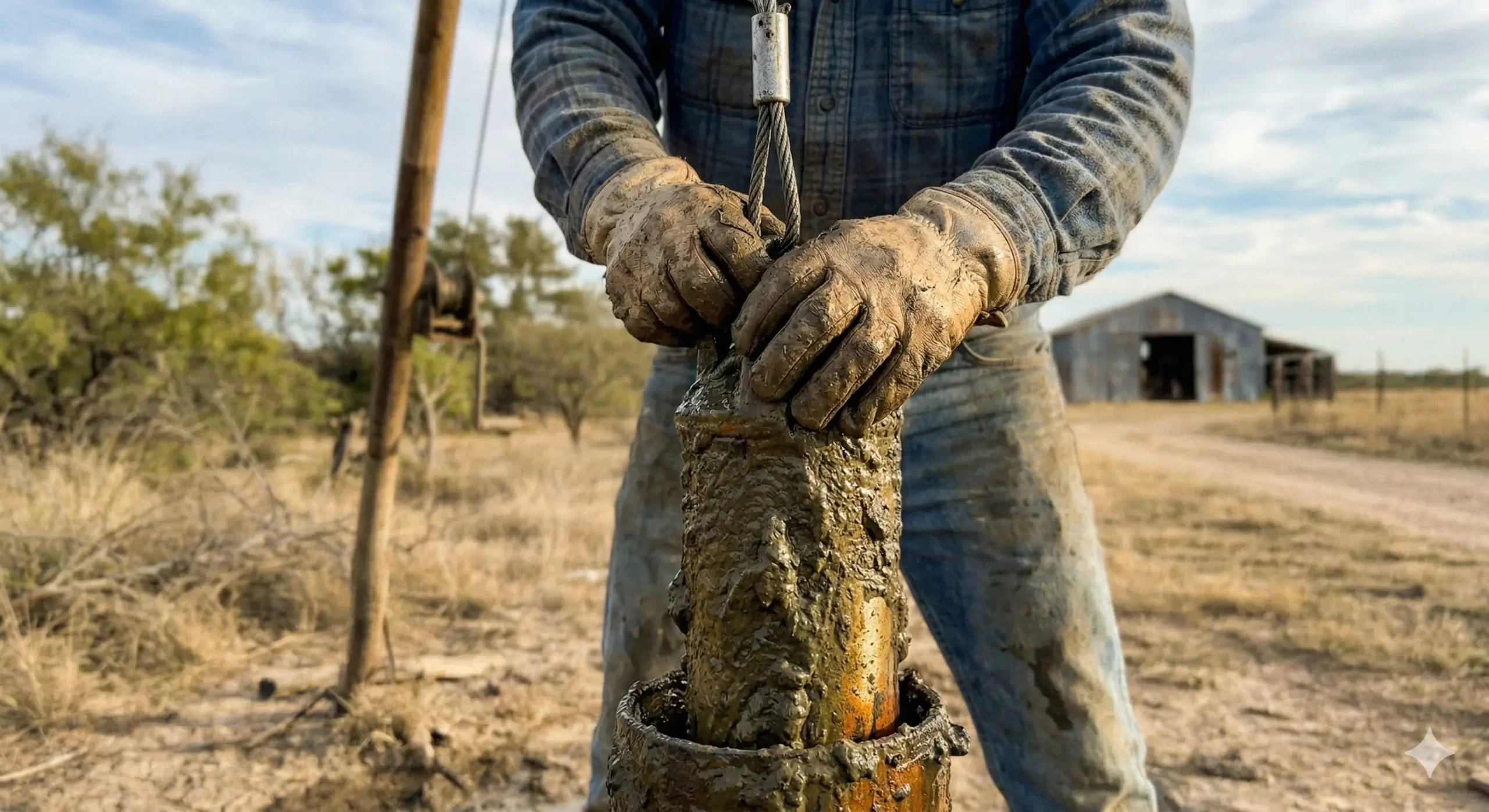
To get a pump out of a deep well in these conditions, we’re not just showing up with a pickup truck & a wrench. We need a heavy-duty pump hoist rig capable of lifting thousands of pounds of pipe, wire, & the pump itself. Specialized tools for fishing out dropped components or dealing with sandy build-up are often necessary. Add to that the cost of skilled labor, transport, & the specific parts resistant to our local water, & you start to see why the cost reflects the complexity & specialized equipment involved.
Spring Well Maintenance in Texas
Heavy spring rains can cause surface runoff to breach well caps. We strongly recommend testing your water for coliform bacteria and inspecting the sanitary seal.
Save $500+ on Replacements
Via the TX Energy Co-op VFD Upgrade Program
71°F in Center
Local Aquifers & Geology
The primary groundwater sources in Center include the The Carrizo-Wilcox Aquifer is the predominant source for most water wells in Center & the surrounding Shelby County area. This aquifer is composed primarily of sand, sandstone, & lignite, with interbeds of clay & shale. It’s known for producing moderate to high yields of fresh to slightly saline water. While generally good quality, the water often contains elevated levels of dissolved iron & manganese, which can lead to staining & aesthetic issues. The sandy nature of the formation also means well screens & pumps must be designed to minimize sand production.. Drilling through the local Shelby County’s soil profile is characterized by a mix of sandy loams & loamy sands on the surface, often with a subsoil of sandy clay loam or sandy clay. Deeper down, you’ll encounter layers of consolidated sand, clay, & shale, typical of the East Texas Timberlands region. Lignite deposits are also present within the Carrizo-Wilcox formation. This sandy composition contributes to the iron & manganese found in our well water. means that average well depths range from 300 ft – 600 ft.
Due to these geological factors, local homeowners frequently struggle with The #1 mechanical failure reason for pumps in Center is abrasive wear & premature motor failure due to sand production. The sandy geology of the Carrizo-Wilcox Aquifer means that if a well is not properly developed, screened, or if the pump is oversized, fine sand particles can enter the system. This acts like sandpaper on impellers, diffusers, & seals, leading to reduced efficiency & eventual catastrophic pump failure. Additionally, the constant load from pushing sandy water often overstresses submersible motors, causing them to burn out..
Drilling Depth Comparison
Deeper wells require heavy-duty crane hoists for pump extraction.
Climate & Water Quality
Pump systems in the Center area face severe environmental stressors. The most significant threat is Our East Texas climate poses significant risks to well equipment. Intense summer heat stresses submersible motors, making them work harder & reducing their lifespan. Frequent thunderstorms bring power surges & lightning strikes, which can instantly fry control boxes, motors, & electrical components. Heavy rainfall can lead to saturated ground, potentially causing erosion around wellheads or affecting buried electrical lines. Freezing temperatures, while less common, can still burst exposed pipes or pressure tanks if not properly insulated.
Additionally, the raw groundwater often presents issues with The most common water quality issues in Center are high levels of dissolved iron & manganese, which cause red/brown or black staining, metallic taste, & can foul plumbing fixtures. We also frequently encounter hydrogen sulfide (sulfur) gas, which gives water a ‘rotten egg’ smell. Sand production, while technically a particulate issue, is a constant challenge for pump longevity & can make its way into homes..
Regional Groundwater Advisory
Known primary contaminant threat to submersible pumps and pipes in this area:
Common Area Systems
VFD Upgrade Savings
Constant Pressure vs StandardReplacing a standard single-speed pump with a Variable Frequency Drive (VFD) eliminates hard starts and drastically reduces energy draw in Texas.
Compliance & Local Permits
Shelby County Level: Shelby County falls under the jurisdiction of the Neches Valley Groundwater Conservation District (NVGCD). While they don’t typically require permits for domestic & livestock wells producing under 25,000 gallons per day, there are important rules. New wells must still be registered with the district within 60 days of completion. All wells, regardless of usage, are subject to spacing requirements from property lines & other wells. The district encourages water conservation practices & provides educational resources. Always check with the NVGCD directly before drilling a new well to ensure compliance with any updated regulations & to understand any potential fees or reporting requirements for non-exempt wells.
Top Pump Brands in Texas
Most frequently installed hardware based on local geology (2026 data).
- Verify power supply at wellhead & control box (voltage, amperage).
- Test pressure switch operation & settings for proper cut-in/cut-out.
- Check bladder tank pressure & condition for proper water storage & pressure maintenance.
- Pull pump & inspect for sand abrasion, motor windings, impellers, & cable integrity.
- Analyze water sample for sediment, iron, manganese, & pH levels to guide equipment selection.
- Inspect well casing integrity & well seal for potential contamination or sand intrusion.
Premium Well Pump Brands We Service
Our licensed technicians in Center are certified to repair, replace, and install high-quality groundwater equipment from industry-leading manufacturers, including:
- No water at all, even with the pump running or hummi’n.
- Low water pressure, especially when multiple fixtures are in use.
- Pump cycling on & off too frequently (short cycling).
- Cloudy, sandy, or rust-colored water suddenly appearing.
- Loud or unusual noises coming from the wellhead or pressure tank area.
- Higher-than-normal electricity bills for no apparent reason.
Center Real Estate Well Regulations
Local Dispatch & Response Times
Live Dispatch: Texas
Updated Just Now⚠️ High demand. Call now to secure the next available technician.
- Typically 2-4 hours for a primary diagnostic visit within a 25-mile radius of Center.
- Full pump pull & replacement can often begin the same day if parts are in stock & conditions allow.
- For non-emergency calls, scheduling is usually within 1-3 business days.
- During severe weather or widespread outages, response times may be extended.
- Our priority is always restoring water as quickly & safely as possible for our neighbors.
⚠️ Shelby County & State Regulatory Warning: Abandoned Wells
Pump Lifespan Estimator
Select household size in Center to see strain impact.
The Cost of Ignoring Symptoms
Fixing a short-cycling pump early saves thousands in Center.
Data reflects average well contractor estimates in Center.
Groundwater Threat Level
Current aquifer and mineral impact on pumps in Center.
Dropping water tables cause pumps to suck air and overheat.
Hard water calcifies pump impellers, reducing lifespan.
Local Center
Well Pros
Fast Local Service & Diagnostics
Calls are routed to a licensed local well professional.
Septic System Services in Center, TX
Do you have a septic tank on your property? Proper maintenance is critical to protecting your well water quality.
Center Homeowner Feedback
“Had my well pump go out a few weeks back. Called these fellas & they were out here quick. Got me fixed up without any fuss. Good honest work.”

Local Homeowner
✓ Verified TX
“Our water pressure had been gettin’ weaker & weaker over the past few months, then just one morning, boom, nothin’. Thought it was the pump, but the tech came out and did a thorough check. Turned out the pressure tank bladder had ruptured, and we also had some pretty bad mineral buildup in the check valve and lines leading out. He replaced the tank and flushed the lines, even showed me the gunk that was restrictin’ the flow. Now we got strong pressure again, like new! Really appreciate the honest diagnostic, saved me from buyin’ a whole new pump when I dident need one.”

Local Homeowner
✓ Verified TX
“Lost water on a Sunday afternoon, naturally. Called them up & they had a crew out here in a couple of hours. Diagnosed the issue, got the parts, & had us back in water before dinner. Can’t beat that kind of fast service when you’re in a pinch.”

Local Homeowner
✓ Verified TX
Expert Center Well System FAQ
Why do I always have reddish-brown stains in my toilet & on my laundry here in Center, even after replacing my pump?
That’s a classic sign of iron in your water, which is very common in Shelby County’s Carrizo-Wilcox Aquifer. The reddish-brown stains are caused by iron oxidizing when it comes into contact with air or chlorine. A new pump won’t solve this; it’s a water quality issue. To address it, you’ll likely need a water treatment system specifically designed to remove iron & manganese. This could be an oxidation/filtration system, a water softener, or even a greensand filter, depending on the concentration of iron & the presence of other minerals. We can test your water to recommend the best & most effective solution for your specific home.
My neighbor’s well is only 200 feet deep, but I was told I need to drill 500 feet for a new well on my property. Why such a big difference?
Well depths can vary significantly even over short distances in East Texas due to local geological formations. The Carrizo-Wilcox Aquifer, while widespread, isn’t uniformly deep or productive. Your neighbor’s well might be tapping into a shallower, localized sand lens or a productive zone of the Queen City Aquifer, which can be closer to the surface. Your property, however, might be in an area where those shallower zones are less productive, or you might need to penetrate deeper into the Carrizo-Wilcox to find a reliable & sustained water supply with better quality & yield. Factors like elevation, fault lines, & the specific composition of the underlying rock & sand layers all play a role in determining optimal well depth. A good driller will use geological maps & nearby well logs to determine the most likely depth for success on your specific plot.
My well pump control box keeps tripping the breaker, especially after a storm. Is my pump shot or is it something else?
A tripping breaker, especially after a storm, can point to a few issues, & not necessarily a totally ‘shot’ pump. First, a power surge or lightning strike from the storm could have damaged the pump’s motor windings, causing it to draw too much current & trip the breaker. It could also have damaged the control box components themselves, such as the starting capacitor or relay. Less severely, it might be an issue with the wiring connecting the control box to the pump, which could have been compromised by the storm or simply due to age & wear. We’d start by testing the control box components & the motor’s insulation resistance with specialized equipment. Sometimes a simple control box replacement is all that’s needed, but if the motor is drawing excessive amps, the pump itself will need to be pulled & replaced.
My water pressure fluctuates wildly – sometimes strong, sometimes barely a trickle. What’s going on with my well system?
Wildly fluctuating water pressure is a common complaint & can be caused by several issues specific to well systems. Often, the culprit is a ‘waterlogged’ pressure tank, meaning the air charge in the bladder tank has been lost, or the bladder itself is ruptured. This causes the pump to short-cycle, turning on & off rapidly, leading to inconsistent pressure. Another possibility is a failing pressure switch, which may not be accurately sensing pressure or has corroded contacts. It could also indicate a partially clogged well screen or pump intake, reducing the pump’s ability to draw water consistently, especially if there’s sand or mineral buildup. Less frequently, it might point to a failing pump motor that’s struggling to maintain pressure under load. We’d start by checking your pressure tank & switch, then move to evaluate the pump’s performance.
Center Groundwater Expert AI
What are the specific groundwater regulations, average well depths, and the local conservation district for Center, Shelby County?
Groundwater Regulations and Well Information for Residential Wells in Center, Shelby County, TX (2026)
As a Senior Hydrogeologist and local groundwater regulatory expert for Texas, I can provide you with specific information regarding residential water wells in Center, Shelby County, as of 2026. It's important to understand the regulatory framework in areas without a local Groundwater Conservation District, as this shifts the primary oversight to state agencies.
1. Local Groundwater Conservation District (GCD)
- No Local GCD: Shelby County, including the city of Center, is currently not located within an active Groundwater Conservation District (GCD). This means there is no local entity directly managing groundwater withdrawals, well spacing (beyond state minimums), or requiring specific local permits for residential wells beyond the state requirements.
2. Primary Regulatory Bodies and Regulations
In the absence of a GCD, the primary state agencies responsible for water well regulation in Shelby County are:
- Texas Department of Licensing and Regulation (TDLR):
- Role: TDLR is the state agency responsible for licensing water well drillers and pump installers, and for establishing minimum standards for water well construction, casing, grouting, and plugging to protect groundwater quality. They regulate the drilling and completion of all non-exempt wells (which typically includes most residential wells).
- Key Regulations: These regulations are primarily found in the Texas Occupations Code, Chapter 1902 (Water Well Drillers and Pump Installers), and the corresponding rules in 16 Texas Administrative Code (TAC), Chapter 76 (Water Well Drillers and Pump Installers).
- Permitting: While TDLR doesn't issue a "permit" in the traditional sense for drilling a private residential well, it requires that the well be drilled by a licensed driller and constructed according to their standards. The licensed driller is responsible for submitting a "Well Report" (also known as a drillers log) to TDLR and the Texas Water Development Board (TWDB) within 90 days of completion.
- Texas Commission on Environmental Quality (TCEQ):
- Role: While TDLR handles well construction, TCEQ is the state's primary environmental agency and has general oversight over water quality and environmental protection. For private residential wells, TCEQ provides guidance on well maintenance and water quality testing, but TDLR is the direct regulator for well drilling.
3. Average Well Depths and Aquifer
- Specific Aquifer: Residential wells in Center, Shelby County, typically draw water from the Carrizo-Wilcox Aquifer. This is a major aquifer system known for providing good quality groundwater in East Texas.
- Average Well Depths: Based on historical state well logs for residential wells in the Center area of Shelby County, the average well depth for accessing sufficient water in the Carrizo-Wilcox Aquifer is approximately 400 to 550 feet. Depths can vary significantly depending on the specific location, desired yield, and local geology, but this range is a reliable average for residential use. Some wells may be shallower (e.g., 250-350 ft for lesser yields) or deeper (e.g., 600+ ft for higher yields or specific zones within the aquifer).
4. Setback Rules and Well Spacing
Since there is no local GCD, setback rules are governed by state law through TDLR and general best practices:
- Texas Department of Licensing and Regulation (TDLR) Rules (16 TAC Chapter 76):
- A minimum separation of 50 feet is generally required between a private water well and any potential source of contamination, such as a septic system drainfield, property line, or feedlot.
- A minimum separation of 100 feet is generally recommended from a septic tank, absorption bed, or other waste disposal facility if the well is for private domestic use.
- Additional separation distances may apply if the well is classified as a public water supply, but for a typical residential well, the 50/100-foot rule is common guidance.
- It's always recommended to consult with your licensed driller, as they are required to adhere to these standards.
- Property Lines: While not always a strict TDLR rule for private wells, it is a common best practice and sometimes a local ordinance requirement to place wells at least 50 feet from property lines to avoid potential conflicts with neighbors and ensure adequate space for future septic systems or other developments.
5. Realistic URLs for Official Resources
Here are some official resources for further information:
- TDLR Water Well Drillers and Pump Installers Program:
- https://www.tdlr.texas.gov/wwd/wwd.htm
- This page provides information on licensing, rules, and regulations for water well drillers and pump installers.
- TDLR Well Report Search (Driller Database):
- https://www.tdlr.texas.gov/Search/ (Select "Water Well Drillers and Pump Installers" and then "Well Report Search")
- You can use this database to find existing well reports (drillers logs) submitted for wells in Shelby County, which can help confirm local well depths and conditions.
- Texas Water Development Board (TWDB) – Major Aquifers:
- https://www.twdb.texas.gov/groundwater/aquifer/majors.asp
- Provides detailed information about the Carrizo-Wilcox Aquifer and other major aquifers in Texas.
- TCEQ Private Water Wells Information:
- https://www.tceq.texas.gov/drinkingwater/private_wells
- Offers general guidance for private well owners on water quality, testing, and maintenance.
Fast Local Service & Diagnostics
Calls are routed to a licensed local well professional.
Blix
provides official
Emergency Well Pump Repair services for the
Center
area.