
Emergency Well Pump Repair in Tyler, TX
Folks around Tyler, Smith County, gotta understand that groundwater here ain’t like municipal water; it’s a wild beast. We’re dealing with varying depths, inconsistent water tables, and a whole lot of iron in this part of East Texas. You rely on that well, and when it goes out, your whole world stops. No shower, no coffee, no flushing.
Our primary source here is often the Carrizo-Wilcox aquifer, which is generally reliable but sits pretty deep. Depending on where you are in Smith County, you might tap into the Queen City or Sparta too. Each has its own characteristics, from water quality to the depth you gotta drill, and that impacts pump selection & longevity.
Too many times, I see folks try to save a buck with a cheap pump from a big box store. Out here, that’s a recipe for disaster. These deep wells, the mineral content, and the constant demand put a tremendous strain on equipment. A cheap pump just won’t stand up to the rigors of a Tyler well and will fail prematurely, costing you more in the long run.
Fast Local Service & Diagnostics
Calls are routed to a licensed local well professional.
Well Pump Repair in
Tyler
Tyler & Smith County Well Stats
Smith County generally sees wells ranging from 200 to 600 feet deep, with some shallower exceptions in areas where the Carrizo-Wilcox or Queen City aquifer comes closer to the surface. Most wells are 4-inch or 6-inch diameter, cased with PVC or steel. Static water levels typically range from 50 to 150 feet, but can fluctuate significantly based on rainfall & localized pumping demands. Yields are usually sufficient for residential use, often between 5-20 GPM, but declining water levels are a growing concern in some areas, necessitating deeper pump settings.
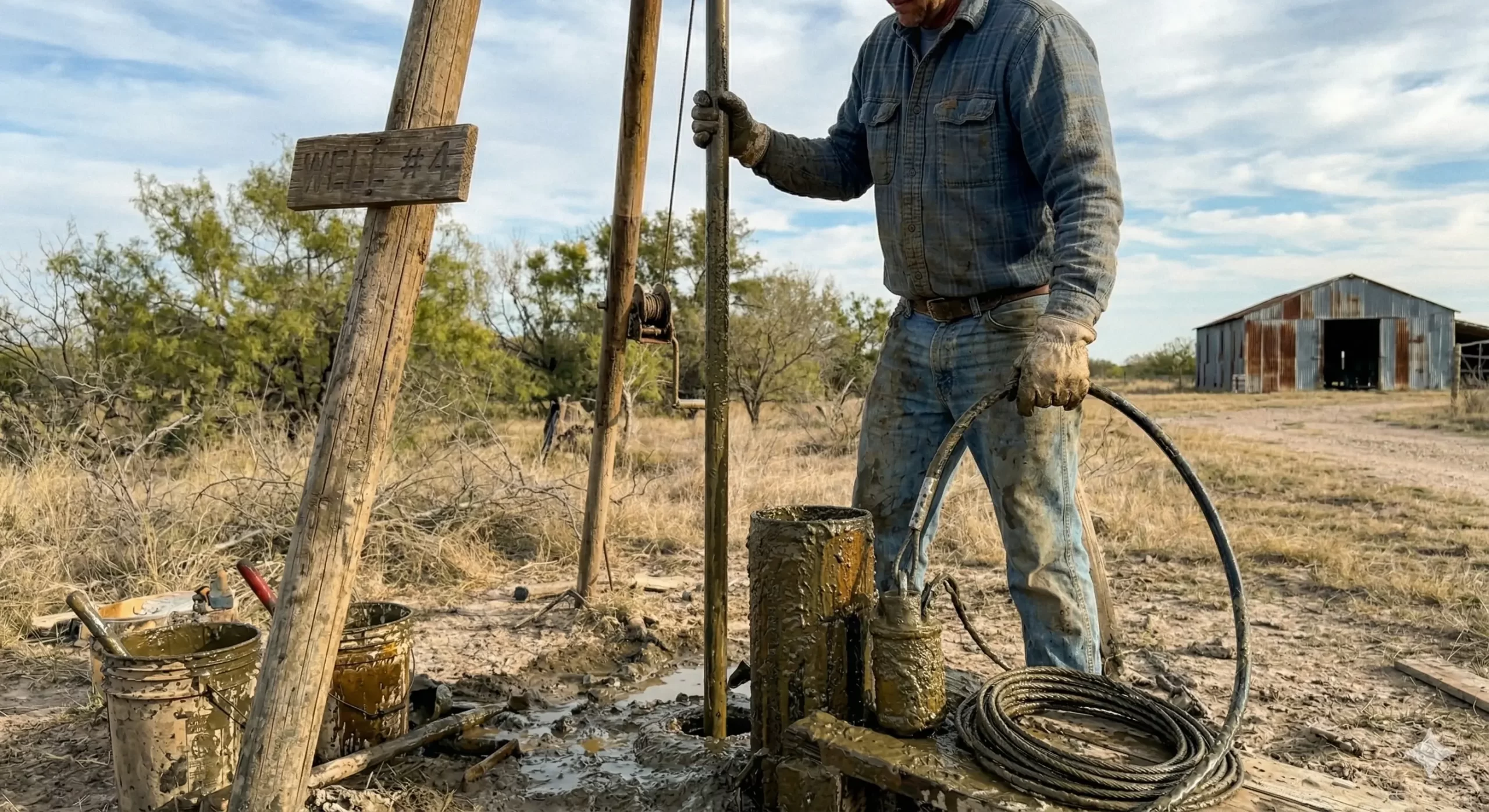
Pulling a pump in Smith County ain’t a simple job. We’ve got pretty stable, deep geological formations, often involving substantial clay and some sandstone layers that require heavy-duty rig equipment to get that well casing secure and to handle the pump itself. Access can be a real bear too; lots of rural properties with narrow driveways or overgrown fields mean we need specialized, compact rigs to even get to the wellhead without tearing up your property. The deeper the well, the more pipe, wire, & weight, making the job more complex & time-consuming.
Beyond the specialized pump hoist or service rig, we’re talking about a full suite of tools: heavy-duty pipe wrenches, torque arrestors, static water level indicators, electrical testers for troubleshooting, and safety gear. Not to mention the pump & motor itself, control boxes, pressure switches, tanks, and all the fittings and wire. It’s a significant investment in specialized equipment & expertise just to get the job done right and safely, which is reflected in the cost.
Spring Well Maintenance in Texas
Heavy spring rains can cause surface runoff to breach well caps. We strongly recommend testing your water for coliform bacteria and inspecting the sanitary seal.
Save $500+ on Replacements
Via the TX Energy Co-op VFD Upgrade Program
73°F in Tyler
Local Aquifers & Geology
The primary groundwater sources in Tyler include the Carrizo-Wilcox Aquifer. This aquifer is a major source of groundwater for much of East Texas, including Smith County. It consists primarily of unconsolidated sand, silt, and clay, with the sand layers being the most productive water-bearing zones. Water from the Carrizo-Wilcox is generally fresh but can have elevated iron content, especially in deeper sections, and occasionally manganese. The aquifer is confined in many areas, meaning it’s under pressure, which helps with yields, but over-pumping can lead to significant drawdowns.. Drilling through the local Tyler and Smith County sit primarily on soils derived from Tertiary-age sediments. The dominant soil types are often fine sandy loams, loamy sands, and clay loams of the Nacogdoches, Kirvin, and Cuthbert series. Nacogdoches soils are deep, well-drained, dark red, and clayey, often found on uplands. Kirvin soils are lighter colored, loamy, and found on gently rolling terrains. Cuthbert soils are finer textured, somewhat poorly drained clays. These soils can compact, retain moisture, and present challenges for excavation or well drilling due to their clay content and occasional hardpan layers, but generally offer good support for well casings. means that average well depths range from 250 ft – 550 ft, with some deeper wells reaching 700 ft or more, particularly in northern parts of the county or for higher yields..
Due to these geological factors, local homeowners frequently struggle with The #1 issue we see in Tyler is pump failure due to sediment & mineral buildup, especially iron fouling. The Carrizo-Wilcox aquifer, while reliable, often carries elevated levels of dissolved iron. Over time, this iron precipitates out, coating pump impellers, diffusers, and intake screens, causing friction, reducing efficiency, and eventually leading to motor burnout or mechanical seizure. Sand intrusion from improperly developed or aging wells also contributes significantly to premature wear..
Drilling Depth Comparison
Deeper wells require heavy-duty crane hoists for pump extraction.
Climate & Water Quality
Pump systems in the Tyler area face severe environmental stressors. The most significant threat is Tyler’s humid subtropical climate, characterized by hot, muggy summers and mild, occasionally freezing winters, takes a toll on well equipment. Extreme summer heat stresses pump motors and control boxes, leading to overheating & premature failure. The high humidity can cause corrosion in exposed electrical components. While rare, hard freezes can damage exposed pressure tanks, pipes, and outdoor electrical conduit if not properly insulated or buried, leading to costly leaks & system shutdowns. Heavy rainfall & saturated soils can also lead to wellhead contamination if not sealed correctly.
Additionally, the raw groundwater often presents issues with Definitely iron and sometimes manganese. We often see reddish-brown staining on fixtures, laundry, and even sometimes a metallic taste in the water. Hardness is generally moderate, not usually a primary concern. Sulfur is present in some localized pockets, giving a ‘rotten egg’ smell, but it’s less widespread than iron. Sand can be an issue in older wells or those not properly developed, leading to abrasive wear on pumps and sediment accumulation in plumbing..
Regional Groundwater Advisory
Known primary contaminant threat to submersible pumps and pipes in this area:
Common Area Systems
VFD Upgrade Savings
Constant Pressure vs StandardReplacing a standard single-speed pump with a Variable Frequency Drive (VFD) eliminates hard starts and drastically reduces energy draw in Texas.
Compliance & Local Permits
Smith County Level: Smith County falls under the jurisdiction of the Neches Valley Groundwater Conservation District (NVGCD). While they don’t typically require permits for domestic, non-exempt wells (wells pumping less than 25,000 gallons per day for domestic or livestock use), they strongly encourage registration. For new wells, or wells that exceed the domestic exemption, a permit *is* required. This involves submitting an application, paying fees, and adhering to spacing rules from property lines and existing wells, as well as production limits. They also have regulations on well plugging and requiring licensed drillers & pump installers. It’s always best to check with the NVGCD directly for the most current requirements before any well work begins.
Top Pump Brands in Texas
Most frequently installed hardware based on local geology (2026 data).
- Verify power supply to control box & pump motor (volts, amps, ohms).
- Check pressure switch operation, settings, & condition.
- Measure static & pumping water levels to assess well performance & drawdown.
- Inspect pressure tank for proper air charge & diaphragm integrity.
- Test water quality for iron, hardness, & sediment presence.
- Examine wellhead integrity, cap, conduit, & any visible pipe leaks or damage.
Premium Well Pump Brands We Service
Our licensed technicians in Tyler are certified to repair, replace, and install high-quality groundwater equipment from industry-leading manufacturers, including:
- No water coming out, or very low pressure.
- Pump runs constantly, never shuts off, or short cycles frequently.
- Cloudy, sandy, or rust-colored water suddenly appearing.
- Strange noises from the wellhead, pressure tank, or control box (buzzing, grinding, clicking).
- Higher-than-normal electric bills without increased water usage.
- Frequent circuit breaker trips when the pump tries to start.
Tyler Real Estate Well Regulations
Local Dispatch & Response Times
Live Dispatch: Texas
Updated Just Now⚠️ High demand. Call now to secure the next available technician.
- Typically within 2-4 hours for critical no-water emergencies within the Tyler city limits & immediate surrounding areas.
- Rural Smith County calls might extend to 4-8 hours depending on travel distance & current workload.
- Our goal is always same-day service for no-water calls received before noon.
- We prioritize elderly or families with infants, aiming for the quickest possible dispatch.
- After-hours & weekend service available for true emergencies, but expect premium rates.
⚠️ Smith County & State Regulatory Warning: Abandoned Wells
Pump Lifespan Estimator
Select household size in Tyler to see strain impact.
Groundwater Threat Level
Current aquifer and mineral impact on pumps in Tyler.
Dropping water tables cause pumps to suck air and overheat.
Hard water calcifies pump impellers, reducing lifespan.
The Cost of Ignoring Symptoms
Fixing a short-cycling pump early saves thousands in Tyler.
Data reflects average well contractor estimates in Tyler.
Local Tyler
Well Pros
Fast Local Service & Diagnostics
Calls are routed to a licensed local well professional.
Septic System Services in Tyler, TX
Do you have a septic tank on your property? Proper maintenance is critical to protecting your well water quality.
Tyler Homeowner Feedback
“Had a problem with my well pump makin’ a terrible racket. Called these fellas, and they were out quick. Fixed it right up, no fuss. Good honest work.”

Local Homeowner
✓ Verified TX
“Our old well pump finally gave up the ghost after a good 20 years. Started acting real weird, spittin’ air and then just stopped one morning. Called up, and John came out that afternoon. Diagnosed it as a burned-out motor, probably from all the iron buildup we’ve got in our water out here in Bullard. He explained that a new motor and pump assembly, plus some adjustments to our pressure tank, would get us squared away. Showed up on time the next day with his rig, pulled the old one, installed a new Grundfos, and now we’ve got better pressure than ever. My wife was real happy, said she almost went crazy without water for the kids. Thanks for the quick service and the good explination!”

Local Homeowner
✓ Verified TX
“Lost water completely on a Sunday afternoon, naturally. Called them up, expecting an answering machine. Spoke to a real person, and they had a tech on his way within the hour. Got us back up and running before dinner. Lifesavers!”

Local Homeowner
✓ Verified TX
Expert Tyler Well System FAQ
My water well pump in Tyler seems to be short cycling. What does that mean and what’s usually the cause?
Short cycling means your pump turns on and off very rapidly, much more frequently than it should. This is a common issue and almost always points to a problem with your pressure tank or a leak in your system. Most often, the pressure tank has lost its air charge, or its internal bladder has failed. Without the air cushion, the pump has no place to store pressurized water, so it just reacts to every small demand. Less commonly, a persistent leak in your plumbing system or a check valve issue in the well itself can cause the pressure to drop quickly, triggering the pump repeatedly. Short cycling significantly reduces the life of your pump motor & pressure switch, so it’s critical to get it checked out promptly.
I’m noticing a reddish-brown stain in my sinks and toilets in my Smith County home. Is this an issue with my well water, and what can be done?
That reddish-brown staining is a classic sign of high iron content in your well water, which is very common in the Carrizo-Wilcox aquifer throughout Smith County. It’s not usually a health hazard, but it can make your water taste metallic, stain everything it touches, and even lead to premature wear on your pump due to buildup. The solution typically involves a water treatment system designed to remove iron. This could range from an oxidation filter system (often using air injection or potassium permanganate) to a water softener if manganese is also present, or even a greensand filter. We’d start with a water test to determine the exact iron levels & recommend the most effective system for your specific needs, considering flow rates & budget.
How often should I have my well pump system inspected in the Tyler area, especially with our deep wells?
For peace of mind and to extend the life of your system, we recommend a professional well inspection every 3-5 years for most residential wells in the Tyler area. Given the depths we’re dealing with and the potential for iron & sand issues, regular checks are crucial. An inspection should include measuring your static & pumping water levels, checking the pump’s electrical draw (amps), verifying pressure tank air charge & function, inspecting the wellhead, and testing water quality. Catching small issues like a failing pressure switch or a weakening capacitor before they cause a complete system failure can save you a lot of money and the headache of being without water.
What are the key things to look for when choosing a well pump service in Smith County, especially for rural properties?
When choosing a well pump service in Smith County, look for a company with a proven track record & deep local experience. First, ensure they are properly licensed by the TDLR as a Water Well Pump Installer. Experience with our specific local geology & water quality challenges (like high iron) is paramount. They should have the right equipment, especially a modern pump hoist or service rig capable of safely pulling deep well pumps. Ask about their emergency response times, particularly if you’re in a more rural area. Check their reviews, and ensure they offer clear, transparent pricing and stand behind their work with warranties. A reputable company will also recommend & install quality pump brands designed for longevity in our conditions, not just the cheapest option.
Tyler Groundwater Expert AI
What are the specific groundwater regulations, average well depths, and the local conservation district for Tyler, Smith County?
Residential Water Well Information for Tyler, Smith County, Texas (2026)
As a Senior Hydrogeologist and Local Groundwater Regulatory Expert for Texas, I can provide you with precise information regarding residential water wells in Tyler, Smith County, for the year 2026. This data is critical for proper planning and compliance.
Local Groundwater Conservation District and Regulations
For Tyler and the entirety of Smith County, the primary local regulatory authority for groundwater is the Neches Valley Groundwater Conservation District (NVGCD). The NVGCD is responsible for developing and implementing a comprehensive management plan to conserve, protect, and enhance the groundwater resources within its jurisdiction, which includes Smith County.
Specific regulations enacted by the NVGCD include rules for well registration, spacing, production limits (though less common for individual residential wells unless aggregated), and water quality protection. You will be required to register any new residential water well with the NVGCD in addition to the state-level requirements.
Contact Information for NVGCD:
- Website: https://www.nvgcd.org/ (This is the official website for the Neches Valley Groundwater Conservation District.)
- It is highly recommended to visit their website or contact them directly for the most current well permitting forms, setback requirements, and any specific local rules for residential wells.
State-Level Regulations
Beyond the NVGCD, all water well drilling, alteration, or plugging in Texas, including residential wells in Tyler, must comply with regulations set by the Texas Department of Licensing and Regulation (TDLR). The TDLR licenses water well drillers and pump installers and enforces construction standards to protect groundwater quality and ensure public health.
Key state regulations include:
- Texas Occupations Code Chapter 1901 (Water Well Drillers and Pump Installers Act): This code establishes licensing requirements for drillers and pump installers.
- 16 Texas Administrative Code (TAC) Chapter 76 (Water Well Drillers and Pump Installers Rules): These rules detail the technical standards for well construction, completion, and plugging, including requirements for casing, cementing, and wellhead completion.
- Setback Requirements: TDLR rules specify minimum distances between a well and potential sources of contamination (e.g., septic tanks, property lines, feedlots). For example, a new residential well typically needs to be at least 50 feet from a septic system and 5 feet from a property line. Local GCDs or county health departments may have stricter setback requirements, so always check with the NVGCD and Smith County Health Department.
- Well Report Submission: Licensed drillers are required to submit a State of Texas Water Well Driller's Report (Form WWD-005) to the TDLR and the NVGCD within 30 days of well completion. This report contains vital information about the well's construction, depth, and encountered geology.
You can verify a driller's license or search for well reports via the TDLR database:
- TDLR Water Well Driller Database: https://www.tdlr.texas.gov/LicenseSearch/
- TDLR Water Well Reports Search: https://www.tdlr.texas.gov/Search/WaterWells/WaterWellsSearch.aspx
Average Well Depths in Tyler, Smith County
Based on historical state well logs for residential and agricultural wells in the Tyler area of Smith County, the average well depth typically ranges from 450 to 700 feet. It is important to note that this is an average, and actual depths can vary significantly depending on the specific location within Tyler, local geological conditions, and the desired water yield. Some wells may be shallower (e.g., 300-400 feet for minor uses) or deeper (e.g., over 800 feet to target specific production zones within the aquifer).
Specific Aquifer Beneath Tyler
The primary and most productive aquifer system utilized by residential wells in Tyler, Smith County, is the Carrizo-Wilcox Aquifer. This major aquifer is a significant source of groundwater for much of East Texas. It consists of multiple sand and lignite layers that yield moderate to large quantities of fresh to slightly saline water.
While the Carrizo-Wilcox is the main target, shallower, less productive aquifers such as the Queen City and Sparta Aquifers may also be present, but typically offer lower yields or are more susceptible to local contamination or drought impacts compared to the Carrizo-Wilcox.
Fast Local Service & Diagnostics
Calls are routed to a licensed local well professional.
Blix
provides official
Emergency Well Pump Repair services for the
Tyler
area.