
Emergency Well Pump Repair in Waller, TX
Out here in Waller, folks rely on their wells, but it ain’t always easy. We’re dealing with a dynamic groundwater situation, where water levels can shift with the seasons, and demand from development keeps rising. The soil’s often sandy, which means your well and pump are constantly battling against abrasive conditions, unlike some of the rocky regions further west. It’s a tough environment for equipment, plain & simple.
Our water largely comes from the Chicot and Evangeline aquifers. These are significant sand and gravel formations that hold a lot of water, but they’re also relatively shallow compared to some deeper aquifers. This means they’re more susceptible to surface influences and faster water table drops during droughts. Understanding these local geological traits is key to properly diagnosing & fixing well issues.
You see a lot of folks try to save a buck with a cheaper pump, but in Waller, that’s often a false economy. Those budget pumps just aren’t built to handle the heat, the constant cycling, or the fine sand that’s common in our local aquifers. They burn out faster, clog easier, and leave you without water when you need it most. Investing in quality upfront saves a lot of headaches & money down the road.
Fast Local Service & Diagnostics
Calls are routed to a licensed local well professional.
Well Pump Repair in
Waller
Waller & Waller County Well Stats
Waller County has a significant number of domestic & agricultural wells, drawing primarily from the Chicot & Evangeline aquifers. Most residential wells range from 250 to 600 feet deep to ensure reliable, sand-free water. The water table fluctuates seasonally and during drought, leading to increased pump cycling and stress. The county sees consistent demand for groundwater, making proper well construction & maintenance crucial for longevity & sustainability.
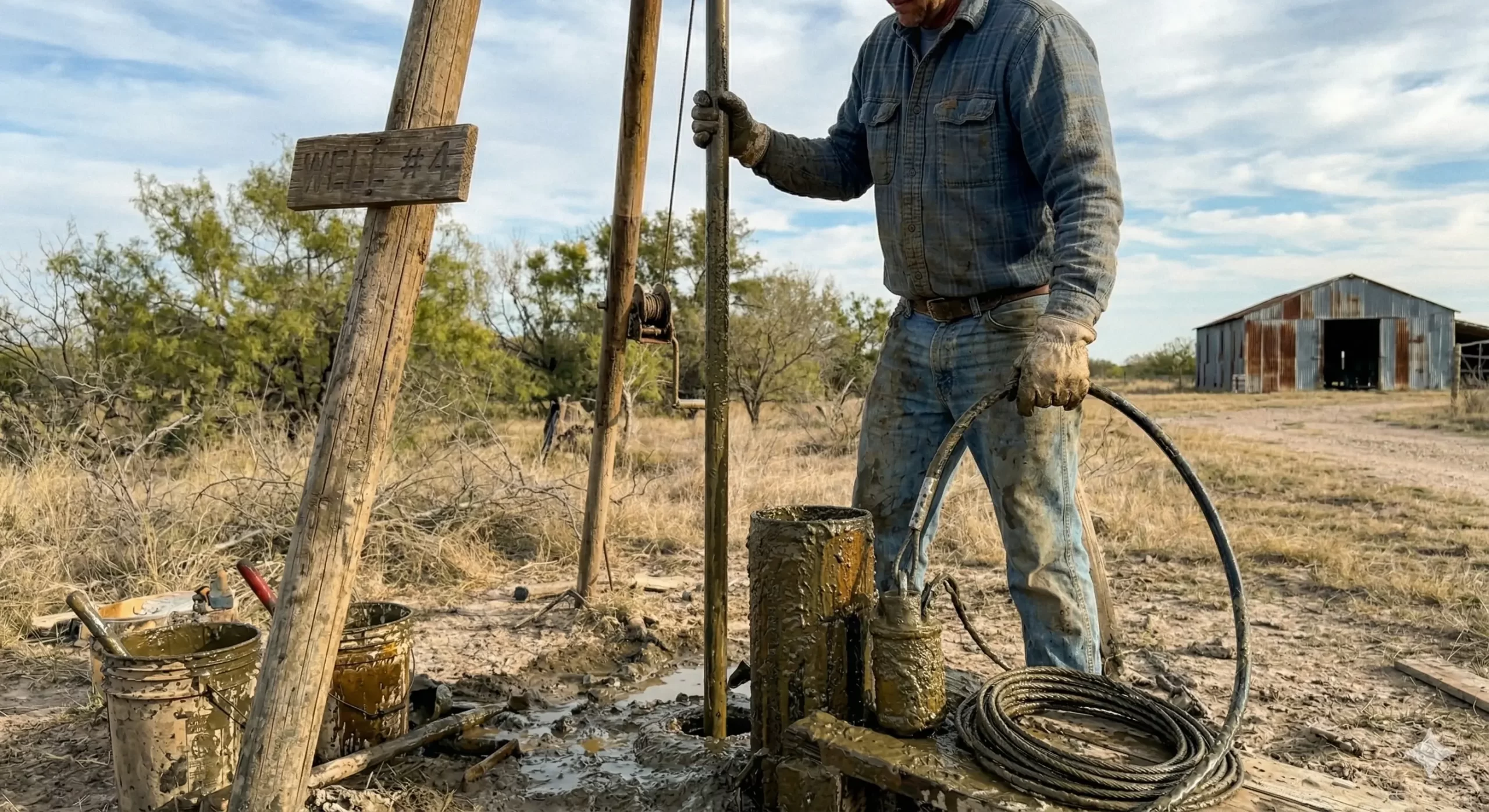
Pulling a pump out here in Waller costs what it does for a few reasons. While we don’t have the hard rock drilling issues of the Hill Country, we’ve got our own challenges. Loose, sandy formations can sometimes collapse around older well casings, making it a slow & careful job to extract the drop pipe and pump without damaging the well further. Also, many properties are rural, with overgrown access roads or tight spots, which requires specialized, maneuverable rigs & experienced operators.
The equipment needed for these jobs isn’t cheap & it’s specialized. We’re talking heavy-duty service rigs with powerful winches, sometimes even small cranes for deeper, heavier pumps. Then there are all the specific tools: pipe wrenches, torque arrestors, safety clamps, electrical testers, not to mention the inventory of pumps, motors, drop pipe, wire, and pressure tanks that we have to keep on hand. It’s an investment to do the job right & safely.
Spring Well Maintenance in Texas
Heavy spring rains can cause surface runoff to breach well caps. We strongly recommend testing your water for coliform bacteria and inspecting the sanitary seal.
Save $500+ on Replacements
Via the TX Energy Co-op VFD Upgrade Program
74°F in Waller
Local Aquifers & Geology
The primary groundwater sources in Waller include the Chicot and Evangeline Aquifers. These are part of the Gulf Coast Aquifer system, characterized by interbedded layers of sand, silt, clay, and gravel. They are generally unconfined to semi-confined, meaning they are recharged relatively quickly but are also more susceptible to surface contamination and changes in water levels due to pumping or drought. They’re known for good water production for domestic and agricultural uses, but also for varying water quality, including hardness & iron.. Drilling through the local Waller County’s soil profile is dominated by sandy loams, such as the Hockley and Waller series, often with underlying clays. These soils generally have good drainage but can be prone to erosion. In lower-lying areas, you’ll find more silty clays and poorly drained soils. The sandy nature contributes to the potential for sand production in wells if not properly screened & developed. means that average well depths range from 250 ft – 600 ft for residential wells, with some irrigation or municipal wells going deeper..
Due to these geological factors, local homeowners frequently struggle with Sand abrasion & sediment intrusion, leading to premature wear on pump impellers, motors, and check valves. This is closely followed by motor burnout due to low voltage, running dry, or consistent over-cycling..
Drilling Depth Comparison
Deeper wells require heavy-duty crane hoists for pump extraction.
Climate & Water Quality
Pump systems in the Waller area face severe environmental stressors. The most significant threat is The intense Texas heat and long summers significantly increase pump demand, leading to motors running hotter and more frequently, accelerating wear. Thunderstorms bring power surges that can damage control boxes & motors. Prolonged droughts cause water tables to drop, forcing pumps to work harder & longer, sometimes even running dry if the well is not deep enough or pump is set too high.
Additionally, the raw groundwater often presents issues with Common issues include moderate to high hardness, elevated iron content causing staining & metallic taste, and occasional sulfur odors. While not strictly a ‘quality’ issue in terms of health, fine sand can also be a persistent problem, causing turbidity and mechanical wear on plumbing fixtures & appliances..
Regional Groundwater Advisory
Known primary contaminant threat to submersible pumps and pipes in this area:
Common Area Systems
VFD Upgrade Savings
Constant Pressure vs StandardReplacing a standard single-speed pump with a Variable Frequency Drive (VFD) eliminates hard starts and drastically reduces energy draw in Texas.
Compliance & Local Permits
Waller County Level: Waller County falls primarily under the Brazos Valley Groundwater Conservation District (BVGCD). Any new well construction or significant alteration, including deepening or major repair, typically requires a permit from the BVGCD. They regulate well spacing, production limits, and require regular reporting of groundwater usage for larger wells to ensure sustainable management of the aquifer. It’s crucial to check with the BVGCD & comply before any work begins to avoid fines & ensure your well is legal.
Top Pump Brands in Texas
Most frequently installed hardware based on local geology (2026 data).
- Measure pump amp draw & voltage at the control box & pump terminals.
- Verify pressure switch cut-in & cut-out settings & diaphragm condition.
- Inspect pressure tank for proper air charge & bladder integrity.
- Conduct water yield test & evaluate water clarity for sand or sediment.
- Check all wiring, splices, & grounding for corrosion or damage.
- Assess overall system efficiency & recommend preventative maintenance.
Premium Well Pump Brands We Service
Our licensed technicians in Waller are certified to repair, replace, and install high-quality groundwater equipment from industry-leading manufacturers, including:
- No water coming from faucets, or very low pressure.
- Pump constantly cycling on & off, even when no water is being used.
- Cloudy or sandy water coming from the tap.
- Strange noises coming from the pressure tank area or control box.
- Higher than normal electric bills, indicating an inefficient or failing pump.
- Flickering lights when the pump kicks on, suggesting a motor issue or low voltage.
Waller Real Estate Well Regulations
Local Dispatch & Response Times
Live Dispatch: Texas
Updated Just Now⚠️ High demand. Call now to secure the next available technician.
- Typically within 24 hours for no-water emergencies, often sooner if schedule allows.
- During severe weather or widespread power outages, response times may extend to 48 hours due to high call volume.
- After-hours & weekend calls incur an emergency service fee.
- Remote rural locations with difficult access can add to travel time & service complexity.
- We prioritize families with no water & critical agricultural needs.
⚠️ Waller County & State Regulatory Warning: Abandoned Wells
Groundwater Threat Level
Current aquifer and mineral impact on pumps in Waller.
Dropping water tables cause pumps to suck air and overheat.
Hard water calcifies pump impellers, reducing lifespan.
Pump Lifespan Estimator
Select household size in Waller to see strain impact.
The Cost of Ignoring Symptoms
Fixing a short-cycling pump early saves thousands in Waller.
Data reflects average well contractor estimates in Waller.
Local Waller
Well Pros
Fast Local Service & Diagnostics
Calls are routed to a licensed local well professional.
Septic System Services in Waller, TX
Do you have a septic tank on your property? Proper maintenance is critical to protecting your well water quality.
Waller Homeowner Feedback
“Had a problem with my well last week, wasn’t getting enough water. Called these folks, & they came out fast. Fixed it up quick, and the water’s flowin’ strong now. Good honest work.”

Local Homeowner
✓ Verified TX
“Our old pump had been acting up for months, spitting sand and losing pressure, especially after a long shower. We thought we needed a whole new well. The technician, Mike, took his time explaining that our submersible pump’s impellers were likely worn out from years of pumping sandy water and that our well screen might need some attention. He was thorough, did a full system check, and ended up replacing the pump and motor with a new Grundfos. Took a bit longer than I ‘spected, but the water pressure is better than it’s ever been and no more sand! Worth every penny for the peace of mind.”

Local Homeowner
✓ Verified TX
“Our well went out completely on a Sunday afternoon. Called these guys and they were out here within a couple of hours. Got us back up and running by sundown. You can’t beat that kind of emergency service out here in Waller. Lifesavers!”

Local Homeowner
✓ Verified TX
Expert Waller Well System FAQ
Why do I get sand in my water sometimes, and what can be done about it?
Sand in your water is a common complaint in Waller, due to our sandy aquifer formations. It often means either your well screen is deteriorating, improperly sized, or the pump is set too deep or too close to the bottom where sediment accumulates. Sometimes it’s a symptom of over-pumping, drawing water in too quickly and pulling in fine particles. We’d start by inspecting the well with a camera if possible, evaluate your pump’s depth and condition, and perform a yield test. Solutions can range from adjusting the pump setting, installing a new pump with better sand handling capabilities, adding a sediment filter, or in severe cases, rehabilitating or replacing the well screen.
My water pressure isn’t what it used to be. What gives?
A drop in water pressure can be caused by several factors, and it’s one of the most frequent calls we get. It could be a failing pressure tank that’s lost its air charge, leading to constant pump cycling & fluctuating pressure. It might also be a worn-out pump impeller that’s no longer moving water efficiently, or a clogged foot valve or check valve. Sometimes, it’s as simple as a faulty pressure switch. We’d systematically check your pressure tank, pressure switch, pump motor amperage, & overall flow rate to pinpoint the exact cause and get your pressure back where it should be.
Do I really need a water test for my well in Waller?
Absolutely. While Waller County’s groundwater is generally safe, private wells are not regulated like municipal water systems. We highly recommend annual water testing, especially for bacteria (coliform & E. coli) and nitrates, which can be indicators of contamination. Given our agricultural activity and septic systems, it’s wise to test for these. Beyond safety, testing for hardness, iron, and total dissolved solids (TDS) can help you understand your water’s quality and determine if you need a water softener or other filtration to protect your plumbing & appliances.
What’s the deal with all the rules from the Groundwater Conservation District (BVGCD)?
The Brazos Valley Groundwater Conservation District (BVGCD) was established to manage and protect our local groundwater resources for long-term sustainability. Their rules are designed to prevent over-pumping, regulate new well construction, and ensure water quality. For homeowners, this means you typically need a permit for a new well or for significantly altering an existing one. While it might seem like extra bureaucracy, their regulations are crucial for preventing future water shortages and ensuring that current & future generations in Waller have access to reliable groundwater. We always ensure our work complies with BVGCD requirements.
Waller Groundwater Expert AI
What are the specific groundwater regulations, average well depths, and the local conservation district for Waller, Waller County?
Groundwater Regulations for Residential Water Wells in Waller, Waller County, TX (2026)
As a Senior Hydrogeologist and Local Groundwater Regulatory Expert for Texas, I can provide you with precise information regarding residential water wells in Waller, Waller County. It's important to note that the regulatory landscape can evolve, but the information provided reflects the current understanding and projected status for 2026.
Local Groundwater Conservation District (GCD)
Unlike many parts of Texas, Waller County does not currently have a Groundwater Conservation District (GCD) operating under Texas Water Code Chapter 36 that directly regulates residential water well drilling or groundwater withdrawal within its boundaries. This means that there are no local permitting requirements for the drilling or operation of a domestic well specific to a GCD in Waller, TX.
While the Harris-Galveston Subsidence District (HGSD) does have jurisdiction over parts of Waller County, its primary focus is on regulating high-volume groundwater withdrawals to mitigate subsidence in specific areas. For typical residential domestic wells in the Waller area, the HGSD generally does not require permits. Therefore, the primary regulatory oversight for your residential well will come from the state level.
State-Level Groundwater Regulations (TDLR)
The primary state agency regulating water well drilling, construction, and plugging in Waller County, as in all areas of Texas without a local GCD, is the Texas Department of Licensing and Regulation (TDLR). All water well drilling and pump installation activities must be performed by licensed professionals according to state standards.
- Licensing: All well drillers and pump installers must be licensed by the TDLR.
- Construction Standards: Wells must be constructed to specific standards to protect groundwater quality and ensure public health. This includes requirements for casing, cementing, and wellhead completion.
- Driller's Log: A detailed driller's log, including well depth, geological formations encountered, and casing information, must be submitted to the TDLR and the Texas Water Development Board (TWDB) within 30 days of well completion.
- Setback Requirements: TDLR rules specify minimum distances between a new well and potential contamination sources. These are critical for protecting water quality:
- 50 feet from property lines.
- 100 feet from a septic tank absorption field (drain field).
- 150 feet from a septic tank or other non-permitted waste disposal system.
- 500 feet from an existing or proposed sewage treatment plant, sewage wet well, or sewage pump station.
- 300 feet from a feedlot, concentrated animal feeding operation, or other concentrated animal confinement area.
- Plugging Requirements: Abandoned or deteriorated wells must be properly plugged by a licensed driller to prevent contamination of aquifers.
For detailed rules and regulations, you can refer to the official TDLR Water Well Driller and Pump Installer Rules, found online at the TDLR website:
- TDLR Water Well Driller Program: https://www.tdlr.texas.gov/wwd/wwd.htm
- TDLR Water Well Driller and Pump Installer Rules (TAC Chapter 76): https://www.tdlr.texas.gov/rules/wwdrules.htm
Average Well Depths in Waller
Based on historical state well logs available through the Texas Water Development Board (TWDB) for domestic wells in and around Waller, Waller County, you can expect average well depths to be approximately 350 to 450 feet. Depths can vary, with some wells being shallower (around 200-300 feet) if targeting higher sand layers, and others exceeding 500 feet, depending on specific hydrogeological conditions, the desired water quantity, and water quality objectives.
You can research specific well logs in your immediate area using the TWDB's interactive groundwater data viewer:
- TWDB Groundwater Data Interactive Map: https://www.twdb.texas.gov/groundwater/data/index.asp
Specific Aquifer Beneath Waller
Waller County lies within the vast Gulf Coast Aquifer System. This complex system is comprised of several major sand and gravel aquifers interbedded with clay and silt layers. For residential water supply in the Waller area, wells typically draw from the deeper, more confined units of this system, primarily the Evangeline Aquifer and the underlying Jasper Aquifer. The shallower Chicot Aquifer is also present but often yields lower quality or less reliable water in this region compared to the deeper sands.
When planning for a residential well, it is highly recommended to engage a TDLR-licensed water well driller who has extensive experience in Waller County to ensure compliance with all state regulations and proper well construction for your specific site.
Fast Local Service & Diagnostics
Calls are routed to a licensed local well professional.
Blix
provides official
Emergency Well Pump Repair services for the
Waller
area.