
Emergency Well Pump Repair in Cedar Park, TX
Folks in Cedar Park, like much of Central Texas, deal with some harsh realities when it comes to groundwater. We’re sitting on a fractured limestone bedrock, which means well yields can be unpredictable, and the water table is sensitive to our boom-&-bust rainfall cycles. When we hit those long, dry summers, folks really start seeing their wells struggle, and that puts a huge strain on equipment.
Our primary source here is typically the Trinity Aquifer, though some shallower wells might hit pockets of the Edwards Aquifer. The Trinity is known for being deep, reliable, but also often having hard water and sometimes fine sand or silt. The Edwards is generally better quality but highly regulated due to its importance as a municipal water source and its recharge zone status.
That’s why those cheap pumps from big box stores just don’t cut it out here. They aren’t built for the abrasive nature of our well water, the deep settings required, or the constant cycling some of these low-yield wells demand. You put a flimsy pump down 400 feet into rock, and you’re just asking for trouble & another service call within a few years.
Fast Local Service & Diagnostics
Calls are routed to a licensed local well professional.
Well Pump Repair in
Cedar Park
Cedar Park & Williamson County Well Stats
Williamson County averages well depths between 350-700 feet, with some going deeper depending on the specific location & desired yield. Static water levels can fluctuate significantly, dropping 50-100 feet or more during extended droughts. Average well yields range from 5-20 gallons per minute (GPM), though some areas might see lower or higher. Most wells are 6-inch diameter, cased in steel or Schedule 40 PVC through the bedrock & aquifer.
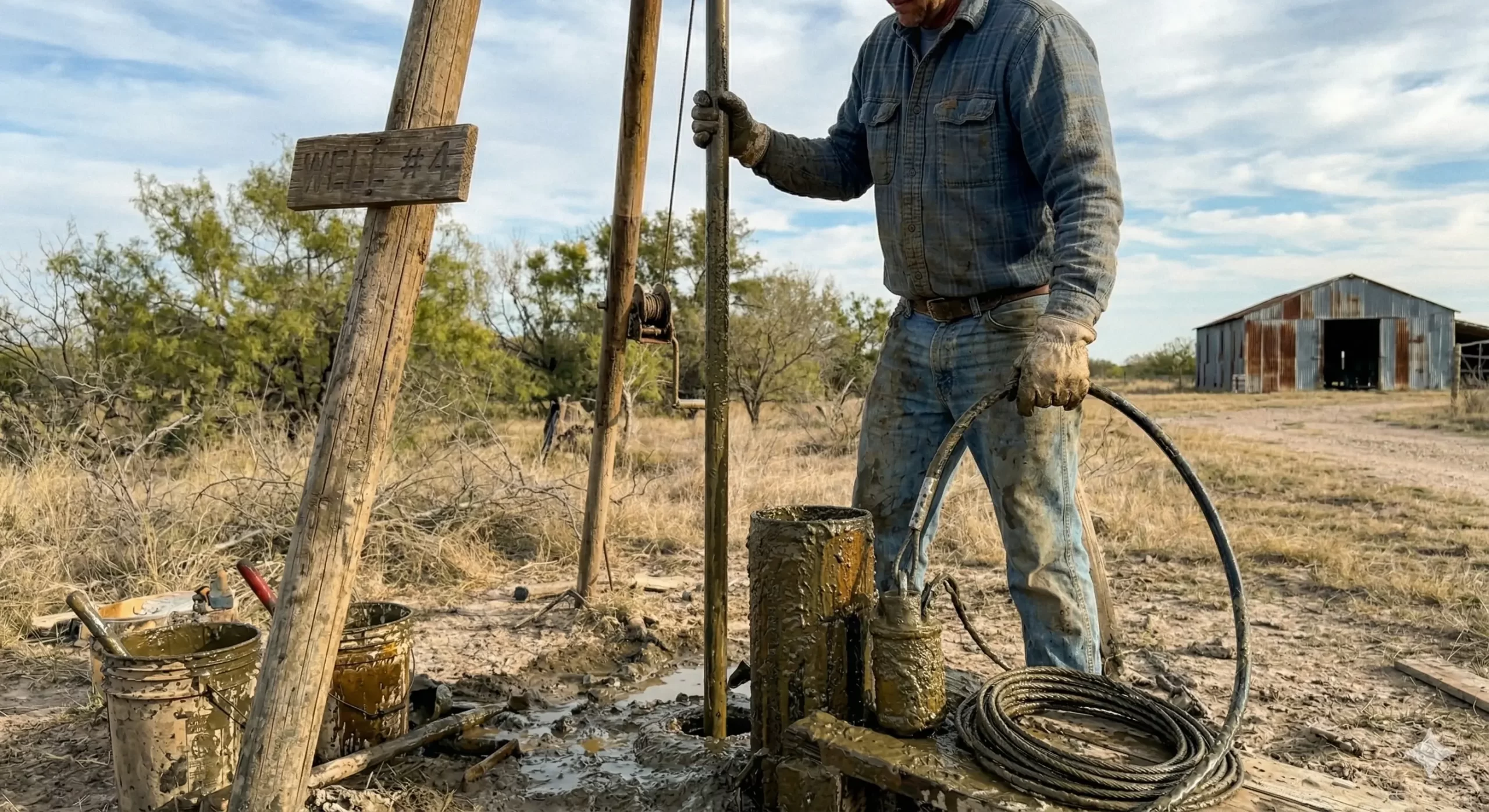
Pulling a pump out here in Cedar Park isn’t like pulling one in East Texas mud. We’re drilling through solid limestone to get these wells in, sometimes 400-600 feet deep. That means when a pump fails, you’re not just lifting it; you’re dealing with immense weight, the potential for rock debris in the casing, and often, challenging access for heavy equipment on older, treed properties. It’s a job that demands a specialized rig & experienced crew.
To safely & efficiently pull a deep well pump in Williamson County, we’re talking about heavy-duty pump hoist rigs, often truck-mounted, capable of lifting thousands of pounds of pipe & pump. We also need specialized tools for pipe wrenches, torque arrestors, safety clamps, and sometimes even casing packers if there are integrity issues. It’s not a job for a pickup truck & a chain, not if you want it done right & safe.
Spring Well Maintenance in Texas
Heavy spring rains can cause surface runoff to breach well caps. We strongly recommend testing your water for coliform bacteria and inspecting the sanitary seal.
Save $500+ on Replacements
Via the TX Energy Co-op VFD Upgrade Program
70°F in Cedar Park
Local Aquifers & Geology
The primary groundwater sources in Cedar Park include the The Trinity Aquifer, specifically the Middle and Lower Trinity Group, is the main source for most domestic wells in Cedar Park. It consists primarily of limestone, dolomite, sand, and shale. Water from the Trinity is generally hard, often containing elevated levels of calcium & magnesium, and can sometimes carry fine sediments like sand or silt, especially after heavy pumping or new well development. Yields are typically moderate but reliable when properly sited & drilled.. Drilling through the local The soil profile in Cedar Park is largely influenced by its geology, primarily Cretaceous limestone. The surface layers often consist of shallow, dark, calcareous clays (like the ‘Blackland Prairie’ soils or similar dark cracking clays) over a bedrock of Georgetown Limestone, Edwards Limestone, & Glen Rose Formation. This means shallow topsoil, limited infiltration, & a direct transition to hard rock, making any digging or excavation challenging. means that average well depths range from 350 ft – 700 ft, sometimes deeper..
Due to these geological factors, local homeowners frequently struggle with Motor burnout due to low water levels or constant cycling from insufficient well yield, followed closely by abrasive wear on impellers & motor components from sand & sediment in the Trinity Aquifer..
Drilling Depth Comparison
Deeper wells require heavy-duty crane hoists for pump extraction.
Climate & Water Quality
Pump systems in the Cedar Park area face severe environmental stressors. The most significant threat is Our hot, dry Texas summers are the biggest culprit. Prolonged droughts cause the water table to drop, leading to pumps running dry, overheating, & burning out motors. When rain does come, sudden heavy downpours can lead to flash flooding around wellheads, potentially contaminating the well or damaging electrical conduit if not properly sealed & protected above grade. The extreme temperature swings also stress pump control boxes & exposed plumbing.
Additionally, the raw groundwater often presents issues with Predominantly high hardness (calcium & magnesium), often leading to scale buildup in plumbing & water heaters. Fine sand or silt is also a common issue, particularly in older wells or those with high pumping rates. Less common but still encountered are elevated iron levels, which can cause staining, & occasional sulfur (rotten egg smell) depending on localized geology..
Regional Groundwater Advisory
Known primary contaminant threat to submersible pumps and pipes in this area:
Common Area Systems
VFD Upgrade Savings
Constant Pressure vs StandardReplacing a standard single-speed pump with a Variable Frequency Drive (VFD) eliminates hard starts and drastically reduces energy draw in Texas.
Compliance & Local Permits
Williamson County Level: For well drilling and maintenance in Williamson County, the primary authority is the Clearwater Underground Water Conservation District (CUWCD). They require permits for drilling new wells, deepening existing wells, or even substantial alterations. These permits ensure compliance with spacing rules, well construction standards (like proper casing & grouting to prevent contamination), & responsible groundwater management. Property owners must register their wells & adhere to pumping limitations or reporting requirements, especially during drought conditions, to protect the aquifer.
Top Pump Brands in Texas
Most frequently installed hardware based on local geology (2026 data).
- Verify power supply to pump control box & motor.
- Check pressure switch operation & settings.
- Inspect pressure tank for proper air charge & bladder integrity.
- Measure pump motor amperage & voltage for proper operation.
- Perform water quality test for hardness, sand, & sediment.
- Acoustic or visual well inspection to check water level & well integrity (if accessible).
Premium Well Pump Brands We Service
Our licensed technicians in Cedar Park are certified to repair, replace, and install high-quality groundwater equipment from industry-leading manufacturers, including:
- No water coming from faucets, or very low pressure.
- Pump runs continuously, but no water delivery.
- Water flow is inconsistent, spitting air & water.
- Unusual noises coming from the wellhead or pressure tank area.
- High electric bills without increased water usage.
- Cloudy or sandy water suddenly appearing at the tap.
Cedar Park Real Estate Well Regulations
Local Dispatch & Response Times
Live Dispatch: Texas
Updated Just Now⚠️ High demand. Call now to secure the next available technician.
- Typically within 24 hours for complete water outages.
- Prioritized dispatch for families with infants or elderly.
- Our crews are strategically located for rapid deployment across Williamson County.
- We maintain a comprehensive stock of common pump parts & motors.
- After-hours & weekend services available, subject to emergency call-out fees.
⚠️ Williamson County & State Regulatory Warning: Abandoned Wells
Groundwater Threat Level
Current aquifer and mineral impact on pumps in Cedar Park.
Dropping water tables cause pumps to suck air and overheat.
Hard water calcifies pump impellers, reducing lifespan.
Pump Lifespan Estimator
Select household size in Cedar Park to see strain impact.
The Cost of Ignoring Symptoms
Fixing a short-cycling pump early saves thousands in Cedar Park.
Data reflects average well contractor estimates in Cedar Park.
Local Cedar Park
Well Pros
Fast Local Service & Diagnostics
Calls are routed to a licensed local well professional.
Septic System Services in Cedar Park, TX
Do you have a septic tank on your property? Proper maintenance is critical to protecting your well water quality.
Cedar Park Homeowner Feedback
“Had a problem with my well pump last summer, barely getting any water. Called these folks up, & they had a man out here fast. Fixed it right up, no fuss. Good, honest work.”

Local Homeowner
✓ Verified TX
“My old pump started acting up something fierce, cycling on & off constantly, then just gave out completely. Thought I was in for a total rebuild, but the tech (I think his name was Mark?) did a thorough check. Turns out my pressure tank bladder was shot, & the pressure switch was clogged with some sediment. He replaced both, cleaned up the connections, & my water pressure is better than it’s been in years. Real professional, explained everything, and didn’t try to upsell me on a new pump I didn’t need. Only thing was, the paperwork was a tad messy, but that’s a small price for working water!”

Local Homeowner
✓ Verified TX
“Woke up to no water, completely dry. Called them up in a panic. They had a crew out to my place in Cedar Park within a couple of hours. Diagnosed a burnt-out pump, had a new one on the truck, & got it installed and running by late afternoon. Lifesavers! Can’t thank ’em enough for the speed.”

Local Homeowner
✓ Verified TX
Expert Cedar Park Well System FAQ
My well in Cedar Park has always had hard water, but lately, it feels like the pressure is dropping and appliances are failing faster. What gives?
That’s a common complaint around here, neighbor. The Trinity Aquifer, our main source, naturally produces very hard water due to the limestone geology. What you’re likely experiencing is scale buildup, which is a direct consequence of that hardness. Over time, calcium and magnesium deposits accumulate in your pipes, water heater, & appliances, restricting flow and reducing efficiency. When pressure drops, it’s often a sign that these deposits are severely constricting your plumbing or even the internal components of your pressure tank or pump. We often recommend a water softener system to mitigate scale, but a thorough system inspection is needed to see if the existing buildup is causing damage to your well components, which might require descaling or component replacement. Don’t let it go too long, or you’ll be replacing appliances more frequently than you should.
I’m looking at a piece of land in Cedar Park to build on, but it doesn’t have a well. What should I expect for drilling a new well here?
Drilling a new well in Cedar Park means dealing with the tough Central Texas geology. Expect to encounter hard limestone, which means drilling will be slower & more expensive per foot than in other parts of the state. You’ll likely need to go deep, typically between 350 to 700 feet, to hit a reliable supply in the Trinity Aquifer. Permitting through the Clearwater Underground Water Conservation District (CUWCD) is mandatory, & they have strict requirements for well spacing, casing, & grouting to protect the aquifer from contamination. We always recommend a hydrogeological survey of the property before drilling to maximize your chances of hitting good water & yield. Budget for a significant upfront cost for drilling & pump installation, but a properly installed well will provide reliable water for decades.
My well pump is short cycling (turns on & off very frequently) in Cedar Park. Is this normal during a drought, or is it a problem?
Short cycling is almost never normal, & it’s a big red flag that needs immediate attention, especially during a drought. While low water levels from a drought can exacerbate the issue, the primary cause of short cycling is typically a problem with your pressure tank. The air bladder inside the tank might be ruptured, or the tank could be waterlogged, meaning it’s lost its air charge. This makes the pump work much harder, turning on & off with every small demand for water, which quickly wears out the pump motor & pressure switch. In a drought, if the well yield itself is significantly reduced, the pump might also be struggling to keep the tank pressurized. Regardless, a professional needs to diagnose it quickly to prevent premature pump failure, which is an expensive repair you want to avoid.
My water suddenly tastes a little off, almost earthy, and sometimes looks slightly cloudy after heavy rain in Cedar Park. What’s causing this?
That ‘earthy’ taste & cloudy appearance after heavy rain is a strong indicator of potential surface water intrusion into your well. While our wells are drilled deep into rock, heavy rains, especially after a dry spell, can sometimes find pathways through fractures in the limestone or around improperly sealed well casings. This can introduce fine sediments, organic matter, and even bacteria into your groundwater supply. It’s critical to have your wellhead inspected for proper sealing & elevation above grade, & a comprehensive water quality test (including for coliform bacteria) should be performed immediately. If contamination is confirmed, disinfection of the well and potentially repairs to the wellhead or casing will be necessary to ensure your drinking water is safe.
Cedar Park Groundwater Expert AI
What are the specific groundwater regulations, average well depths, and the local conservation district for Cedar Park, Williamson County?
As a Senior Hydrogeologist and Local Groundwater Regulatory Expert for Texas, I can provide you with precise information regarding residential water wells in Cedar Park, Williamson County, TX, as of the year 2026.
Local Groundwater Conservation District (GCD) and Regulatory Bodies
For Cedar Park, Williamson County, the primary regulatory body for groundwater at the local level is the Central Texas Groundwater Conservation District (CTGCD). This district governs groundwater use, drilling, and well management within its jurisdiction, which includes portions of Williamson, Lampasas, and Burnet Counties.
At the state level, all water well drilling and pump installation activities, as well as well registration, are regulated by the Texas Department of Licensing and Regulation (TDLR). TDLR licenses drillers and pump installers and sets statewide minimum construction standards for water wells.
Specific Groundwater Regulations for Residential Wells
You will need to adhere to regulations from both the TDLR and the CTGCD:
- TDLR Regulations (State Level):
- Well Driller Licensing: All water wells in Texas must be drilled by a driller licensed by the TDLR.
- Well Registration: New wells must be registered with the TDLR within 30 days of completion. This is mandated under Texas Water Code Chapter 35 and 16 Texas Administrative Code (TAC) Chapter 76.
- Construction Standards: TDLR sets minimum well construction standards, including requirements for casing, cementing, and capping to protect water quality and prevent contamination. This also includes setback rules from potential contamination sources (e.g., septic systems, property lines). For example, there are specific distances required from septic drain fields (e.g., 50 feet) and property lines (e.g., 5 feet from the property line for most domestic wells, though CTGCD rules may supersede or add to this).
- Central Texas Groundwater Conservation District (CTGCD) Regulations (Local Level):
- Permitting and Registration: Even residential wells for domestic and livestock use, which are often exempt from production fees, typically require a permit or registration from the CTGCD before drilling commences. This is distinct from TDLR registration. You must submit an application and obtain approval from the CTGCD. You can usually find application forms and specific requirements on their official website.
- Well Spacing Requirements: The CTGCD enforces well spacing requirements to prevent interference with existing wells and to ensure equitable access to groundwater. These rules dictate minimum distances from property lines and other wells. It is crucial to consult the CTGCD's most current rules and regulations, as these can vary based on aquifer, well depth, and anticipated production.
- Well Plugging: The CTGCD, in conjunction with TDLR, also has rules governing the proper plugging and abandonment of unused or deteriorated wells to prevent aquifer contamination.
- Management Plan: The CTGCD operates under a voter-approved Management Plan, as authorized by Texas Water Code Chapter 36, which outlines its goals and strategies for groundwater conservation.
Recommendation: Before any drilling, always contact the Central Texas Groundwater Conservation District directly for the most current residential well permit applications, spacing rules, and fees. You will also need to ensure your driller is licensed by the Texas Department of Licensing and Regulation.
Average Well Depths in Cedar Park, Williamson County
Based on historical state well logs from the Texas Water Development Board (TWDB) and driller reports for the Cedar Park area of Williamson County, residential water wells primarily tap into the **Trinity Aquifer**. The Trinity Aquifer in this region consists of formations such as the Glen Rose, Hensell, and Cow Creek (Middle Trinity) and the Travis Peak (Lower Trinity).
The average well depth for residential use in Cedar Park typically ranges from **300 to 500 feet**. A good estimate for an average well depth would be approximately **400-450 feet** to reliably access sufficient water-bearing zones within the Lower Trinity formations. However, specific depth can vary significantly depending on the exact geological conditions of your property, elevation, and the desired yield, potentially ranging from shallower depths on higher elevations or closer to aquifer outcrop areas to deeper wells in valleys or where higher yields are sought.
Specific Aquifer
The primary aquifer system underlying Cedar Park, Williamson County, from which residential wells draw water, is the **Trinity Aquifer**. Specifically, these wells typically tap into the Middle Trinity (Glen Rose, Hensell, Cow Creek formations) and the Lower Trinity (Travis Peak formation) divisions of the aquifer.
Fast Local Service & Diagnostics
Calls are routed to a licensed local well professional.
Blix
provides official
Emergency Well Pump Repair services for the
Cedar Park
area.