
Emergency Well Pump Repair in Decatur, TX
Folks often don’t realize just how tough groundwater can be here in Wise County. We’ve got a unique combination of deep rock formations, unpredictable rainfall, and water quality issues that can make a mess of a perfectly good well pump if you’re not using the right equipment or service. It ain’t like pullin’ water out of a creek; it’s a battle against nature’s own stubbornness down there.
Our local wells primarily tap into the Trinity Group aquifer. This means we’re dealing with various layers of sandy formations, limestone, and shale. These aren’t always consistent, leading to different well depths and yields across the county. Understanding these geological nuances is key to knowing what kind of pump will last and how to get the most out of your water supply.
That’s why I always tell people, cheap pumps are a false economy out here. The high head pressure from deep wells, coupled with the mineral content and occasional sand, will chew through an inexpensive pump in no time flat. You might save a few hundred bucks up front, but you’ll pay for it tenfold in premature failures, lost water, and emergency repair calls. Invest in quality, or you’ll be seeing me more often than your grandkids.
Fast Local Service & Diagnostics
Calls are routed to a licensed local well professional.
Well Pump Repair in
Decatur
Decatur & Wise County Well Stats
Wise County wells generally range from 250 to 700+ feet deep, with yields varying significantly based on the specific formation tapped within the Trinity Group. Most residential wells utilize 4-inch or 6-inch submersible pumps. Static water levels can fluctuate dramatically with drought conditions, impacting pump performance and longevity. Typical yields are between 5-20 gallons per minute, sufficient for most residential and agricultural needs, but some areas can be tighter.
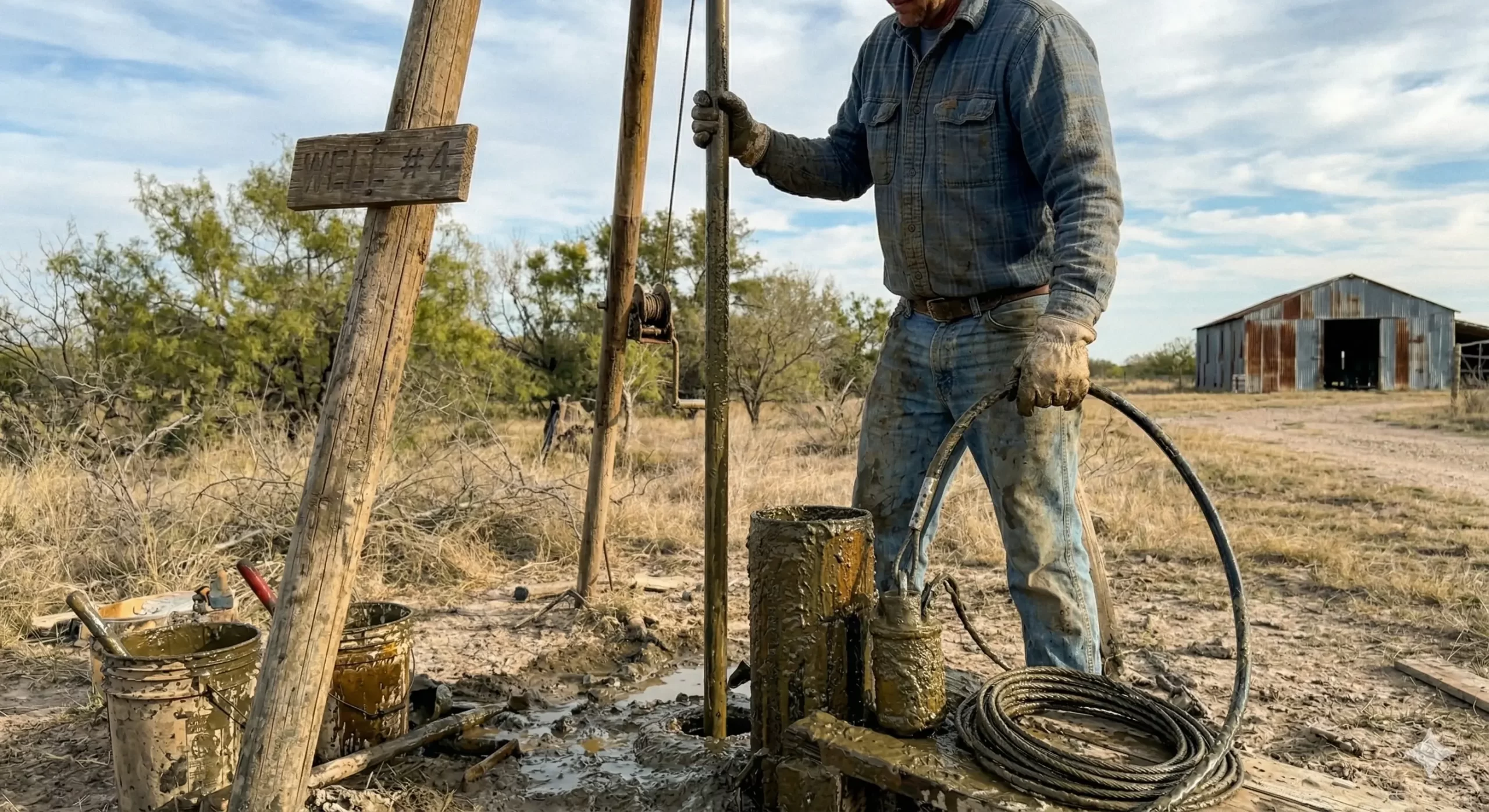
Pulling a pump in Wise County isn’t like changing a tire. Our wells are often deep, ranging from 300 to over 700 feet. Many properties have challenging access, requiring careful maneuvering of heavy-duty well rigs around trees, fences, or sloping terrain. Then there’s the geology: sometimes we hit hard rock formations that make pulling stuck pipe or clearing obstructions a real bear. All this adds significant time and specialized labor, which translates into the cost.
To get a pump out of these deep wells, we’re not just using a pickup truck and a winch. We’re talking about a dedicated well service rig, sometimes a crane for the really deep ones or complex setups. You need specialized tools for measuring, cutting pipe, handling electrical splices, and sometimes even fishing out dropped tools or pumps. The equipment itself is a major investment, designed to handle thousands of pounds of pipe and water, safely and efficiently.
Spring Well Maintenance in Texas
Heavy spring rains can cause surface runoff to breach well caps. We strongly recommend testing your water for coliform bacteria and inspecting the sanitary seal.
Save $500+ on Replacements
Via the TX Energy Co-op VFD Upgrade Program
82°F in Decatur
Local Aquifers & Geology
The primary groundwater sources in Decatur include the The primary aquifer system here in Wise County is the Trinity Group. This extensive aquifer consists of several formations, most notably the Paluxy, Glen Rose, and Twin Mountains formations. These are largely composed of sandstones, limestones, and shales. Water quality can vary; the Paluxy and Twin Mountains tend to have sandier water, while the Glen Rose can be more limestone-rich. Yields are generally moderate, providing reliable water but requiring properly sized pumps for varying depths.. Drilling through the local The soil profile around Decatur and Wise County is quite diverse. We primarily see clayey loams, sandy loams, and significant areas of rocky, stony clay soils, especially where limestone bedrock is closer to the surface. You’ll also find some deep, dark, rich clays in floodplains. This diverse soil makes it tough for trenching pipe, and heavy rains can make accessing properties a muddy mess, while droughts turn it into concrete. means that average well depths range from 300 ft – 700 ft.
Due to these geological factors, local homeowners frequently struggle with The #1 mechanical failure for pumps in this area, hands down, is motor burnout due to running dry or excessive cycling caused by pressure tank issues, leaks, or low water levels in the well itself. Sediment and mineral buildup, especially iron and hardness, are close seconds, causing wear and tear on impellers and motors..
Drilling Depth Comparison
Deeper wells require heavy-duty crane hoists for pump extraction.
Climate & Water Quality
Pump systems in the Decatur area face severe environmental stressors. The most significant threat is Our specific local weather is brutal on well equipment. Extreme heat in summer drives water tables down, forcing pumps to work harder or even run dry, leading to motor burnout. Extended droughts exacerbate this, putting immense strain on the entire system. Conversely, our occasional hard freezes can burst exposed lines, pressure switches, and tanks. And you can’t forget the lightning – Wise County gets its share of electrical storms, which love to fry pump control boxes and motors, even with surge protection.
Additionally, the raw groundwater often presents issues with Hardness (calcium & magnesium) is very common, leading to scale buildup in pipes and on heating elements. Iron is also prevalent, causing staining and sometimes an unpleasant metallic taste or odor. Sulfur, manifesting as a rotten egg smell, pops up in certain areas. Lastly, sand or sediment can be an issue, particularly in newer wells or those drawing from sandier formations, causing premature pump wear..
Regional Groundwater Advisory
Known primary contaminant threat to submersible pumps and pipes in this area:
Common Area Systems
VFD Upgrade Savings
Constant Pressure vs StandardReplacing a standard single-speed pump with a Variable Frequency Drive (VFD) eliminates hard starts and drastically reduces energy draw in Texas.
Compliance & Local Permits
Wise County Level: Wise County falls under the Prairielands Groundwater Conservation District (PGCD). For any new well drilling, substantial alteration, or even just deepening a well, you absolutely need to obtain a permit from the PGCD before starting any work. They require information on well location, intended use, estimated depth, and drilling contractor details. There are also specific rules about well spacing from property lines, septic systems, and other potential contamination sources. Furthermore, wells are typically required to register and may be subject to production reporting, especially for larger commercial or irrigation uses. Always check with the PGCD directly before any work to ensure compliance.
Top Pump Brands in Texas
Most frequently installed hardware based on local geology (2026 data).
- Measure voltage & amperage at control box and pump motor leads.
- Test pressure switch for proper cut-in/cut-out settings & condition.
- Inspect pressure tank for proper air charge and bladder integrity.
- Check well cap & conduit for secure seals and rodent/insect ingress.
- Pull pump & inspect motor, impellers, discharge head, and drop pipe for wear, corrosion, or damage.
- Test well for static water level, pumping water level, and recovery rate.
Premium Well Pump Brands We Service
Our licensed technicians in Decatur are certified to repair, replace, and install high-quality groundwater equipment from industry-leading manufacturers, including:
- No water at all, or very low water pressure.
- Pump constantly running or cycling on and off rapidly.
- Cloudy or sandy water suddenly appearing in your home.
- Unusual noises coming from the well area or pressure tank.
- Higher than usual electricity bills without increased usage.
- Water running cold in the shower when the well pump should be delivering.
Decatur Real Estate Well Regulations
Local Dispatch & Response Times
Live Dispatch: Texas
Updated Just Now⚠️ High demand. Call now to secure the next available technician.
- Within Wise County: Typically 2-4 hours, depending on current call volume and location.
- Adjacent counties (e.g., Denton, Parker): 3-6 hours.
- Overnight service: Available for critical emergencies.
- Weekend/Holiday: Available, often with a premium rate.
- Our priority is always getting your water back on, especially for homes with no other supply.
⚠️ Wise County & State Regulatory Warning: Abandoned Wells
The Cost of Ignoring Symptoms
Fixing a short-cycling pump early saves thousands in Decatur.
Data reflects average well contractor estimates in Decatur.
Groundwater Threat Level
Current aquifer and mineral impact on pumps in Decatur.
Dropping water tables cause pumps to suck air and overheat.
Hard water calcifies pump impellers, reducing lifespan.
Pump Lifespan Estimator
Select household size in Decatur to see strain impact.
Local Decatur
Well Pros
Fast Local Service & Diagnostics
Calls are routed to a licensed local well professional.
Septic System Services in Decatur, TX
Do you have a septic tank on your property? Proper maintenance is critical to protecting your well water quality.
Decatur Homeowner Feedback
“Old Man Johnson’s pump went out on a Sunday. Called these boys, they were out there by lunch, had me fixed up before supper. Good honest work, highly recommend.”

Local Homeowner
✓ Verified TX
“Had a real head-scratcher with my well. The pressure was dropping somethin’ fierce, and the pump just seemed to be runnin’ all the time. Another fella tried to fix it and just told me I needed a new pump, plain and simple. Called these guys, and the tech, a real seasoned feller, he spent a good hour checkin’ everything. Turns out, it wasn’t the pump at all but a hairline crack in my drop pipe about 200 foot down that was bleedin’ off pressure and making the pump overwork. Took ’em another day to get the rig out and pull it, but they found it and got it patched up. Saved me thousands on a pump I didn’t even need. Realy appreciate the honest work and not just tryin’ to sell me the most expensive fix.”

Local Homeowner
✓ Verified TX
“Our well quit on a Friday afternoon, right when company was coming for the weekend. Called them in a panic, and they had a crew out there faster than I expected for a Friday. They worked late, got us fixed up, and had water flowing by dark. Lifesavers!”

Local Homeowner
✓ Verified TX
Expert Decatur Well System FAQ
With these ongoing droughts in North Texas, how deep should I consider drilling a new well in Wise County to ensure a reliable water supply?
That’s a critical question, especially with our variable rainfall. While a typical residential well here might be 300-500 feet, during drought conditions, the static water level can drop significantly. I’d recommend drilling to at least 500-600 feet, or even deeper if the geology allows, to ensure you have sufficient water column above your pump intake during prolonged dry spells. We typically install pumps at a depth that allows for substantial drawdown, protecting your investment and ensuring continuity of supply. Always rely on a professional driller who understands the specific geological formations in your exact location, as conditions can vary even within a few miles.
My water from the well in Decatur tastes a bit metallic and stains my fixtures orange. What’s causing this, and what can be done about it?
That sounds like a classic case of iron in your well water, which is a fairly common issue in Wise County. The metallic taste and orange or reddish-brown staining on fixtures, laundry, and even sometimes your hair, are dead giveaways. This iron can also cause issues with your plumbing over time. The best solution usually involves a whole-house water treatment system. This might range from an oxidation filter, a water softener (if you also have hardness), or even a specialized iron filter system, depending on the concentration and type of iron present. We always recommend a water analysis first to determine the exact levels and suggest the most effective and cost-efficient treatment for your specific situation.
I’m buying a rural property near Boyd with an old well. What should I look for, and do I need to worry about well abandonment regulations if it’s no good?
When buying a property with an older well, definitely get a professional well inspection, including a water quality test and flow rate check. Look for signs of neglect: a corroded wellhead, exposed wires, or a pressure tank that’s seen better days. Check the well log, if available, for drilling depth and pump installation records. If the well is indeed ‘no good’ and you plan to replace it, or if there’s an old, unused well on the property, you absolutely need to address well abandonment. Unused wells are direct conduits for surface contamination into our aquifers. TDLR regulations require proper plugging of abandoned wells by a licensed driller, which involves filling it with cement or bentonite to restore the integrity of the geological formations. This isn’t just a recommendation; it’s a legal requirement to protect our groundwater.
My pump seems to be getting sand in the water intermittently. Is this a sign I need a new well, or can it be fixed?
Intermittent sand can be a concerning issue, but it doesn’t always mean you need a new well. It could be several things. Sometimes, it’s just a sign of your pump being set too deep in the well, or the well screen (the slotted pipe that lets water in) might be partially clogged or damaged, allowing fine sediment to enter. Another possibility is that the aquifer itself is producing sand, which can happen after significant water level fluctuations or heavy pumping. We’d start by inspecting the well with a camera to assess the well casing and screen, check the pump setting, and verify the integrity of the filter pack around the screen. Often, we can address this by adjusting the pump depth, cleaning the well, or installing a sand separator or sediment filter. A new well is usually a last resort after exhausting other repair options.
Decatur Groundwater Expert AI
What are the specific groundwater regulations, average well depths, and the local conservation district for Decatur, Wise County?
Residential Water Well Regulations in Decatur, Wise County, Texas (2026)
As a Senior Hydrogeologist and Local Groundwater Regulatory Expert for Texas, I can provide you with precise information regarding residential water wells in Decatur, Wise County, for the year 2026. The regulatory landscape for groundwater in areas without a local Groundwater Conservation District (GCD) differs significantly from those within one, making Wise County a unique case in this regard.
Local Groundwater Conservation District (GCD)
- Wise County is NOT currently located within a confirmed Groundwater Conservation District. This is a critical distinction. In the absence of a local GCD, the primary regulatory oversight for water well drilling and construction falls under state agencies, specifically the Texas Department of Licensing and Regulation (TDLR).
Specific Groundwater Regulations (Wise County, Texas)
Since Wise County does not have a local GCD, the following state-level regulations primarily govern residential water wells:
- Texas Department of Licensing and Regulation (TDLR):
- Licensing Requirement: All water well drilling and pump installation activities must be performed by individuals or companies holding a valid license issued by the TDLR. This ensures adherence to professional standards and best practices.
- Well Registration: Any new water well drilled must be registered with the TDLR by the licensed driller. This includes providing well location, depth, casing information, and other construction details. This data contributes to the state's groundwater resources inventory.
- Construction Standards: Wells must be constructed according to state standards to prevent contamination of groundwater and ensure safe, reliable operation. These standards cover aspects such as:
- Casing: Proper casing material and depth to prevent collapse and isolate undesirable water zones.
- Cementing/Grouting: Adequate cement or bentonite grout is required around the casing in the upper portion of the well to seal the annulus and prevent surface contaminants from entering the aquifer.
- Wellhead Completion: Requirements for wellhead sanitary seals, caps, and electrical connections to prevent contamination.
- Setback Rules: State regulations include specific setback requirements to protect the well from potential sources of contamination. While local ordinances can add to these, state minimums generally include:
- Property Lines: Typically a minimum distance from property lines (e.g., 5 feet or more, as per TDLR rules or local platting).
- Septic Systems/Wastewater Treatment Facilities: Significant setbacks are required (e.g., 50 to 100 feet from septic tanks and drain fields, as specified in 16 Texas Administrative Code §76.1000).
- Potential Contamination Sources: Wells must be located away from feedlots, waste disposal sites, and other potential sources of pollution.
- Well Plugging: Abandoned or deteriorated wells must be properly plugged by a licensed driller to prevent contamination of the aquifer and eliminate physical hazards. This is mandated under state law (Texas Water Code Chapter 36, Subchapter K, and TDLR rules).
- Relevant State Codes:
- Texas Occupations Code Chapter 1901: Governs the licensing and regulation of water well drillers and pump installers.
- Texas Administrative Code (TAC) Title 16, Part 4, Chapter 76: Contains the specific rules and technical standards for water well drillers and pump installers, including well construction standards and plugging requirements.
- Texas Water Code Chapter 36: While Chapter 36 primarily outlines the authority and responsibilities of Groundwater Conservation Districts, sections related to waste and well plugging are universally applicable statewide. Chapter 11 of the Texas Water Code also addresses general water rights and waste.
Average Well Depths in Decatur, Wise County
Based on historical state well log data for residential wells in the Decatur area of Wise County, tapping into the primary groundwater source:
- Average Well Depth: Residential water wells in Decatur typically range from 350 to 650 feet in depth. A realistic average for residential use targeting the more productive zones of the aquifer would be approximately 500 feet.
- Variability: Depths can vary significantly depending on the specific location within Decatur, the elevation of the property, and the desired yield, as deeper sections of the aquifer may be targeted for higher production.
Specific Aquifer Beneath Decatur
- The primary aquifer system underlying Decatur, Wise County, is the Trinity Aquifer. This system is comprised of several distinct hydrogeologic units, predominantly:
- The upper, shallower Paluxy Formation.
- The middle Glen Rose Formation.
- The deeper Travis Peak Formation (including the Hosston Sand).
Residential wells in the area commonly draw water from one or more of these formations, with deeper wells often targeting the Glen Rose or Travis Peak for increased yield and water quality.
Official Resources and Forms
For detailed regulations, forms, and to verify licensed professionals, please refer to these official state resources:
- TDLR Water Well Driller and Pump Installer Program:
Access regulations, search for licensed professionals, and find forms for well registration.
URL: https://www.tdlr.texas.gov/wwd/wwd.htm - Texas Water Development Board (TWDB) Groundwater Data:
Explore well location data, water levels, and quality information.
URL: https://www.twdb.texas.gov/groundwater/data/index.asp - Texas Administrative Code - Title 16, Part 4, Chapter 76 (Water Well Drillers and Pump Installers Rules):
The definitive source for specific well construction standards and regulatory requirements.
URL: https://texreg.sos.state.tx.us/public/readtac$ext.ViewTAC?tac_view=5&ti=16&pt=4&ch=76 - Texas Water Code Chapter 36 (Groundwater Conservation Districts - General Provisions):
While Wise County is not in a GCD, this chapter provides the foundational state law for groundwater management.
URL: https://statutes.capitol.texas.gov/Docs/WA/htm/WA.36.htm
When planning for a residential water well in Decatur, it is crucial to engage with a TDLR-licensed water well driller who is familiar with the local geology and state regulations to ensure proper well construction and compliance.
Fast Local Service & Diagnostics
Calls are routed to a licensed local well professional.
Blix
provides official
Emergency Well Pump Repair services for the
Decatur
area.