
Diagnosis: A Yaskawa iQpump LF (Loss of Prime/Underload) fault indicates the pump is running dry, pumping air instead of water. This is typically caused by a dropping well water level, requiring professional well diagnostics and adjustment of the VFD’s operating frequency to prevent catastrophic pump damage.
In this Guide:
What Causes the Yaskawa Code LF Issue?
The ‘LF’ or ‘Loss of Prime / Underload’ fault on a Yaskawa iQpump 1000 or iQpump Micro is an intelligent protective trip, not a simple malfunction. The Variable Frequency Drive (VFD) continuously monitors the electrical load (amperage) required by the submersible motor. Pumping water, a dense and heavy fluid, requires significant torque and thus a high amperage draw. When the well’s water level drops below the pump’s intake, the pump begins to pump air. Air is nearly 800 times less dense than water, causing the workload on the motor to plummet. The VFD detects this sharp, sustained drop in amperage as an ‘underload’ condition, correctly interpreting it as a dry run. It then trips the LF fault to shut down the system and prevent the self-destruction of the pump and motor.
When a submersible pump runs dry, the most immediate and catastrophic damage occurs to the pump’s internal components, specifically the bearings and impeller stacks. These components rely on the pumped fluid—water—for both lubrication and cooling. Without water, the hydrodynamic film that separates rotating and stationary parts vanishes. This leads to direct metal-on-metal or plastic-on-metal contact within the bearing assemblies, generating immense frictional heat. Within seconds, temperatures can spike high enough to melt synthetic components and cause the stainless steel pump shaft to gall and seize, permanently locking the entire rotating assembly.
Simultaneously, the submersible motor, located below the pump, is placed in extreme jeopardy. These motors are designed to be cooled by the constant flow of ambient well water moving past the motor’s outer housing, wicking away the heat generated by its electrical windings. During a dry run, this cooling medium is lost. The motor windings rapidly overheat, causing the enamel insulation to degrade, crack, and burn off. This breakdown leads to short circuits between windings or to the motor casing (a ground fault), resulting in complete and irreversible motor failure. Furthermore, the mechanical shaft seal, which prevents water from entering the motor, will overheat and fail, compromising the motor’s integrity even if a thermal overload eventually trips.
DIY Troubleshooting Steps
- Observe and Document Fault Conditions: Do not immediately reset the fault. Go to the Yaskawa drive’s keypad and record the monitored values at the moment of the trip. Key parameters to note are the Output Frequency (Hz), Output Current (Amps), and DC Bus Voltage (V). This data provides a critical snapshot of the system’s state for a professional technician.
- Perform a Controlled System Reset: Turn off the circuit breaker for the pump system, wait two minutes, and turn it back on. Stand near the pressure tank and listen. Time how long the pump runs before the LF fault reappears. A consistent, short run time (e.g., 60 seconds) strongly indicates the well’s water level is being drawn down faster than it can recover.
- Inspect for Obvious System Leaks: Carefully inspect all visible plumbing, including the pressure tank, pressure switch, and any yard hydrants or irrigation connections. A significant leak downstream of the pump can cause it to run continuously, leading to excessive well drawdown and triggering an LF fault.
- Check the Motor Amperage (If Safe and Qualified): If you are qualified and have a clamp-on ammeter, measure the amperage on one of the power legs leaving the VFD during a brief run cycle. Compare this reading to the motor’s nameplate Full Load Amps (FLA). A reading significantly below the FLA just before the LF fault confirms an underload condition.
- Verify Well Recovery Time: After the system faults, leave it off for an extended period (1-2 hours). After this recovery period, reset the system again. If the pump runs for a noticeably longer duration before faulting, it confirms the issue is related to a poor well yield, not a component failure.
- Review VFD Underload Settings (Do Not Change): Navigate to parameter L6-01 (Underload Detection Level) in the drive’s menu. Note the current percentage setting. This parameter defines the underload threshold. DO NOT adjust this value, as lowering it can mask the root cause and allow the pump to destroy itself.
When to Call a Professional Well Service
Upon arrival, a certified technician’s first step is a comprehensive electrical assessment at the surface. Using a high-quality clamp-on ammeter and multimeter, they will verify the VFD’s output and confirm the amperage drop prior to the LF fault. The critical diagnostic step is to de-energize and lock out the system, then disconnect the motor leads at the wellhead. Here, they will employ a Megohmmeter (often called a ‘megger’) to perform an insulation resistance test. This instrument applies a high voltage (500V or 1000V) to the motor windings and drop cable to measure resistance to ground. A low reading (less than 1 megohm) indicates compromised insulation, likely due to overheating from past dry-run events, necessitating the pump be pulled for inspection or replacement.
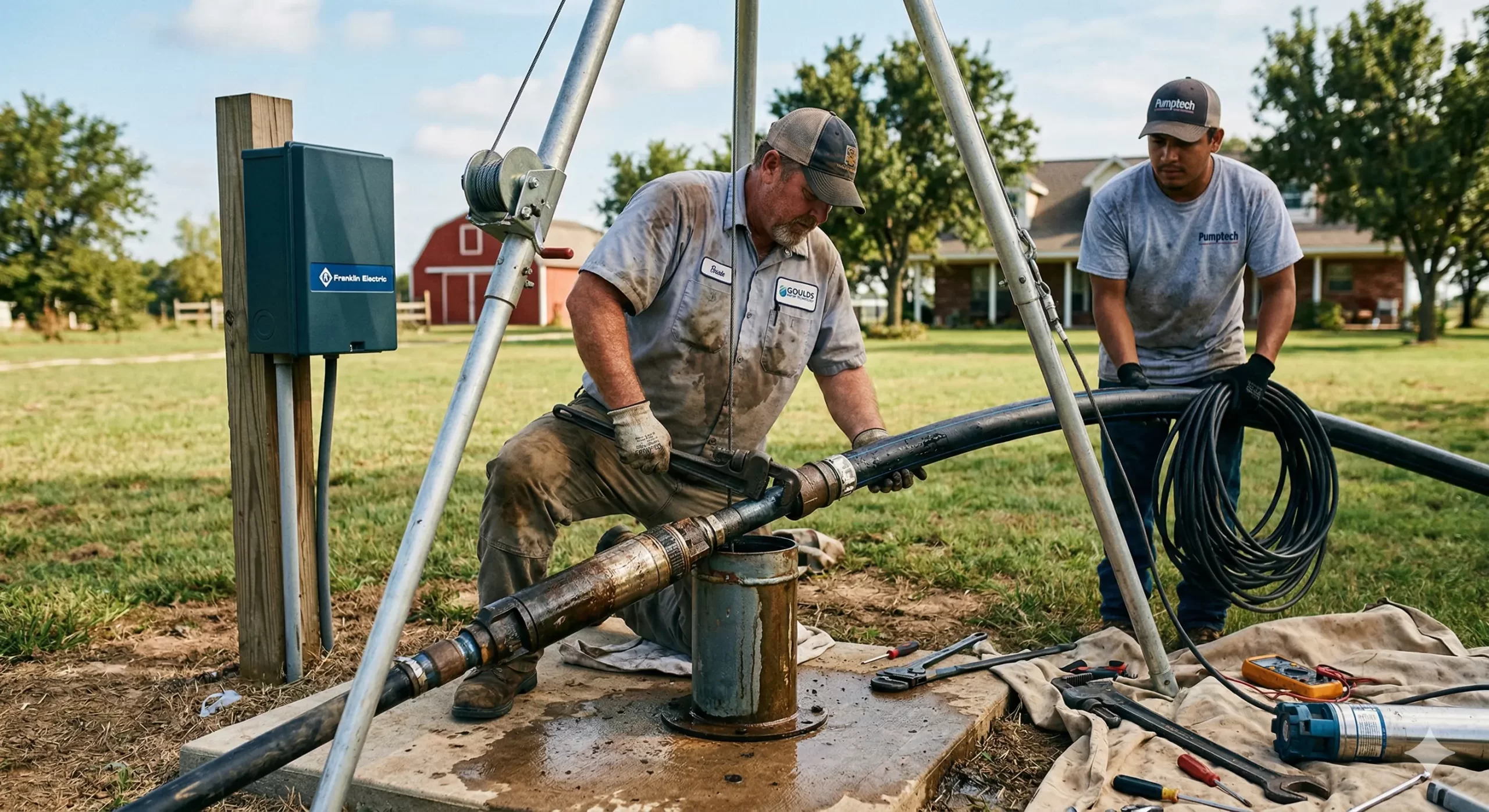
If the electrical tests pass, the problem is confirmed to be hydraulic—the pump is not getting enough water. The next phase requires mechanically pulling the pump assembly from the well. This is a hazardous procedure that mandates specialized equipment. A hydraulic Pump Hoist or dedicated pulling rig is essential to safely manage the combined weight of the pump, motor, pipe, wire, and the column of water inside, which can easily exceed 500 lbs. The technician will use a specialized Pitless Key to latch onto and disengage the pitless adapter from inside the well casing. Once the pump is at the surface, it will be physically inspected for heat damage, clogged intake screens, or a seized rotating assembly. The technician will then use an electronic water level sounder to accurately measure the static water level and total well depth, providing the data needed to diagnose the well’s yield and determine the correct pump setting depth.
The final repair involves addressing the mismatch between the pump’s capacity and the well’s production rate. Often, the solution is not simply lowering the pump but rather intelligently de-rating its performance using the VFD. After ensuring the pump is mechanically sound and set at an appropriate depth, the technician will re-install it and focus on tuning the iQpump drive. By adjusting the ‘Maximum Frequency’ parameter (D1-01), they can cap the pump’s speed. This reduces the gallons per minute (GPM) output to a sustainable rate that the well can support without being dewatered. This advanced VFD adjustment is the definitive solution for a low-yield well, ensuring long-term system reliability and protecting the owner’s investment.
Safety Protocol: All work on a 240V well system, especially one involving heavy overhead lifting, must be performed by a licensed and insured professional. The risk of severe electrical shock and the crushing hazard posed by a dropped pump assembly are significant.
Repair Cost & Time Assessment
The cost to diagnose and resolve a Yaskawa iQpump LF fault varies based on whether the pump needs to be physically pulled from the well. For an initial service call involving electrical diagnostics with a multimeter and megohmmeter, system inspection, and VFD parameter adjustment (if the problem can be solved with tuning alone), a customer can expect to pay between $350 and $750. This typically covers 2-4 hours of a senior technician’s time and the use of specialized diagnostic equipment.
If diagnostics determine the pump must be pulled for inspection, repair, or repositioning, the cost increases substantially. A full service call involving a two-person crew, a hydraulic pump hoist rig, pulling and reinstalling the pump, performing a well yield assessment, and re-programming the drive will typically range from $900 to $2,200. This price reflects the specialized equipment, higher liability, and extended labor (4-8 hours) involved. It is critical to note that this cost is for labor and equipment usage only; if the pump, motor, drop cable, or pipe are found to be damaged from the dry running and require replacement, the cost of these premium parts will be additional.
Fast Local Service & Diagnostics
Calls are routed to a licensed local well professional.