
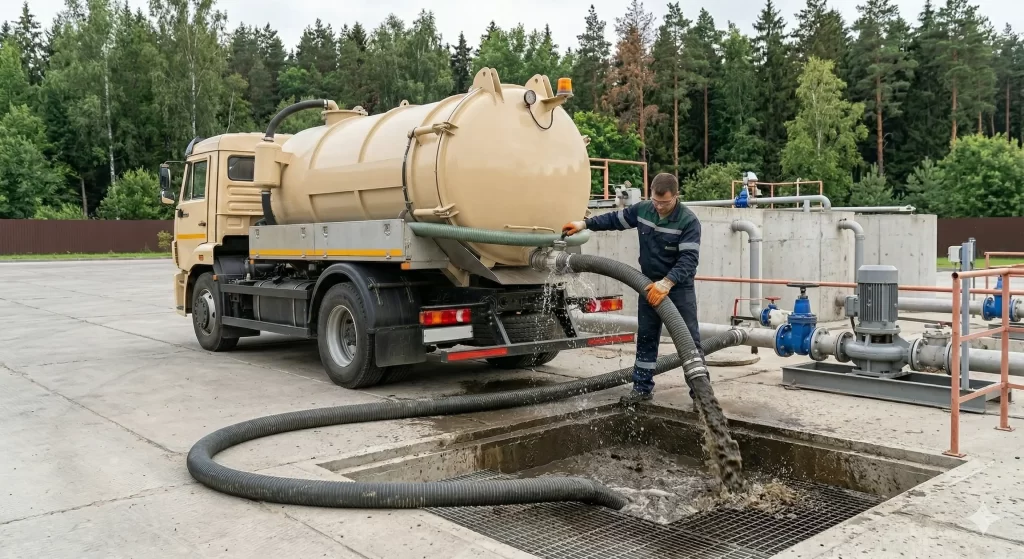
For millions of homeowners living beyond the reach of municipal sewer grids, the private wastewater system is a silent, subterranean workhorse. Buried deep in the backyard, a healthy septic system effortlessly manages, treats, and disposes of tens of thousands of gallons of household wastewater every single year. It is a marvel of localized biological engineering.
However, this delicate balance of anaerobic bacteria, hydraulic pressure, and soil percolation is not infinite. When the primary holding tank reaches its maximum capacity for solid waste, the system transforms from a reliable utility into a ticking environmental and financial time bomb. The transition from "full" to "catastrophically failed" can happen in a matter of days.
Ignoring the warning signs your septic tank is full is a gamble that homeowners almost always lose. In the United States, delaying routine maintenance until an emergency occurs can increase your service bill by up to 400% due to after-hours dispatch fees, hazardous material handling, and potential drain field excavation. This is a critical reality whether you are navigating the high water tables and Oolite limestone of Florida's septic landscape, or dealing with the dense, slow-draining clay soils managed by septic professionals in Texas.
In this definitive, expert-led guide, we will dissect the exact biological, visual, acoustic, and olfactory signals your property emits when your septic system is crying out for help. Recognizing these 7 critical indicators early is the ultimate key to saving your lawn, protecting your family's health, and avoiding a five-figure replacement bill.
Expert Guide Summary
- The Anatomy of a Failure: Why Tanks Overflow
- 1. The Yard Swamp: Pooling Water
- 2. Slow Drains & Simultaneous Backups
- 3. The Olfactory Alert: Sewage Smells
- 4. Lush Lawn vs. Brown Grass
- 5. Acoustic Warnings: Gurgling Pipes
- 6. Backups in Basements & Bathtubs
- 7. Water Quality: Nitrate Spikes in Wells
- Diagnosis: Full Tank vs. Failing Drain Field
- The Economics of Septic Maintenance
- Frequently Asked Questions
The Anatomy of a Failure: Why Tanks Overflow
To understand the warning signs, you must first understand the mechanics of the tank. A conventional septic tank is designed to hold wastewater long enough for it to separate into three distinct layers:
- The Scum Layer: Fats, oils, and greases (FOG) that float to the very top.
- The Effluent Layer: The relatively clear, partially treated liquid wastewater in the middle.
- The Sludge Layer: Heavy, solid waste that sinks to the bottom where anaerobic bacteria break it down.
As new wastewater enters the tank from your house, an equal amount of liquid effluent is pushed out through the outlet baffle, into the Distribution Box (D-Box), and out into the perforated pipes of the drain field (leach field), where the soil naturally filters it.
The problem arises when the sludge and scum layers grow too thick. The clear effluent layer in the middle shrinks. Eventually, the heavy solids reach the level of the outlet pipe. Instead of clear water flowing into your drain field, thick, untreated solid waste is pushed into the narrow pipes and the porous soil. This "biomat" of the drain field becomes instantly clogged, causing total systemic hydraulic failure.

1. The Yard Swamp: Pooling Water and Spongy Soil
One of the most undeniable, physical manifestations that your septic tank requires immediate professional pumping is the sudden appearance of standing water or extraordinarily muddy, spongy soil in your backyard. This usually occurs directly over the concrete tank lids or across the expanse of the drain field.
If it hasn't rained in a week, yet you have a miniature swamp forming near your property line, you are witnessing a severe hydraulic overload. Because the tank is completely full of solid sludge, the liquid effluent has no volume left to occupy. The drain field is saturated, and the contaminated water, following the path of least resistance, forces its way upward to the surface of your lawn.
Regional Terrain Factors
In low-elevation coastal states, this pooling can happen rapidly. When summer storms raise the groundwater table, a full septic tank can become "hydraulically locked"—meaning the water in the ground is pushing back harder than the water trying to exit the tank. This makes pre-storm pumping critical for emergency preparation.
2. Slow Drains & Simultaneous Backups
Every homeowner deals with a slow drain at some point. Hair clogs a shower drain, or coffee grounds slow down the kitchen sink. These are localized plumbing issues. However, the diagnostic key changes entirely when multiple drains across your home become sluggish at the exact same time.
If you flush a second-story toilet and notice that the water takes abnormally long to recede, while simultaneously the water begins to back up into the first-floor bathtub when the washing machine enters its drain cycle, the problem is not in your walls. The problem is buried in your yard.
The main sewer line connecting your house to the septic tank is backing up. It is holding water because the concrete vault outside is at 100% capacity. There is simply no void space left to accept new wastewater.
- Do NOT use chemical drain cleaners: Pouring harsh, caustic acids (like Drano or Liquid Plumr) down a slow drain when the septic tank is full will not clear the blockage. Worse, the high concentration of bleach and lye will massacre the fragile ecosystem of beneficial bacteria inside your tank, halting the biological digestion of solids entirely.
3. The Olfactory Alert: Severe Sewage Odors
A properly installed, healthy septic system is a closed, practically airtight biological reactor. The gases produced during the anaerobic digestion of human waste—primarily methane and hydrogen sulfide (which produces a distinct "rotten egg" smell)—are designed to be safely vented upward and out through the plumbing vent stacks located on the roof of your home.
If you walk outside onto your patio, or stroll near the perimeter of your drain field, and are physically hit by a wall of raw sewage odor, the system's containment has failed. The liquid level inside the tank has risen so high that the gases are no longer venting properly through the roof. Instead, they are being forced out through the seams of the concrete lids, the access risers, or bubbling up through the saturated soil itself.
Similarly, if you begin to smell raw sewage indoors—particularly around floor drains in a basement, laundry room, or lower-level bathroom—the liquid in the tank has risen to a critical point where it is actively pushing sewer gases backward, overcoming the water barrier inside your plumbing's P-traps.
Smell Sewage in Your Yard?
Foul odors indicate your tank is actively overflowing and potentially contaminating local groundwater. Do not wait for a biohazard backup.
4. The Fertilizer Effect: Unusually Lush, Green Grass
It sounds highly counterintuitive, but one of the most common and visually striking signs of a failing septic system is a remarkably beautiful patch of lawn. If you look out your window in the middle of a dry, hot summer and notice that a specific, rectangular section of your yard is significantly greener, taller, and growing with intense vigor compared to the surrounding dormant grass, you have a problem.
When a septic tank overflows, or a drain field pipe cracks under pressure, the effluent that escapes into the shallow topsoil is highly concentrated with nitrogen and phosphorus. These are the exact same chemical compounds found in premium commercial lawn fertilizers.
While your turfgrass absolutely loves this constant supply of nutrient-rich water, it is a glaring environmental red flag. It indicates that your tank is actively leaking raw, untreated biohazardous material just inches below where your children or pets might be playing.
*Statistically, ignoring "Moderate" signs increases the final repair bill by an average of $3,500 due to lateral line damage.
5. Acoustic Warnings: Gurgling Pipes and Toilets
Your plumbing system speaks to you. Listen closely the next time you use the facilities. Does your toilet sound like it’s "burping" or gurgling several seconds after you flush it? Does the kitchen sink drain make strange, rhythmic bubbling noises when the washing machine empties its load?
This acoustic warning sign is rooted in basic fluid dynamics. When a volume of water travels rapidly down a pipe, it pushes the air in front of it and pulls a vacuum of air behind it. If your septic tank is overfilled, the standing liquid level rises high enough to completely submerge the inlet baffle (the pipe where waste enters the tank from your house).
Because the end of the pipe is underwater, the air being pushed down by your flushing toilet cannot escape into the empty space of the tank. The air has nowhere to go but backward. As the wastewater forces its way down, it pushes the trapped air violently back up the pipes, causing the water sitting in your toilet bowls and P-traps to bubble, burp, and gurgle.
6. Backups in Basements & Bathtubs (The Ultimate Nightmare)
This is the final, undeniable, and most hazardous sign that your septic system has completely and utterly failed. If you see dark, foul-smelling liquid backing up into your basement floor drains, ground-level bathtubs, or the lowest toilets in your home, your septic tank has absolutely zero capacity left.
Because plumbing relies entirely on gravity, the lowest drains in your home's architecture will always be the first point of overflow when the mainline backs up. This is no longer just a frustrating mechanical issue; it is a severe, actionable biohazard.
Raw sewage contains highly dangerous pathogens, aggressive bacteria, and viruses. If you experience an indoor backup, you must take immediate triage steps:
- Halt All Water Usage: Turn off the main water valve if necessary. Do not run dishwashers, washing machines, or allow anyone to flush a toilet. Every drop of water used will end up on your floor.
- Isolate the Area: Keep all children and pets strictly away from the contaminated room.
- Do Not DIY Clean: Do not attempt to mop up raw blackwater sewage without industrial-grade personal protective equipment (PPE) and sanitizers.
- Call Dispatch Immediately: This requires an emergency vacuum truck extraction to relieve the pressure on the house mainline.
7. High Nitrate Levels in Well Water (The Invisible Threat)
For millions of rural homeowners who rely on a private well for their domestic drinking water, a full or failing septic tank poses a massive, invisible health risk. You cannot see it, and you cannot smell it in the early stages.
When a septic tank overflows, or a heavily compacted drain field is pushed beyond its absorption capacity, the untreated wastewater bypasses the natural biological filtration process of the deep soil layers. The raw effluent sinks directly downward into the groundwater aquifer that supplies your well.
If your routine annual well water testing suddenly shows elevated or spiking levels of nitrates, nitrites, or coliform bacteria, your septic system is the primary suspect. Consuming water with high nitrate levels is particularly dangerous—and potentially lethal—for infants (causing "blue baby syndrome") and pregnant women. If your water tests positive for contamination, you must switch to bottled water immediately and have your septic tank pumped, scoped with a camera, and inspected by a licensed professional to locate the subterranean breach.
Diagnosis: Full Tank vs. Failing Drain Field
Many homeowners misdiagnose a localized plumbing clog, assuming their septic tank is failing, or conversely, assume they just need a pump-out when their entire drain field has actually collapsed. Before you panic, review the comparative diagnostic matrix below. Understanding exactly what is happening under your property ensures you hire the right professional for the right job.
| Symptom Observed | Localized Plumbing Clog | Full Septic Tank (Requires Pumping) | Failing Drain Field (Requires Replacement) |
|---|---|---|---|
| Drainage Speed | Only one specific fixture (e.g., guest shower) is slow. | ALL drains in the house are sluggish simultaneously. | Drains are slow, but the severity fluctuates (worse during heavy rain or laundry day). |
| Acoustic Profile | Gurgling heard only in the affected sink or tub. | Global gurgling, especially loud when flushing main toilets. | Occasional gurgling; toilets lack "flushing power" persistently. |
| Yard Conditions | Completely normal, dry, and odorless. | Slight odors near the access lids; a patch of lush grass directly above the tank. | Spongy, wet soil over a wide area; standing black water; intense, widespread sewage smell. |
| Nature of Backups | Rare. Usually just gray soapy water backing up in one sink. | Raw, black sewage actively backs up into the lowest drains (basement/first-floor tub). | Sewage may back up into the yard or distribution box rather than inside the house. |
| Professional Snake/Auger | Clears the issue permanently in 20 minutes. | The snake hits a wall of solid sludge at the tank inlet; the issue returns instantly. | The mainline is clear, but water has nowhere to exit the tank because the soil is clogged. |
| Response to Pumping | N/A (Pumping not required). | Issue is resolved entirely for the next 3-5 years. | Tank is emptied, but drains slow down again within 48 hours as the tank refills with water. |
The Economics of Septic Maintenance
If you recognize even one of these seven warning signs, your window of opportunity to prevent a catastrophic, wallet-draining failure is closing rapidly. Pumping a septic tank is a standard, routine maintenance task. According to current national data, the average cost to pump a 1,000-gallon septic tank hovers around $350 to $500, depending on your local market, fuel surcharges, and municipal dumping fees.
However, if you ignore the signs—if you let the sludge escape the tank and permanently clog the biomat of your drain field—pumping will no longer save you. You will be forced to excavate and replace the entire leach field network. The cost of a new drain field ranges from $7,000 to over $15,000.
The mathematics of property management are unforgiving: spending $400 proactively today is the cheapest, most effective insurance policy you can buy to protect a $15,000 asset tomorrow.
Pumping Frequency Guidelines
Do not wait for the warning signs to appear. Follow these industry-standard guidelines based on the Environmental Protection Agency (EPA):
- Household of 4 (1000-gallon tank): Pump every 2.5 to 3 years.
- Household of 2 (1000-gallon tank): Pump every 5 years.
- Homes with Garbage Disposals: Pump 50% more frequently. Disposals introduce massive amounts of un-digested organic solids that fill the sludge layer at an accelerated rate.
- Homes with Water Softeners: The backwash brine can disrupt the bacterial balance, requiring more frequent checks.
Frequently Asked Questions
Can tree roots cause my septic tank to fill up faster?
Will chemical additives eliminate the need for pumping?
How can I save money when the pumping truck arrives?
Septic Intelligence AI: USA
What is a distribution box (D-box) and how does it work?
The Septic System Distribution Box (D-box): An Essential Component Explained
As a global expert in wastewater management, I can attest to the critical role of every component within a septic system. Among these, the distribution box, often simply called a D-box, is a seemingly humble yet profoundly important device that dictates the long-term success and efficiency of your drain field. Understanding its function is key to proactive homeowner maintenance and emergency prevention.
What is a Distribution Box (D-box)?
A distribution box (D-box) is a critical junction within a conventional septic system, positioned between the septic tank and the drain field (also known as a leach field or absorption field). Its primary purpose is to evenly distribute the liquid effluent – the partially treated wastewater that has separated from solids in the septic tank – into the multiple perforated pipes or trenches of the drain field.
- Typically made of precast concrete, plastic, or fiberglass, a D-box is a watertight container with a single inlet pipe (from the septic tank) and multiple outlet pipes (leading to the drain field laterals).
- It is usually buried shallowly in the ground, accessible via a lid or riser for inspection and maintenance.
- Without a functioning D-box, effluent would preferentially flow into only one or a few drain field pipes, leading to premature saturation and failure of those specific sections, rather than utilizing the entire absorption area effectively.
How Does a Distribution Box Work?
The operational principle of a D-box is elegantly simple: hydraulic equalization.
- Effluent Entry: Partially treated wastewater flows by gravity (or is pumped in systems with a lift station) from the septic tank into the D-box's single inlet opening.
- Chamber Filling: The effluent collects in the bottom of the D-box chamber.
- Even Distribution: As the liquid level rises within the D-box, it reaches the elevation of the outlet pipes. Crucially, all outlet pipes are designed to be at the exact same elevation. This ensures that the effluent is discharged equally and simultaneously into each lateral pipe of the drain field.
- Drain Field Absorption: From these perforated pipes, the effluent seeps into the surrounding soil, where further natural treatment occurs through biological processes before it re-enters the groundwater.
The effectiveness of the D-box hinges entirely on its levelness. If the D-box shifts, tilts, or settles unevenly over time, some outlets will be higher than others. The effluent will then flow preferentially out of the lower outlets, oversaturating those drain field trenches while others remain underutilized. This imbalance drastically shortens the overall lifespan of the drain field.
Homeowner Maintenance and Emergency Prevention
While homeowners typically do not perform direct maintenance on the D-box itself, understanding its vulnerabilities is crucial for proactive system care and preventing costly emergencies.
- Regular Professional Inspection: During routine septic system inspections (recommended every 1-3 years in the USA, depending on usage and local regulations), your septic professional should locate and inspect the D-box. They will check its levelness, look for cracks, root intrusion, or blockages in the outlet pipes.
- Maintain Proper Tank Pumping Schedule: Regular septic tank pumping prevents excessive solids from overflowing into the D-box and drain field. If too many solids reach the D-box, they can accumulate, block outlets, and eventually clog the drain field pores.
- Be Mindful of Landscaping: Avoid planting trees or shrubs with aggressive root systems near the D-box or drain field. Roots are a common cause of D-box outlet blockages and pipe damage.
- Avoid Heavy Loads: Do not drive or park vehicles, construct patios, or place heavy structures over the D-box or drain field. Compaction can damage the D-box, pipes, and the soil absorption capability.
- Observe for Signs of Trouble:
- Wet spots or standing water in the drain field area, especially during dry periods.
- Unpleasant odors emanating from the yard.
- Lush, greener grass in specific areas over the drain field (indicating localized oversaturation).
- Slow drains, gurgling toilets, or sewage backups inside your home (can indicate a failing drain field due to D-box issues).
- Prompt Professional Intervention: If any of these signs appear, contact a certified septic professional immediately. Addressing D-box issues early can often prevent complete drain field failure, which is an extremely expensive repair.
Relevance to Septic Pumping
While septic pumping focuses on removing accumulated solids and scum from the septic tank, the D-box is intrinsically linked to the overall health of the system during this service:
- System Health Indicator: A septic professional will often inquire about the overall performance of your system, which includes the drain field. Issues with the D-box or drain field can manifest as frequent backups, even if the tank is being pumped regularly.
- During Inspection: Many reputable pumping companies will, as part of their service, visually inspect the area around the D-box if it's easily accessible, or at least discuss its importance and suggest a more thorough inspection if concerns arise. They may note any visible signs of drain field stress or D-box malfunction that might indicate deeper problems beyond just a full tank.
- Preventing Premature Drain Field Failure: A well-maintained D-box ensures the drain field operates as designed, maximizing its lifespan. Conversely, a failing D-box can render a recently pumped septic tank effectively useless if the effluent has nowhere to go.
Local Relevance (USA, 2026)
In the USA, septic system regulations are primarily managed at the state and local (county or municipal) levels. In 2026, while national guidelines and best practices exist, the specifics of D-box installation, repair, and inspection requirements can vary significantly:
- Permitting and Codes: Any repair or replacement of a D-box, or related drain field components, typically requires a permit from your local health department or environmental agency. Adherence to local codes ensures proper design, materials, and installation.
- Certified Professionals: Always utilize licensed and certified septic system professionals in your specific state and county. They are knowledgeable about local soil conditions, groundwater tables, and regulatory mandates that directly impact D-box and drain field performance.
- System Variations: While the D-box is standard in conventional gravity systems, some advanced treatment units or pressurized drain fields may utilize different distribution methods (e.g., pump chambers with header pipes and orifices), but the underlying principle of even distribution remains paramount.
In conclusion, the distribution box is a small but mighty component that acts as the gateway to your septic system's most expensive part – the drain field. Proactive care, regular professional inspection, and adherence to sound septic practices are your best defense against D-box failure and the costly repercussions it can bring to your entire wastewater management system.
“I ignored the strange gurgling sound in my downstairs guest bathroom for weeks, thinking it was just a venting issue. By the time I noticed the smell outside, my yard was a swamp. The local tech I found through Blix arrived in under 2 hours, pumped the tank, and literally saved my drain field from total collapse. An expensive lesson, but amazing service!”

Don't Wait for a Sewage Disaster
If your drains are slow, your pipes are gurgling, or your yard smells, your tank is at critical capacity. Blix connects you with top-rated, strictly vetted local professionals for fast, transparent, and code-compliant service.
Available 24/7 for emergency dispatch in most zip codes.