

Table of Contents
- 1. The 2026 Landscape of Texas OSSF Regulations
- 2. System Types: Conventional vs. Aerobic (ATU) Compliance
- 3. The Strict Mandate on Maintenance Contracts
- 4. Legal Pumping: Manifests and Authorized Transporters
- 5. How Regulations Impact Pumping Costs
- 6. TCEQ Fines, Penalties, and Enforcement (Graph)
- 7. Regional Rule Variations Across Texas
- 8. Real Estate Transfers Involving Septic Systems
1. The 2026 Landscape of Texas OSSF Regulations
If you own a property in Texas that is not connected to a municipal sewer system, you are the legal operator of an On-Site Sewage Facility (OSSF). In the state of Texas, all OSSFs are strictly governed by the Texas Commission on Environmental Quality (TCEQ) under Title 30 of the Texas Administrative Code (TAC), Chapter 285. As we navigate through 2026, the regulatory environment has tightened significantly, driven by rapid suburban expansion and heightened environmental protection standards.
The days of unregulated "wild west" septic installations and unrecorded pump-outs are definitively over. Today, the state utilizes a rigorous system involving Authorized Agents (AAs)—usually your local county environmental health department or river authority—and Designated Representatives (DRs) who conduct the actual inspections and enforce compliance. Ignorance of these rules is no longer a valid defense. If your system surfaces untreated effluent into a local ditch or water body, you are violating state environmental laws, which carries severe financial penalties.
Before you even schedule a vacuum truck to service your property, it is critical to understand what kind of system you have, what the law requires you to do with it, and what documentation must be submitted to the county to prove your compliance.
2. System Types: Conventional vs. Aerobic (ATU) Compliance
TCEQ categorizes septic systems based on how they treat and disperse wastewater. The regulatory burden on the homeowner shifts drastically depending on the technology buried in your backyard. Below is a comprehensive comparison of how TCEQ treats different systems in 2026.
| System Classification | TCEQ Permitting Status | Routine Maintenance Mandate | Failure Detection & Pumping Rule |
|---|---|---|---|
| Standard Conventional (Gravity) | Permitted only in highly porous, deep soils with no high water table. | No mandatory state contract, but highly recommended every 3-5 years. | If effluent surfaces, system is deemed failed. Pumping is required before repair. |
| Aerobic Treatment Unit (ATU) | Mandatory for heavy clay, rocky terrain, or coastal floodplains. | Continuous maintenance contract legally required. Inspections every 4 months. | Trash tanks must be pumped when sludge accumulation exceeds 30-50% capacity. |
| Low Pressure Dosing (LPD) | Alternative for shallow soils requiring uniform distribution. | Requires periodic pump tank cleanouts and filter washing. | Pump chambers must be vacuumed to clear sediment that clogs dosing lines. |
3. The Strict Mandate on Maintenance Contracts
If your home is equipped with an Aerobic Treatment Unit (ATU) that utilizes surface application (spray heads in your yard), you are operating under the strictest segment of TCEQ regulations. Because ATUs discharge treated water above ground, any failure in the mechanical treatment process (such as a dead air compressor or empty chlorinator) results in raw sewage being sprayed onto your lawn.
To prevent public health crises, TCEQ requires ATU owners to maintain a continuous, active maintenance contract with a licensed maintenance provider. The provider is legally obligated to inspect your system at least three times a year (every four months) and report the biological health and mechanical functionality directly to the county.
Regional Enforcement Hotspots
Counties positioned over sensitive aquifers or in dense urban sprawls track these contracts relentlessly. For instance, homeowners over the Edwards Aquifer in Austin, Georgetown, and Boerne face immediate Notices of Violation (NOVs) if their contract lapses. Similarly, coastal areas battling constant water table issues like Beaumont and Vidor maintain strict oversight to prevent floodwater contamination.
4. Legal Pumping: Manifests and Authorized Transporters
A common misconception among rural property owners is that they can hire a local farmer with a tractor-pulled tank to empty their septic system. Under 2026 TCEQ rules, this is highly illegal and carries massive fines for both the homeowner and the unauthorized pumper.
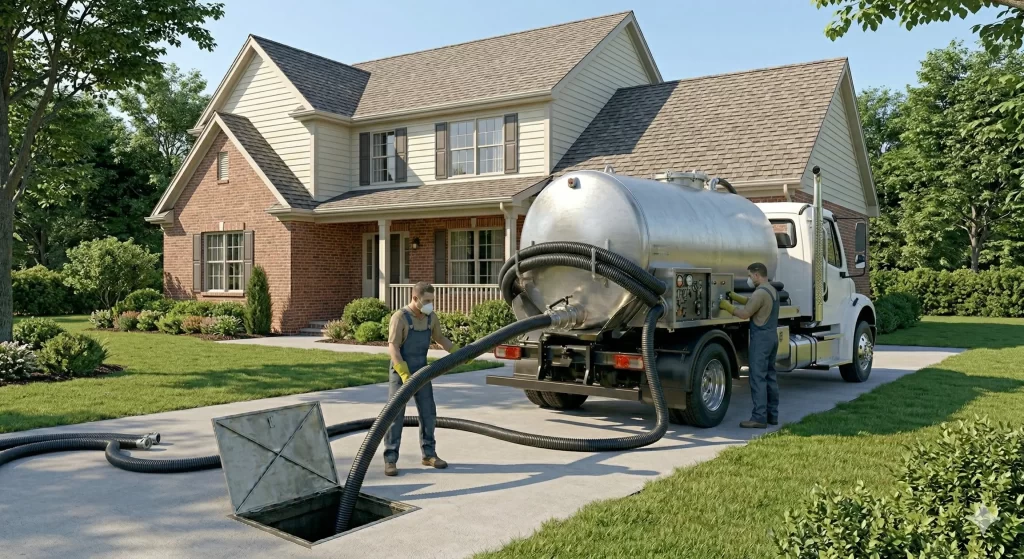
All septic waste (domestic septage) must be removed by a TCEQ-Registered Sludge Transporter. When a legitimate vacuum truck arrives at your property, a strict chain of custody begins:
- The Trip Ticket (Manifest): The technician will generate a multi-part trip ticket detailing the exact volume of waste removed from your property (e.g., 1,000 gallons).
- The Disposal Site: The waste cannot be dumped in a ditch or on private land. It must be transported to a TCEQ-permitted wastewater treatment plant or a state-authorized land application site.
- County Reporting: A copy of the manifest is provided to you, kept by the transporter, given to the disposal facility, and ultimately reported to the county. This proves you have safely and legally maintained your system.
5. How Regulations Impact Pumping Costs
The rigorous tracking, disposal fees at municipal plants, and the heavy commercial insurance required by the state have all directly impacted the cost of septic services. When you pay for a pump-out, you are not just paying for the labor of driving a truck to your house; you are paying for the legal liability of hazardous waste disposal.
If you have a standard-sized tank, we highly recommend reading our deep-dive analysis on the 1000 gallon septic tank pumping cost to understand the exact breakdown of disposal fees versus labor. Furthermore, for a broader look at how regional economics and advanced ATU cleanouts affect your wallet this year, consult our comprehensive 2026 guide to septic pumping costs.
6. TCEQ Fines, Penalties, and Enforcement
Environmental enforcement in Texas is not to be taken lightly. The state grants local Authorized Agents the power to investigate nuisance complaints (usually submitted by neighbors smelling sewage) and issue citations. Violations of the Texas Health and Safety Code regarding OSSFs are typically prosecuted as Class C Misdemeanors, but the fines can compound daily.
Common OSSF Violations & Estimated Maximum Fines (Per Day)
*Fines can vary by county and specific circumstances. Criminal charges may apply for severe environmental contamination.
7. Regional Rule Variations Across Texas
While TCEQ sets the baseline rules, local Authorized Agents have the power to enact more stringent regulations based on local environmental threats. They cannot make the rules looser, but they can definitely make them tighter.
- North Texas (DFW Metroplex): The heavy, expanding Blackland Prairie soils frequently destroy underground pipes. Counties around Frisco and Plano are highly aggressive regarding surface discharge because conventional systems fail so rapidly here, pushing massive ATU adoption.
- West Texas & The Permian Basin: In arid, dusty environments with "caliche" soil, drain fields struggle to absorb anything. Massive commercial wear and tear in oilfield hubs like Midland and Odessa trigger strict scrutiny of commercial lift station pumping frequency. Further south, cities like Laredo deal with hard, unforgiving terrain that mandates specialized dosing systems.
- East Texas (Piney Woods): Regions near Tyler contend with acidic soils and aggressive pine tree root systems that completely crush concrete tanks and PVC lines, necessitating frequent hydro-jetting and root-killer maintenance.
- The Panhandle: High plains cities like Lubbock have deep soils, but extreme temperature shifts and freezing events dictate how shallow the piping can be legally installed.
8. Real Estate Transfers Involving Septic Systems
If you are selling a home in Texas in 2026, the OSSF is one of the most critical points of failure in the transaction. Buyers and their lenders will demand a comprehensive functional inspection of the system by a licensed professional. Note: A standard home inspector is usually NOT licensed to perform a true OSSF functional inspection.
Before listing a property, you must have the tank pumped so the inspector can view the physical integrity of the concrete or fiberglass walls, check the critical inlet and outlet baffles, and evaluate the structural integrity of the dividing wall. Furthermore, if the system is an ATU, the seller must transfer an active, up-to-date maintenance contract to the buyer. Any lapse in county documentation will halt the title transfer process immediately.
Final Expert Advice for Texans
Compliance with TCEQ isn't just about avoiding state fines; it is about protecting your massive investment in your property's infrastructure. Keep your pump-out manifests in a safe place, renew your ATU maintenance contracts religiously, and never hesitate to call a certified professional at the first sign of a gurgling pipe or a wet spot in your yard. The cost of a proactive pump-out is vastly cheaper than replacing a ruined drain field in Texas clay.