
Emergency Well Pump Repair in Hallettsville, TX
Lavaca County groundwater ain’t for the faint of heart. We deal with deep wells, plenty of caliche, and water that’s often loaded with minerals & sometimes sand. Cheap pumps just don’t last out here; they get eaten alive by the conditions.
Most folks in Hallettsville are drawing from the Gulf Coast Aquifer system, primarily the Catahoula and Oakville formations. These are sandstone layers, often interbedded with clay, that yield a decent supply of water but come with their own challenges regarding quality.
I’ve seen countless generic pumps fail in a few years, sometimes months. The impellers get worn down by abrasive sand, or the motor windings burn out trying to push against the head pressure from a deep well and scaled-up plumbing. Investing in quality upfront saves a whole lot of headaches and money down the line.
Fast Local Service & Diagnostics
Calls are routed to a licensed local well professional.
Well Pump Repair in
Hallettsville
Hallettsville & Lavaca County Well Stats
Lavaca County, like much of this region, features a mix of older domestic wells from the mid-20th century alongside newer installations. Many older wells may have smaller diameter casings (4-inch), making pump selection and retrieval more difficult. Depths generally range from 200 to 600 feet, though some irrigation wells can go deeper. Water quality issues like hardness and iron are prevalent, leading to higher maintenance demands on pumps and pressure tanks.
Pulling a pump in Lavaca County often means dealing with significant challenges that drive up costs. Many wells are quite deep, and the geology here frequently includes hard caliche and clay layers, which means more effort & specialized equipment to extract submersible pumps. Access to the wellhead on rural properties can also be restricted, requiring careful maneuvering of heavy machinery.
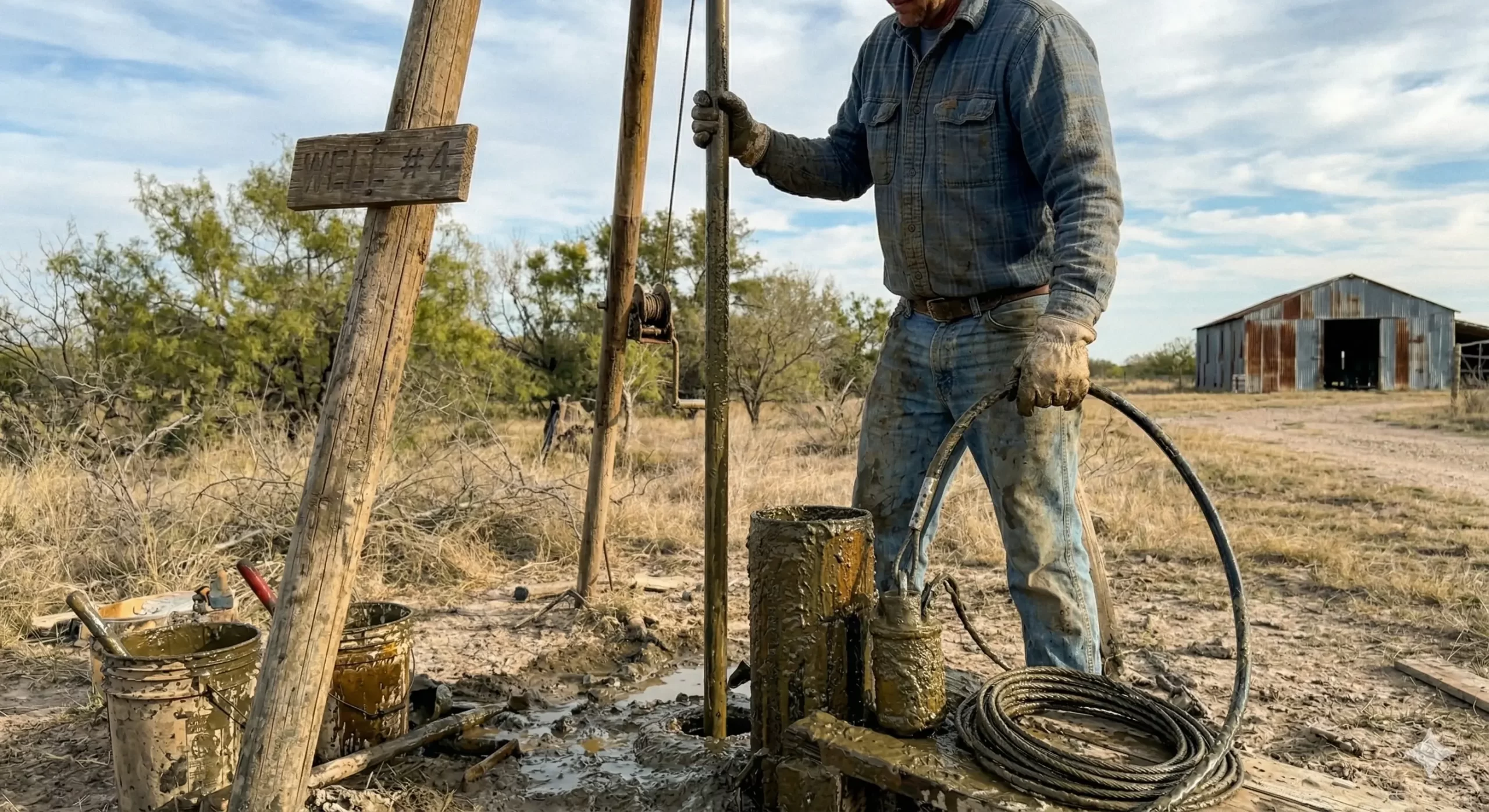
A proper well pump replacement requires a specialized service rig, often a crane truck or a dedicated pump hoist, to safely pull hundreds of feet of pipe & wiring. We also need heavy-duty pipe wrenches, safety equipment, new pitless adapters if needed, and of course, a new pump, motor, and often pressure switch & gauge. Electrical work to tie into the existing system is also standard.
Spring Well Maintenance in Texas
Heavy spring rains can cause surface runoff to breach well caps. We strongly recommend testing your water for coliform bacteria and inspecting the sanitary seal.
Save $500+ on Replacements
Via the TX Energy Co-op VFD Upgrade Program
77°F in Hallettsville
Local Aquifers & Geology
The primary groundwater sources in Hallettsville include the The primary source for most domestic wells in the Hallettsville area is the Gulf Coast Aquifer, specifically the Catahoula and Oakville formations. The Catahoula is known for its volcanic ash content, which can contribute to higher total dissolved solids (TDS) and occasionally uranium. The Oakville formation, on the other hand, is generally a sandier unit that often yields water of better quality, though still prone to hardness and iron. Both are confined aquifers, meaning the water is under pressure, and they are recharged primarily through rainfall and streamflow where they outcrop.. Drilling through the local The Hallettsville area primarily features soils derived from the Gulf Coastal Plain, including fine sandy loams, loamy sands, and clay loams. These soils are generally well-drained but can vary significantly. In some areas, particularly closer to river bottoms or certain geological formations, you’ll encounter heavier, expansive clays, often referred to as ‘blackland’ or ‘gumbo’ soils, which can present challenges for well pad stability and trenching. Subsurface, caliche is a common impediment to drilling & excavation. means that average well depths range from 200 ft – 600 ft.
Due to these geological factors, local homeowners frequently struggle with Sand abrasion on impellers & motor casings, followed closely by hard water mineral buildup that restricts flow and scales internal pump components, causing motors to overheat. Lightning strikes are also a frequent culprit for control box and motor failures during our intense summer storms..
Drilling Depth Comparison
Deeper wells require heavy-duty crane hoists for pump extraction.
Climate & Water Quality
Pump systems in the Hallettsville area face severe environmental stressors. The most significant threat is Our hot, humid Texas summers contribute to increased water demand, which can stress pumps, especially if groundwater levels drop during droughts, forcing pumps to work harder. The frequent, intense thunderstorms bring power surges & lightning, which are notorious for frying pump motors, control boxes, & pressure switches. During drier periods, lower water tables can expose pump intakes to more sediment, leading to premature wear.
Additionally, the raw groundwater often presents issues with Hardness (calcium & magnesium), iron, & occasional sulfur (rotten egg smell) are common. Sand and sediment can also be an issue, especially in older wells or those drawing from shallower, less consolidated formations. High manganese is also present in some areas..
Regional Groundwater Advisory
Known primary contaminant threat to submersible pumps and pipes in this area:
Common Area Systems
VFD Upgrade Savings
Constant Pressure vs StandardReplacing a standard single-speed pump with a Variable Frequency Drive (VFD) eliminates hard starts and drastically reduces energy draw in Texas.
Compliance & Local Permits
Lavaca County Level: The Lavaca County Underground Water Conservation District (LCUWCD) is responsible for managing groundwater resources here. Any new well construction, deepening, or major alteration requires a permit from the LCUWCD. This includes providing well spacing information (to prevent interference with neighboring wells), estimated pump rates, & ensuring compliance with district rules aimed at conserving the aquifer. It’s crucial to check with them before starting any significant well project; failing to do so can result in fines & require retrofitting. They also have rules regarding well plugging.
Top Pump Brands in Texas
Most frequently installed hardware based on local geology (2026 data).
- Check motor amperage & voltage against manufacturer specifications.
- Inspect pressure tank pre-charge & bladder integrity.
- Verify pressure switch cut-in & cut-out settings.
- Test for proper grounding & insulation of pump wiring.
- Examine wellhead for proper sealing, security, & sanitary condition.
- Measure static & pumping water levels if possible, to assess aquifer health & pump performance.
Premium Well Pump Brands We Service
Our licensed technicians in Hallettsville are certified to repair, replace, and install high-quality groundwater equipment from industry-leading manufacturers, including:
- No water at all, often accompanied by the pump trying to run constantly or not at all.
- Low water pressure throughout the house, especially when multiple fixtures are in use.
- Water pump cycling on & off too frequently (short cycling).
- Murky, sandy, or discolored water coming from the tap.
- Unusual noises coming from the wellhead, pump, or pressure tank.
- Spiking electricity bills without a clear reason, indicating an inefficient or failing pump motor.
Hallettsville Real Estate Well Regulations
Local Dispatch & Response Times
Live Dispatch: Texas
Updated Just Now⚠️ High demand. Call now to secure the next available technician.
- Typically within 24-48 hours for complete loss of water, depending on current workload & technician availability.
- More complex issues requiring specialized parts might extend this slightly.
- We prioritize calls for homes with no water, especially those with vulnerable residents.
- During peak season (summer) or after major storms, response times can sometimes be a bit longer.
- Always call directly; online inquiries might have a delay in processing.
⚠️ Lavaca County & State Regulatory Warning: Abandoned Wells
The Cost of Ignoring Symptoms
Fixing a short-cycling pump early saves thousands in Hallettsville.
Data reflects average well contractor estimates in Hallettsville.
Groundwater Threat Level
Current aquifer and mineral impact on pumps in Hallettsville.
Dropping water tables cause pumps to suck air and overheat.
Hard water calcifies pump impellers, reducing lifespan.
Pump Lifespan Estimator
Select household size in Hallettsville to see strain impact.
Local Hallettsville
Well Pros
Fast Local Service & Diagnostics
Calls are routed to a licensed local well professional.
Septic System Services in Hallettsville, TX
Do you have a septic tank on your property? Proper maintenance is critical to protecting your well water quality.
Hallettsville Homeowner Feedback
“Had a pump go out right before Thanksgiving. Called ’em up & they had a crew out that same day. Got us fixed up quick so we could cook for the family. Good folks.”

Local Homeowner
✓ Verified TX
“Our well pump started acting real funny, just kinda sputtering & then completely quit on us. Called these guys and they came out, pulled the old pump, and found the impellers were totally shredded by sand, and the motor had burnt out trying to push against it. The fella, Mark, was super thorough. He explained everything, recommended a better heavy-duty submersible, and even checked our pressure tank. He replaced the old worn-out pittless adapter too. It’s been working perfect ever since. Really appreciate the honest work; you don’t see that much anymore. Plus, they were really polit.”

Local Homeowner
✓ Verified TX
“Lost water in the middle of the night. Figured it was a goner. Called ’em first thing in the morning, & they were here by lunch. Had us back up & running before supper. Lifesavers when you live out here in the country!”

Local Homeowner
✓ Verified TX
Expert Hallettsville Well System FAQ
My water suddenly turned cloudy & sandy, but my pump is still running. What could be going on?
This often indicates an issue with the well itself, rather than just the pump. It could mean the well screen is deteriorating or clogged, allowing sediment to enter the well. Sometimes it’s a cracked casing or a falling water table, which exposes the pump intake to looser formations. It might also be a sign that the pump itself is starting to fail and is pulling in more sediment than usual. We’d need to pull the pump to inspect the well casing & screen, and assess the pump’s condition. Running a pump with excessive sand can quickly destroy it.
I’m getting a rotten egg smell from my well water in Hallettsville. Is this common, & what can be done?
Yes, the “rotten egg” smell, caused by hydrogen sulfide gas, is fairly common in some parts of Lavaca County due to specific geological formations. While generally not harmful in small amounts, it’s unpleasant. The most common solutions involve water treatment. This could range from installing a simple carbon filter to more advanced systems like aeration, chemical oxidation (using chlorine or hydrogen peroxide), or an activated carbon filtration system designed for hydrogen sulfide removal. The best approach depends on the concentration of hydrogen sulfide & other water quality parameters, so a water test is always the first step.
How often should I have my well pump system inspected or serviced, especially with our hard water?
Given the challenging water conditions in Hallettsville with prevalent hard water, iron, & occasional sand, we recommend a professional inspection of your well system every 3-5 years. This allows us to check pump performance, pressure tank function, electrical components, & assess water quality trends. Proactive maintenance can identify minor issues before they become major, costly breakdowns. For systems with significant iron or hardness, annual water quality testing & inspection of any water treatment equipment is wise.
My old well casing looks pretty rusty at the surface. Is that a big deal, or just cosmetic?
While some surface rust might seem cosmetic, it can be an indicator of deeper issues, especially in older steel casings. Rusting at the surface suggests potential corrosion below ground, which could eventually lead to holes or structural failure of the casing. A compromised casing can allow contaminated surface water to enter your well or lead to sediment intrusion, affecting both water quality & pump longevity. It’s crucial to have a professional inspect the wellhead & potentially use a downhole camera to assess the casing’s integrity. Sometimes, a protective casing extension or repair sleeve can mitigate further damage.
Hallettsville Groundwater Expert AI
What are the specific groundwater regulations, average well depths, and the local conservation district for Hallettsville, Lavaca County?
Groundwater Regulations and Residential Wells in Hallettsville, Lavaca County, TX (2026)
As a Senior Hydrogeologist and local groundwater regulatory expert for Texas, I can provide you with precise information regarding residential water wells in Hallettsville, Lavaca County, for the year 2026. It's crucial to understand both state-level oversight and local district regulations.
1. Local Groundwater Conservation District (GCD)
For Hallettsville and all of Lavaca County, the designated groundwater regulatory authority is the Lavaca County Groundwater Conservation District (LCGCD). This district is empowered by the Texas Legislature under Texas Water Code Chapter 36 to develop and implement rules to manage groundwater resources within its jurisdiction.
- LCGCD Website (Realistic URL): https://www.lavacacountygroundwater.org (You should visit their official site for the most up-to-date rules and forms).
2. Specific Groundwater Regulations
Residential water well owners in Hallettsville must comply with regulations from both the State of Texas and the Lavaca County GCD.
A. State-Level Regulations (Texas Department of Licensing and Regulation - TDLR)
- Well Driller Licensing: All water well drilling, deepening, or plugging in Texas must be performed by a licensed water well driller and pump installer regulated by the Texas Department of Licensing and Regulation (TDLR). This is mandated by Texas Occupations Code Chapter 1901.
- Well Registration/Reporting: Licensed drillers are required to submit a "Drillers Log and Water Well Report" to the TDLR and the LCGCD within 60 days of completing a well. This ensures wells are properly recorded.
- Well Plugging: Abandoned or deteriorated wells must be properly plugged by a licensed driller to prevent contamination of groundwater, as per TDLR rules (16 TAC Chapter 76).
- TDLR Well Driller Database (Realistic URL): You can verify a driller's license and search for existing well logs at https://www.tdlr.texas.gov/LicenseSearch and https://www.twdb.texas.gov/groundwater/data/wellreports/index.asp.
B. Lavaca County Groundwater Conservation District (LCGCD) Regulations
The LCGCD has specific rules governing well permitting, spacing, and construction for groundwater wells within its boundaries. Even for residential wells used for domestic and livestock purposes, certain regulations apply:
- Well Registration & Permitting: While most GCDs exempt *small domestic and livestock wells* (typically pumping less than 25,000 gallons per day, which covers most residential wells) from full operating permits and production fees, they still require registration. The LCGCD, under its current rules, requires all wells, including domestic and livestock wells, to be registered and to obtain a drilling permit prior to construction. There may be specific forms for "Exempt Well Registration" or "Drilling Permit for Exempt Wells."
- Well Spacing Requirements: The LCGCD has rules regarding minimum distances between new wells and existing wells, property lines, and potential contamination sources (e.g., septic systems). These rules are designed to prevent excessive drawdown and protect water quality. You would need to consult the LCGCD's current rules for specific setback distances, which often vary based on well type and aquifer.
- Well Construction Standards: The LCGCD often adopts or supplements TDLR well construction standards to ensure wells are built to prevent contamination and ensure longevity. This includes requirements for casing, cementing, and surface completion.
- LCGCD Rules (Realistic URL): Specific rules and permit applications are available on their website, typically under sections like "Rules" or "Permits": https://www.lavacacountygroundwater.org/rules-and-forms.
3. Average Well Depths in Hallettsville
Based on historical state well logs for residential wells in the Hallettsville area of Lavaca County, the average well depth can vary significantly depending on the target aquifer zone and desired yield. However, for a typical residential well targeting the upper to mid-sections of the Gulf Coast Aquifer system for a reliable supply, an estimated average depth is around 325 feet.
- Residential wells in the area commonly range from 250 to 450 feet deep. Deeper wells (400-600+ feet) may be drilled to access more prolific water-bearing sands or to ensure a more consistent supply during drought conditions.
4. Specific Aquifer Beneath Hallettsville
Hallettsville, Lavaca County, is located over the Gulf Coast Aquifer System. This complex aquifer system is composed of several regionally significant sands and clays, primarily including the:
- Chicot Aquifer: The shallowest and uppermost portion.
- Evangeline Aquifer: Underlies the Chicot.
- Jasper Aquifer: Underlies the Evangeline, typically deeper and often yields higher quality water.
Residential wells in Hallettsville typically draw water from the Chicot and Evangeline aquifers, with some potentially extending into the Jasper Aquifer for improved yield or water quality. These are primarily unconfined to confined sand and gravel aquifers.
It is highly recommended to contact the Lavaca County GCD directly and a licensed local well driller to discuss your specific needs and the most current regulations and conditions for your property.
Fast Local Service & Diagnostics
Calls are routed to a licensed local well professional.
Blix
provides official
Emergency Well Pump Repair services for the
Hallettsville
area.