
Diagnosis: A slow blinking red light on your SymCom PumpSaver or MotorSaver indicates a critical ‘Dry Well’ or undercurrent fault. This occurs when the well water level drops below the pump intake, causing the motor to run without load and triggering the protective shutdown. The solution involves letting the well recharge and potentially having a professional lower the pump.
In this Guide:
What Causes the SymCom Blinking Red (Slow) Issue?
The slow, blinking red light on a SymCom PumpSaver is a specific fault condition indicating ‘Undercurrent,’ which is almost universally caused by the pump running in a dry well. From an engineering perspective, the PumpSaver is an intelligent electronic overload relay that continuously monitors the amperage (current) drawn by the pump motor. The amount of current a motor draws is directly proportional to the mechanical load it is under. For a centrifugal pump, the ‘load’ is the mass of the water it is moving. When the well is full of water and the pump is pushing it uphill into a pressure tank, the motor is heavily loaded and draws a predictable amount of current, known as the Full Load Amps (FLA). If the water level in the well drops below the pump’s intake screen, the pump is no longer moving water; it’s spinning freely in air. This drastic reduction in mechanical load causes the motor’s current draw to plummet, falling significantly below the calibrated ‘underload’ setpoint on the PumpSaver. The device correctly interprets this as a dangerous dry-run condition and immediately de-energizes the motor to prevent catastrophic damage.
Allowing a submersible pump to run dry, even for a few minutes, initiates a cascade of destructive events. Water serves two critical, non-negotiable functions beyond being the pumped medium: it is the primary coolant for the motor and the exclusive lubricant for the pump’s internal components. Without the flow of water past the motor’s housing, the heat generated by the motor windings cannot dissipate. This causes the internal temperature to rise rapidly, potentially exceeding the thermal limits of the winding’s enamel insulation. This thermal stress can cause the insulation to crack and fail, leading to short circuits between windings or a fault to ground, which permanently destroys the motor. Simultaneously, inside the pump end (the ‘wet end’), the multi-stage impeller and diffuser assemblies rely on the water for lubrication. Without it, the high-speed rotational friction between the thermoplastic impellers and stationary diffusers generates immense heat, causing the components to melt, deform, and ultimately seize the entire rotating assembly.
Furthermore, the internal seals are immediate victims of a dry-run event. The main shaft seal, which prevents water from entering the motor housing, is a precision component that relies on a microscopic film of water between its lapped faces (typically ceramic and carbon) for both lubrication and cooling. When run dry, these faces grind against each other, generating intense localized heat that can shatter the ceramic or melt the elastomeric components holding them in place. This compromises the seal integrity permanently. Even if water returns to the well, a damaged seal will now allow well water to enter the motor housing, contaminating its cooling fluid, shorting out the windings, and guaranteeing a complete motor failure. The PumpSaver’s undercurrent trip feature is therefore not a nuisance; it is the essential guardian preventing a multi-thousand-dollar equipment replacement.
DIY Troubleshooting Steps
- Confirm the Fault and Observe the Controller: Do not immediately reset the breaker. Approach the pump control panel and verify the fault code. A slow, rhythmic red blink (approximately once per second) specifically indicates an undercurrent/dry well fault. Check the dial for the ‘Restart Delay’ setting. This is the mandatory waiting period the controller will enforce before attempting another start cycle. A typical setting is 30 to 240 minutes. This is your well’s required recovery time.
- Perform a Calculated Power Cycle: Turn off the two-pole breaker supplying the pump controller for at least 5 minutes to allow all control logic to reset. Turn it back on. Listen carefully. The pump should attempt to start. If it runs for a short period (3-10 seconds), you hear water moving, and then it trips again on the same slow red blink, you have confirmed the controller is working correctly and the water level in the well is too low.
- Analyze Recent Water Demand: Scrutinize your water usage over the last 24-48 hours. Have you been running irrigation systems for an extended period, filling a swimming pool, or do you have a known leak (like a running toilet or a faulty livestock waterer)? A sudden, sustained high demand can easily exceed your well’s yield, or its rate of natural recharge, leading to a temporary drawdown condition.
- Inspect Pressure Tank and Switch: While not the root cause, a faulty pressure system can worsen a drawdown issue. Ensure your pressure tank has the correct air pre-charge (typically 2 PSI below the pressure switch’s cut-in setting). Check that the pressure switch contacts are clean and not arcing, which could cause the pump to cycle rapidly and deplete the well’s available water more quickly.
- Amperage Reading (Qualified Personnel Only): If you are trained and equipped with a clamp-on ammeter, you can verify the fault electrically. With the system energized, clamp one of the motor leads (T1 or T2). When the pump starts, you will see a brief inrush current, followed by a normal running current. As the pump evacuates the remaining water and begins to cavitate, you will see the amperage drop sharply right before the PumpSaver trips. This is a definitive confirmation of the undercurrent fault condition. WARNING: This involves exposure to live 240V terminals and should not be attempted by untrained individuals.
- The Ultimate DIY Test – The Overnight Wait: The most reliable and safest check is to turn the pump breaker off completely and leave it off for several hours, preferably overnight. This allows maximum time for the aquifer to replenish the well. Upon turning it on the next morning, if the pump runs for a full cycle and builds pressure normally, you have unequivocally confirmed that your issue is an insufficient well yield for your demand.
When to Call a Professional Well Service
Upon arrival, a professional technician’s first step is to perform a definitive electrical diagnosis at the control panel before ever touching the wellhead. They will verify the fault code and then disconnect the power and isolate the motor leads from the controller. Using a megohmmeter (often called a ‘megger’), they will conduct an insulation resistance test. This specialized instrument applies a high DC voltage (typically 500V or 1000V) to the motor windings and measures any current leakage to ground. A reading of many megaohms indicates healthy insulation, while a low or zero reading signifies a critical failure in the motor’s windings or the submersible cable. Following the megger test, they will use a multimeter capable of reading low resistance to check the phase-to-phase resistance of the motor windings. The readings between all three phases must be nearly identical; any significant deviation points to an internal short or open winding, condemning the motor. This comprehensive electrical health check prevents the costly mistake of pulling a pump only to find the problem was elsewhere.
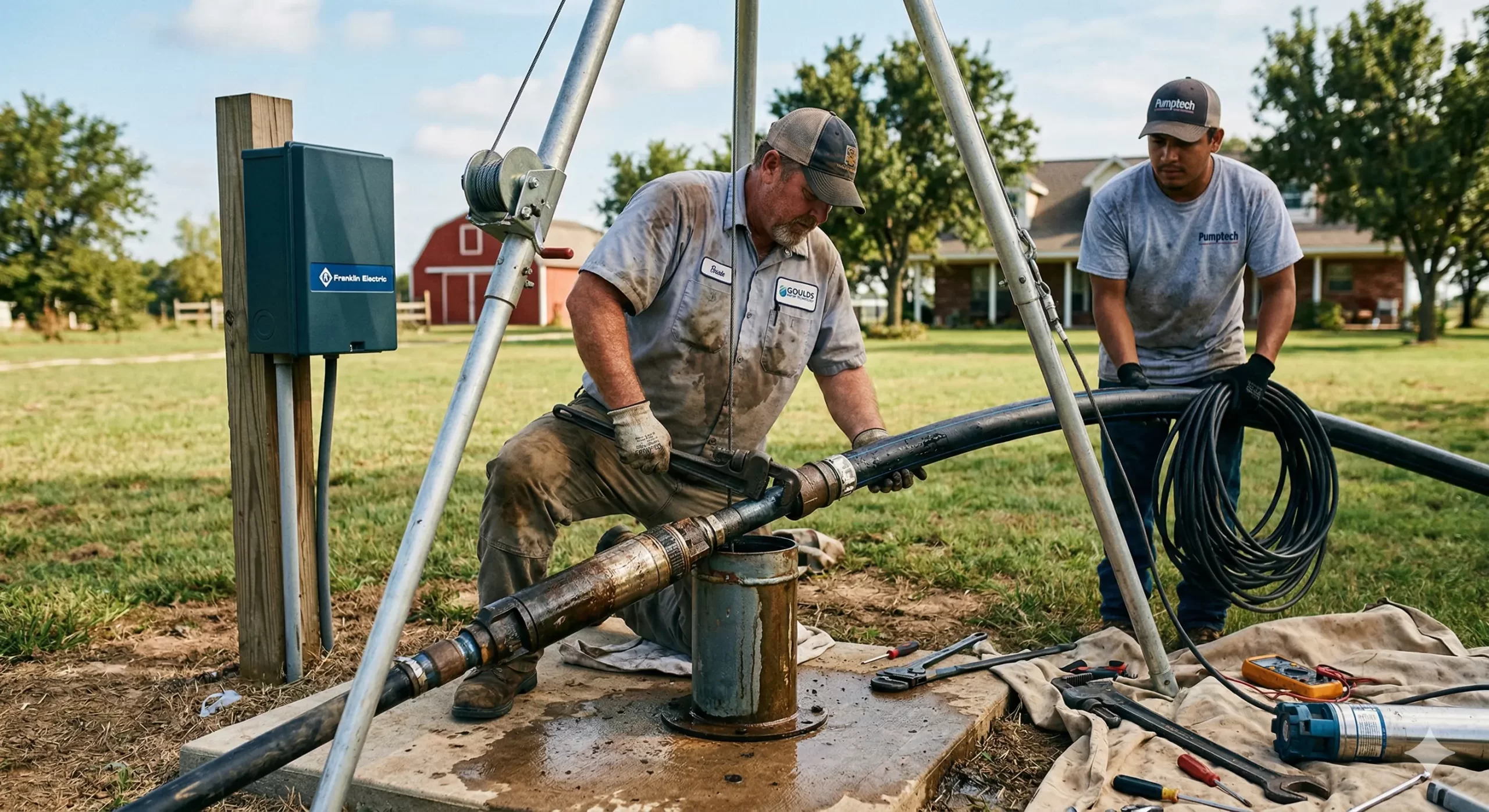
Once a downhole issue is confirmed, the process of pulling the pump begins. This is a hazardous operation that demands specialized equipment. A submersible pump, drop pipe full of water, and cable can weigh 300-800 lbs or more. The technician will use a dedicated pump hoist or crane rig, which provides the mechanical advantage and control necessary to lift the assembly safely. After removing the well cap, they will insert a pitless adapter key—a long T-handle tool—down the casing to engage with the pitless adapter. This allows them to disengage the pump assembly from the well’s main plumbing and lift it straight out. The hoist is used to methodically pull the drop pipe, cable, and pump from the well, with a second technician managing the pipe and wire to prevent them from kinking, abrading on the casing, or falling back into the well, which could cause catastrophic damage.
With the pump on the surface, a full physical inspection and well assessment can be performed. The pump’s intake screen will be checked for blockage from sediment or scale. The technician will then use a calibrated electronic water level sounder to get a precise measurement of the current static water level and the total well depth. By comparing the static level to the length of the drop pipe removed, they can determine the severity of the drawdown. If there is sufficient well depth below the current pump setting, the solution may be as simple as adding one or more lengths of drop pipe to lower the pump deeper into the water column. If the pump is already near the bottom or the well is simply ‘silted in,’ a discussion about well cleaning, hydro-fracturing to improve yield, or managing water usage is necessary. After any repairs or adjustments, the pump is carefully re-installed, the pitless adapter is re-seated, and the system is sanitized and tested.
Safety Protocol: All work is performed after the main circuit breaker has been de-energized, locked out, and tagged out. The significant weight of the pump assembly presents a crushing hazard, mandating the use of a mechanical hoist and proper rigging techniques. The risk of dropping tools or the entire pump assembly down the well, potentially destroying the well itself, requires a methodical and professional approach at all times.
Repair Cost & Time Assessment
The cost for diagnosing and repairing a dry well fault can vary significantly, typically ranging from $450 to over $3,000. The initial service call, which includes travel time and the first one or two hours of on-site electrical diagnostics with a megohmmeter and multimeter, will generally cost between $175 and $400. If diagnostics confirm the issue is in the well, the next major expense is the labor and equipment for pulling the pump. The use of a specialized pump hoist rig alone often adds $400 to $900 to the invoice, depending on the region and pump depth. Labor is typically billed at $125 to $200 per hour for a two-person crew, which is standard for this type of work.
If the solution is simply to lower the existing pump by adding a section of drop pipe and wire, the total cost might land in the $800 to $1,500 range. However, if the dry-running has damaged the pump or motor, a full replacement is required. A quality 4-inch residential submersible pump and motor can cost between $900 and $2,500 for parts alone, pushing the total project cost (including labor and the pump pull) into the $2,500 to $4,500+ bracket. The customer is paying not just for parts and time, but for the technician’s diagnostic expertise, the investment in thousands of dollars of specialized tools (hoist, megger, sounder), and the liability insurance necessary to cover high-risk work involving high voltage electricity and heavy suspended loads.
In terms of time, a simple diagnostic call may take 1-2 hours. A standard pump pull, pump lowering, and re-installation on a 300-foot well can take a two-person crew 3-5 hours. If a full pump replacement is needed, including wiring a new heat-shrink splice and potentially replacing the drop pipe, expect the job to take 5-8 hours, often consuming the better part of a full day.
Fast Local Service & Diagnostics
Calls are routed to a licensed local well professional.