
Diagnosis: A solid red light on a SymCom PumpSaver indicates severe rapid cycling, where the pump starts and stops too frequently. This is almost always caused by a failed hydro-pneumatic pressure tank (waterlogged) or a significant leak in the drop pipe, leading to a loss of system pressure.
In this Guide:
What Causes the SymCom Solid Red (Горит постоянно) Issue?
The solid red fault on a PumpSaver or MotorSaver unit is a critical alert signifying a ‘Rapid Cycling’ condition. From an engineering perspective, this means the pump motor is being commanded to start and stop more frequently than its design allows, typically multiple times per minute. The root cause is a failure in the system’s ability to store pressurized water. The most common culprit is a ruptured bladder or diaphragm within the hydro-pneumatic pressure tank. This failure allows the tank to become ‘waterlogged,’ eliminating the compressed air cushion that is essential for smooth operation. Without this air cushion to absorb pressure changes, any small use of water causes an immediate pressure drop, forcing the pressure switch to engage the pump. As soon as the pump starts, the pressure spikes instantly, disengaging the switch. This destructive on/off pattern is what the PumpSaver correctly identifies as a system-endangering fault.
This incessant cycling inflicts severe mechanical trauma on the entire pump assembly. Every startup subjects the motor and pump shaft to immense torsional stress and axial thrust, violently hammering the thrust bearings. These bearings are designed for sustained runs, not a series of high-torque jolts. Continuous hammering leads to accelerated wear, bearing race damage (brinelling), and eventual seizure of the rotating assembly. Furthermore, the constant, rapid pressure fluctuations can compromise the pump’s internal mechanical seals. These seals rely on stable pressure and lubrication to prevent water from entering the oil-filled motor housing. The vibration and pressure shocks from rapid cycling can cause these seals to unseat or wear unevenly, leading to catastrophic motor failure via water ingress.
Electrically, the damage is just as severe and is precisely what the PumpSaver is designed to prevent. A motor draws an immense ‘inrush current’ upon starting—up to 600% of its normal running load amperage. This surge generates a significant amount of heat in the motor windings. In normal operation, the motor runs long enough for its cooling mechanisms to dissipate this startup heat. During rapid cycling, the motor never reaches a stable operating state. It endures one heat-generating inrush current event after another with insufficient time to cool down. This cumulative thermal stress degrades the lacquer insulation on the copper windings, leading to a ‘dielectric breakdown’—an internal short circuit between windings or to the motor casing. The PumpSaver senses these repeated, high-amperage events in quick succession and trips the solid red fault to interrupt power, acting as a final safeguard against the thermal destruction of the motor.
DIY Troubleshooting Steps
- SAFETY FIRST: De-energize the Circuit. Before touching any component, locate the two-pole circuit breaker for the well pump in your main electrical panel and switch it to the full OFF position. Verify with a non-contact voltage tester at the pressure switch that all power is off. This is a 240V system and is extremely dangerous.
- Perform a Pressure Tank ‘Tap Test’. With the system still pressurized, carefully tap on the top and bottom of the metal pressure tank with your knuckle. A properly functioning tank should sound hollow on top (where the air cushion is) and solid on the bottom (where the water is). A waterlogged tank will sound solid and dull all the way up.
- Check the Tank’s Air Pre-charge. With the pump breaker still OFF, open a nearby faucet to completely drain the water system until the flow stops. Locate the air valve on the tank (usually on top, like a car tire valve). Use a reliable tire pressure gauge to check the pressure. It should be exactly 2 PSI below your pressure switch’s cut-in setting (e.g., a 40/60 PSI switch requires a 38 PSI pre-charge). If it’s very low or water comes out of the valve, the tank’s internal bladder has failed.
- Monitor the Cycle Time Under Load. If the tank pressure seems correct, you may have a leak. Turn the breaker back on and have someone open a single faucet inside the house. Using a stopwatch, time the pump’s ‘on’ cycle and ‘off’ cycle. A healthy system should run for at least 60 seconds to replenish the tank’s drawdown capacity. If the pump is turning on and off every 5-15 seconds, you have confirmed a rapid cycle condition.
- Inspect the Thermal Overload Reset. Examine the pump control box (if one is present separate from the PumpSaver). Some have a manual red reset button for a thermal overload. Ensure this button is pressed in and not tripped. While this is rarely the root cause of this specific fault, it is an essential diagnostic check.
- Listen for Leaks and Air Sputtering. While the pump is running, listen carefully near the wellhead for any sound of running water, which could indicate a leak in the pitless adapter or buried service line. Also, note if faucets ‘sputter’ with air when first opened, a classic sign of a leak in the drop pipe inside the well casing.
When to Call a Professional Well Service
Upon arrival, a professional technician will first confirm the homeowner’s diagnosis using calibrated pressure gauges and an ammeter. The first step is to verify the pressure tank’s pre-charge and drawdown capacity. If the tank is confirmed to be waterlogged, it will be isolated, depressurized, and replaced. However, if the tank is functional, the focus shifts to a downhole problem. The technician will then perform an insulation resistance test using a megohmmeter (often called a ‘Megger’). This instrument applies a high voltage (500V-1000V) to the motor windings to test the integrity of their insulation. A reading below 1 megohm to ground indicates a serious insulation failure, likely caused by the heat of rapid cycling, and means the motor is compromised.
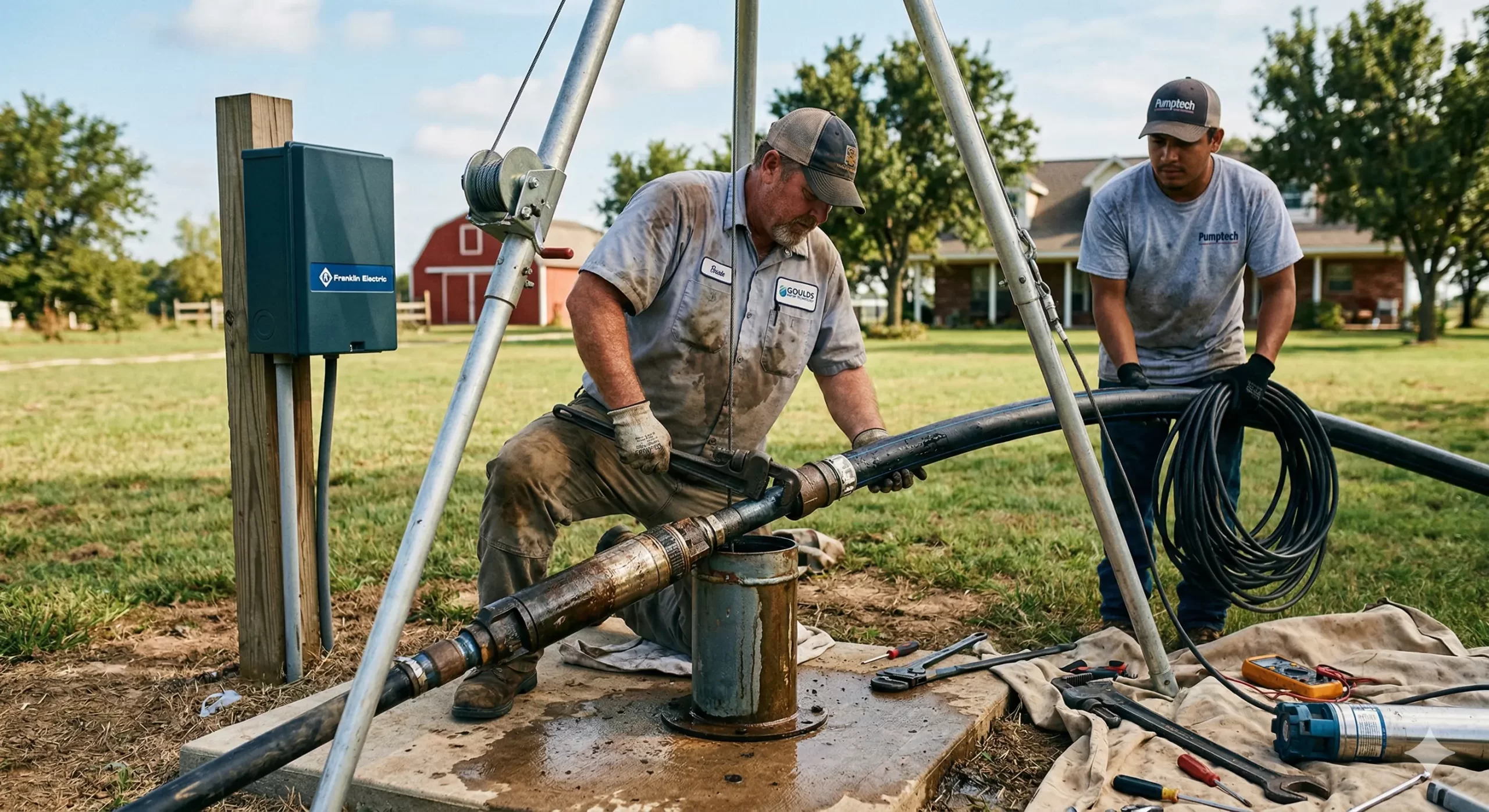
If the megohmmeter test passes but symptoms point to a downhole leak, the pump must be pulled. This is a non-negotiable task for professionals with specialized equipment. A submersible pump, drop pipe full of water, and heavy gauge power cable can have a combined weight of 300 to 1000+ pounds. Attempting to lift this by hand is impossible and incredibly dangerous. The technician will set up a dedicated pump hoist or a specialized pulling rig over the well casing. They will then use a T-handle pitless adapter key, a long tool lowered into the well, to engage the pitless adapter and disengage the entire pump assembly from the water line connected to the house. This allows the pump to be hoisted straight up and out of the well without any excavation.
Once the pump is at the surface, a thorough inspection begins. The technician will meticulously examine every section of the drop pipe for stress cracks, abrasion marks, or holes. They will also inspect the submersible wire for any chafing against the well casing and test the integrity of the waterproof heat-shrink splices connecting the pump motor leads to the main wire. Check valves, both integrated in the pump and installed in-line, will be tested for proper seating. After replacing the faulty component—be it a section of pipe, the check valve, or the entire pump/motor assembly—the system is carefully lowered back into the well, re-engaged with the pitless adapter, and the well cap is securely sanitized and sealed. A final test of amperage draw, flow rate, and pressure cycle timing ensures the repair was successful.
Safety Protocol: All work on a 240V well system is performed under strict Lockout/Tagout (LOTO) procedures. The breaker is locked in the off position to prevent accidental energization. The heavy lifting is managed with certified hoists and rigging. Technicians are trained to safely handle the stored energy in pressurized tanks and the immense physical weight of the downhole equipment.
Repair Cost & Time Assessment
The cost of resolving a PumpSaver rapid cycling fault varies significantly based on the root cause. For a straightforward pressure tank replacement, the customer can expect to pay for the new tank (typically $250 – $700 depending on size and brand) plus 2-3 hours of labor from a qualified technician. The total cost for this repair usually falls within the $500 to $1,200 range.
If the diagnosis determines the problem is downhole, requiring the pump to be pulled, the costs escalate. This is a two-person job that requires a specialized pump hoist truck or rig. The labor will range from 4 to 8 hours. The total cost for pulling and resetting a pump to replace a faulty drop pipe or check valve typically ranges from $1,500 to $3,000. If the rapid cycling has destroyed the motor, you must also factor in the cost of a new pump and motor assembly ($800 – $2,500+ for premium stainless steel models). In this worst-case scenario, the total repair cost could easily exceed $5,000.
Fast Local Service & Diagnostics
Calls are routed to a licensed local well professional.