
Diagnosis: An F3 Overload Fault on a Flint & Walling Commander VFD indicates the motor is drawing excessive current, typically due to severe mechanical failure. The primary causes are seized pump impellers from mineral buildup (calcium, iron) or advanced internal motor wear. This high-difficulty fault requires professional diagnosis and often a full pump and motor replacement.
In this Guide:
What Causes the Flint & Walling Code F3 Issue?
The F3 Overload fault code on a Flint & Walling Commander VFD is a critical protective measure, not a nuisance trip. It signifies that the drive is detecting a sustained current draw that exceeds the motor’s designated Full Load Amperage (FLA) rating. This is a direct electrical symptom of a severe downstream mechanical problem. The root cause, as identified, is either advanced motor wear or the mechanical seizure of the pump’s rotating assembly (impellers) due to mineral deposits. In either scenario, the motor is being physically forced to work harder, demanding more torque to spin. This increased torque demand translates directly into a higher amperage draw, and the VFD intelligently shuts down the system to prevent catastrophic thermal burnout of the motor windings.
When mineral-rich water (high in calcium carbonate or iron) is present, these deposits precipitate out and form a rock-hard scale on the precision-engineered surfaces of the impellers and inside the diffuser stack. This process, known as encrustation, progressively reduces the tight tolerances between the rotating and stationary parts of the pump’s wet end. The result is a dramatic increase in frictional drag. The motor must now overcome not only the hydraulic load of lifting water but also this intense mechanical friction. The binding can become so severe that the shaft can barely turn, causing the motor to operate in a near-locked-rotor state, which draws immense current and immediately triggers the F3 fault.
In pumps exceeding a decade of service, internal motor degradation becomes the primary suspect. The motor’s thrust bearings, designed to handle thousands of pounds of hydraulic downthrust, eventually wear out, leading to shaft misalignment and increased friction. More critically, the shaft seals can fail, allowing well water to intrude and contaminate the motor’s dielectric oil fill. This contamination compromises the insulation on the copper stator windings. Electrical current begins to leak between windings (a turn-to-turn short), creating a less efficient magnetic field and demanding more amperage to produce the required torque. The VFD detects this inefficiency as an overload, providing a final warning before the insulation fails completely, resulting in a direct short-to-ground and a dead motor.
DIY Troubleshooting Steps
- Safely Measure Amperage Draw: If you are qualified and comfortable working with live 240V circuits, use a quality true-RMS clamp-on ammeter on the motor leads at the control box. Power on the system and observe the current reading. Compare this reading to the Full Load Amps (FLA) listed on the motor’s nameplate. A reading that quickly climbs to and exceeds the FLA rating before the F3 fault occurs confirms a severe overload condition.
- Verify VFD Parameters: Access the F&W Commander’s advanced parameter settings. Ensure that the programmed motor FLA (Parameter P02.01) precisely matches the data on your motor’s nameplate or well completion report. An incorrectly programmed VFD could cause nuisance trips, but this is less likely for an established installation.
- Perform a Hard Power Reset and Listen: Turn the circuit breaker off for at least 5 minutes to allow all capacitors to discharge. Power the system back on. Listen intently at the wellhead during the startup attempt. Any audible grinding, groaning, or humming sounds indicate a seized or struggling pump assembly.
- Inspect All Surface Wiring and Connections: With the breaker OFF (verified with a multimeter), open the control box, pressure switch enclosure, and VFD cover. Look for any signs of overheated wires, melted insulation, loose terminal screws, or corrosion. A poor connection can create high resistance and voltage drop, causing the motor to draw more current.
- Check for External Overload Devices: Some older installations may have a separate, auxiliary motor starter or control box with its own thermal overload reset button. Ensure this device, if present, has not tripped and is correctly sized for the motor.
- Review Well Yield and History: Consider if the well’s static water level has dropped significantly. If a pump is forced to run dry or in cascading water, it can lose cooling and lubrication, leading to overheating and eventual seizure, which will manifest as an F3 overload.
When to Call a Professional Well Service
Upon arrival, a professional technician will validate the F3 fault and immediately proceed to advanced diagnostics to isolate the failure. The primary tool for this is a megohmmeter, or ‘megger’. After safely disconnecting the motor leads at the wellhead, the technician will conduct an insulation resistance test. This test applies a high voltage (typically 500V or 1000V) to measure the resistance between the motor’s power windings and the ground wire. A reading of many megaohms indicates a healthy motor; a reading below 1-2 megaohms confirms a catastrophic insulation failure. This test definitively proves the problem is with the downhole motor or its wiring, eliminating the VFD or surface controls as the cause.
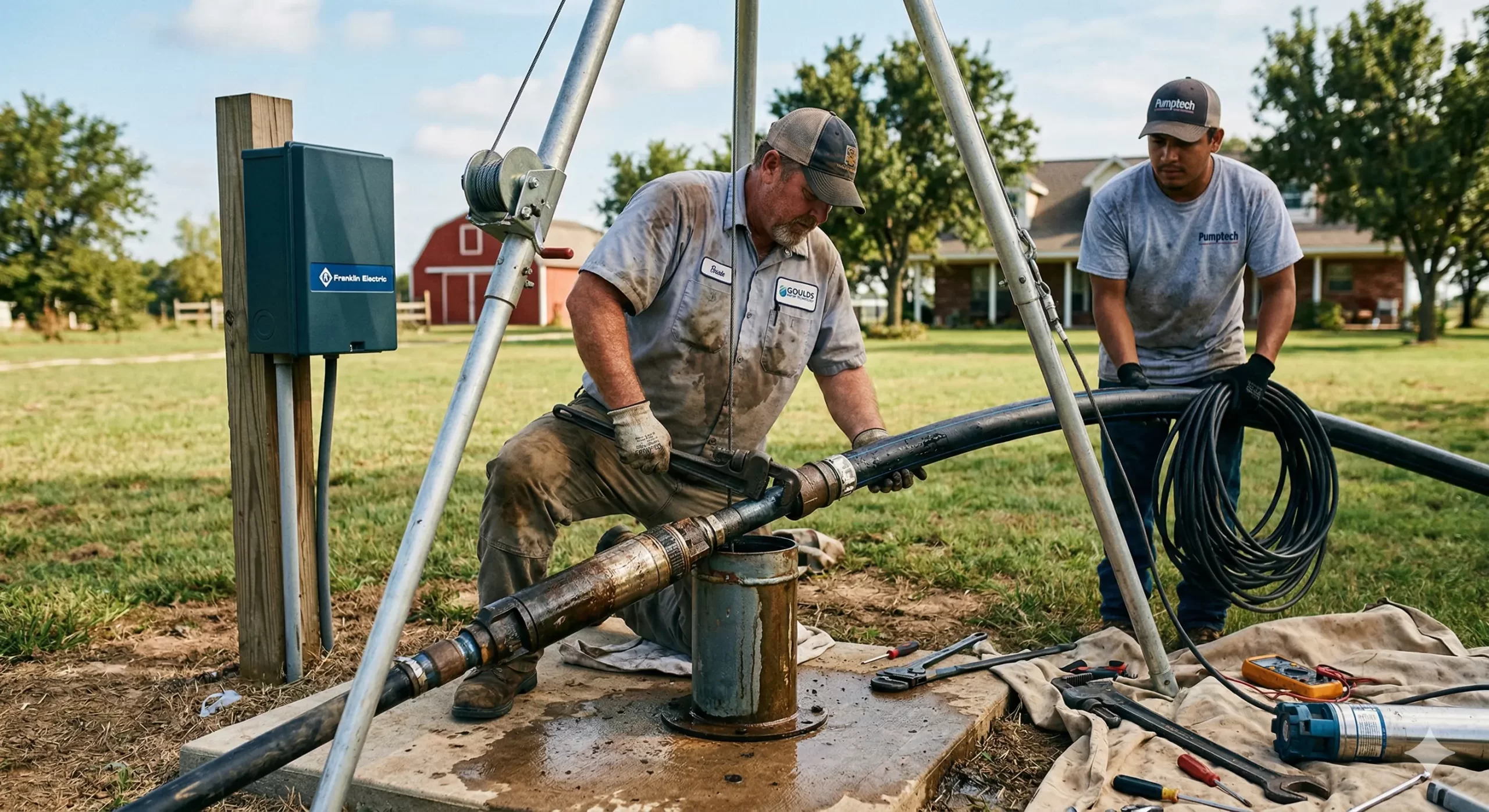
Once the motor is condemned, the pump must be pulled (‘Подъем насоса’). This is a high-risk operation requiring specialized equipment and is not a DIY task. A portable pump hoist or a dedicated pulling rig is positioned over the well. The immense weight of hundreds of feet of water-filled pipe, the pump, motor, and cable (often exceeding 500 lbs) makes manual lifting impossible and extremely dangerous. The technician uses a pitless adapter T-handle key to latch onto the assembly deep inside the well casing and disengage it. The hoist then carefully lifts the assembly, while a second technician manages the pipe and cable, disconnecting 20-foot sections of drop pipe one at a time until the pump reaches the surface.
Safety Protocol: All work begins with strict Lockout/Tagout (LOTO) procedures at the circuit breaker to ensure the system cannot be accidentally energized. Technicians use insulated hand tools and wear appropriate personal protective equipment (PPE). The rigging and hoisting equipment must be rated for the load and inspected before each use. A failed splice or dropped pipe can not only destroy the well but also cause severe injury. Once on the surface, a physical inspection confirms the diagnosis—often, the shaft cannot be turned by hand, indicating a complete seizure. For any unit over 10 years old, the standard professional practice is a complete replacement of both the motor and the pump wet end. A new, waterproof heat-shrink splice is meticulously constructed, and the entire assembly is lowered, reconnected, and the system is disinfected and recommissioned.
Repair Cost & Time Assessment
The cost for a professional pump replacement to resolve an F3 fault is significant, typically ranging from $2,500 to $6,000 or more in the United States. This price reflects a combination of high-skill labor, specialized equipment, and premium components. The breakdown generally includes: a service call fee, hourly labor for two technicians (a lead installer and a helper) for 4-8 hours, a fee for the use of the pump hoist rig, and the cost of the new submersible pump and motor unit itself, which varies widely by horsepower, brand, and construction (e.g., stainless steel).
Customers are paying for much more than just parts. The cost covers the expertise to correctly diagnose the problem, the safety protocols to handle high-voltage electricity and heavy suspended loads, and the specialized knowledge to select the correct replacement pump for the well’s specific depth and yield (‘debit’). The price also includes ancillary materials that are critical for a long-lasting repair, such as a new heat-shrink splice kit, new drop wire if the old is compromised, torque arrestors, and potentially a new check valve. The job is typically completed in a single day, restoring water service quickly and with a warranty on parts and labor that guarantees the longevity of the investment.
Fast Local Service & Diagnostics
Calls are routed to a licensed local well professional.