
Diagnosis: The Flint & Walling Commander VFD’s F1 fault code indicates a critical output short circuit, usually caused by a compromised downhole cable, a failed waterproof splice, or a shorted submersible motor. This is a hard fault requiring immediate shutdown to protect the drive. Repair is a high-difficulty task that involves pulling the pump from the well and requires professional diagnosis with specialized equipment.
In this Guide:
What Causes the Flint & Walling Code F1 Issue?
An F1 fault on a Commander VFD is an instantaneous overcurrent trip, specifically triggered by a phase-to-phase or phase-to-ground short circuit on the drive’s output (terminals U, V, W). The drive’s internal Insulated-Gate Bipolar Transistors (IGBTs) detect a near-infinite current draw within microseconds and immediately shut down to prevent catastrophic failure. The most common physical cause is the degradation of the submersible drop cable’s insulation. Over years of operation, the motor’s start-up torque causes the cable to twist and rub against the rough interior of the steel well casing. This ‘casing rub’ eventually wears through the insulation, exposing the copper conductor and causing a direct short to the grounded casing.
A second prevalent cause is the failure of an underwater heat-shrink splice. These splices, which connect the motor’s short lead wire to the main drop cable, are a critical failure point. If the splice was not perfectly clean during installation, or if the heat-shrink tubing was inadequately heated, a microscopic channel can allow water ingress over time. The high-purity, mineral-free water inside a motor is a poor conductor, but well water is rich in conductive minerals. Once this water penetrates the splice, it creates a conductive path between phases or to ground, leading to a high-amperage short circuit that can melt the splice materials and trip the F1 fault.
Internally, the motor itself can be the source of the short. A failure of the main shaft seal assembly can allow well water to enter the motor housing. This water contaminates the dielectric oil or fill fluid, drastically reducing its insulating properties. The motor windings, coated in a thin enamel, can then arc to the motor’s steel housing, creating a phase-to-ground short. This event is violent, often vaporizing a section of the winding and generating significant carbon, which further propagates the short. This type of failure places immense stress on the motor’s thrust bearings and is considered a terminal event for the motor, requiring complete replacement.
DIY Troubleshooting Steps
- SAFETY FIRST – Complete Power Isolation: Before any inspection, locate the main circuit breaker feeding the VFD and pump system. Turn it off and apply a lockout/tagout device. This is a 240V+ system; failure to completely de-energize it can be lethal. Confirm there is no voltage at the VFD’s line-in terminals with a multimeter.
- Visual Inspection (Surface Level): Examine all exposed wiring between the VFD disconnect and the well head cap. Look for signs of rodent damage, chafing from vibrations, or corrosion at the terminal block inside the well cap. Address any obvious external wiring faults.
- Fault Confirmation & VFD Isolation: After a 10-minute cooldown, power the VFD back on. If the F1 code appears immediately without the pump running, the VFD itself may have a failed output module. If it only appears when you command the pump to start, the fault is downstream. To confirm, power off and lock out the system again, then disconnect the three motor leads (U, V, W) from the VFD’s output terminals. Power the drive back on. If you can enable the drive (without the pump connected) and the F1 fault does NOT appear, you have definitively proven the short circuit is in the drop cable or the motor itself.
- Check Grounding Integrity: Verify that the grounding conductor from the VFD chassis to the well head and the main panel ground bus is secure and free of corrosion. A poor ground can sometimes contribute to intermittent faulting, although an F1 is typically a hard, non-intermittent fault.
- DO NOT Repeatedly Reset: It is critical to understand that an F1 fault is the drive protecting itself from extreme current. Each time you attempt to restart the system into a short circuit, you are subjecting the VFD’s power components to immense electrical stress. Resetting the fault more than once or twice for diagnostics risks destroying the drive.
When to Call a Professional Well Service
A professional technician’s first diagnostic step is to use a megohmmeter, or ‘megger’. With the system locked out, the megger is connected to the motor leads at the well head. This instrument applies a high voltage (typically 500V or 1000V) to test the insulation integrity of the drop cable and motor windings. A healthy system will show readings of hundreds or thousands of megaohms. A shorted system, as indicated by an F1 fault, will read near zero ohms to ground, confirming a direct electrical path where one should not exist. This test is non-destructive and definitively confirms the need to pull the pump assembly from the well.
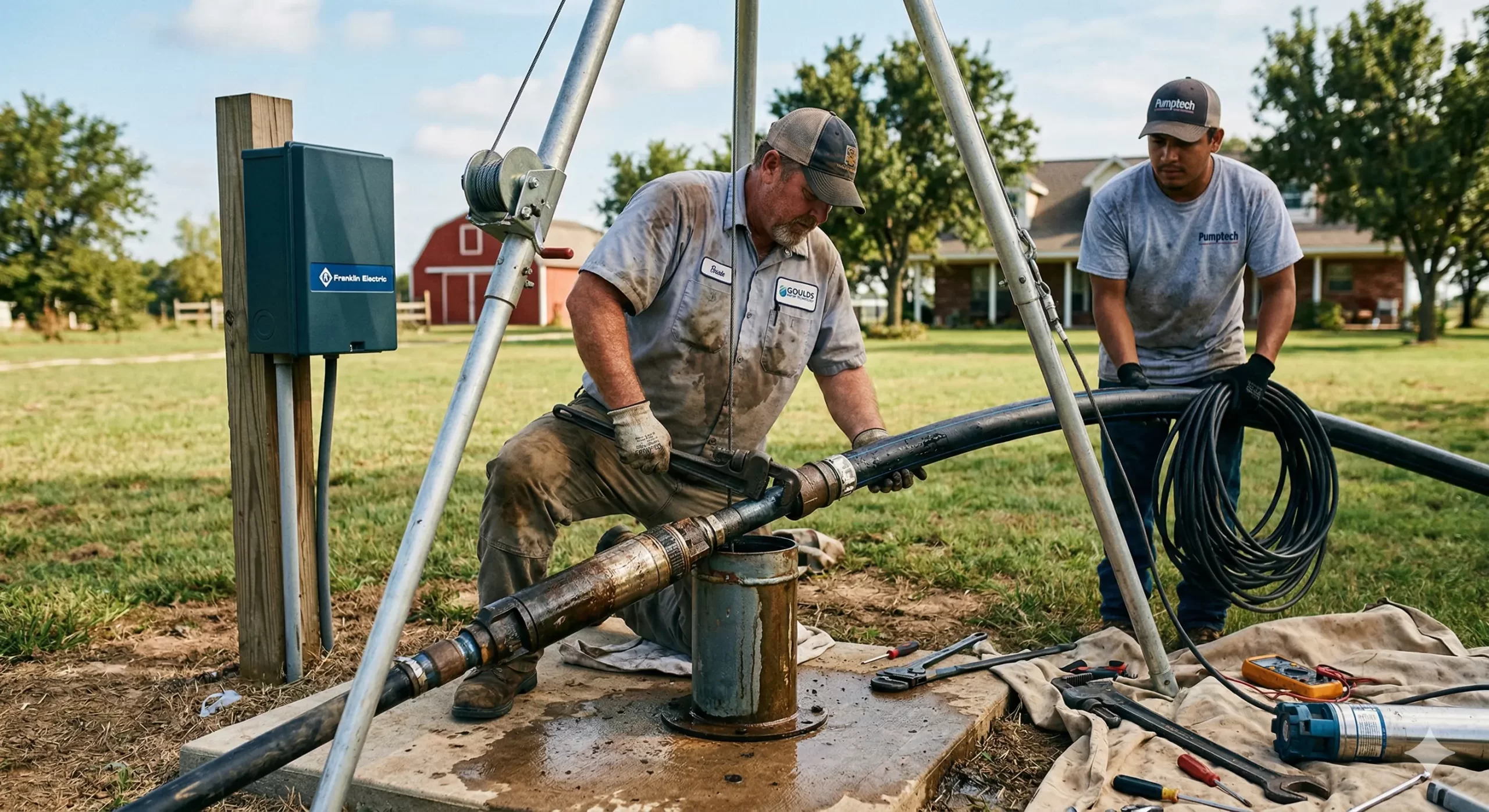
Safety Protocol & Extraction: The extraction process is hazardous and requires specialized equipment. A submersible pump and pipe column can weigh over 500 lbs and is hundreds of feet long. The technician will position a hydraulic pump hoist or a small crane over the well. After removing the well cap, a ‘pitless key’ is lowered and threaded into the pitless adapter inside the casing. This tool allows the technician to safely disengage the drop pipe from the side-wall discharge port and lift the entire assembly. The crew then hoists the column, unthreading sections of pipe (typically 20 feet at a time) and carefully laying them out on the ground alongside the attached power cable. This process prevents injury and avoids dropping the entire pump assembly down the well, which would be a catastrophic and expensive event.
Once on the surface, a thorough visual inspection of the drop cable is performed to locate the abraded section from casing rub. The megger is used again to isolate the fault: the motor is disconnected from the drop cable and each component is tested separately. If the cable is faulty, the damaged section is excised and a new, industrial-grade heat-shrink splice kit is meticulously installed. If the motor itself reads shorted, it is beyond field repair and must be replaced. After the repair or replacement, the entire assembly is tested one last time on the surface before being carefully lowered back into the well, re-engaged with the pitless adapter, and sanitized according to local health codes.
Repair Cost & Time Assessment
The professional repair of a fault causing an F1 code is a significant expense, typically ranging from $1,500 to $4,500 in the United States. The final cost is dictated by several factors: the depth of the well (deeper wells require more labor time and have a higher risk), the accessibility of the well head for the pump hoist truck, and the cost of replacement parts. A typical service call will include a minimum of two technicians for 4 to 8 hours. The largest line items are the labor and the use of the specialized pump hoist rig, which can cost several hundred dollars per hour on its own.
If only a cable repair is needed, costs will be on the lower end of the scale. However, if the submersible motor must be replaced, you can expect to add $600 to $2,000+ to the bill, depending on the horsepower and brand (e.g., Franklin, Grundfos). This is not a ‘flat rate’ repair. The customer is paying for the technicians’ expertise, liability insurance, specialized diagnostic tools like the megohmmeter, and the heavy machinery required to perform the job safely and effectively. Expect the property to be without water for at least a half-day to a full business day.
Fast Local Service & Diagnostics
Calls are routed to a licensed local well professional.