
Diagnosis: An ‘OL’ or open loop reading on a submersible motor winding indicates a catastrophic failure, typically a burnt-out copper winding or a severed submersible drop cable. This high-difficulty repair requires professional diagnostics with a megohmmeter and specialized equipment like a pump hoist to pull the pump for motor or cable replacement. Homeowners should perform preliminary electrical checks at the control box before calling a certified technician.
In this Guide:
What Causes the Multimeter Test Reads OL (Open Loop) Issue?
From an engineering perspective, an ‘OL’ (Open Loop or Open Line) reading from a multimeter signifies a complete loss of electrical continuity. The most common cause is a burnout of the motor’s copper stator windings. This failure cascade is almost always initiated by excessive heat. Contributing factors include rapid cycling due to a waterlogged pressure tank or faulty pressure switch, dry-running caused by a declining well yield, or operating under a low-voltage ‘brownout’ condition. These scenarios dramatically increase amperage draw, elevating the winding temperature far beyond the thermal rating of its enamel insulation. The insulation melts and chars, ultimately causing the thin copper conductor to vaporize and break, creating the open circuit your meter is detecting.
The failure is not always purely electrical in origin; a mechanical fault can precipitate the electrical burnout. For instance, the failure of a thrust bearing assembly due to age or abrasive sediment (sand) can cause the motor’s rotor to become misaligned and make physical contact with the stator. This mechanical friction and grinding generates immense localized heat, capable of physically severing the delicate windings. Another common mechanical failure point is the main shaft seal assembly. If these seals are compromised, well water will breach the hermetically sealed motor housing. Water, especially with high total dissolved solids (TDS), is conductive and will immediately create a short-to-ground fault. This massive, uncontrolled flow of current can instantly vaporize a section of the winding, resulting in an open circuit.
It is also critical to consider the components outside the motor. The fault may lie in the hundreds of feet of submersible drop cable connecting the wellhead to the motor. Over years of service, the cable can abrade against a rough or jagged well casing, eventually wearing through the insulation and causing a phase-to-phase or phase-to-ground short that burns the conductor open. A more frequent culprit is a poorly executed heat-shrink splice. If not performed meticulously, moisture can penetrate the splice over time, leading to corrosion and creating a high-resistance point that eventually overheats and breaks the electrical connection. In these cases, the multimeter at the surface will report ‘OL’ because the electrical path to the motor is severed, perfectly mimicking an internal motor failure.
DIY Troubleshooting Steps
- Safety First – De-energize and Lock Out the Circuit: Before any inspection, locate the double-pole circuit breaker for the well pump in your electrical panel and switch it to the full OFF position. Apply a lockout/tagout device. Verify with a non-contact voltage tester at the pump control box that all power is disconnected. This is a non-negotiable first step.
- Inspect All Surface-Level Contacts: Open the pump control box and pressure switch covers. Visually inspect all electrical contacts for signs of extreme arcing, pitting, or carbonization. A contact point that has completely burned away can create an open circuit before power ever reaches the wiring to the well.
- Check for a Tripped Thermal Overload: Many pump control boxes contain a manual reset button for a thermal overload protector. Press this button firmly. If it clicks, it was tripped. Do not repeatedly reset it; a single immediate re-trip indicates a severe fault downhole.
- Verify Correct Voltage Supply: This step is for users comfortable and qualified to work with 240V systems. With the breaker ON, carefully measure the incoming voltage at the line-side terminals of the control box (L1 & L2). A healthy supply will read between 230-250 VAC. If voltage is absent, the problem lies in your home’s electrical system, not the pump.
- Isolate and Re-Test the Downhole Circuit: Turn the breaker OFF. Disconnect the wires coming from the well at the load side of the control box. Perform your multimeter resistance check again directly on these wires (e.g., Yellow to Red, Yellow to Black). This test isolates the well wiring and motor from all surface controls, confirming the fault is located down in the well.
- Examine the Start Capacitor (If Equipped): For 3-wire submersible pumps, the control box houses a start capacitor. A visual inspection may reveal a bulging top, leaking fluid, or burn marks. A failed capacitor will prevent the motor from starting and can be misdiagnosed by an amateur, though it will not typically cause an ‘OL’ reading on the windings themselves.
When to Call a Professional Well Service
Upon arrival, a professional technician will first confirm the ‘OL’ reading with their own calibrated digital multimeter. The critical next step is to perform an insulation resistance test using a megohmmeter (often called a ‘Megger’). This instrument applies a high DC voltage (typically 500V or 1000V) to the motor windings to test the integrity of the insulation between the windings and the motor’s steel casing (ground). An ‘OL’ reading on a standard ohmmeter combined with a very high (giga-ohms) insulation resistance reading points towards a clean break in the drop cable or a failed splice. Conversely, an ‘OL’ ohm reading combined with a very low megohm reading (near zero) confirms a catastrophic internal winding failure that has both opened the circuit and shorted to ground.
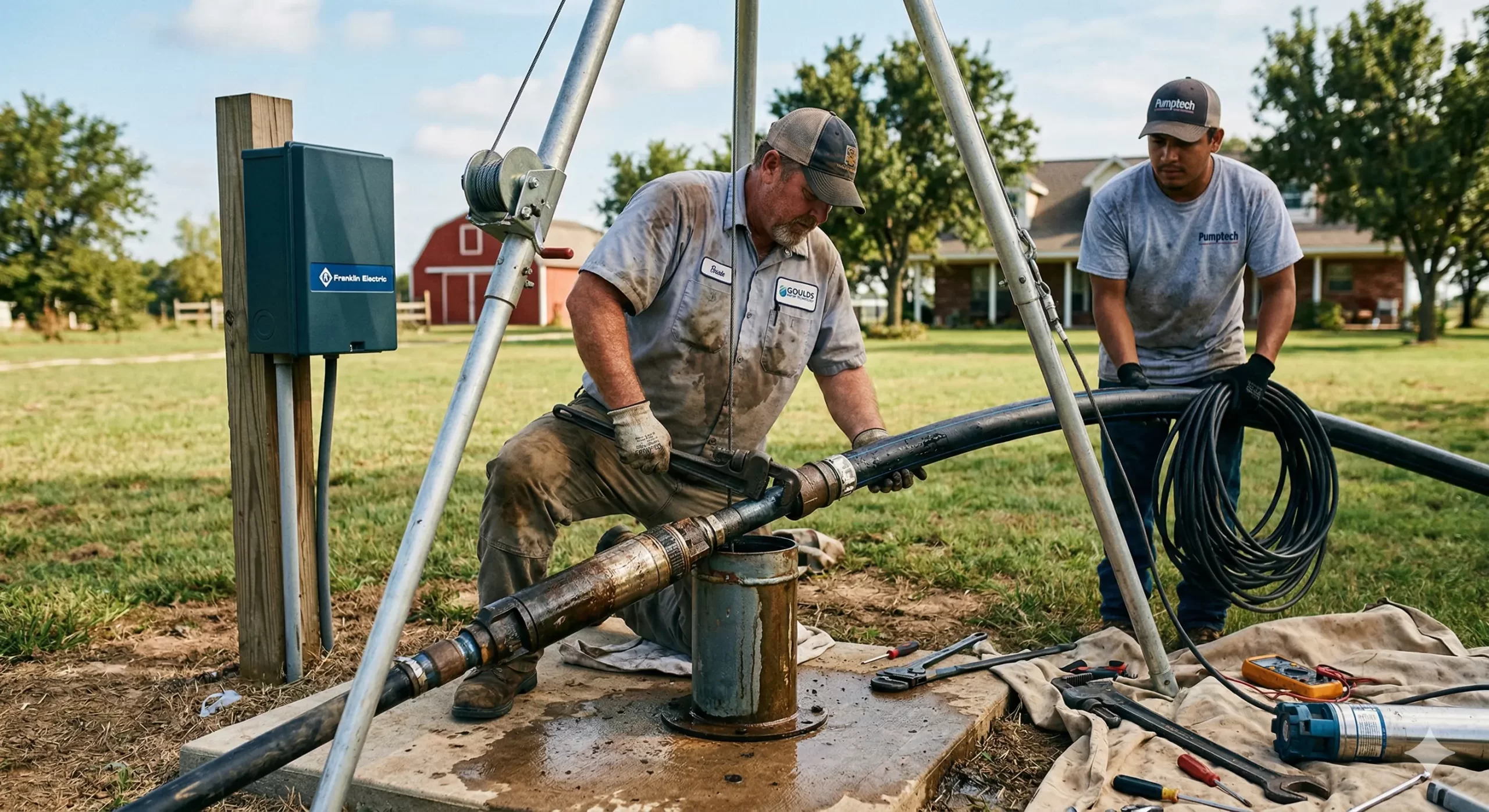
Once the fault is confirmed to be downhole, the pump must be physically extracted from the well. This is a hazardous operation requiring a specialized hydraulic pump hoist or pulling rig mounted on a service truck. These rigs provide the immense, controlled lifting power necessary to safely manage the combined weight of the pump, motor, hundreds of feet of water-filled drop pipe, and heavy electrical cable, which can easily exceed 500 lbs. The technician begins by removing the well cap and using a long T-handle pitless adapter key to latch onto and disengage the pump assembly from the pitless adapter located several feet below ground inside the casing. The hoist then carefully raises the entire assembly, with technicians managing the pipe and cable in sections to prevent damage.
Safety Protocol and Professional Justification
This is emphatically not a DIY project. Attempting to pull a submersible pump manually is exceptionally dangerous. The combination of high voltage (240V) at the wellhead, immense weight, and the risk of dropping the entire assembly—irretrievably—down the well casing makes professional intervention essential. A dropped pump can destroy the well itself, leading to a far more expensive drilling operation. Technicians are trained in high-voltage safety, lockout/tagout procedures, and the proper operation of the pulling rig to ensure the job is done without injury or damage to the well system.
With the pump on the surface, a final diagnostic is performed directly on the motor leads to pinpoint the failure. The defective component—either the motor or the cable—is replaced. If the motor is at fault, it is unbolted from the pump end (‘wet end’), and a new, correctly sized motor is installed. If the cable is severed or a splice has failed, a new section of cable is connected using an industrial-grade, waterproof heat-shrink splice kit. Each conductor is crimped and then sealed with multiple layers of adhesive-lined heat shrink tubing to create a permanent, watertight seal. The entire assembly is then carefully lowered back into the well, re-engaged with the pitless adapter, sanitized with chlorine to disinfect the system, and pressure tested to ensure full operational readiness.
Repair Cost & Time Assessment
The total cost for a professional submersible motor or cable replacement in the United States typically ranges from $2,500 to $6,000, with some complex, deep-set jobs exceeding this. The final price is heavily influenced by the pump’s depth, its horsepower, and local labor rates. The customer’s invoice will include several distinct charges: a diagnostic service call fee ($150-$300), the labor for one or two technicians for 4-8 hours ($800-$2,000), the mobilization and use of the pump hoist truck ($400-$800), and the cost of materials.
The primary material costs are the new motor itself, which can range from $600 for a small residential motor to over $2,500 for a high-horsepower stainless steel unit from a premium brand like Franklin Electric or Grundfos, and the submersible drop cable, which can cost $2 to $6 per foot. A straightforward replacement in a 200-foot well might be completed in 3-5 hours. However, a more difficult job in a 500-foot well with accessibility issues or a corroded pitless adapter that also needs replacement can easily become a full-day project, significantly increasing labor costs.
Fast Local Service & Diagnostics
Calls are routed to a licensed local well professional.