
Diagnosis: A 6-flash error on a Franklin Electric SubDrive or MonoDrive signals a critical overvoltage condition, often from lightning strikes or utility grid instability. This fault protects the VFD and motor from damage by shutting down when line voltage exceeds safe limits. Troubleshooting involves verifying input voltage, inspecting for surge damage, and potentially replacing the controller or installing a surge arrestor.
In this Guide:
What Causes the Franklin Electric Flashes 6 times (Мигает 6 раз) Issue?
A 6-flash fault code on a Franklin Electric SubDrive or MonoDrive platform is a protective trip, indicating that the DC bus voltage within the Variable Frequency Drive (VFD) has exceeded its maximum design threshold. This condition is almost exclusively caused by external electrical events, most commonly a transient overvoltage from a nearby lightning strike or significant instability from the utility power grid. The VFD’s input rectifier section converts incoming AC power to a DC voltage stored in large capacitors (the DC bus). For a standard 240V AC single-phase input, the DC bus voltage is nominally around 340V DC. The drive’s logic board continuously monitors this bus, and if it surges past its upper limit (often around 410V DC), the controller immediately shuts down the inverter stage to protect the sensitive IGBTs (Insulated-Gate Bipolar Transistors) and the submersible motor itself.
From an engineering perspective, the energy contained in a voltage surge must be dissipated. While the drive has some built-in Metal Oxide Varistors (MOVs) for minor clipping, a substantial event like a lightning-induced surge injects massive energy in microseconds. This can overwhelm the MOVs and cause the DC bus capacitors to charge uncontrollably, triggering the fault. If the surge is powerful enough, it can physically destroy components, causing an arc flash inside the controller that leaves carbon scoring on the circuit board, vaporizes traces, and destroys the logic processor. This results in a controller that will not reset and is permanently damaged. Even if the controller survives, the primary failure mode is often damage to the input rectifier diodes or the DC bus capacitors, which are the first line of defense.
The downstream submersible motor is also at extreme risk. A high-voltage transient can propagate down the drop cable and breach the motor’s winding insulation. This causes micro-arcing between windings or from a winding to the motor’s steel casing (a short-to-ground fault). This damage is cumulative and may not cause an immediate failure but will drastically shorten the motor’s lifespan. Furthermore, the violent electromagnetic forces generated by the surge can impart a significant mechanical shock to the motor’s rotating assembly. This can stress the thrust bearings, designed to handle downward force, and potentially compromise the integrity of the motor’s mechanical seals. In essence, the 6-flash code is the system’s last-ditch effort to prevent catastrophic electrical and mechanical failure deep within the well.
DIY Troubleshooting Steps
- SAFETY FIRST – DE-ENERGIZE SYSTEM: Before any inspection, locate the circuit breaker supplying power to the well pump controller. Switch it to the OFF position. Wait a minimum of 5 minutes for the high-voltage capacitors inside the drive to safely discharge before opening any access panels. This is a critical safety step.
- System Reset and Observation: After waiting, restore power at the breaker. Press the reset button on the SubDrive/MonoDrive controller. Observe the status lights carefully. If the fault clears and the system operates normally, the event was likely transient. If the 6-flash fault returns immediately upon reset, it indicates a persistent hardware failure within the drive.
- Measure Incoming Line Voltage: Using a True RMS multimeter, carefully measure the AC voltage across the L1 and L2 input terminals of the controller. For a nominal 240V service, a healthy reading is typically between 230V and 245V. Document any readings consistently above 250V, as this indicates a problem with the utility supply that will cause recurring faults.
- Visual Inspection for Physical Damage: With the power OFF and capacitors discharged, open the controller’s cover. Use a flashlight to carefully inspect the main circuit board for any signs of damage. Look for blackened or burnt components, bulging or leaking capacitors, and the distinct smell of burnt electronics, all of which confirm a catastrophic surge event and a failed board.
- Verify Grounding Integrity: Inspect the grounding conductor running from your main electrical panel to the drive’s chassis ground lug, and ensure a proper ground wire runs all the way to the wellhead. A poor or missing ground connection provides no path for surge energy to dissipate, forcing it through the sensitive electronics and guaranteeing damage. The connection should be tight and free of corrosion.
- Check Pump-to-Ground Resistance: For advanced users comfortable with a multimeter that has a high-resistance (Ohms) setting: With power off, disconnect the motor leads (U, V, W) from the drive. Measure the resistance from each lead to the ground terminal. You should see an open line or infinite resistance (‘OL’). Any low-resistance reading indicates a short in the drop cable or motor windings, a job for a professional.
When to Call a Professional Well Service
Upon arrival, a professional technician’s first step is advanced insulation testing. Using a megohmmeter (often called a ‘megger’), they will perform a dielectric strength test on the submersible motor and drop cable. The megger applies a high voltage (typically 500V or 1000V) to measure insulation resistance in megohms. A reading of several hundred megohms is ideal; any reading below 2 megohms suggests insulation compromise, and a reading below 1 megohm confirms a critical failure requiring the pump to be pulled. This test definitively differentiates between a failed controller and a failed motor/cable, preventing the costly mistake of replacing only the drive when the motor downhole is also shorted.
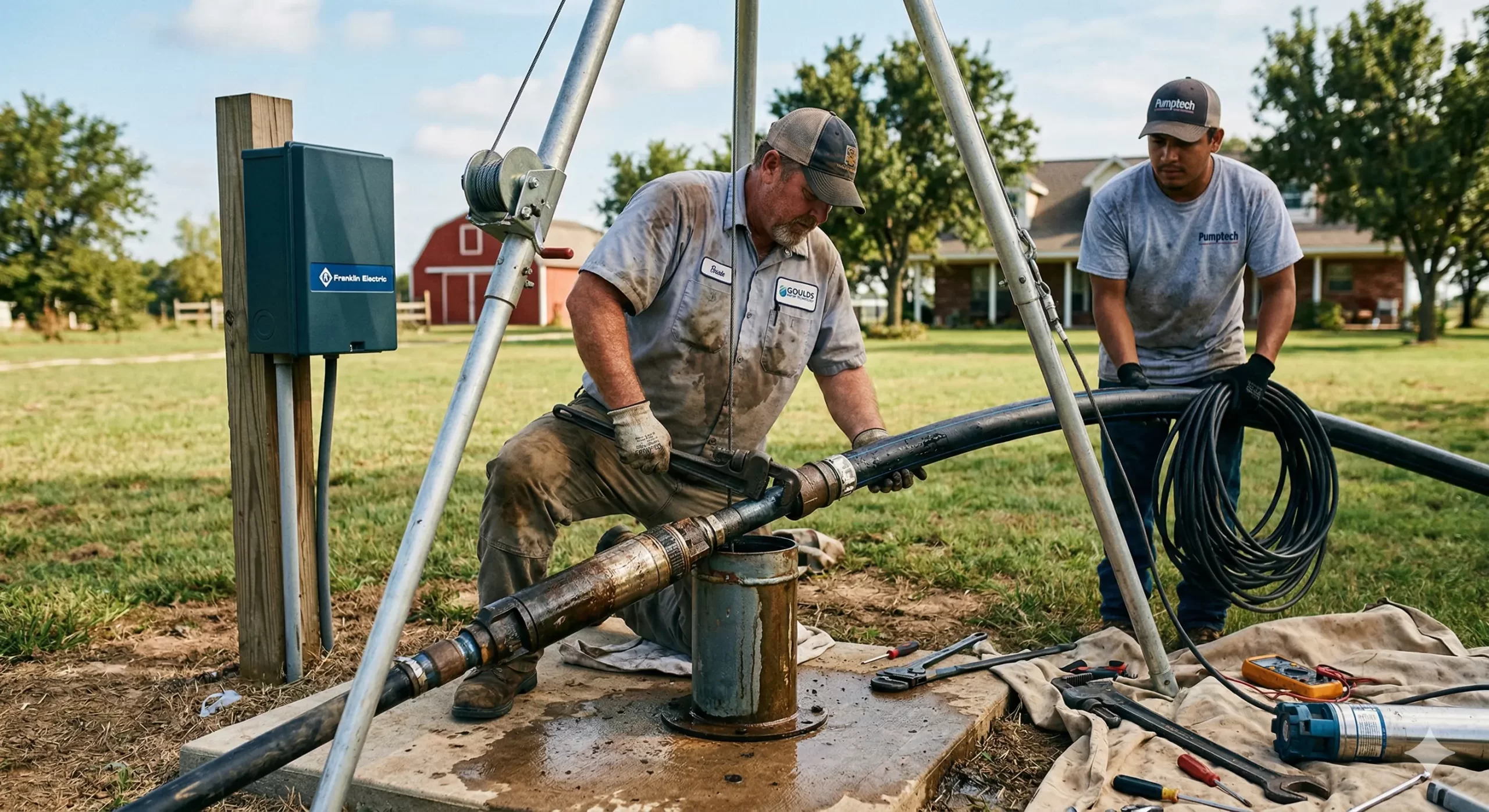
If the megger test fails or the controller is visibly destroyed, the pump assembly must be pulled from the well. This is a hazardous operation requiring specialized equipment. A hydraulic pump hoist or heavy-duty pulling rig is used to safely manage the static and dynamic loads of the pump, motor, water-filled pipe, and cable, which can easily weigh 500-1000 lbs or more. The technician will use a T-handle pitless adapter key to latch onto the pitless adapter inside the well casing and disconnect it, allowing the entire assembly to be hoisted to the surface. Attempting this manually is exceptionally dangerous and risks dropping the entire assembly to the bottom of the well, causing irreversible damage.
With the pump on the surface, the motor is isolated and re-tested. If faulty, it is replaced. The drop cable is meticulously inspected for abrasions, and the splices are re-made using high-quality, submersible heat-shrink splice kits to ensure a waterproof seal. The failed SubDrive controller is replaced, and most importantly, a robust Type 1 or Type 2 surge arrestor is installed at the main service disconnect. This device acts as the primary defense against future events, diverting high-energy transients safely to ground before they can reach the new controller. The entire system is then re-installed, pressure tested, and commissioned to ensure proper operation and flow rate.
Safety Protocol: All work on 240V well systems presents a risk of lethal electrocution and severe physical injury. Professionals adhere to strict Lockout/Tagout (LOTO) procedures to ensure the circuit is de-energized. They utilize calibrated test equipment, wear appropriate Personal Protective Equipment (PPE), and exclusively use a certified pump hoist for pulling operations. The immense weight and stored potential energy in a tensioned drop pipe assembly demand mechanical assistance for safe handling.
Repair Cost & Time Assessment
The cost to resolve a Franklin SubDrive 6-flash overvoltage fault varies widely, from a basic service call to a complete system replacement. A minimum service call for diagnosis, which includes testing voltages and meggering the motor from the surface, typically costs between $350 and $600. If the issue is simply a transient event and the controller resets, and the homeowner opts to have a robust surge arrestor installed to prevent recurrence, the total cost would likely be in the $600 to $950 range, including parts and 2-3 hours of labor.
If the diagnostic tests confirm the SubDrive controller is damaged beyond repair, the cost increases significantly. The replacement controller itself can cost between $1,400 and $2,200, depending on the model. Labor to install and program the new drive brings the total project cost to the $1,800 to $2,800 range. This assumes the motor and downhole wiring are still in good condition.
The most expensive scenario is when the surge has damaged both the controller and the submersible motor. This requires pulling the pump, replacing the motor (and often the pump, or ‘wet end’, as a matched unit), replacing the controller, and installing a new surge arrestor. This is a full-day job requiring a pump hoist rig and two technicians. The total cost for this comprehensive repair can range from $4,000 to $7,500+, depending on the well depth, pump horsepower, and local labor rates. The customer is paying for the mobilization of heavy equipment, 6-10 hours of specialized labor, and premium replacement components designed for long-term reliability.
Fast Local Service & Diagnostics
Calls are routed to a licensed local well professional.