
Diagnosis: The Goulds Aquavar F08 fault code indicates a ‘Dry Run’ condition, meaning the pump is operating without sufficient water. This is typically caused by the well’s static water level dropping below the pump intake due to drought or over-pumping. The VFD detects this by sensing a sharp drop in motor load (amperage) and shuts down to prevent catastrophic pump and motor damage.
In this Guide:
What Causes the Goulds Код F08 Issue?
The Goulds Aquavar SOLO and SOLO2 Variable Frequency Drives (VFDs) are intelligent controllers designed to protect the significant investment of a submersible pump and motor. The F08 ‘Dry Run’ fault is a critical protective trip, triggered when the drive’s algorithm detects a severe underload condition. Unlike simpler systems that rely on external sensors, the Aquavar continuously monitors the relationship between the motor’s operating frequency (Hz) and its current draw (Amps). When a pump is moving a column of water, it presents a consistent hydraulic load to the motor. If the water level drops below the pump’s intake screen, the pump becomes vapor-locked and is no longer moving water. This causes the hydraulic load to plummet, and the motor’s amperage draw drops significantly below the expected value for that speed. The VFD interprets this discrepancy as a dry run and initiates a protective shutdown to prevent mechanical destruction.
From a mechanical engineering perspective, a dry run is catastrophic for a submersible pump. The pump’s multi-stage impeller and diffuser assembly relies on the pumped fluid for hydrodynamic lubrication of its journal bearings. These bearings, often made of carbon-graphite or ceramic composites, are designed to operate with a thin film of water separating the rotating and stationary surfaces. Without water, these surfaces experience immediate high-friction contact, generating intense localized heat. This leads to rapid abrasive wear, galling, and potential seizure of the entire rotating assembly. Furthermore, the plastic components, such as Noryl impellers, can overheat, warp, or even melt, destroying the pump’s hydraulic efficiency permanently.
Simultaneously, the submersible motor is critically dependent on the constant flow of cool well water across its stainless-steel housing to dissipate the heat generated by its electrical windings. During a dry run, this essential cooling medium is absent. The motor’s internal temperature will rapidly rise, quickly exceeding the thermal limits of its insulation class (e.g., Class F, 155°C / 311°F). This overheating can melt the magnet wire’s enamel insulation, causing turn-to-turn shorts within a winding or a phase-to-ground fault. Additionally, the mechanical seals that separate the motor’s dielectric oil-filled interior from the well water will overheat and fail without water for lubrication and cooling. This allows water to intrude into the motor, leading to a complete and irreversible electrical failure.
DIY Troubleshooting Steps
- Acknowledge and Monitor Recovery: Press the reset button on the Aquavar controller once to clear the F08 fault. Do not repeatedly reset it. Power down the pump via its circuit breaker for 2-4 hours to allow the well’s static water level to recover. If the pump runs normally after this period but faults again later, it strongly indicates the well yield is insufficient for the demand.
- Inspect the Circuit Breaker: Locate the dedicated double-pole circuit breaker for the well pump in your main electrical panel. Verify that it has not tripped. A breaker that feels loose or trips immediately upon reset may indicate a more serious electrical issue, such as a shorted motor, that requires professional diagnosis.
- Review the Drive’s Fault Log: Access the menu on the Aquavar display to view the fault history. Confirm that F08 is the primary or only recurring fault. The presence of other faults, like F02 (Overcurrent) or F04 (Overvoltage), may point to issues with the power supply or a failing motor rather than just a low water level.
- Analyze Last-Fault Parameters: The drive often stores key parameters at the moment of the fault. Note the recorded motor frequency (Hz) and current (Amps). A very low amperage reading relative to the operating frequency is a definitive sign of the underload condition that triggered the F08 fault.
- Check for Major System Leaks: Perform a thorough visual inspection of all accessible plumbing between the wellhead and the pressure tank. A major underground leak in the service line can cause the pump to run continuously without satisfying system pressure, eventually drawing the well down and causing a dry run fault.
- Assess Recent Water Usage: Consider if there has been unusually high water demand prior to the fault, such as filling a swimming pool, extensive irrigation, or a running fixture. High demand can temporarily outpace the well’s recovery rate, known as its yield.
When to Call a Professional Well Service
Upon arrival, a certified technician’s first step is to confirm the diagnosis electrically before any mechanical work begins. After verifying the F08 fault history on the Aquavar drive, they will perform a full electrical lockout/tagout at the main panel. The motor leads at the wellhead or control box will be disconnected, and an insulation resistance tester, commonly known as a Megohmmeter or ‘Megger’, will be used. This instrument applies a high DC voltage (typically 500V or 1000V) to test the integrity of the motor winding insulation between phases and from each phase to ground. A reading of many hundreds or thousands of megohms indicates a healthy motor. A low or zero reading signifies a critical insulation failure, meaning the motor has been compromised and must be replaced along with the pump.
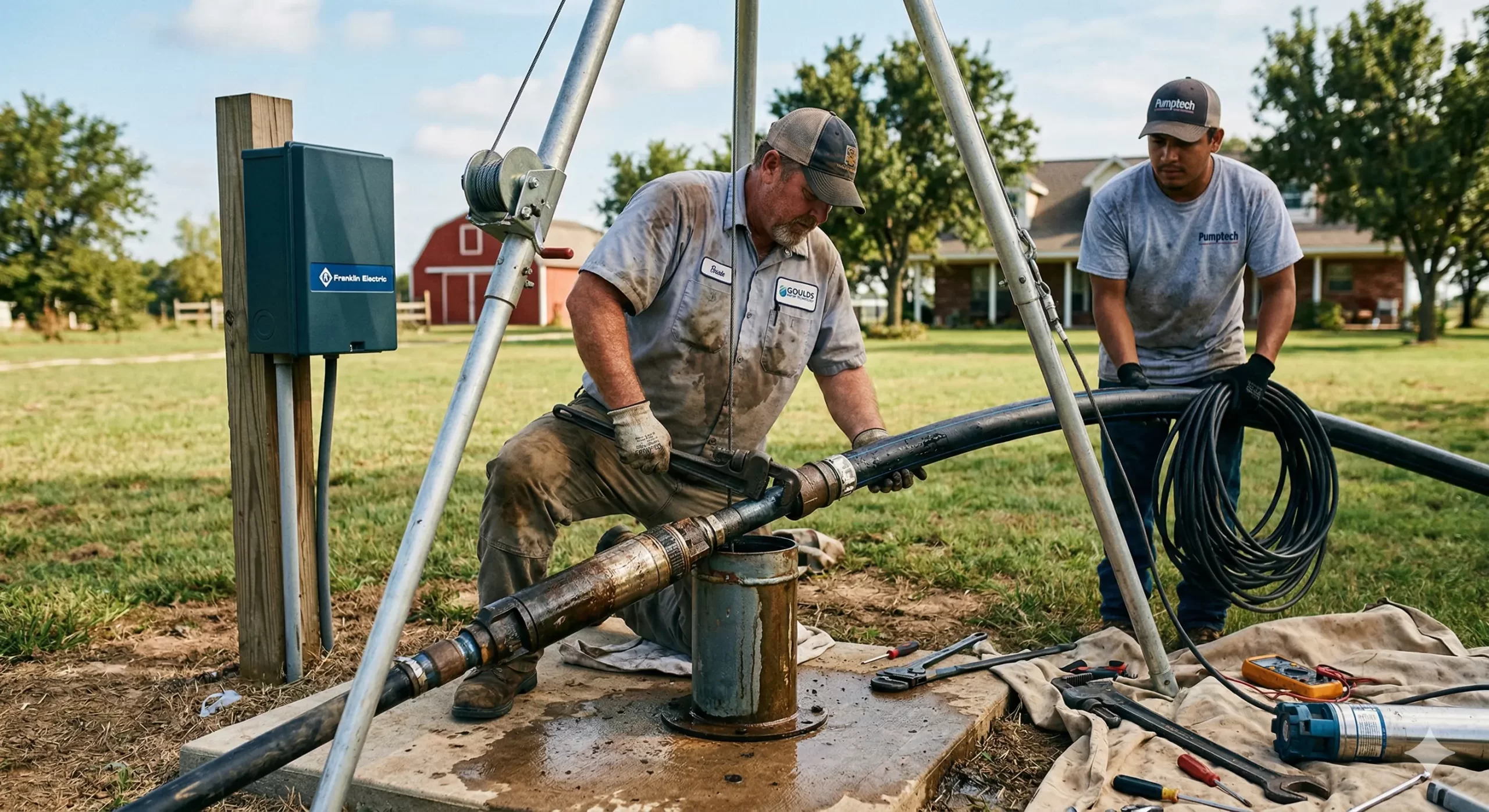
If the motor’s electrical integrity is confirmed, the primary corrective action is to physically lower the pump further into the well bore. This is a hazardous operation requiring specialized equipment. A dedicated pump hoist or pulling rig is erected over the wellhead to manage the immense weight of the pump, motor, water-filled pipe, and cable. The technician uses a T-handle pitless adapter key to unlock and disengage the pump assembly from the pitless adapter located inside the well casing below the frost line. The entire column is then carefully hoisted from the well. The technician will then add one or two 20-foot sections of drop pipe and extend the submersible power cable using a code-compliant, permanent heat-shrink splice kit. This splice is a critical component that must be perfectly executed to ensure a durable, watertight seal for decades of submersion.
Once the pump is set at its new, deeper elevation, the assembly is lowered back into the well, and the pitless adapter is re-engaged and seated. Before restoring power, the well is typically sanitized with a chlorine solution to address any surface contamination introduced during the repair. The technician will then power up the system, recommission the Aquavar drive, and monitor the pump’s performance through several cycles. They will use a clamp-on ammeter to verify that the motor’s current draw is stable and consistent with the new, higher total dynamic head, ensuring the F08 issue is resolved and the system is operating efficiently.
Safety Protocol
This repair involves lethal 240-volt electricity and lifting loads that can exceed 500 pounds. All electrical work must be performed by a qualified individual following strict lockout/tagout procedures. The use of a professional pump hoist is non-negotiable; attempting to pull a pump by hand or with an inadequate vehicle hitch can result in the pump assembly being dropped, destroying the well, or causing severe personal injury. This is not a DIY-level task.
Repair Cost & Time Assessment
The professional repair cost for a recurring F08 fault, involving lowering the submersible pump, typically ranges from $950 to $2,800 in the United States. This price variation depends heavily on the pump’s current depth, the difficulty of the extraction, regional labor rates, and the type of materials required (e.g., schedule 120 PVC pipe vs. galvanized steel). A standard service call of this nature often takes between 3 and 6 hours for a two-person crew.
The customer’s investment covers several key components: the initial diagnostic service call fee ($150 – $300), the hourly labor rate for two licensed technicians ($200 – $400/hr total), a specific equipment charge for the pump pulling rig ($200 – $500), and the cost of materials. Materials include new sections of drop pipe, a high-quality submersible heat-shrink splice kit ($50 – $100), new torque arrestors, and possibly a new length of safety rope. You are paying for the expertise to safely manage high-voltage and heavy machinery, the use of thousands of dollars in specialized tools, and the assurance of a code-compliant, reliable repair.
Fast Local Service & Diagnostics
Calls are routed to a licensed local well professional.