
Diagnosis: The ‘No Contact’ error on a Grundfos CU 301 control box indicates a failure in the power line communication (PLC) signal to the SQE submersible pump. This is most often caused by a faulty waterproof splice in the power cable or physical damage to the wire itself, which interrupts the data signal traveling between the controller and the pump motor.
In this Guide:
What Causes the Grundfos Нет связи (No contact to pump) Issue?
The Grundfos CU 301 and SQE pump system is an advanced design that utilizes Power Line Communication (PLC) for control and monitoring. This means that a high-frequency data signal is superimposed onto the main 240-volt power conductors, eliminating the need for separate control wires. The ‘No Contact’ error is triggered when the CU 301 sends a signal but receives no response from the pump’s microprocessor. The primary engineering cause for this failure is an increase in electrical resistance or a complete open circuit somewhere between the controller and the pump motor. Most commonly, this occurs at a submerged heat-shrink splice. If not installed perfectly, microscopic voids can allow water intrusion over time. This water, especially if mineral-rich, creates a path for galvanic corrosion, degrading the copper connection and significantly increasing resistance, effectively filtering out the delicate PLC signal while still potentially allowing enough power through to confuse diagnostics.
A compromised electrical connection has severe secondary effects on the pump’s mechanical and electrical components. Intermittent communication can lead to control logic faults, causing the pump to cycle rapidly or attempt to start against a closed check valve—a condition known as ‘chattering’. Each start attempt draws a massive inrush current, typically 5-7 times the normal running amperage. This repeated current surge generates significant heat within the motor windings, which can thermally degrade and break down the winding’s enamel insulation, leading to an eventual short circuit and motor burnout. This thermal stress, combined with the physical shock of repeated hard starts, places extreme strain on the motor’s internal components.
Mechanically, the violent torque from these hard starts exerts immense force on the entire rotating assembly. The thrust bearings, designed to handle the axial load of lifting the water column, are subjected to repeated impact loads, leading to premature wear and failure. The impeller stack can also suffer, with the stress potentially causing stress fractures or loosening on the shaft. Furthermore, the constant vibration and pressure fluctuations can compromise the motor’s internal mechanical seals. Once these seals are breached, well water can enter the hermetically sealed motor housing, contaminating the fill fluid, shorting the windings, and causing catastrophic, unrepairable failure of the entire pump motor.
DIY Troubleshooting Steps
- Conduct a Thorough Visual Inspection: Start at the CU 301 controller and visually trace the wiring all the way to the wellhead. Look for any signs of physical damage, such as chafing against conduit, rodent chews on the insulation, or corrosion on terminals inside the well cap junction box. Ensure all screw-down terminals are tight.
- Perform a Hard Power Cycle: Locate the dedicated two-pole circuit breaker for the well pump in your main electrical panel. Turn it completely off and wait for a full five minutes. This allows all capacitors in the controller and pump to discharge. Turn the breaker back on. This simple reset can sometimes re-establish a weak or intermittent connection.
- Verify Correct Voltage at the Controller: Set a multimeter to AC Volts. Carefully test the ‘L1’ and ‘L2’ output terminals on the CU 301 that lead to the pump. You should have a stable reading between 230 and 240 volts. A significantly lower, fluctuating, or absent voltage points to a problem with the controller or the incoming power, not the pump communication.
- Check for Ground Faults (Power OFF): Turn the pump circuit breaker OFF. At the wellhead, disconnect the pump wires from the incoming supply. Set your multimeter to the resistance (Ohms) setting. Check the resistance between each of the two power wires and the ground wire. The reading should be infinite (often displayed as ‘OL’). Any other reading indicates a dangerous short to ground in the cable or motor.
- Measure Winding and Cable Resistance (Power OFF): With the power still off, measure the resistance between the two power conductors leading down to the pump. You should get a low but measurable resistance reading, specific to the pump model and cable length. An infinite (‘OL’) reading confirms a broken wire in the cable or a failed motor winding.
- Inspect the Thermal Overload Reset: The Grundfos SQE pump has built-in thermal protection. While the CU 301 reports this, severe overheating can sometimes cause a fault that mimics a communication loss. Ensure the pump has had adequate time to cool down if it has been cycling frequently.
When to Call a Professional Well Service
A professional technician’s first step is to perform conclusive diagnostics that go beyond a standard multimeter. They will use a Megohmmeter, commonly known as a ‘Megger,’ to test the insulation integrity of the downhole cable and motor windings. This instrument applies a high DC voltage (typically 500V or 1000V) to the conductors. It can detect minute flaws, moisture intrusion, or carbon tracking in the wire’s insulation that would not show up during a low-voltage continuity test. The Megger provides a definitive reading in megohms (MΩ); a low reading confirms that the electrical insulation is compromised and the pump must be pulled from the well for physical inspection and repair.
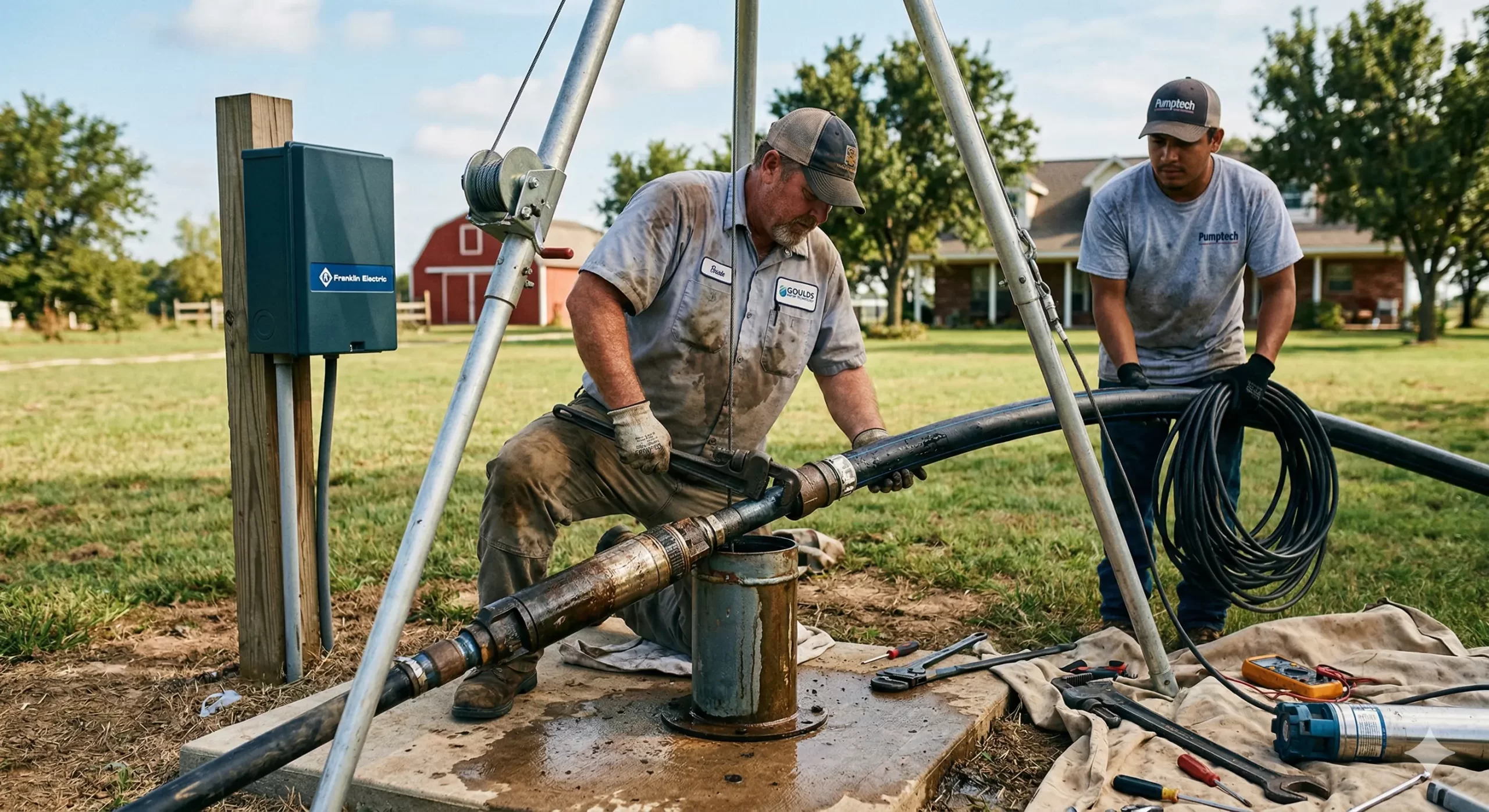
Once the fault is confirmed to be downhole, the pump assembly must be retrieved. This requires specialized equipment, primarily a hydraulic pump hoist or a tripod pulling rig. An average 4-inch submersible pump assembly can weigh between 100 and 500 pounds, depending on the depth and type of drop pipe used. The technician will first remove the well cap and use a T-handle pitless adapter key to unlock the pump assembly from the pitless adapter located inside the well casing below the frost line. This allows the entire drop pipe, power cable, and pump to be lifted vertically out of the well without excavating the buried water line.
As the pump is carefully hoisted, the technician will inspect every foot of the power cable, looking for the point of failure. In most cases, the issue is a failed heat-shrink splice. The repair involves precisely cutting out the damaged section of cable. New connections are made using high-quality, non-insulated butt connectors and a hydraulic crimping tool to ensure a solid electrical bond. A multi-wall, adhesive-lined heat-shrink tubing kit is then meticulously applied over the repair. Each layer is heated with a heat gun, causing it to shrink and the inner adhesive to melt, forming a permanent, robust, and completely waterproof seal that is critical for decades of reliable service thousands of feet underground. After the repair, the Megger test is performed again to certify the integrity of the work before the pump is reinstalled.
Safety Protocol: All work on a 240V submersible pump system is extremely hazardous. Before any tools touch the well, the corresponding circuit breaker is turned off, and a lockout/tagout (LOTO) device is applied to prevent accidental re-energization. The pump hoist must be positioned on stable ground and operated according to manufacturer specifications to manage the heavy overhead load. All personnel must wear appropriate Personal Protective Equipment (PPE), including steel-toed boots, gloves, and hard hats, especially during the lifting phase.
Repair Cost & Time Assessment
The professional repair cost for a ‘No Contact’ error on a Grundfos CU 301 system typically ranges from $750 to $2,800 in the United States. The final price is heavily dependent on the depth of the well, as this dictates the amount of labor and the size of the pump pulling rig required. A shallow well (under 150 feet) will be at the lower end of the cost spectrum, while a deep well (over 400 feet) will be at the higher end.
The cost breakdown includes several components. The primary expense is specialized labor, usually requiring two licensed technicians for 3 to 6 hours at a rate of $150-$225 per hour. There is also a significant equipment fee for the use of the hydraulic pump hoist, typically a flat rate of $300-$600 for the job. Material costs are relatively minor, consisting of a premium-grade heat-shrink splice kit ($75-$150). If a significant portion of the cable is damaged, replacing the submersible wire can add several dollars per foot to the total cost. The higher end of the range accounts for very deep sets, difficult access to the wellhead, or the need for a full replacement of the downhole power cable.
While the cost may seem high relative to the parts used, the customer is paying for critical expertise and safety. This includes the technician’s ability to accurately diagnose the fault with specialized tools like a Megohmmeter, the use of a purpose-built rig to safely pull a heavy pump without dropping it down the well (a catastrophic event), and the skill to create a perfect waterproof splice that will last for years. This is not a DIY-friendly task due to the high voltages and extreme weight involved.
Fast Local Service & Diagnostics
Calls are routed to a licensed local well professional.