
Diagnosis: A Grundfos CU 301 ‘Overload’ error indicates excessive current draw from the SQE pump, typically caused by mineral buildup (iron or manganese) creating mechanical friction inside the pump’s hydraulic stages. This condition requires a licensed professional to pull the pump from the well for an acid wash or replacement of the hydraulic end. Verifying stable voltage and checking connections are preliminary steps before scheduling service.
In this Guide:
What Causes the Grundfos Индикатор “Overload” Issue?
The primary cause of a CU 301 ‘Overload’ fault is a mechanical binding of the pump’s hydraulic assembly, most commonly due to mineral fouling. In wells with high concentrations of dissolved iron and manganese, these minerals precipitate out of solution and form a hard, abrasive scale on the pump’s impellers and inside the diffuser stack. Modern multi-stage submersible pumps like the Grundfos SQE are built with extremely tight tolerances between the spinning impellers and the stationary diffusers to achieve high efficiency. As this scale builds up, it closes these critical clearances, causing the impellers to physically rub against the housing. This friction dramatically increases the rotational torque required from the motor to maintain speed and pressure, resulting in a proportional increase in current (amperage) draw.
From an electrical engineering perspective, this mechanical resistance forces the permanent magnet motor to demand more power to overcome the friction. The CU 301 controller, a sophisticated variable frequency drive (VFD), continuously monitors the current supplied to the motor. When the amperage exceeds the pre-programmed safety threshold for the specific SQE model, the controller correctly interprets this as an ‘Overload’ condition. It then shuts down the motor to prevent catastrophic failure. This is a protective measure; without it, the excessive current would generate extreme heat (I²R losses) in the motor windings, rapidly degrading the winding’s enamel insulation. This can lead to a phase-to-phase or phase-to-ground short circuit, permanently destroying the submersible motor.
Sustained or repeated overload events place immense stress on the entire pump and motor assembly, leading to secondary mechanical failures. The increased axial and radial loads caused by the binding impellers accelerate wear on the motor’s thrust bearings and radial sleeve bearings. This can introduce shaft wobble and vibration, which in turn compromises the integrity of the mechanical shaft seals. Once these seals fail, well water can intrude into the hermetically sealed motor housing. This contamination will short out the windings and foul the bearings, leading to complete and irreparable motor failure. Therefore, an overload fault is not just an electrical nuisance; it’s a critical symptom of a progressive mechanical problem that requires immediate attention.
DIY Troubleshooting Steps
- Power Cycle and Observe: Perform a hard reset by switching off the dedicated two-pole breaker for the pump system. Wait at least five minutes to allow the controller’s capacitors to fully discharge. Power the system back on and carefully observe the indicator lights on the CU 301. Note if the pump attempts to start and for how long before the ‘Overload’ light illuminates. An immediate trip indicates a severe bind or short circuit.
- Verify Supply Voltage: Using a true RMS multimeter, carefully measure the incoming AC voltage at the L1 and L2 terminals of the CU 301 controller. You should see a stable 230-240V. Consistently low voltage forces the motor to draw higher amperage to produce the required horsepower, which can sometimes trigger an overload fault.
- Inspect All Wiring and Connections: Visually inspect all electrical connections from the breaker panel to the CU 301 and from the controller to the wellhead junction box. Look for any signs of corrosion, discoloration from overheating, or loose terminal screws. A poor connection can create high resistance and voltage drop under load.
- Measure Amperage Draw (Advanced): If you are qualified and have a clamp-on ammeter, measure the current on one of the motor leads (U, V, or W) leaving the CU 301 during a start-up attempt. Compare this reading to the Full Load Amps (FLA) listed on the pump’s data sheet or motor nameplate. A reading significantly exceeding the FLA confirms the overload condition is real and not a sensor error.
- Check for Downstream Obstructions: Ensure all valves after the pressure tank are open and that there are no clogged sediment filters or failed check valves downstream. While less common, extreme backpressure can slightly increase motor load, though it is rarely the cause of a true ‘Overload’ trip which points to a more severe issue at the pump itself.
- Review Controller Fault History: Consult the Grundfos GO app or a R100 remote to access the CU 301’s fault log. A history of intermittent overload faults over weeks or months strongly suggests a progressively worsening condition like mineral buildup, rather than a sudden electrical failure.
When to Call a Professional Well Service
Upon arrival, a certified technician will first conduct advanced electrical diagnostics from the surface to confirm the nature of the fault before committing to pulling the pump. This critical first step involves using a megohmmeter (often called a ‘megger’) to test the insulation resistance of the motor windings and the submersible drop cable. By applying a high voltage (500-1000V), the megger can detect minute weaknesses in the insulation between the motor conductors and ground. A reading below 1-2 megaohms indicates a potential short circuit in the motor, splice, or cable, which could also cause an overload fault. This test definitively distinguishes between a mechanical bind and a true electrical failure, preventing the unnecessary pulling of a pump when the fault is in the wiring.
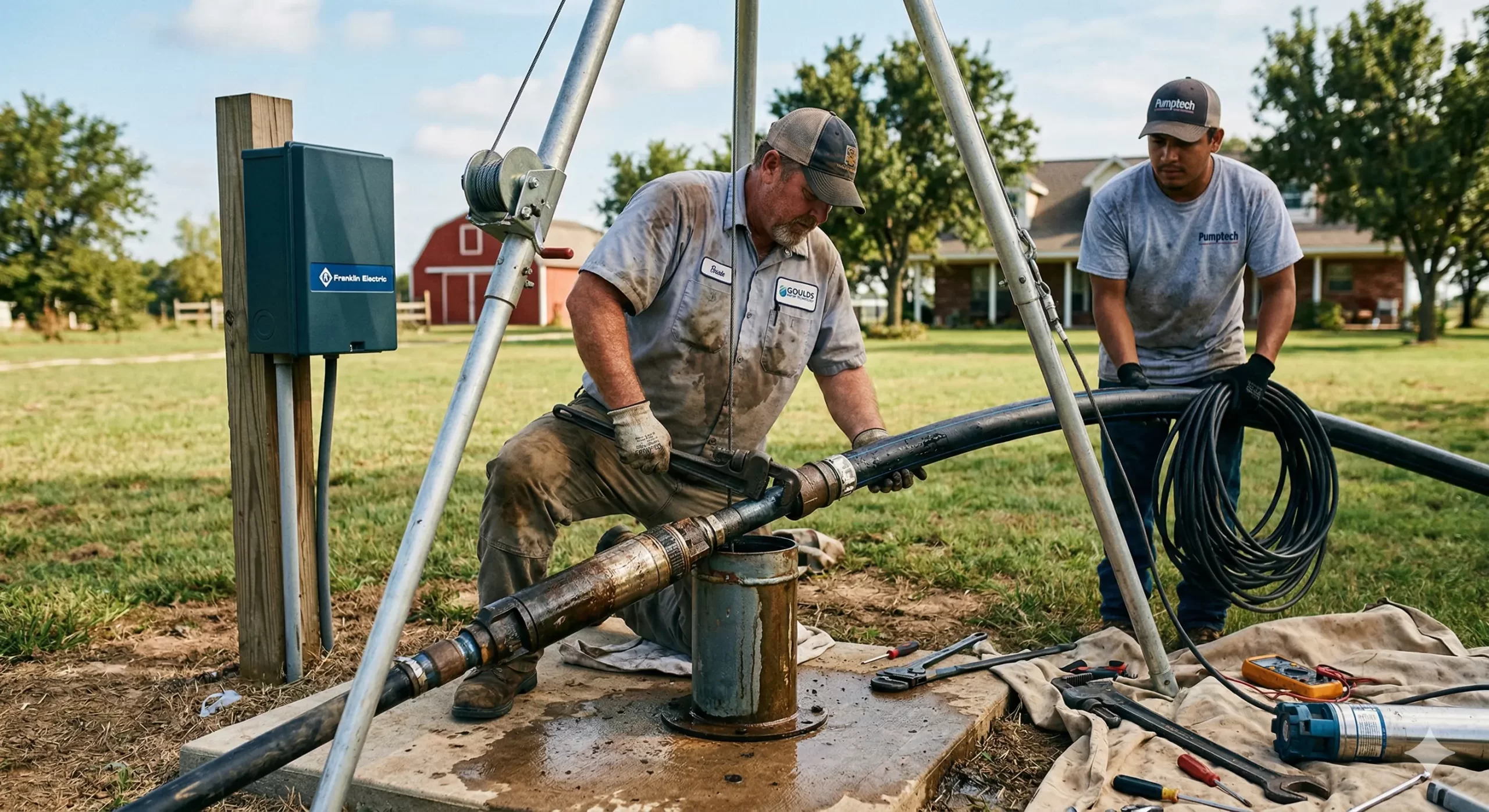
Once a mechanical issue is confirmed, the technician will prepare for pump extraction using specialized equipment. For a pump set at any significant depth (over 100 feet), a hydraulic pump hoist or a tripod pulling rig is mandatory. This equipment provides the mechanical advantage needed to safely lift the combined weight of the pump, motor, water-filled drop pipe, and cable, which can easily exceed 500 lbs. The technician will use a specific pitless adapter key, a long T-handle tool, to reach down the well casing and disengage the pump assembly from its connection point below the frost line. This process requires skill to avoid dropping the entire assembly down the well or damaging the well casing.
Safety Protocol
Working with a 240V system and heavy suspended loads is inherently dangerous. The technician will follow strict lockout/tagout (LOTO) procedures at the breaker panel to ensure the circuit is de-energized. The work area around the wellhead will be secured, and the pulling rig must be properly anchored. Every component, from shackles to the hoist cable, is inspected before the pull. This professional approach mitigates the risk of electrical shock and the severe physical danger posed by a falling pump assembly.
With the pump on the surface, the hydraulic end is unbolted from the motor. A manual rotation test of the pump shaft will confirm the diagnosis; if it feels gritty, stiff, or is completely seized, mineral fouling is the cause. The technician will then perform a controlled acid wash of the hydraulic end using a solution like sulfamic acid to dissolve the iron and manganese scale without damaging the stainless steel and composite components. If inspection reveals that the fouling has caused significant abrasive wear on the impellers or diffusers, the entire hydraulic end will be replaced. Following reassembly with a new waterproof heat-shrink splice, the pump is tested before being carefully reinstalled in the well, ensuring years of reliable service.
Repair Cost & Time Assessment
The cost for professionally resolving a Grundfos CU 301 ‘Overload’ fault in the United States typically ranges from $900 to $2,500. This price variation depends heavily on the pump’s depth, the accessibility of the wellhead, and the ultimate repair action required. The cost breakdown generally includes a service call and diagnostic fee ($150 – $250), hourly labor for two technicians ($125 – $175 per hour, per technician), and a surcharge for the use of a specialized pump pulling rig ($200 – $400). The total labor time for pulling, repairing, and reinstalling a pump is typically 3 to 6 hours.
The largest variable in the final invoice is the cost of parts. If an acid wash is sufficient, material costs may be under $100. However, if the hydraulic pump end is too worn and requires replacement, the part itself for a Grundfos SQE model can cost between $600 and $1,200, depending on the specific pump size and number of stages. While this may seem expensive, the customer is paying for a certified technician’s diagnostic expertise, the use of thousands of dollars in specialized and safety-critical equipment, and the assurance of a professional, warrantied repair that prevents the catastrophic failure of dropping the pump down the well or misdiagnosing the problem.
Fast Local Service & Diagnostics
Calls are routed to a licensed local well professional.