
Diagnosis: Iron bacteria can cause total submersible pump failure by creating a thick biofilm that clogs the intake screen, leading to motor overheating and burnout. Repair involves pulling the pump for a deep acid-wash and shock chlorinating the well, a high-difficulty job requiring professional service.
In this Guide:
What Causes the Water Quality Red slime in toilet / Rotten egg smell Issue?
The root cause of this failure is the proliferation of iron-related bacteria (IRB), such as Gallionella ferruginea, within the well environment. These microorganisms metabolize dissolved ferrous iron, converting it into an insoluble ferric iron oxide which they encase in a gelatinous slime or biofilm. This biofilm is incredibly resilient and adheres tenaciously to every wetted surface in the well: the casing, drop pipe, wiring, and, most critically, the submersible pump itself. The fine mesh of the pump’s intake screen acts as a perfect substrate for this growth, becoming progressively clogged until water ingress is severely restricted.
This blockage initiates a catastrophic failure cascade rooted in basic fluid dynamics and electrical theory. As the intake screen becomes occluded, the pump is starved of water and forced into a state of severe cavitation or a near ‘dead-head’ condition. The motor must now work exponentially harder to try and move fluid that isn’t available, causing its amperage draw to skyrocket far beyond its designated Full Load Amp (FLA) rating. This sustained over-amperage state generates immense thermal energy within the hermetically sealed motor housing. Submersible motors rely on the constant flow of cool well water over their exterior for heat dissipation; when this flow stops due to the clog, the motor rapidly and uncontrollably overheats.
At a component level, this thermal overload is devastating. The extreme temperatures, often exceeding 300°F (150°C), first bake the Class F or H enamel insulation on the copper motor windings, causing it to become brittle and crack. This leads to turn-to-turn shorts and eventual winding-to-ground faults, creating a direct short circuit. Simultaneously, the heat vaporizes the lubricant within the motor’s thrust and journal bearings, leading to galling, excessive friction, and complete seizure. Finally, the precision-lapped carbon-ceramic or silicon-carbide faces of the mechanical shaft seal can warp or fracture from the intense thermal stress, compromising the motor’s integrity and allowing water intrusion, which guarantees an immediate and irreversible electrical failure.
DIY Troubleshooting Steps
- Safety First – Power Disconnection: Before any inspection, perform a full shutdown of the 240V circuit feeding the pump at your main electrical panel. Verify with a multimeter at the pressure switch or controller that power is definitively off. This is a life-safety critical step.
- Amperage Draw Test: If you are qualified to do so safely, use a clamp-on ammeter on one of the hot legs at the control box or pressure switch. Have someone briefly turn the breaker on. An instantaneous reading significantly higher than the motor’s FLA (Full Load Amps) rating, or one that immediately trips the breaker, indicates a seized or shorted motor. A reading of zero indicates an open circuit in the wiring or motor.
- Control Box Component Inspection (3-Wire Pumps): With power off, open the pump control box. Visually inspect the start capacitor for any signs of bulging at the top, distortion of the casing, or leaking dielectric fluid. Check the start relay for blackened or welded contacts. These components are common failure points but can also fail as a result of a struggling motor.
- Thermal Overload Reset: Check the pump controller or pressure switch for a manual thermal overload reset button. If it has tripped, allow the system to remain off for 30 minutes to cool down before attempting to reset it. If it trips again immediately upon startup, the motor is experiencing a severe over-current condition from which it cannot recover.
- Pressure Switch and System Monitoring: Observe the pressure gauge during a brief startup attempt. Is the pump building any pressure at all? If the motor runs continuously but the pressure does not rise, this confirms a severe flow restriction (the clog) or a completely failed pump ‘wet end’.
- Wellhead Sensory Check: Carefully remove the well cap. Note any presence of a thick, reddish-brown or orange slime coating the pipes and wires. Also, check for a distinct ‘rotten egg’ or ‘swampy’ odor, which is hydrogen sulfide gas, a common byproduct of the anaerobic environment created by these bacteria. These are definitive signs of advanced bacterial iron fouling.
When to Call a Professional Well Service
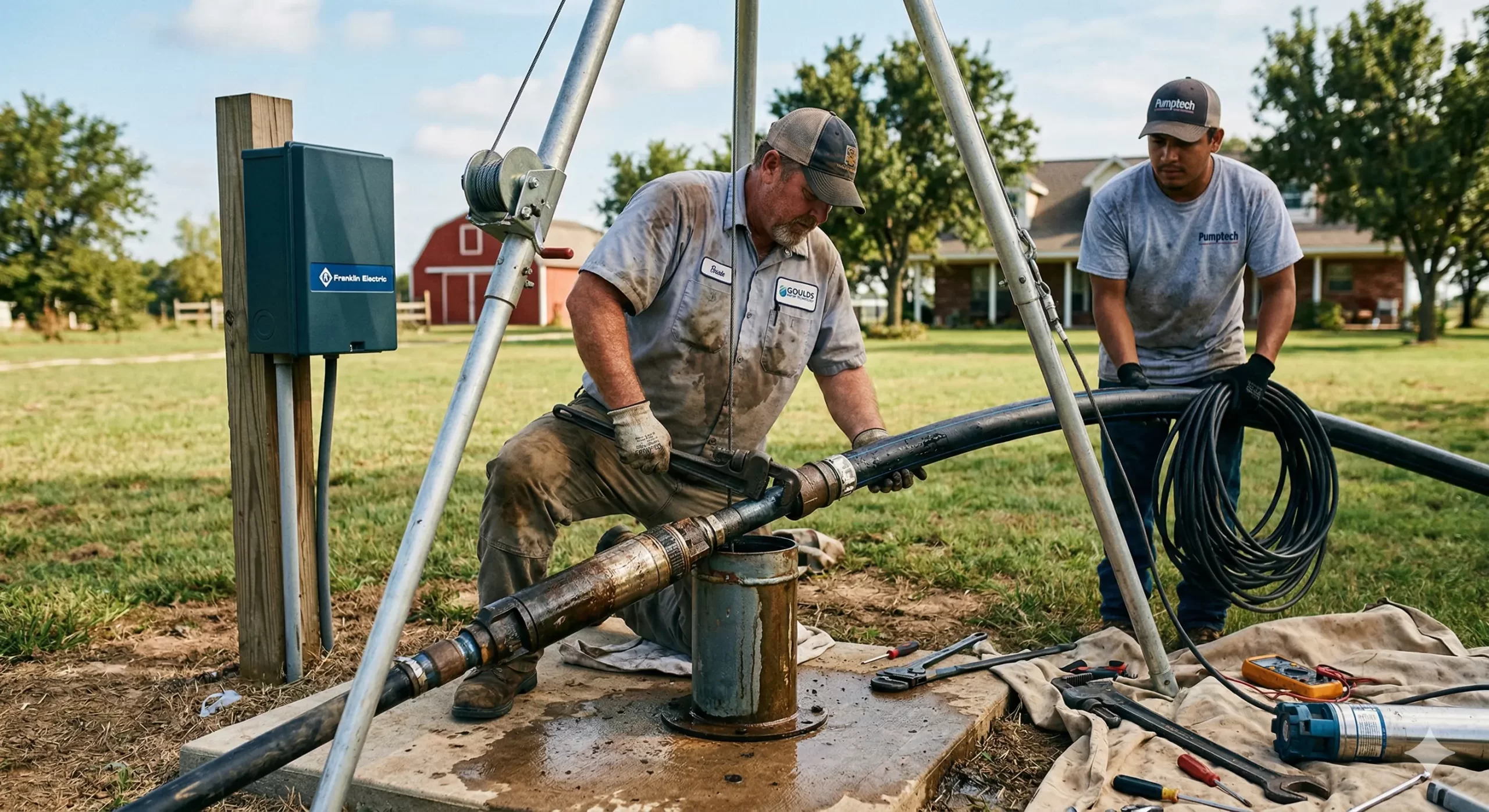
A professional repair for this issue is a complex, equipment-intensive operation. The first step is the safe extraction of the pump, which, depending on its depth and size, can be an assembly weighing 300-800 lbs or more when including the water-filled pipe. A dedicated hydraulic pump hoist or a small crane rig is not optional; it is mandatory for safety and to prevent damage to the well or equipment. The technician will first execute a verified Lockout/Tagout (LOTO) on the circuit. They then use a specialized T-handle pitless adapter key to disengage the pump assembly from the pitless unit located several feet down inside the well casing, allowing the entire drop pipe, wire, and pump to be lifted straight out.
Once the pump is on the surface, a full diagnostic procedure begins. The extent of the biological fouling on the intake screen, pump housing, and motor will be immediately apparent. The primary diagnostic tool used at this stage is a megohmmeter, or ‘megger’. This instrument applies a high voltage (500V-1000V) to test the integrity of the motor winding insulation. A reading of hundreds or thousands of megohms to ground indicates a healthy motor; a reading near zero confirms a dead short, meaning the motor is electrically destroyed and must be replaced. The pump’s wet end is then disassembled to inspect the impellers and diffusers, which are often packed solid with the iron bacteria slime.
The remediation and reinstallation phase is twofold: equipment and well sanitation. The pump and motor (if salvageable) and the entire length of drop pipe are mechanically cleaned with high-pressure water jets and then undergo a chemical wash with an acidic solution (like sulfamic acid) to dissolve the mineral scale and remaining biofilm. The well itself is then subject to a powerful shock chlorination. This involves introducing a high concentration of chlorine (200-500 ppm) into the well to kill the bacteria colony throughout the water column and in the immediate aquifer formation. After the new or cleaned pump is reinstalled with a waterproof, heat-shrink electrical splice, the entire system must be flushed for hours or even days until water tests show chlorine levels are back to a safe, potable range.
Safety Protocol: All on-site work is conducted after a verified Lockout/Tagout on the 240V circuit. The extreme weight of the pump assembly constitutes a severe crush and strain hazard, mandating the use of a certified mechanical pulling rig operated by trained personnel. Full Personal Protective Equipment (PPE), including impact-resistant safety glasses, chemical-resistant gloves, and steel-toed boots, is required at all times.
Repair Cost & Time Assessment
For a severe iron bacteria fouling event that has resulted in a burned-out motor, a homeowner in the United States should budget for a repair cost ranging from $2,500 to $6,000+. This wide range is influenced by the depth of the well, the horsepower of the pump, local labor rates, and the accessibility of the wellhead for the service rig.
This cost is a comprehensive figure that includes several key items. The majority is allocated to the new submersible pump and motor assembly, which are premium, industrial-grade components. Labor costs typically account for two technicians for a period of 4 to 8 hours. This reflects the specialized skill required for well work and pump diagnostics. An equipment charge for the service truck equipped with the pump hoist/crane is standard. Finally, the cost covers consumable materials such as a new heat-shrink splice kit for the motor connection, potentially new sections of drop pipe or wiring, and the significant volume of chemicals (acid and chlorine) required for the cleaning and sanitation process.
The on-site repair typically consumes a full working day. However, the well will remain out of service during the shock chlorination period, which requires the chlorinated water to sit in the well for 12-24 hours. Following this ‘dwell time’, the homeowner will need to run an outside hose for several hours to flush the system until the chlorine smell dissipates and the water runs clear. To prevent a rapid recurrence, the technician will almost always recommend the installation of a permanent water treatment system, such as a chlorine injection pump or an ozone generator, as a necessary follow-up investment.
Fast Local Service & Diagnostics
Calls are routed to a licensed local well professional.