
Emergency Well Pump Repair in Kyle, TX
Folks out here in Hays County, especially around Kyle, know the harsh realities of relying on groundwater. We’re sitting on a whole lot of limestone, which means you’ve got deep wells, hard water, and during those brutal Texas droughts, water tables that can drop faster than a politician’s promise. It’s not a forgiving environment for cheap equipment, and I’ve seen more than my share of folks learn that lesson the hard way.
Our groundwater largely comes from the Edwards Aquifer and the Trinity Aquifer, with some influence from the Buda Limestone formation. The Edwards is a prolific producer but is also heavily managed. The Trinity, particularly the Middle Trinity, is deeper and often provides the primary water source for many rural homes here, but it’s also prone to significant drawdowns during dry spells. Understanding which aquifer you’re drawing from can tell you a lot about your water quality and well’s long-term prospects.
Around here, a ‘bargain’ pump often means a premature failure. The mineral content in our water, combined with the stress of lifting water from significant depths, rapidly degrades substandard pumps. We see impellers eroding, motor windings overheating, and control boxes failing prematurely due to constant cycling against hard water scale. Investing in quality equipment upfront saves you a heap of headaches and money down the line.
Fast Local Service & Diagnostics
Calls are routed to a licensed local well professional.
Well Pump Repair in
Kyle
Kyle & Hays County Well Stats
Hays County has a significant number of private wells, estimated to be over 10,000, predominantly serving rural and suburban homes outside municipal water districts. Average well depths range from 300 to 800 feet, with some going deeper into the Middle Trinity Aquifer. Static water levels fluctuate significantly, especially during drought cycles, often dropping 50-100 feet or more. Water quality is typically very hard, with high dissolved solids and sometimes iron or sulfur in deeper formations.
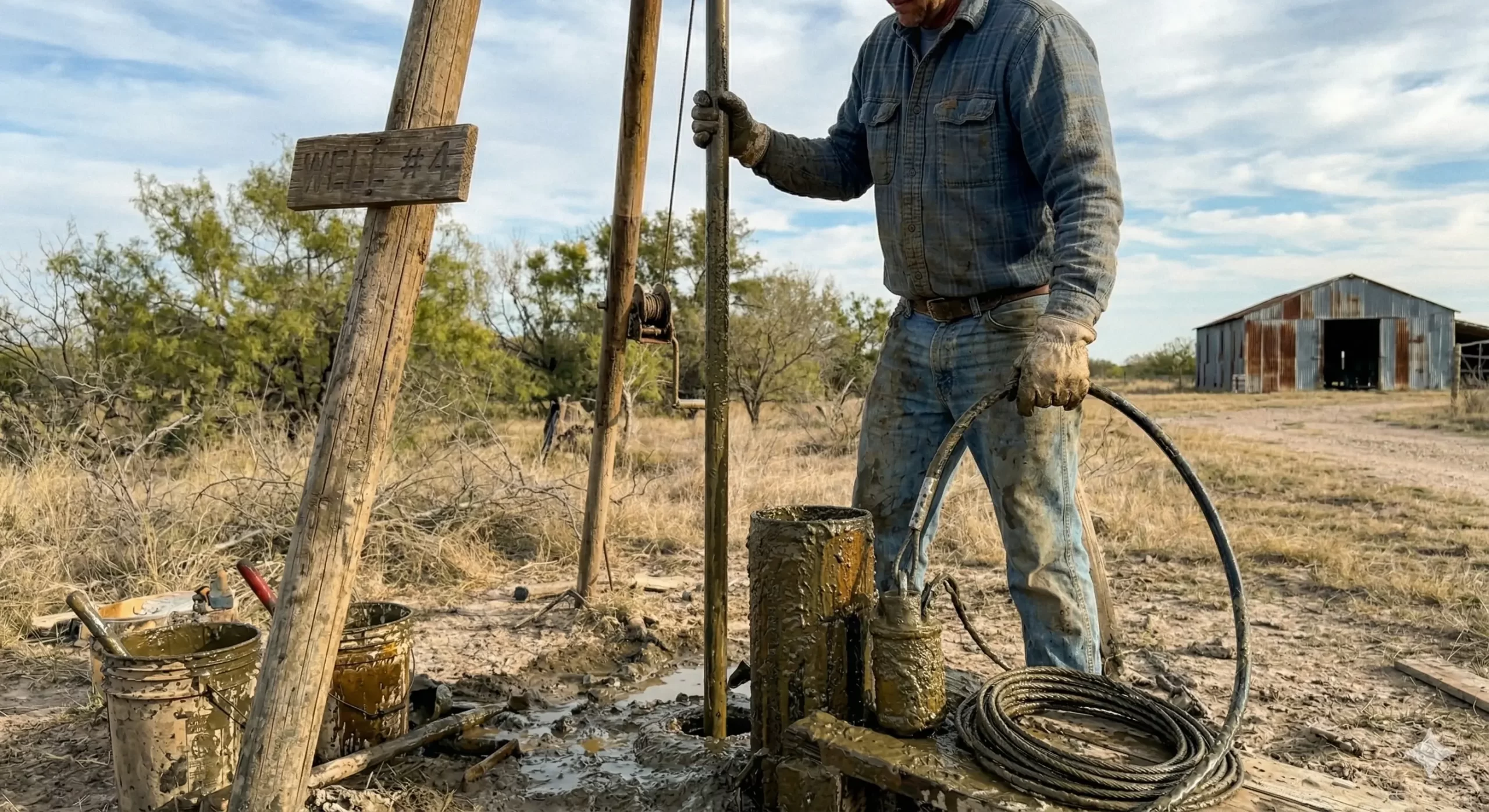
Pulling a pump in Hays County is rarely a simple job. Many wells here are drilled deep into solid limestone, sometimes 400 to 800 feet or more. This hard rock means the well casing is often tight, and any encrustation or pipe damage makes extraction a major challenge. Add to that the rural properties often having limited rig access due to gates, trees, or septic fields, and you can see why it’s not a quick ‘pop out, pop in’ job.
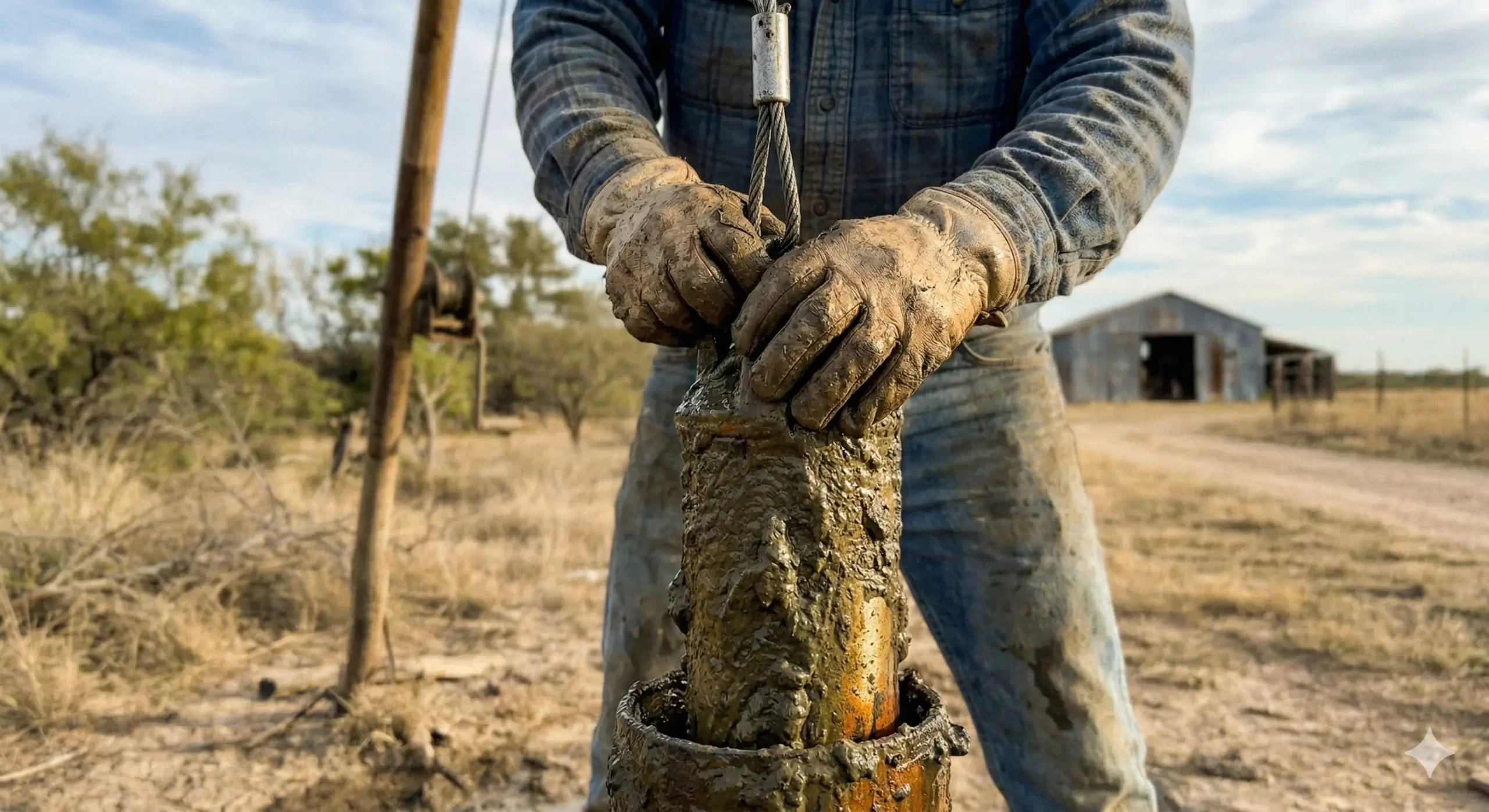
We’re not talking about a couple of guys with wrenches. A full pump pull & replacement requires specialized equipment: a heavy-duty well rig or hoist capable of lifting thousands of pounds of pipe, pump, and electrical line; well cameras to inspect the casing; specialized pipe wrenches; and often a portable generator to power it all if the main power is out or unsafe. The sheer weight and depth demand robust machinery & skilled operators.
Spring Well Maintenance in Texas
Heavy spring rains can cause surface runoff to breach well caps. We strongly recommend testing your water for coliform bacteria and inspecting the sanitary seal.
Save $500+ on Replacements
Via the TX Energy Co-op VFD Upgrade Program
78°F in Kyle
Local Aquifers & Geology
The primary groundwater sources in Kyle include the Edwards Aquifer (primarily influencing the northern and eastern parts of the county) and the Trinity Aquifer (Upper, Middle, & Lower, prevalent throughout the county, especially in rural areas). The Edwards is a karst aquifer known for high-volume flows and excellent water quality, though it’s highly regulated. The Trinity, particularly the Middle Trinity, consists of fractured limestone and dolomite, yielding hard water but generally reliable supply, though often at deeper levels and with slower recharge rates than the Edwards.. Drilling through the local The dominant soil types in Hays County are primarily derived from limestone bedrock, leading to shallow, rocky soils (e.g., ‘Tarrant’ and ‘Brackett’ series) on uplands and more fertile, deeper clays and loams in valleys and floodplains (e.g., ‘Houston Black’ and ‘Austin’ series). These soils are often alkaline, well-drained but can become very hard when dry, impacting excavation and foundation work. means that average well depths range from 300 ft – 800 ft.
Due to these geological factors, local homeowners frequently struggle with Mineral buildup & scaling on pump components and within the well casing, often leading to decreased pump efficiency, cavitation, and eventual motor failure due to increased load. This is exacerbated by the extremely hard water common in Hays County..
Drilling Depth Comparison
Deeper wells require heavy-duty crane hoists for pump extraction.
Climate & Water Quality
Pump systems in the Kyle area face severe environmental stressors. The most significant threat is Prolonged droughts are the biggest climate risk here. When rainfall diminishes, the water table drops significantly, causing pumps to run dry or ‘deadhead,’ leading to overheating and premature motor failure. The intense Texas heat also stresses external control boxes and electrical components. Conversely, rare hard freezes can burst exposed lines and pressure tanks, though this is less common for submersible pump components deep underground.
Additionally, the raw groundwater often presents issues with Severe hardness (300-500 ppm or 17-29 grains per gallon is typical), which leads to significant scale buildup. Iron and sulfur are also common in deeper Trinity wells, causing staining and ‘rotten egg’ odors. Fine sand or sediment can be an issue in some wells, abrading pump impellers..
Regional Groundwater Advisory
Known primary contaminant threat to submersible pumps and pipes in this area:
Common Area Systems
VFD Upgrade Savings
Constant Pressure vs StandardReplacing a standard single-speed pump with a Variable Frequency Drive (VFD) eliminates hard starts and drastically reduces energy draw in Texas.
Compliance & Local Permits
Hays County Level: In Hays County, new well drilling and sometimes major repairs are governed by the Hays Trinity Groundwater Conservation District (HTGCD). You’ll typically need to obtain a drilling permit from HTGCD before any new well construction. The district has rules concerning well spacing from property lines and other wells, well registration, and can enforce production limits, especially during drought conditions. They aim to conserve and protect the quality of the groundwater resources for all users, so always check with them first. Many repairs and replacements of existing wells often don’t require new permits, but always confirm.
Top Pump Brands in Texas
Most frequently installed hardware based on local geology (2026 data).
- Check pump amperage & voltage at the control box & well head for proper motor function.
- Inspect pressure tank pre-charge & air volume control for correct system cycling & water delivery.
- Verify all electrical connections, wiring insulation, & grounding for safety & efficiency.
- Examine well head seal (sanitary seal) for integrity against contaminants & pest intrusion.
- Test static & pumping water levels to assess aquifer health & pump placement.
- Analyze water samples for hardness, iron, sulfur, & sediment to identify potential water quality issues.
Premium Well Pump Brands We Service
Our licensed technicians in Kyle are certified to repair, replace, and install high-quality groundwater equipment from industry-leading manufacturers, including:
- No water coming from faucets, or water pressure dropping suddenly to zero.
- Low water pressure throughout the house, often fluctuating or inconsistent.
- Dirty, cloudy, or sandy water coming out of the taps, especially after heavy pump use.
- Pump cycling on & off frequently, even when no water is being used, indicating a pressure tank or leak issue.
- Unusually high electricity bills without changes in usage, suggesting an inefficient or failing pump motor.
- Strange noises coming from the pressure tank area or, if accessible, a humming or grinding from the well head.
Kyle Real Estate Well Regulations
Local Dispatch & Response Times
Live Dispatch: Texas
Updated Just Now⚠️ High demand. Call now to secure the next available technician.
- Priority is given to no-water emergencies, especially for homes with livestock or critical needs.
- Expect a typical response time within 24-48 hours for non-holiday emergencies, depending on technician availability & ongoing jobs.
- Travel time to remote Hays County properties can be significant, so factor in an hour or more just for transit.
- On-site diagnosis & basic repairs often take 2-4 hours; pump pulls & replacements can take a full day or more.
- Delays can occur due to rig access issues, unexpected well casing problems, or parts availability, though we stock common components.
⚠️ Hays County & State Regulatory Warning: Abandoned Wells
The Cost of Ignoring Symptoms
Fixing a short-cycling pump early saves thousands in Kyle.
Data reflects average well contractor estimates in Kyle.
Groundwater Threat Level
Current aquifer and mineral impact on pumps in Kyle.
Dropping water tables cause pumps to suck air and overheat.
Hard water calcifies pump impellers, reducing lifespan.
Pump Lifespan Estimator
Select household size in Kyle to see strain impact.
Local Kyle
Well Pros
Fast Local Service & Diagnostics
Calls are routed to a licensed local well professional.
Septic System Services in Kyle, TX
Do you have a septic tank on your property? Proper maintenance is critical to protecting your well water quality.
Kyle Homeowner Feedback
“Had no water Sunday mornin’. Called ’em up, they were out by lunch. Had us fixed up before supper. Good honest folks.”

Local Homeowner
✓ Verified TX
“Our well pump started acting real funny, constantly turning on and off, but we still had water, just poor pressure. The electric bill was sky-high. Called these guys and they diagnosed a bad pressure switch and a waterlogged pressure tank. They also found a small crack in the drop pipe that was causing the pump to loose prime. They got it all fixed up in one day, even with the crack repair. Pump’s runnin’ smooth now, and my wife isn’t complainin’ about the shower anymore. Gratefull for the quick service & knowlege.”

Local Homeowner
✓ Verified TX
“Lost water on a Friday afternoon. Thought for sure we’d be out all weekend. Called them, and they understood the urgency. Had a crew dispatched quickly, and they worked late to get the old pump pulled and a new one installed. Absolutely saved our weekend. Can’t thank them enough for the fast, professional response.”

Local Homeowner
✓ Verified TX
Expert Kyle Well System FAQ
Why is the water in Kyle so hard, and what’s the best way to deal with it for my well system?
The hardness in Kyle’s well water comes directly from our geology. We’re situated on limestone, and as rainwater percolates through these rock formations, it dissolves calcium and magnesium minerals. This ‘hard water’ can cause scale buildup in pipes, appliances, and on your pump. The best solution for your entire home is a properly sized water softener. For your well system specifically, using high-quality submersible pumps with stainless steel components can help them resist the corrosive effects and buildup that hard water can cause over time, extending their lifespan significantly.
My well seems to be going dry during the summer droughts. What can I do, and is this common in Hays County?
Yes, unfortunately, wells ‘going dry’ or experiencing significantly lowered water levels during prolonged droughts is a common issue in Hays County, especially for wells drawing from the Trinity Aquifer. Our aquifers have limited recharge during dry periods, and increased pumping demands from a growing population exacerbate the problem. You can monitor your well’s static water level, ensure your pump is set at an appropriate depth to avoid running dry, and consider a low-water cutoff switch to protect your pump motor. In severe cases, deepening the well or even drilling a new one might be necessary, but those are last resorts after proper assessment of the current well and aquifer conditions.
What permits do I need to drill a new water well on my property in Hays County?
For a new water well in Hays County, you’ll need to obtain a drilling permit from the Hays Trinity Groundwater Conservation District (HTGCD). This process involves submitting an application, a site plan showing well location, septic systems, and property lines, and sometimes a pumping plan. The HTGCD reviews these to ensure proper well spacing, protect neighboring wells, and manage aquifer resources sustainably. There may also be county health department requirements if your well is for potable water for human consumption. It’s crucial to consult with a licensed well driller who is familiar with all local and state regulations before starting any work.
How often should I have my well inspected, and what’s included in a routine well maintenance check in Kyle?
As a rule of thumb, I recommend a comprehensive well inspection every 3 to 5 years, or immediately if you notice any changes in water quality or pressure. A routine check typically includes testing your pump’s performance (amperage, voltage, flow rate, pressure switch cut-in/cut-out), inspecting the pressure tank’s pre-charge and overall condition, checking the well head for proper sealing against contaminants, and assessing the general integrity of exposed components. We also conduct a basic water quality test for common issues like hardness, iron, and often a bacteria test, which is crucial for health and safety. Proactive maintenance can catch small problems before they become costly emergencies.
Kyle Groundwater Expert AI
What are the specific groundwater regulations, average well depths, and the local conservation district for Kyle, Hays County?
Groundwater Regulations and Well Information for Residential Wells in Kyle, Hays County (2026)
As a Senior Hydrogeologist and local groundwater regulatory expert for Texas, I can provide you with specific information regarding residential water wells in Kyle, Hays County, based on current regulations and historical data, projected for the year 2026.
Local Groundwater Conservation District (GCD)
For Kyle, located within Hays County, the primary local regulatory authority for groundwater is the Hays Trinity Groundwater Conservation District (HTGCD). The HTGCD is responsible for conserving, preserving, protecting, and recharging the groundwater and groundwater resources within its boundaries, and for controlling subsidence caused by groundwater withdrawal.
- HTGCD Website: https://haysgroundwater.com/
Specific Groundwater Regulations
Residential water wells in Kyle are subject to both state and local regulations. It is crucial to comply with both sets of rules.
1. Hays Trinity Groundwater Conservation District (HTGCD) Regulations:
The HTGCD operates under the authority granted by the Texas Legislature, primarily through Texas Water Code Chapter 36. For residential wells, key HTGCD regulations include:
- Drilling Permits: A permit from the HTGCD is required before drilling any new water well, including domestic residential wells. This permit ensures compliance with local spacing and construction standards.
- Well Registration: All new wells must be registered with the HTGCD upon completion. Existing wells are also required to be registered.
- Well Spacing Requirements: The HTGCD has specific rules regarding the minimum distance a new well must be from property lines, septic systems, and other existing wells to prevent interference and contamination. These are detailed in the HTGCD District Rules. For example, specific setbacks often apply to property lines (e.g., 25-50 feet) and wastewater disposal systems (e.g., 50-100 feet).
- Well Construction Standards: The HTGCD enforces construction standards to ensure wells are properly cased, cemented, and completed to protect groundwater quality and prevent contamination. These often align with or exceed state minimum standards.
- Production Reporting: While typically not required for individual domestic wells (defined by HTGCD as pumping less than 10,000 gallons per day) unless in specific management zones or large-volume situations, it's essential to be aware that the District has the authority to require reporting.
- HTGCD Rules: Download HTGCD District Rules (PDF) (Please note, this link provides current rules, check HTGCD website for the most up-to-date version for 2026).
2. Texas Department of Licensing and Regulation (TDLR) Regulations:
The TDLR licenses water well drillers and pump installers and sets statewide standards for water well construction. These standards are found in the Texas Administrative Code, Title 16, Chapter 76 (Water Well Drillers and Pump Installers), authorized by Texas Water Code Chapter 35. Key aspects include:
- Licensed Drillers: All water wells in Texas must be drilled by a TDLR-licensed water well driller.
- Well Construction Standards: TDLR mandates minimum casing depths, cementing requirements, and setback distances from potential contamination sources (e.g., 50 feet from a septic tank, 100 feet from a septic drain field, 50 feet from a property line if no agreement with neighbor).
- Well Plugging: Abandoned or deteriorated wells must be plugged by a licensed driller according to TDLR rules to prevent contamination.
- TDLR Water Well Driller and Pump Installer Program: https://www.tdlr.texas.gov/wwd/wwd.htm
- Search for a Licensed Driller: TDLR License Search
3. Texas Commission on Environmental Quality (TCEQ) Regulations:
While the HTGCD and TDLR handle most well-specific regulations for residential wells, the TCEQ generally oversees broader water quality standards and permitting for on-site sewage facilities (septic systems). If a residential well is planned in conjunction with a new septic system, the septic system permitting (often handled by Hays County Development Services or a licensed professional) will need to consider the well's location to ensure adequate separation distances as required by TCEQ rules.
- TCEQ Private Water Wells: https://www.tceq.texas.gov/agency/water_supply/pws_private_wells.html
Average Well Depths and Aquifer
The primary aquifer system targeted for residential water wells in Kyle, Hays County, is the Trinity Aquifer. Specifically, wells typically penetrate the Middle and Lower Trinity geological formations.
- Specific Aquifer: The residential wells in Kyle primarily draw from the Middle Trinity Aquifer and the Lower Trinity Aquifer (specifically the Hosston and Sligo Formations).
- Estimated Average Well Depth: Based on historical state well logs and drilling patterns for domestic use in the Kyle area, the average well depth for residential supply is typically in the range of 400 to 700 feet. A realistic average estimate for a newly drilled residential well in Kyle targeting the Middle to Lower Trinity Aquifer in 2026 would be approximately 550 feet. Depths can vary significantly depending on the exact geological location within Kyle, with wells generally being shallower in the western parts and deeper as one moves eastward.
It is always recommended to consult with a TDLR-licensed well driller experienced in Hays County and the HTGCD directly during the planning stages for the most precise and up-to-date information for your specific property.
Fast Local Service & Diagnostics
Calls are routed to a licensed local well professional.
Blix
provides official
Emergency Well Pump Repair services for the
Kyle
area.